DevOps, Cloud & Cybersecurity

Practical guides for building, operating, and securing your infrastructure.

Blog Posts

Conceptual split image showing chaotic legacy IT systems transitioning into structured cloud infrastructure with APIs, data pipelines, and modern digital architecture

Building Smarter IT Systems for a Cloud-Driven World

Most businesses today aren't short on technology. They're short on coherence. The real challenge isn't adopting more cloud tools. It's building IT systems that actually work together, scale without friction, and support the business when conditions change.

Futuristic AI data processing network with real-time analytics dashboards, high-speed data flow, and interconnected digital infrastructure in a smart city environment

Exploring the Cloud Ecosystem: Key Sources You Should Know

The cloud is not a single product. It is an interconnected operating environment made up of platforms, frameworks, APIs, automation layers, and service models that collectively support how modern software is built, deployed, and scaled. So what are the main sources powering the cloud ecosystem, and why does understanding them matter for anyone responsible for digital infrastructure?

Modern data center server room with illuminated racks representing cloud computing infrastructure cybersecurity and high performance data processing

The Next Frontier: DevOps for Cloud-First Enterprises

What’s next for DevOps in cloud computing? It’s no longer about adding more tools. It’s about creating a cloud operating model where delivery, security, infrastructure, and observability work together. DevOps has long been focused on speed. But in complex cloud environments, fragmented tools and siloed teams create more friction than progress. The next phase is more structured: platform-led, self-service, and built for governance, reliability, and scale. This article explores that shift and why DevOps in cloud-first enterprises is becoming a full operating model, not just a delivery practice.

Abstract visualization of interconnected data nodes and glowing digital network representing AI machine learning and data flow

Managed Cloud Services Providers: The Unseen Force Behind Enterprise Success

Most enterprise cloud environments were not built as unified systems. They grew over time, one project and one team at a time, until they became fragmented, difficult to manage, and hard to fully understand. This is where managed cloud services companies create real value. This article explains how they turn complex, costly, and vulnerable cloud environments into controlled, scalable systems that support enterprise growth.

Modern data center with server racks and high-speed data flow visualization, representing network infrastructure and real-time data processing.

Cloud Security: The New Backbone of Digital Infrastructure

Cloud security has shifted from a compliance checkbox to the control plane for modern digital operations. As organizations manage AI workloads, SaaS sprawl, machine identities, and sovereign-cloud requirements simultaneously, security no longer sits beside infrastructure. It governs it. This article explains why security-first architecture is now essential for resilience, continuity, and safe cloud growth.

Futuristic cloud computing system visualized above a data center with CI/CD pipeline, data flows, and network infrastructure.

Cloud Computing + Cyber Resilience: The Ultimate Duo

When disruption hits, the real question is not whether an attack or outage will happen, but whether your organization can keep operating through it. That is where cyber resilience and cloud computing intersect: modern organizations depend on cloud infrastructure to absorb incidents, recover faster, and reduce operational impact - through redundancy, automated failover, backup isolation, and operational discipline built into the environment from the start.

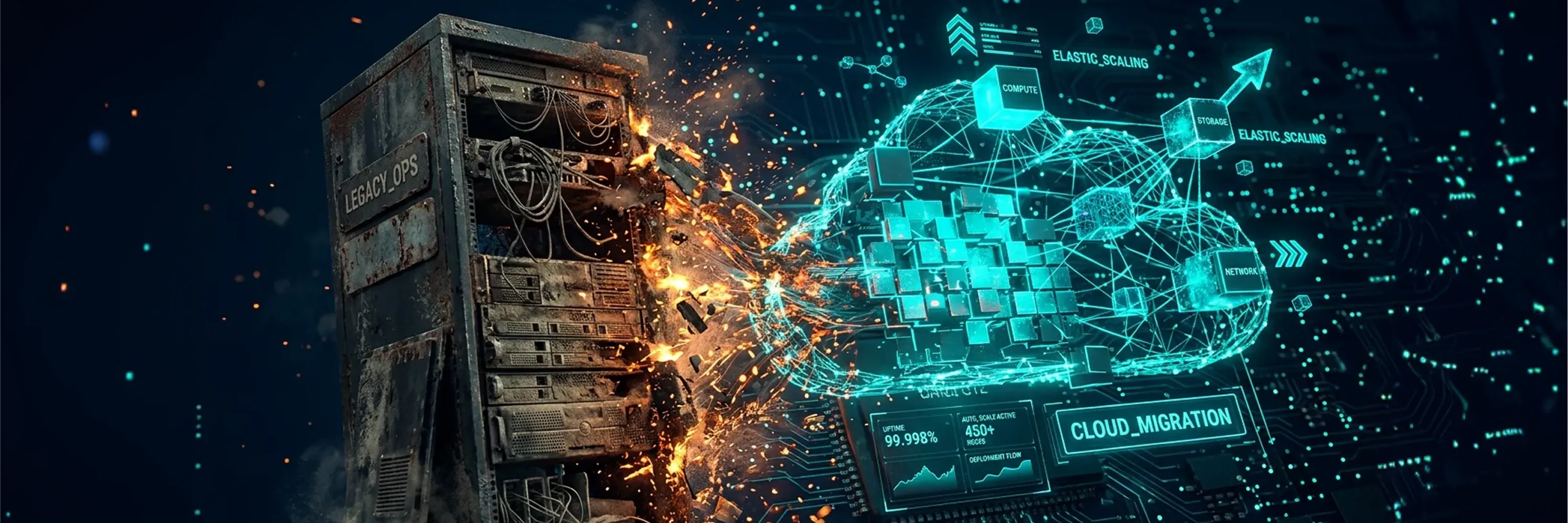
Visual of legacy server infrastructure transforming into cloud computing environment, illustrating cloud migration, elastic scaling, and digital transformation with network and compute resources.

From Legacy to Cloud: The Shift to On-Cloud Operations

Most organizations know they need the cloud. The real challenge is turning that move into faster, more resilient, and more efficient operations. On-cloud solutions do more than replace legacy infrastructure. They change how teams provision, scale, monitor, and manage services day to day. This article explores what that operational shift looks like in practice, and why migration alone is not enough to deliver better outcomes.

CI/CD pipeline visualization showing automated build, test, and deployment workflow across cloud infrastructure and DevOps environments.

From Pipelines to Platforms: How Cloud Fuels DevOps Innovation

Software teams everywhere face the same pressure: ship faster, break less, and scale without burning out. Yet many organizations still wrestle with slow release cycles, fragile environments, and a gap between what development builds and what operations can reliably run. The question at the center of this tension is not whether cloud helps - it does. The real question is how: cloud does not automatically create DevOps maturity; it removes infrastructure friction so that teams can build the practices that do.

Futuristic digital tunnel representing AI development pipeline with build and deploy stages in automation workflow.

Modern DevOps Meets the Cloud: A New Way to Build and Deploy

Today, cloud strategy is no longer a one-time infrastructure decision - it is a continuous delivery challenge. When a single provider cannot meet every operational need, deployment speed, reliability, and cost all suffer.

Futuristic circuit board illustrating CI/CD pipeline with agile triggers and DevOps automation processes

DevOps: The Core Engine Behind Agile Businesses

Many organizations adopt agile expecting faster delivery, but the actual pace of release often barely improves. Teams add standups, sprints, and new structures, yet software still takes too long to reach production. That usually happens because the planning model changes, but the delivery model does not.

Digital illustration of gears integrated into a circuit board representing AI automation and machine learning systems

IT Infrastructure Automation: How to Scale IT Infrastructure with Cloud Automation

Modern enterprises are overwhelmed by manual tickets, ad-hoc server builds, and late-night incident responses. The result is fragile infrastructure that struggles to scale when business demand suddenly increases. As organizations rely more heavily on cloud platforms and scalable storage services such as Amazon S3 to handle growing volumes of data - building on earlier cloud storage concepts introduced by services like Amazon Cloud Drive - the need for automated infrastructure becomes unavoidable. How can teams shift from constant firefighting to intelligent orchestration? This guide explains how to design an automated cloud backbone that scales in real time, allowing engineers to focus on architecture and innovation instead of repetitive operational tasks.

AI-powered cloud data center infrastructure visualizing real-time data processing, connected servers, and digital cloud computing networks

Cloud Architecture Design: Building Scalable and Secure Cloud Architectures

Modern enterprises run on software, yet many leadership teams still see their cloud footprint growing faster than their ability to control it. When 70% of CEOs admit their environment evolved “by accident, rather than design,” the need for intentional cloud architecture could not be clearer. Strong cloud architecture in cloud DevOps and a resilient cloud server architecture are now essential for secure, scalable, and cost-efficient growth through 2026.