Why Agile Transformation Stalls Without a Delivery Engine
Agile transformation typically starts with restructuring teams into squads or pods, introducing sprints, and establishing new rituals like standups and retrospectives. These are valuable changes. But they address how work is planned and prioritized, not how it is built, tested, released, and monitored.
This is where most transformations hit a wall. Teams plan in two-week sprints, but deployments still happen monthly because release processes are manual. Developers write code faster, but QA cycles take weeks because testing environments are inconsistent. Product owners gather feedback, but it takes so long to act on it that the insights become stale.
The underlying issue is that agile changes how teams plan work, but not necessarily how that work gets built and shipped. DevOps helps connect those two sides.
Without DevOps, agile remains a planning methodology. With it, it becomes a delivery system.
Agile Moves Faster When Delivery Systems Change
Cox Automotive provides a clear illustration. The company was operating on two-month release cycles, far too slow for market demands. By shifting to a DevOps environment with MuleSoft, they moved to two-week sprints, aligning their delivery cadence with agile planning. The key was not just reorganizing teams but rebuilding how code moved from development to production.
This pattern repeats across industries: agile transformation accelerates only when the underlying delivery pipeline is redesigned to support it.
How DevOps Powers Agile Transformation Through Continuous Delivery
DevOps removes the breaks between development, testing, deployment, and operations, so delivery becomes more continuous and less fragmented. Instead of working as separate phases with repeated handoffs, these functions become part of one connected pipeline where code changes move more smoothly from commit to production.
Continuous integration (CI) is the foundation. Every time a developer pushes code, automated builds and tests run immediately. This means integration problems surface within minutes, not at the end of a sprint. Continuous delivery (CD) extends this by ensuring that every successful build is automatically deployable. Teams do not wait for a "release window." They release when the feature is ready.
When deployment is automated and reliable, teams can:
-
Release small increments of value multiple times per week
-
Respond to user feedback within days instead of months
-
Roll back changes quickly if something goes wrong, reducing the risk of every release
-
Run A/B tests and feature flags to validate ideas with real users before full rollout
This changes the value of agile rituals themselves. Sprint reviews become more meaningful when teams are showing work that is already deployed or ready to ship. Retrospectives also improve because they can focus on real delivery outcomes, not just internal process friction.
For a practical deep dive into building robust CI/CD release processes, blue-green deployments, and automated rollbacks, see CI/CD Automation: How CI/CD Pipeline Automation Powers Modern Software Delivery.
Breaking Down Silos That Block Agile Execution

One of agile's central ideas is cross-functional collaboration. Yet in many organizations, development and operations remain fundamentally separated. Developers write code and hand it to operations for deployment. Operations teams manage infrastructure with little visibility into what is being built. Security reviews happen late in the cycle, creating bottlenecks.
DevOps addresses this by changing how teams actually operate day to day. Instead of relying on handoffs between separate functions, teams work through the same pipeline, use the same delivery workflows, and take more joint ownership of outcomes. When a development team owns the full pipeline from code to production monitoring, handoff delays disappear. When infrastructure is defined as code and stored in the same repository as application code, environment inconsistencies vanish.
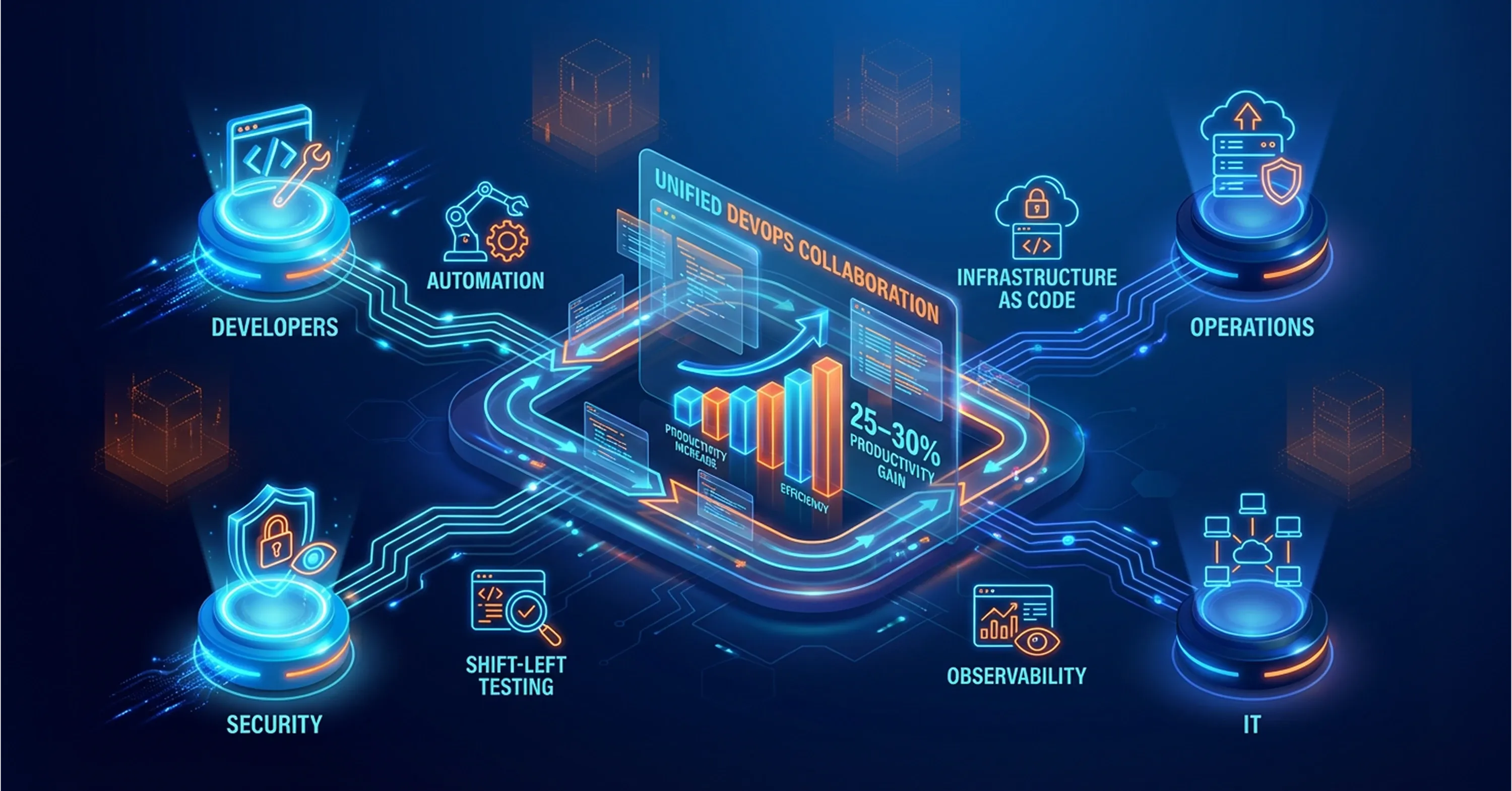
This cross-functional model resolves several common blockers:
-
Siloed teams: DevOps creates shared ownership of delivery outcomes, so "it works on my machine" stops being an acceptable response
-
Manual release processes: Automated pipelines replace error-prone manual steps, reducing deployment failures
-
Slow QA cycles: Shift-left testing, where testing happens early and continuously, replaces late-stage quality gates
-
Inconsistent environments: Infrastructure as code ensures staging and production environments are identical
-
Lack of observability: Integrated monitoring and logging give all teams real-time visibility into system health
These are not abstract improvements. Agile approaches applied to IT infrastructure groups can boost productivity by 25 to 30% within six to 18 months, a gain driven largely by removing the friction between teams.
From DevOps to Platform Engineering
As DevOps practices mature, many organizations move beyond the "DevOps team" model toward platform engineering. Instead of each team managing its own pipelines and infrastructure, a dedicated platform team builds internal tools, golden paths, and reusable pipelines that product teams consume as a service.
This shift matters because it scales DevOps capabilities without requiring every developer to become an infrastructure expert. Platform engineering operationalizes what DevOps introduced: standardized environments, automated delivery, and self-service deployment - packaged into an internal developer platform that reduces cognitive load across the organization.
For agile teams, this means less time configuring toolchains and more time shipping features. The distinction is practical: DevOps defines the practices; platform engineering is how many organizations deliver those practices at scale in 2026.
The Cultural and Organizational Foundation DevOps Requires
Technology alone does not deliver agile transformation. DevOps-powered agility requires cultural shifts that many organizations underestimate. Leadership must support experimentation and accept that faster release cycles come with a need for faster learning, including learning from failure.
Three areas demand particular attention:
-
Leadership commitment: Executives must fund pipeline automation, support team restructuring, and accept short-term disruption for long-term delivery capability. Without visible sponsorship, DevOps initiatives stall at the team level.
-
Process discipline: Automation does not mean chaos. DevOps requires rigorous version control, change management through code, and clear governance for what gets deployed and when.
-
Cloud and infrastructure readiness: DevOps practices depend on elastic, programmable infrastructure. Organizations still running legacy on-premises environments often struggle to implement infrastructure as code or auto-scaling without first modernizing their foundations.
Resistance to operational change is one of the most common obstacles. Teams accustomed to manual control over deployments may view automation as a threat. Security teams may worry that faster releases mean less oversight. These concerns are valid and must be addressed through gradual adoption, clear guardrails, and demonstrable results.
For a complete guide to automating infrastructure, drift remediation, and robust governance, check out Infrastructure as Code (IaC): How Infrastructure as Code Automates Cloud Deployments.
Organizations that combine DevOps with standardized and fully virtualized infrastructure have seen IT costs drop by as much as 25%, showing that the investment in cultural and technical modernization pays off financially, not just operationally.
Why Tools Alone Do Not Create Transformation
A healthcare technology company attempted to adopt DevOps by purchasing a CI/CD toolchain but skipping the organizational work. Within months, adoption remained low because teams lacked training, leadership had not adjusted approval workflows, and security reviews still happened manually at the end of the cycle. Only after investing in cross-functional training, rewriting their change management policy, and integrating security scanning into the pipeline did they see meaningful improvement.
Tools without culture change produce expensive shelfware, not agile delivery.
What Separates Superficial Agile From DevOps-Enabled Transformation
The difference between organizations that achieve genuine agility and those that merely adopt agile terminology comes down to execution infrastructure. Superficial agile adoption changes how teams plan. DevOps-enabled transformation changes how teams deliver.
What makes DevOps so important to agile transformation is that it reduces the operational friction between deciding what to build and actually releasing it. It does that by making release workflows more reliable through automation, standard environments, continuous testing, and better feedback from production. Without it, agile ceremonies become rituals disconnected from actual software delivery. With it, every sprint produces working, deployable, observable software.
In practical terms, DevOps helps agile teams deliver more consistently, with fewer manual delays and fewer release risks. It shortens feedback loops so teams learn faster. It automates repetitive work so engineers focus on value. It standardizes infrastructure so deployments are reliable. And it creates the visibility that leaders need to make informed decisions about what to build next.
Organizations that view DevOps mainly as a tooling decision often miss the larger operational shift it requires. DevOps is a delivery operating model, and it is the engine that agile businesses depend on to move fast without breaking things.
When DevOps Will Not Solve the Problem
DevOps is a powerful delivery engine, but it is not a fix for every organizational problem. There are situations where adopting DevOps practices will have little impact or may even create new friction.
DevOps will not help when:
-
The core problem is strategy, not delivery. If a team is building the wrong product, faster releases only accelerate the wrong direction. DevOps speeds up execution — it does not replace product vision or market judgment.
-
Leadership is not aligned. Without executive support and willingness to change approval workflows, security reviews, and governance processes, DevOps adoption stalls at the team level regardless of tooling.
-
The organizational structure is fundamentally siloed. Automation and pipelines cannot substitute for missing collaboration. If business, development, and operations teams do not share goals and accountability, DevOps tooling adds overhead without improving outcomes.
-
Technical debt is too severe. Legacy monoliths, undocumented systems, or deeply unstable codebases may need structural remediation before CI/CD pipelines provide meaningful value.
-
Teams lack the skills to maintain what they automate. Pipelines break, infrastructure drifts, and monitoring generates noise. Without the operational discipline to maintain these systems, automation becomes a liability.
Recognizing these limits early saves organizations from investing in DevOps transformation as a substitute for harder organizational or strategic work.
Conclusion
Agile transformation succeeds when organizations move beyond process changes and invest in the delivery infrastructure that makes agility real. DevOps provides that infrastructure. It automates what should not be manual, standardizes what should not vary, and connects what should never be siloed.
Without DevOps, agile often remains a planning model. Agile changes how work is planned. DevOps changes whether that work can move reliably into production.