What does DevSecOps actually mean today?
DevSecOps is an operating model where security controls live inside the continuous delivery process, executed automatically alongside builds and deployments. It replaces the old handoff between delivery teams and a separate security team with shared tooling and shared accountability for the security posture of every release.
The practical difference is where the work happens. In traditional DevOps with bolted-on security, a security review sits at the end of the pipeline as a gate. In DevSecOps, scanning, policy checks, secrets detection, and configuration validation run on every commit and every build, and runtime monitoring feeds results back to the teams that wrote the code.
According to Sonatype's 10th Annual State of the Software Supply Chain Report, malicious open source packages grew 156% year over year, and more than 704,102 have been identified since 2019. That kind of growth in attacker activity is why security can't be a single late-stage checkpoint anymore. If a vulnerable dependency lands in a build at 9 a.m., the pipeline itself has to be the thing that catches it before it reaches production.
Why end-of-cycle security no longer works
End-of-cycle security broke down because release cycles and software supply chains moved faster than a manual review can. A pre-release gate assumes the code under review is small and the dependencies are known. None of those assumptions hold for cloud-native delivery, where pipelines push changes daily and pull in third-party code on every build.
The Black Duck 2025 Global State of DevSecOps Report found that 81% of DevSecOps professionals say that security testing
slows down development. This issue creates a toxic
tension between development and security teams and actively
undermines the entire point of DevSecOps.
That friction is the real cost. When the review sits at the end, teams either delay releases to wait for it or route around it to ship. Both outcomes weaken the pipeline.
How release cycles outpace manual review
Manual security review can't keep pace with daily or hourly deployments because human gatekeeping turns into a queue, and queues either delay releases or get skipped. Velocity has to be matched by automation that runs inside the pipeline on every change.
Google's DORA research, summarized in Datadog's DORA benchmarks, classifies elite performers as teams deploying on demand with multiple deploys per day and lead times under one hour. No human reviewer can clear that volume of changes individually. Security stays present at that pace when checks run as automated steps inside CI/CD, with humans focused on triage and policy design.
The takeaway for engineering leaders: if your deployment frequency is climbing while your security review is still manual, the gap will widen until something breaks.
Why late fixes cost more
Fixing a vulnerability in production is dramatically more expensive than fixing it during development because the surface area of impact grows at every stage. By production, the code is already serving customers, and a fix has to be coordinated with operations and support.
The IBM Systems Sciences Institute "Rule of 100," referenced in this 2025 software bug cost report, puts a bug fixed in the design phase at roughly $100, in coding at $1,000, in integration testing at $10,000, and in production at $100,000 or more. The same multiplier applies to security defects, with the added downside that production vulnerabilities can become breaches before they're fixed.
Shifting detection left keeps remediation cost and breach exposure from compounding across releases.
How cloud complexity expands attack surface
Cloud-native infrastructure widens the attack surface because workloads are ephemeral and assembled from services that traditional perimeter security doesn't see. Containers spin up and down in minutes, and a single application can pull from hundreds of third-party libraries and cloud services.
Gartner analysis cited by Fidelis Security projects that through 2025, 99% of cloud security failures will be the customer's fault, primarily due to misconfigurations. That's a direct argument for moving security controls inside the workload and the pipeline. Firewalls and network segmentation can't catch an over-permissive IAM role in a Terraform file before it's applied.
The practical implication is that controls have to travel with the workload, encoded as policy in the pipeline and enforced at runtime, because the perimeter no longer exists as a defensible line.
How DevSecOps embeds security into CI/CD
DevSecOps maps specific security controls to specific CI/CD stages so the pipeline itself becomes the enforcement mechanism. Commit triggers static analysis. Build triggers dependency and container scanning. Infrastructure-as-code definitions get scanned before provisioning. Deployment triggers configuration validation. Production triggers runtime monitoring that feeds findings back to engineering.
The rest of this section walks through the controls stage by stage, so the model reads as engineering practice.
Automated code scanning at commit
Static Application Security Testing (SAST) and code analysis tools catch insecure patterns the moment a developer commits and return findings inside the same pull request workflow the developer is already using. The signal arrives while the code is fresh in the author's head, which is when a fix is cheapest.
The Functionize summary of IBM System Science Institute's cost data shows the cost to fix a bug found during implementation is about six times higher than one identified during design. SAST at commit pulls detection back toward that earlier window. Beyond cost, it stops insecure patterns from propagating into shared branches and downstream services where they become harder to untangle.
Dependency and supply chain checks
Software Composition Analysis (SCA) inspects every dependency, direct and transitive, against known vulnerability databases and policy rules, and it blocks builds that pull in compromised or out-of-date packages. Modern applications inherit most of their risk from this layer.
Black Duck's 2025 OSSRA findings, summarized in this supply chain attack statistics overview, report that 97% of commercial codebases contain open source components. The same findings report that 86% contain open source vulnerabilities and the average application contains 911 open source components. At that scale, manual review of dependencies isn't a real option. SCA inside the pipeline is the only way to keep the supply chain auditable on every build.
Infrastructure and configuration validation
Infrastructure-as-Code (IaC) scanning evaluates Terraform and Kubernetes manifests against security policy before anything gets provisioned, and it catches exposed ports and over-permissive roles at the definition stage. The fix is a pull request edit.
A StationX cloud security review cites Fortinet 2026 showing 70% of organizations identifying misconfigured cloud services as a major risk. That's a category of failure that IaC scanning is built to prevent, because the misconfiguration exists in a file under version control before it ever runs.
Validating configuration as code also gives security teams something they rarely had under legacy models: a complete, diffable history of every infrastructure change, reviewable in the same system that holds application code.
Secrets management and policy enforcement
DevSecOps prevents credential leaks by combining centralized secrets stores with policy-as-code that blocks non-compliant changes from progressing, while automated checks detect hardcoded credentials at commit. The pipeline refuses to build when an API key shows up in source and refuses to deploy when a policy is violated. Credential rotation happens without human handling.
The Cloud Security Alliance cites Gartner findings that misconfiguration-related issues cause 80% of all data security breaches. A hardcoded credential is a misconfiguration with a long blast radius, because it persists in commit history and gets copied into forks and developer machines.
Policy-as-code is the more durable control here. Once the rule is written, it applies to every team and every pipeline without depending on someone remembering to check.
Continuous monitoring after deployment
Runtime monitoring and Dynamic Application Security Testing (DAST) extend security past the release boundary; they detect drift and active threats in production, then feed the signal back to the teams that own the affected services. The loop closes when a production finding lands as a ticket in the same backlog as feature work.
IBM's Cost of a Data Breach Report 2025 put the global average cost of a breach at $4.4 million, a 9% decrease over last year driven by faster identification and containment. Continuous monitoring shortens the window between compromise and detection, which is where most of that cost compounds. Without it, the pipeline goes dark the moment code ships, and any drift between the validated configuration and the running one becomes invisible.
Want to see how this maps to your current pipeline? ABS offers a complimentary security gap assessment
Does DevSecOps slow teams down?
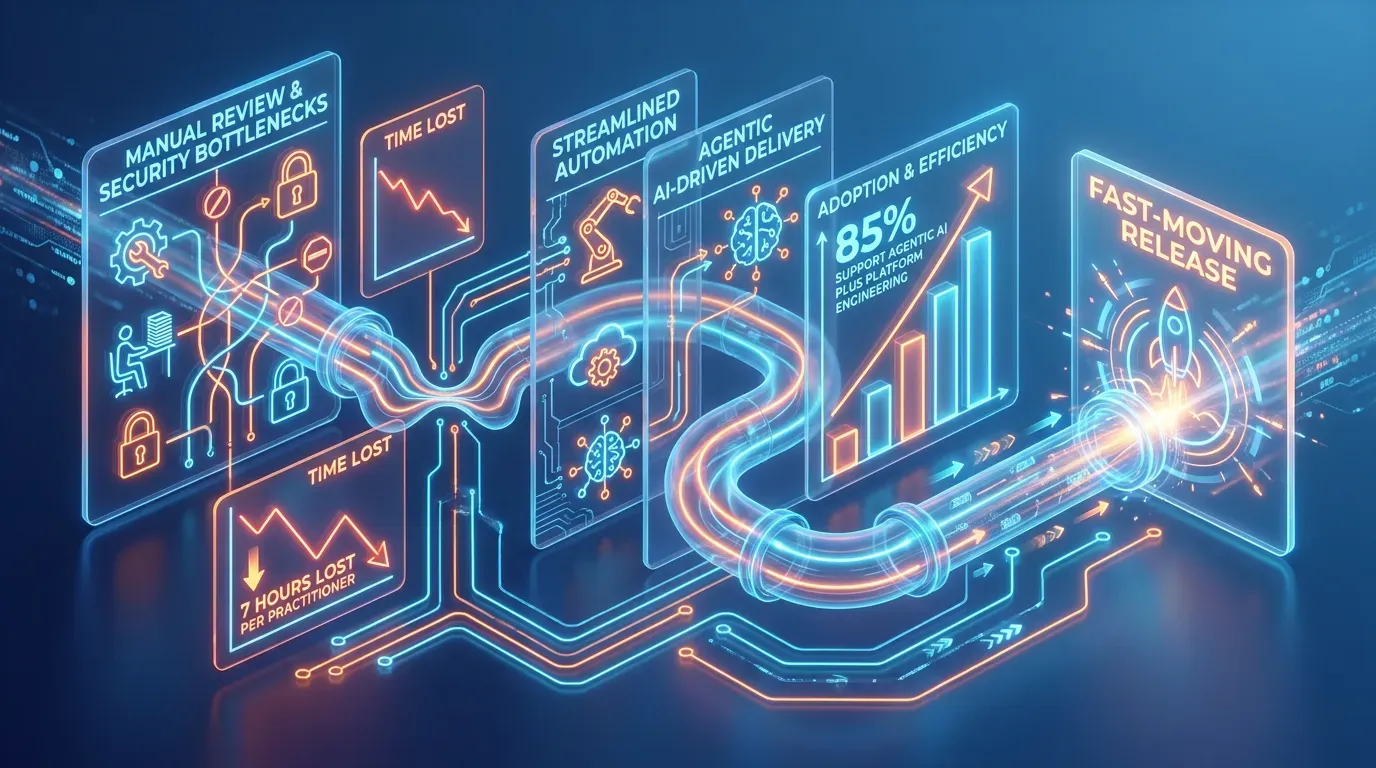
Well-implemented DevSecOps speeds delivery up, because catching issues at commit is faster than catching them in production, and automated checks remove the manual review bottleneck that used to sit between code-complete and release. The friction people associate with security comes from the gate model.
Cloudware's DevSecOps statistics reports that organizations more often standardize automated workflows because manual coordination does not scale with modern release velocity. In practice, DevSecOps only works when security checks execute automatically inside CI/CD; otherwise, teams reintroduce the same approval bottlenecks and delayed remediation cycles the model is supposed to eliminate.
Cloudaware's 2026 DevSecOps statistics, reports that practitioners lose roughly 7 hours per week to inefficient processes, and 85% say agentic AI works best when paired with platform engineering. The numbers point at the same conclusion from two directions: most of the lost time is coordination and context-switching. Moving checks into the pipeline removes the coordination tax.
There is a real adoption curve. Teams that bolt on tools without integrating them feel slower for the first few months. Teams that invest in platform engineering and clear ownership ship more often with higher confidence, because the questions a release used to raise are answered by the pipeline before anyone asks.
How DevSecOps changes team accountability
DevSecOps redistributes responsibility so security becomes a shared outcome backed by shared tooling and shared metrics. Developers own the security of the code they write, and operations owns the security of how it runs. The security team owns the platform and the threat model.
The practical mechanism is shared tooling. When SAST findings, SCA findings, IaC violations, and runtime alerts all land in the same issue tracker tagged to the same service, the question of who fixes what stops being a negotiation. Ownership follows the service.
The DevProJournal summary of GitLab's research found that 74% of security professionals have already shifted left or plan to in the near future, and 56% of organizations now use DevOps or DevSecOps methods, a 9% increase year over year. That shift is what shared accountability looks like in practice. Security stops being a department and becomes a property of the delivery system.
What measurable outcomes should teams expect?
DevSecOps produces measurable improvements in four areas: fewer vulnerabilities reaching production, faster mean time to remediate (MTTR), stronger compliance posture, and more reliable releases. The outcomes are connected, because catching issues earlier reduces remediation cost, which frees engineering time, which improves release confidence.
The key for engineering leaders is to instrument these outcomes from day one. Without baseline measurement, the value of the program becomes a matter of opinion.
Fewer vulnerabilities reaching production
Shifting detection left reduces the volume of critical findings in deployed code because most issues get caught and fixed in the commit-to-build window, before they ever reach a release candidate. The pipeline filters out the noise that used to land on the security team's desk after the fact.
The Sonatype 10th State of the Software Supply Chain Report noted that several critical vulnerabilities in 2024 took maintainers over 500 days to patch upstream. If your pipeline doesn't catch the vulnerable version on the way in, you inherit that 500-day window. SCA at build time is what keeps known-bad components out of production regardless of how slowly upstream moves.
Faster remediation and lower MTTR
DevSecOps shortens MTTR because automated detection and clear service ownership compress every step between "vulnerability found" and "fix deployed." The alert lands with the team that owns the service, and the fix moves through the same pipeline as any other change. Verification is automated.
DORA benchmarks summarized by DX classify elite performers as teams with time-to-restore under one hour and change failure rates between 0% and 15%. Low performers sit at one week to one month for restore and 46% to 60% for failure rate. The gap between those two profiles is mostly automation and ownership clarity, which are the same two things DevSecOps invests in for security work.
Stronger governance and compliance
Continuous policy enforcement and automated evidence collection make compliance a byproduct of the pipeline. When every change runs through the same gates and every gate produces an immutable log, the audit trail builds itself.
For regulated industries, this is the difference between a quarterly evidence scramble and a continuous report. Security remains the number one investment priority in regulated sectors like financial services and telecommunications, which lines up with the audit-readiness pressure those industries face. Policy-as-code gives them a way to prove control to an auditor without pausing delivery to assemble screenshots and spreadsheets.
Where most DevSecOps adoptions struggle
Most DevSecOps adoptions struggle for predictable reasons: tool sprawl, alert fatigue, unclear ownership, and treating the program as a tooling rollout. Buying a SAST product doesn't produce DevSecOps any more than buying a CI server produces DevOps.
The most common failure modes are worth naming directly:
-
Stacking overlapping scanners that produce duplicate, low-context findings developers learn to ignore.
-
Underinvesting in the platform engineering needed to keep the security toolchain reliable and well-integrated with the developer experience.
-
Leaving ownership ambiguous, so findings sit in queues without a clear owner accountable for the fix.
The GitLab survey reported by DevProJournal found 74% of AI users want to consolidate their toolchains to reduce complexity and context switching. Tool sprawl is the leading cause of alert fatigue and the reason mature programs prioritize platform consolidation over adding the next scanner. DevSecOps services works when the platform is treated as a product with users (the developers) and an owner (platform engineering) who is funded to make it reliable.
Build a secure delivery pipeline with ABS
ABS Technologies helps organizations operationalize DevSecOps without overloading internal engineering teams. Our managed IT and managed DevOps services cover the underlying pipeline infrastructure and security tooling, with continuous monitoring handled through the same platform, so your engineers stay focused on shipping product while we run the platform that keeps releases secure.
What that looks like in practice:
-
We assess your current CI/CD pipeline and identify where security controls are missing or duplicated, then map a roadmap to integrated, policy-as-code enforcement.
-
We operate the secrets management and runtime monitoring stack as a managed service, and scanning runs under the same SLAs and shared dashboards.
-
We work alongside your engineering and security leaders to define ownership and metrics so DevSecOps becomes a sustained practice.
If you're a CTO or engineering leader evaluating how to keep delivery velocity high without weakening protection, book a consultation with ABS Technologies. We'll review your current pipeline and surface the highest-impact gaps, then put a concrete DevSecOps roadmap in front of you within the first engagement.