Designing Cloud Architecture That Grows with Your Business

Content authorBy Irina BaghdyanPublished onReading time14 min read
Title:
Designing Cloud Architecture That Grows with Your Business

Meta description:
See How to build cloud architecture for growth and security? You can plan cloud choices that scale while keeping ri

This article is a strategic guide on designing cloud architecture that scales with a business without sacrificing secure control or resilience. It walks through scalable design, including the resilience and governance layers that keep growth manageable, plus the organizational realities that decide whether an architecture actually holds up. By the end, you will be able to assess your current setup and prioritize the decisions that let it evolve instead of forcing a rebuild.

Why architecture decides whether you scale

The question of cloud architecture growth is rarely the one teams ask at the start. They ask how to ship the first product and keep the lights on for launch. That's the right instinct early. But the architecture that gets you to your first real traction is almost never the one that carries you through the tenth time your traffic doubles, and you can feel the seams pulling apart well before anything breaks.

Cloud architecture is the strategic foundation behind the services you wire together. When it's optimized only for today's load, growth turns its early shortcuts into a specific kind of tax: your highest-value engineers stop building the developer platform and start managing infrastructure drift. Scaling one component forces a change in three others. A permissions model that was fine for eight engineers becomes a permissions sprawl no one can audit and instead of shipping features, your senior engineers are the ones untangling it. Costs climb faster than revenue, because nothing was built to be measured, and the operational toil compounds with every team and workload you add.

So the central tension is set early. Sustainable growth depends on an architecture that absorbs changing business requirements while handling a threat surface that keeps expanding and an operational load that compounds with every new team and workload. The rest of this piece is about building for that absorption deliberately, instead of paying for it later in a disruptive rewrite.

How to build cloud architecture for growth

Start with treating each foundational choice as a design decision that buys future flexibility. The building blocks below are the ones you'll evaluate independently, and each earns its place by letting the system change in one area without destabilizing the rest. That property, more than any single technology, is what lets an architecture grow into demand instead of fighting it.

Modular design and workload segmentation

Modular design plays a role here as well, because it lets you add or change a capability without putting the whole system at risk. When workloads are separated by function or data sensitivity, a change stays contained inside the module that needs it. That containment is the point. It shrinks the blast radius of both failures and mistakes, so a bad deploy in one service doesn't cascade into an outage everywhere.

Segmentation also makes scaling decisions surgical instead of blunt. A workload that spikes during business hours has a different profile than a batch job that runs overnight, and isolating them means you scale each on its own terms rather than oversizing one envelope to fit both. The payoff for a growing organization is direct: every change stops being a high-stakes event. You can move on one part of the system while the rest keeps running untouched.

Microservices, APIs, and containers

Microservices and clean API contracts, supported by containerized runtimes, give you independent scaling and faster delivery across environments. A service can scale on its own metrics and ship on its own cadence, while its runtime can move between environments without dragging the rest of the system along. Containers make that portability concrete, which is part of why 95% of new digital workloads are expected to run on cloud-native platforms, up from 30% in 2021.

But be honest about the cost. Every service you split out adds network overhead and coordination across deployment pipelines and versioned interfaces between the teams that own each side. The complexity moves from inside a codebase to the spaces between services, where it's harder to see. These patterns earn their overhead when your teams and your scaling needs have outgrown a single deployable unit. They punish you when you adopt them before that point because the system would have been simpler kept whole.

Infrastructure automation and IaC

Infrastructure as Code (IaC) turns provisioning into something repeatable, with review and version control built in. Environments stop being hand-built artifacts that drift apart over time and become definitions you can review in a pull request and roll back. That's how a growing estate stays consistent instead of fragmenting into snowflakes no one fully understands.

The security and recovery benefits are where this pays off at scale:

  • A baseline configuration applies the same controls to every environment, so a new service inherits your security posture by default rather than waiting for someone to remember it.

  • Recovery becomes predictable, because environment rebuilds execute code.

This matters because configuration error is the dominant failure mode in the cloud. Gartner has long held that through 2025, 99% of cloud security failures are the customer's fault, mostly down to misconfiguration. Codifying infrastructure is how you build cloud architecture without letting human error scale alongside your footprint.

Need IT Support?

Book a free consultation with ABS Technologies experts we'll help you find the right managed IT, cloud, or security solution for your business.

Book a Free Consultation

Designing for resilience as demand grows

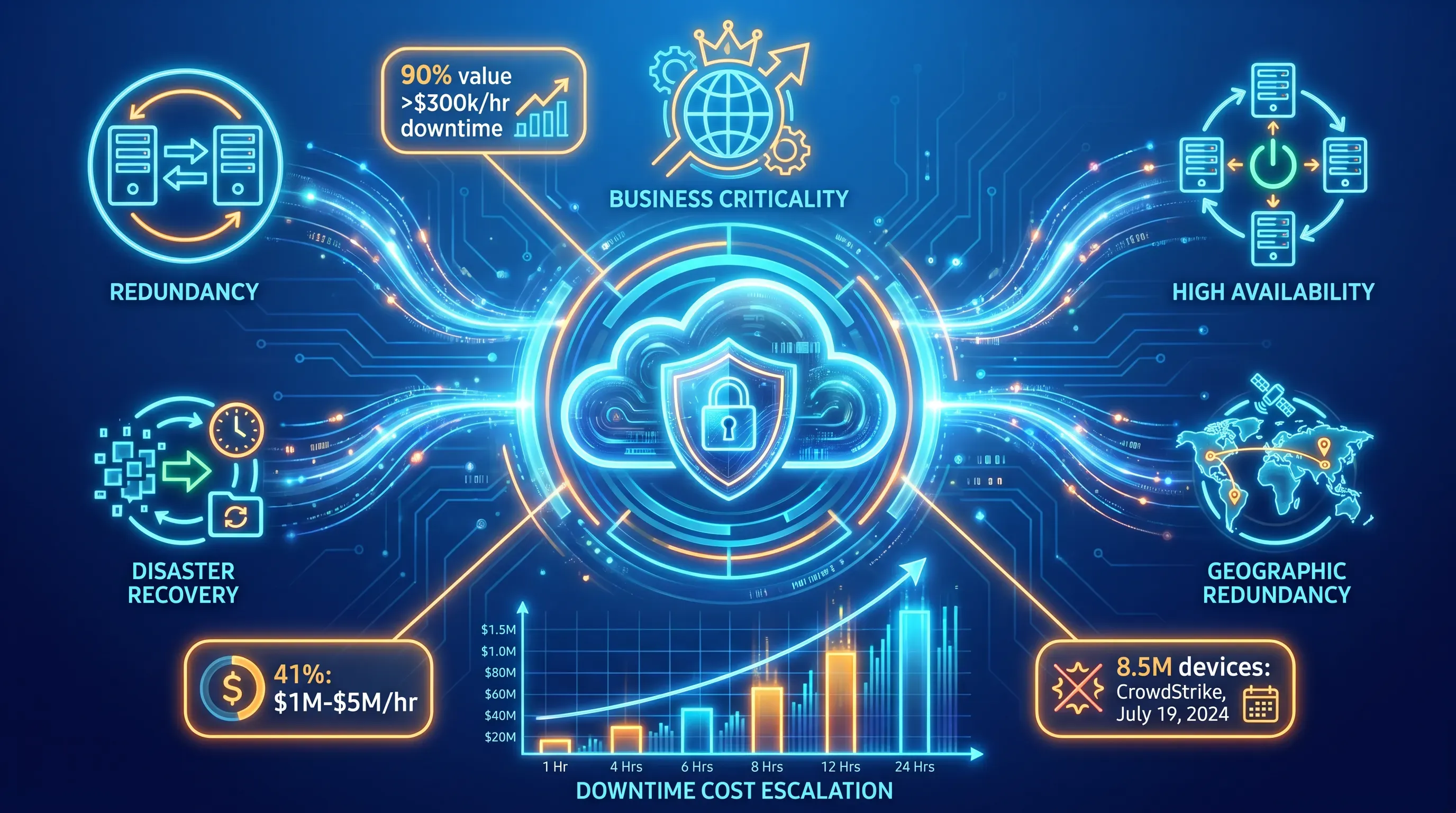
A neon hi-tech infographic featuring a central glowing cloud icon, surrounded by resilience layers and key statistics on downtime costs.

Resilience focuses on the number your business actually cares about: how much an hour of downtime costs. According to ITIC's most recent survey, over 90% of mid-size and large enterprises put a single hour of downtime above $300,000, and 41% of enterprises say it runs from $1 million to over $5 million. High availability and disaster recovery are the levers that keep those numbers off your incident report.

Each lever maps to a continuity outcome you're accountable for. High availability and fault tolerance keep a service running when an infrastructure component or dependency fails, which is the difference between a degraded request and a full outage. Disaster recovery defines how fast you come back when something larger goes wrong, expressed as the recovery time and recovery point you've committed to. Geographic redundancy protects you when an entire region has a bad day, and entire regions do have bad days.

The CrowdStrike incident on July 19, 2024 made the case better than any architecture diagram. A single faulty update disabled 8.5 million Windows devices worldwide, which grounded flights and knocked hospitals and banks offline, because so many critical systems shared one point of failure with no graceful fallback. That's the scenario redundancy exists to survive.

Resilience costs money and complexity, though, and not every workload deserves the same level. Matching redundancy to criticality is the right way to keep the investment defensible. A payment path that loses revenue by the minute justifies multi-region failover. An internal reporting tool that can be down for an afternoon does not. When you can tie each resilience decision to the cost of the outage it prevents, the budget conversation with the rest of the business stops being a debate and becomes arithmetic.

Hybrid and multi-cloud trade-offs

Hybrid and multi-cloud have become the norm and most engineers who operate them will tell you, candidly, that they'd rather not. The Flexera 2026 State of the Cloud Report found hybrid cloud continuing to lead, with 73% of organizations now operating hybrid estates, up three points year over year, and multi-cloud adoption also rising. The appeal on paper is real: placement flexibility, leverage in vendor negotiations, and the freedom to put each workload where it runs best. The lived reality is usually more painful due to fractured identity models, duplicated tooling, and a governance surface that doubles without doubling the team managing it. That frustration is well-founded, and it points to the right decision framework.

The cost shows up in governance. Every environment you add creates another surface to monitor and another identity model to reconcile, with more room for misconfiguration to hide. Distributing workloads multiplies the things that must be watched and controlled, and the operational drag is easy to underestimate when the architecture diagram looks clean. Most organizations don't run true cross-cloud workloads at all. The same Flexera data shows the top pattern is apps siloed on different clouds, which is several single-cloud estates under one banner more than one unified system.

So decide based on what you actually need. Multi-cloud earns its governance burden when you have a concrete driver such as a regulatory requirement to keep certain data in a certain provider or a continuity mandate that won't accept a single vendor as a single point of failure. If your reason is a vague wish to avoid lock-in, you'll pay the complexity tax without collecting the benefit. The flexibility is worth it when a named business requirement points to it, and not before.

Governance that keeps cloud architecture secure

One of the hardests parts of building secure cloud infrastructure is governance, because it's where most teams assume they have to choose between control and speed. They don't, when the control layer is designed well. Governance is what lets autonomy stay safe as teams and workloads multiply, and the control mechanisms below are built to scale with delivery rather than throttle it.

Identity, access, and network segmentation

Identity and access management built on least privilege, paired with network segmentation, is the backbone of cloud security that scales. Centralizing identity means every human and machine gets access from one source of truth, governed by fine-grained, policy-based rules rather than ad hoc grants. That's how you prevent the permissions sprawl that turns a two-year-old account into an attacker's easiest path in.

The industry has settled on this direction decisively. 81% of organizations plan to implement zero trust strategies within the year, according to the Zscaler ThreatLabz 2025 VPN Risk Report. The reason is the same one segmentation addresses: when identity is the perimeter and access is scoped tightly, a compromised credential reaches far less while your breach blast radius stays small.

Need IT Support?

Book a free consultation with ABS Technologies experts we'll help you find the right managed IT, cloud, or security solution for your business.

Book a Free Consultation

Encryption and policy controls

Encryption at rest and in transit is table stakes, but the part that scales is policy-as-code and what that looks like in practice is more specific than a general commitment to security. It means implementing DMARC and SPF records to protect email deliverability and prevent domain spoofing, so your brand integrity holds up as the business grows. It means designing the architecture from the start to support frameworks like ISO 9001, so that when a compliance audit arrives, the evidence already exists rather than needing to be reconstructed. When your rules for encryption and resource configuration live as code, they enforce themselves on every change instead of waiting for a reviewer to catch a violation. Protection extends to the entire business ecosystem and compliance becomes continuous and traceable rather than a quarterly scramble.

The stakes here are measured in dollars. IBM's 2025 report puts the global average cost of a data breach at $4.44 million, and that figure rises to $10.22 million in the United States. Codified policy standardizes protection across a growing estate without forcing anyone to manually inspect every deploy, which is the only way the work stays sane once you're shipping dozens of changes a day.

Centralized observability

You can't govern what you can't see, and distributed environments are where visibility goes to die. The distinction that matters is between two very different modes of observability: continuous, preventative health checks that catch a memory leak climbing toward a threshold before it becomes a service disruption and reactive emergency response, the kind that wakes an engineer at 3 AM for a full outage that proper monitoring would have intercepted hours earlier. Centralized observability and log aggregation are prerequisites for running hybrid and multi-cloud estates precisely because unified telemetry is what enables the former and prevents the latter. Without it, your detection is always reactive, your security posture has structural gaps, and your compliance evidence is incomplete.

You can't govern what you can't see, and distributed environments are where visibility goes to die. Centralized observability and log aggregation are prerequisites for running hybrid and multi-cloud estates, because unified telemetry is what makes everything else trustworthy. Without it, your security detection has blind spots and your compliance evidence is incomplete.

Observability is the feedback loop the rest of the governance model depends on. It feeds threat detection and produces the audit trail compliance needs, with spend signals that keep cloud costs in view. That last point isn't minor. Flexera found 84% of organizations call managing cloud spend their top challenge, and you can't manage what you can't measure across every environment at once.

Blueprints that balance agility and control

The building blocks and governance layers come together in a reference pattern called a golden path: a paved route through your environment where the fast way to ship is also the compliant way. Automation and platform engineering combine through IaC and security-by-design so teams move quickly within guardrails instead of around them. The goal is to make the secure default the path of least resistance.

A workable blueprint has recognizable layers:

  1. A foundation layer where account structure and identity are defined as code, with network segmentation applied uniformly, so every workload starts inside the same security posture.

  2. A platform layer that exposes self-service provisioning through templates, so teams can stand up services without filing tickets or learning the deep infrastructure underneath.

  3. A delivery layer where CI/CD pipelines carry policy checks and encryption defaults automatically, with observability hooks included so compliance travels with the code rather than being bolted on later.

The results show up in numbers you can defend. The 2025 DORA report found that platform engineering is now the critical enabler of delivery performance, with 90% of organizations running an internal developer platform and a direct correlation between platform quality and the ability to maintain throughput without sacrificing stability. The gap between teams that get this right and those that don't is mostly about whether the safe path and the fast path are the same path. When they are, you get faster delivery and a stronger security posture from the same design, rather than trading one for the other.

Autonomy versus standardization

Here is the balance the whole article has been circling. Flexibility without governance creates risk, and excessive control kills the speed that made the cloud worth adopting. Lean too far toward autonomy and you get permissions sprawl and configuration drift across a fragmented estate no one can secure. Lean too far toward control and delivery slows as every change waits on a central team while your best engineers route around the process out of frustration, which is worse than no process at all.

Effective architecture lets teams move fast without compromising security or compliance, and that outcome rests as much on ownership models and continuous optimization as on technology. The technology choices are the easy part. The hard part is deciding who owns what, including where the guardrails sit, and how decisions get made when a team needs something the standard doesn't cover.

Platform engineering is how organizations operationalize this balance, which is why Gartner forecasts that by 2026, 80% of large software engineering organizations will run platform teams, up from 45% in 2022. An internal developer platform gives teams self-service inside standardized guardrails, so they get autonomy where it speeds delivery and standardization where it protects the business. To diagnose your own organization, watch the symptoms. If shadow infrastructure and inconsistent security are spreading, you've leaned too far toward autonomy. If teams are waiting on tickets and routing around the platform, you've leaned too far toward control.

Building architecture that evolves

The strongest architectures evolve incrementally rather than being rebuilt under pressure. Durable decisions compound: modular boundaries and codified infrastructure, reinforced by scaled governance and a platform that paves the safe path, produce developer productivity and operational efficiency with the headroom to adopt what comes next without tearing down what works. To prioritize your next moves, find the layer creating the most drag today, whether that's permissions sprawl or blind spots, and fix the foundation before the features.

Getting this right while the business keeps shipping is genuinely hard, and experienced partners in cloud architecture and managed services can carry the high-stakes setup so your teams stay on product. If you'd rather hand that off than learn it under pressure, book a free consultation with ABS Technologies to work through how to build cloud architecture for growth and security.

Need IT Support?

Book a free consultation with ABS Technologies experts we'll help you find the right managed IT, cloud, or security solution for your business.

Book a Free Consultation

Start with a current-state review of workloads, data sensitivity, dependencies, and failure points. "How to build cloud architecture for growth and security?" is the planning question that turns those findings into priorities. Rank fixes by risk first, then by delivery speed.

Reassess cloud architecture at least twice a year and after major product, traffic, or compliance changes. Use the review to check access rules, service boundaries, recovery targets, and spend patterns. A fixed review cycle keeps small design gaps from turning into rebuild projects.

Yes, small teams can use platform engineering practices by starting with reusable templates and shared deployment pipelines. A full internal platform isn't required on day one. Standard account setup, access rules, and logging defaults give engineers a safer path without adding a large platform team.

Migrate legacy applications only when the move solves a defined scaling, security, or reliability problem. If the application is stable and low risk, wrap it with monitoring and access controls first. For higher-risk systems, split the migration into parts that can be tested and rolled back.

Track deployment frequency, change failure rate, recovery time, access policy violations, and cost per workload. These metrics show whether growth is improving delivery or adding risk. Prefer to have an expert run this audit for you? Contact ABS Technologies for a free cloud DevOps review. →

Schedule a Meeting

Book a time that works best for you and let's discuss your project needs.

You Might Also Like

Discover more insights and articles

Title:
How do businesses fast-track Azure deployment? What actually speeds rollout

Meta description:
So, how do businesses fast-track Azure deployment? You learn to build reusable foundations and aut

How do businesses fast-track Azure deployment? What actually speeds rollout

This article is for teams that have committed to Azure and keep watching dates slip. It compares the levers that genuinely shorten an Azure rollout against the shortcuts that look fast on a slide but create rework later. The distinction matters: fast rollout does not mean skipping governance or avoiding assessment. It means automating governance so it runs inside the pipeline and making assessment reusable and wave-based. The levers below are built on that principle.

Title:
AWS Setup for Startups: From Zero to Cloud Launch

Meta description:
Curious about What’s the right way to set up AWS for startups? You will discover how to configure accounts to prevent mistak

AWS Setup for Startups: From Zero to Cloud Launch

A few AWS decisions made on Day 1 are the ones most expensive to reverse later. This is a Day-1 blueprint for technical founders and their first engineers who are about to run AWS for a real product. It walks you from a clean first account to a foundation designed to support early growth and avoid the common rework that appears before Series A, and it flags where a partner saves you time.

Title:
Continuous Monitoring: The New Rule of Cloud Compliance

Meta description:
To protect your data, answer this: Why is continuous monitoring non-negotiable today? You will learn to stop cloud dri

Continuous Monitoring: The New Rule of Cloud Compliance

Continuous monitoring is now the baseline requirement for cloud compliance because cloud environments change faster than any audit cycle can track. A control that passed last quarter can drift out of compliance within hours. Control effectiveness today depends on ongoing, timestamped visibility captured across the full operating period.

Title:
Containers and Orchestration: The Future of Scalable Apps

Meta description:
Read: How are containers redefining scalability? You learn to deploy code faster and cut server costs.

Article:
# C

Containers and Orchestration: The Future of Scalable Apps

Most teams adopt containers expecting speed and simplicity. What they get is Kubernetes in production. The DORA research is direct about what happens next: migrating workloads to flexible cloud infrastructure without changing how you operate them can be more harmful than staying in a traditional data center. This article is an operational guide to what happens after adoption.