Vulnerability Management Services: Finding Security Weaknesses Before Attackers Do

Content authorBy Irina BaghdyanPublished onReading time13 min read
Title:
Vulnerability Management Services: Finding Security Weaknesses Before Attackers Do

Meta description:
See how vulnerability management services help you find weak spots before attackers and dec

This article explains what vulnerability management services do and how they help you find security weaknesses before an attacker exploits them. It walks through how vulnerability management services handle the full lifecycle of finding and fixing weaknesses, with priority and monitoring built into that cycle, then shows where a managed service fits and how to judge one provider against another.

Why weaknesses go unnoticed

Most breaches start with a documented weakness that was already known and fixable. Vulnerability management services exist because attackers move faster than stretched teams can patch, and the gap between the two is where breaches happen. Verizon's 2026 report found that 31% of breaches now begin with vulnerability exploitation, making it the most common initial access vector for the first time in the report's 19-year history. At the same time, organizations fully remediated only 26% of critical vulnerabilities in the CISA Known Exploited Vulnerabilities catalog during 2025, while the median time to resolve them increased to 43 days. That leaves attackers with a widening window to exploit known weaknesses before defenders can close them.

The timing is what makes this hard. Attackers often begin exploiting newly disclosed vulnerabilities within days, while organizations typically need weeks to identify, prioritize, test, and deploy patches across their environments. So the fix exists, but it lands months after the attacker already knows how to get in. That's the core problem, and no amount of good intentions closes it on its own.

Why does the gap stay open? Because scanning cadence rarely matches the recommended pace. The Center for Internet Security recommends performing authenticated vulnerability scans at least weekly for internet-facing systems and after significant infrastructure changes. Add a small team consumed by day-to-day operations, and you get long stretches where nobody is looking. New assets appear in the cloud in minutes, and the picture drifts as laptops leave and rejoin the network.

For a mid-sized business, the attack surface keeps growing across cloud services and on-premises systems such as servers and endpoints that different teams add without central oversight. More than 40,000 CVEs were published in 2024, the highest annual total on record, giving security teams an ever-growing backlog of issues to identify, prioritize, and remediate. You can't fix what you never see, and you can't see it if you only look once a quarter. That's why vulnerability management has to be a structured, continuous process rather than a periodic exercise.

What vulnerability management is

Vulnerability management is the continuous practice of finding security weaknesses across your environment and making sure the important ones get fixed with confirmation afterward. It's a discipline that runs on a repeating cycle with no end date. The distinction matters because the language people use around it blurs three very different things.

A one-off vulnerability scan is a single snapshot. It tells you what a tool saw on the day it ran, and it goes stale the moment a new CVE drops or someone deploys a new server. A penetration test is a focused, human-led attempt to break in through specific paths, once or twice a year for compliance. Both are useful. Neither keeps pace with a flow of new weaknesses. Vulnerability management is the ongoing program that ties scanning and remediation into a risk-prioritized loop that never fully stops.

The vulnerability management services program spans cloud environments where resources appear and vanish on demand as well as the core business systems and employee endpoints you run. Coverage across all of it is the point, because attackers don't respect the boundaries between your on-prem network and your cloud accounts.

One more piece of shared vocabulary will make the rest of this article clearer. A vulnerability is a weakness in software or configuration, like an unpatched library or an exposed admin port. A threat is something or someone that can act against that weakness, such as a ransomware group scanning the internet for it. Risk is what happens when the two meet on an asset that matters to your business. A critical-rated vulnerability on an isolated test box carries less risk than a medium-rated one on your customer database. Keep that separation in mind, because it's the foundation of good prioritization.

How the process works

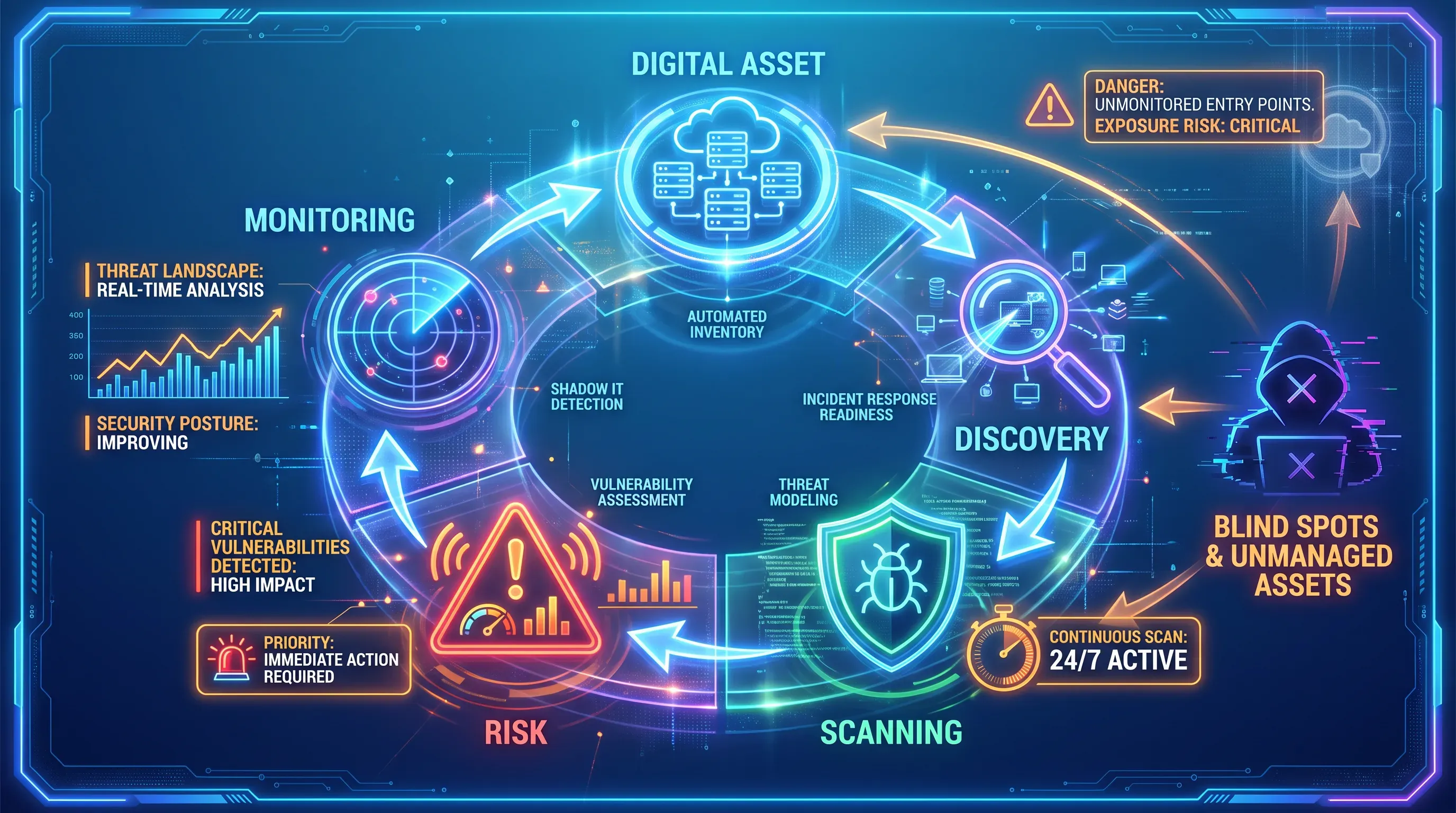
High-tech neon infographic illustrating the cyclical process of vulnerability management in a SaaS environment with vibrant icons and glowing elements.

The work within vulnerability management services runs as connected stages that repeat on a cycle: find the weaknesses and fix the ones that matter by risk, with monitoring to keep anything from slipping. Each stage feeds the next, and the whole thing loops back to the start because the environment never holds still. Here's what actually happens at each step, and why it matters.

Need IT Support?

Book a free consultation with ABS Technologies experts we'll help you find the right managed IT, cloud, or security solution for your business.

Book a Free Consultation

Identify weaknesses

You can't protect what you haven't counted, so identification starts with an asset inventory. That means you need an inventory of every cloud resource and internal system you're responsible for, even the resources a developer spun up last week and forgot to tell anyone about. Automated asset discovery matters here because cloud instances appear in minutes, and a manual spreadsheet is out of date before you finish it.

With an inventory in place, scanning examines those assets for known weaknesses. A strong scan goes beyond a basic network sweep because authenticated scans can log into systems for a deeper look, while application and cloud checks cover the areas shallow sweeps miss. The GreyNoise 2025 report found that 40% of vulnerabilities exploited in 2024 dated from 2020 or earlier, which tells you old, forgotten assets are exactly what attackers hunt for.

Cadence decides whether any of this is useful. A scan that runs once a quarter leaves blind spots of 45 to 90 days, and with a five-day median time to exploit, that's more than enough room for an attacker to move first. In vulnerability management services, frequent scanning of your exposed and critical systems is what keeps the picture current.

Prioritize with cyber risk assessment

Scanning always produces more findings than any team can fix. One published academic framework started with 16,182 vulnerabilities flagged as urgent under a severity-only approach. This is where the real value sits, because deciding what to fix first is harder and more important than finding things in the first place.

A security risk assessment ranks vulnerabilities by more than their raw CVSS severity score. It weighs active exploitation in the wild and the business impact of the affected asset, from internet exposure or sensitive data to the damage a successful attack causes. Modern prioritization combines several signals to answer one question: does this weakness actually threaten us?

  • CVSS tells you how severe a vulnerability is in theory, on a scale from 0 to 10.

  • The CISA Known Exploited Vulnerabilities catalog confirms which flaws attackers are using right now.

  • The Exploit Prediction Scoring System predicts the likelihood a vulnerability gets exploited in the next 30 days.

When that same academic framework layered these signals into a proper cyber risk assessment, the urgent workload dropped to around 850 vulnerabilities while still covering 85% of the flaws that were actually exploited. That's the difference between chasing every "critical" and fixing what threatens the business. Remember the vulnerability-versus-risk distinction from earlier, because a security risk assessment is how you turn a wall of findings into a short list of things that carry real risk. Skipping this step is how teams burn out and miss the flaw that matters.

Remediate the findings

Remediation is where prioritized weaknesses get fixed. Most of the time that means patching, but not always. Some fixes require a configuration change, and when a patch isn't available or can't be applied without breaking a critical system, a compensating control like network segmentation or tighter access rules reduces the exposure until a proper fix lands.

This stage is where mid-sized teams stall, because it demands coordination between security, who found the problem, and IT operations, who own the systems and the maintenance windows. Security wants the patch now. Operations worries about downtime, and that tension is real. Automox found that 81% of CIOs and CISOs have delayed a patch specifically to avoid disrupting the business. Remediation is ongoing work with a queue that never empties.

Monitor continuously

Monitoring closes the loop. After a fix goes in, a re-scan verifies it worked, because patches fail more than people expect. Over 80% of security leaders in the Automox survey found patches they believed were deployed had never reached all their endpoints. So verification is confirmation.

Continuous re-scanning also catches what's new. Every day brings fresh CVEs and fresh changes to your environment, and both open new exposures the moment they land. This is exactly the gap-between-scans problem from the opening, and monitoring is what closes it. A single scan gives you a point-in-time snapshot that's already aging. Continuous monitoring is what turns that snapshot into protection you can rely on week to week.

Need IT Support?

Book a free consultation with ABS Technologies experts we'll help you find the right managed IT, cloud, or security solution for your business.

Book a Free Consultation

What vulnerability management services cover

As part of vulnerability management services, a managed vulnerability management service takes that four-stage loop and runs it for you, at a cadence and scale most in-house teams can't sustain alone. The value is operational discipline that keeps the whole cycle active across a modern attack surface without gaps.

Coverage is the first thing these services deliver. A capable provider scans cloud environments and internal assets, and it uses authenticated access for the application and cloud configuration checks that shallow tools skip. That breadth matters because vulnerability exploitation is rising, and web applications remain the most common entry point. Leaving one layer of the environment unwatched is how attackers find their way in.

Beyond scanning, most vulnerability management services carry the volume and cadence that overwhelm a small team. They run continuous or weekly scans on your exposed systems and feed the findings through a risk-based security risk assessment, which gives your operations team a ranked remediation plan. That triage is the part that saves the most time, given that scanning without prioritization is what drives alert fatigue in the first place.

Reporting and compliance support round out what these services provide. Frameworks like PCI DSS require quarterly scans by an Approved Scanning Vendor, with rescans after fixing high-risk findings, and other standards set their own cadences for scanning and monitoring. Good vulnerability management services produce the documentation and audit trails these frameworks demand, so you can prove your posture to an auditor instead of scrambling to reconstruct it. If you're starting to picture buying this rather than building it, that combination of coverage and evidence, with prioritization built in, is what you're actually buying.

In-house or managed service

The honest version of this decision has real tradeoffs on both sides, and pretending otherwise doesn't help you. Running vulnerability management in-house gives you control and speed. Your team knows your environment and can respond to an incident with the tooling it owns, without waiting on an outside party. When a new critical flaw hits the news, an internal team that already understands your systems can move fast. That's a genuine advantage, and for some organizations it's decisive.

But in-house demands scarce, expensive talent and constant attention, and that's where the model breaks down for most mid-sized businesses. The ISC2 Workforce Study put the global cybersecurity talent gap at 4.76 million professionals. Hiring the specialists who can run a continuous program is hard, and keeping them is harder. Expecting a small team to cover scanning and remediation coordination around the clock, with prioritization and monitoring layered on top, is how you burn them out. The SANS 2026 SOC Survey found that 66% of SOC teams can't keep pace with their alert volume, and 70% of junior analysts leave within three years.

Managed vulnerability management services close the staffing and coverage gap. You get continuous scanning and remediation guidance, with a proper security risk assessment on every cycle. The cost is some direct control, because a provider isn't sitting inside your organization and won't know your business context as intimately on day one. For most mid-sized teams, that's a reasonable trade. You keep ownership of the decisions and the fixes while handing off the relentless operational load that no small team sustains for long. The right answer depends on your headcount, your budget, and whether the people you'd assign to this have room to do it well without dropping everything else.

Choosing a provider

Once you've decided a managed service fits your need for vulnerability management services, comparing two or three options comes down to asking pointed questions. Treat the following as the evaluation conversation to have with each provider.

Start with coverage against your actual environment. Ask whether the provider scans your whole attack surface across your specific cloud platforms and web applications. A service that covers only part of your attack surface leaves the same blind spots you're trying to eliminate. Have them walk you through how they discover new and ephemeral assets, because cloud resources that appear for an hour still create exposure.

Then dig into how they prioritize. A provider that hands you a raw list ranked by CVSS alone hasn't done the hard part. Ask how their security risk assessment combines active exploitation data with business risk, and ask them to show you a sample report. The point of a security risk assessment is a short, ranked list you can act on, so make them prove theirs produces one.

Remediation guidance and reporting deserve equal scrutiny. Consider asking these questions directly:

  1. When you flag a vulnerability, do you tell us exactly how to fix it, or just that it exists?

  2. How does your reporting map to the compliance frameworks we answer to, like PCI DSS or ISO 27001?

  3. Do you integrate with the ticketing and security tools we already use, so findings flow into our workflow instead of a separate portal?

Integration matters more than it sounds, because a service that lives in an isolated dashboard adds friction your team will eventually route around. Compliance support is the last thing to confirm. If you handle payment data or operate under a regulatory framework, verify the provider can produce the documentation and audit trails you'll need, and that they understand the scanning cadence your framework requires. A provider who can speak fluently about your specific obligations is one who's done this before.

Getting ahead of attackers

The whole point of this work is to find and fix your weaknesses before someone else finds them for you. Attackers are exploiting known flaws within days of disclosure, and occasional scanning leaves the gaps where they get in. Continuous, prioritized effort is what closes those gaps, and the decision in front of you is whether your team can sustain that loop or whether handing it off makes more sense.

A low-pressure first step is to look honestly at your current scanning cadence and how much of your environment it actually covers. If you'd rather have an expert run that review than piece it together yourself, book a free cloud and security assessment with ABS Technologies, and we'll map your gaps and where managed vulnerability management services fit your environment →

Need IT Support?

Book a free consultation with ABS Technologies experts we'll help you find the right managed IT, cloud, or security solution for your business.

Book a Free Consultation

Include every system that stores, processes, or exposes business data. That means cloud accounts, servers, laptops, containers, network devices, web apps, APIs, and internet-facing SaaS connections. Tag each asset by owner and business function so findings go to the right team for review and repair.

Confirm the fix with a follow-up scan against the affected asset. Patch records and closed tickets help, but they don’t prove the weakness is gone. A re-scan shows whether the patch applied correctly, the configuration changed, or the exposure still exists under a different path.

No, vulnerability management doesn’t replace penetration testing. It finds and tracks known weaknesses on a regular cycle, while penetration testing checks whether a person can chain weaknesses into a real attack path. Use vulnerability management for ongoing hygiene and penetration testing for deeper validation at planned intervals.

Patch critical vulnerabilities first when they affect exposed or business-sensitive systems. A critical flaw on an unused lab machine has less business risk than an exploited medium flaw on a payment system. Use exploit activity, asset value, and exposure to set the repair order.

A first review should document asset coverage, scan frequency, prioritization logic, remediation workflow, and reporting needs. It should also identify gaps between current practice and required compliance checks. ABS Technologies can use a free assessment to show where vulnerability management services fit your environment and what work stays with your team.

Schedule a Meeting

Book a time that works best for you and let's discuss your project needs.

You Might Also Like

Discover more insights and articles

Title:
Cloud Readiness Assessment: How to Know If Your Business Is Ready to Migrate

Meta description:
Use this cloud readiness assessment guide to see if you can migrate safely and identify gaps befo

Cloud Readiness Assessment: How to Know If Your Business Is Ready to Migrate

This article is a practical guide to running a cloud readiness assessment before you move any workload off your current setup. It walks through what to audit and how to reach a clear verdict on your business's migration readiness.

Title:
Security Awareness Training: Reducing Human Risk in Cybersecurity

Meta description:
Use security awareness training so you reduce risky clicks and get faster reports from your team.

Article:

Security Awareness Training: Reducing Human Risk in Cybersecurity

This article explains why employee behavior stays risky even after a security awareness training rollout, and how to design an effort that shifts habits instead of filling a compliance log. It walks through the behaviors that create exposure and pairs each with a practical response you can put in place without a dedicated security team.

Title:
Server Management Services: Keeping Critical Business Systems Reliable

Meta description:
See how server management services help you find upkeep gaps and keep business systems dependable.

Art

Server Management Services: Keeping Critical Business Systems Reliable

This article explains what server management services actually cover and how the individual disciplines connect into systems you can depend on. It walks through the core server-maintenance disciplines so you can audit your own environment and see which areas are handled well and which are quietly exposing the business.

Title:
Automating IT Scaling: The Future of Elastic Infrastructure

Meta description:
Discover unclustered methods to automate your IT scaling so you can reduce cloud waste and maintain speed under he

Automating IT Scaling: The Future of Elastic Infrastructure

Automated scaling turns capacity management from a human-triggered task into a continuous system that watches live conditions and allocates resources in real time according to policy. It reads signals like latency and queue depth, then adds or removes capacity in seconds. That shift makes infrastructure respond at machine speed instead of ticket speed.