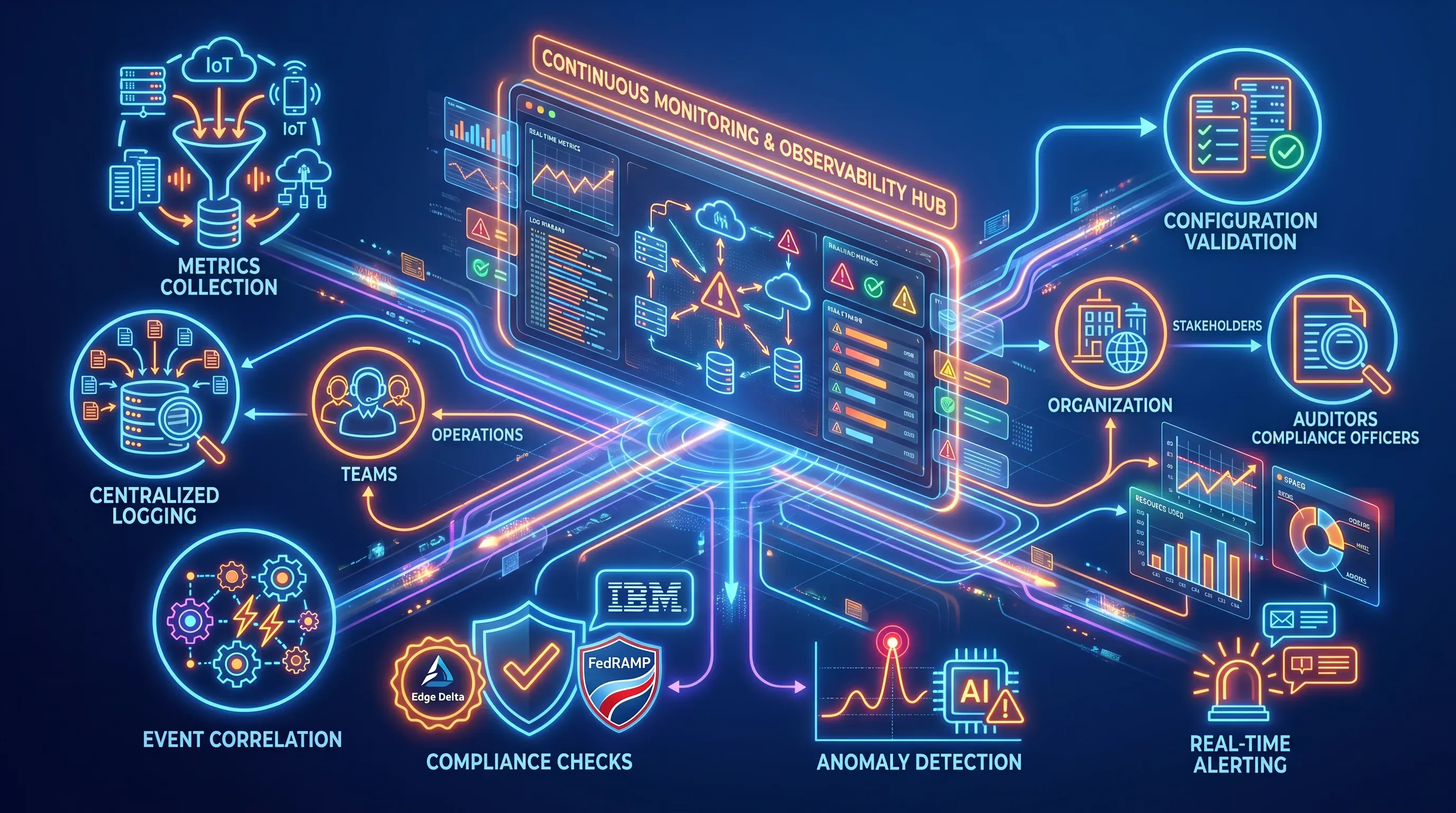
Policy enforcement for preventing drift
Policy enforcement prevents drift because it validates changes against standards and guides them into approved patterns before a violation forms. This moves monitoring from catching problems to preventing them.
The documented benefit is substantial. Policy-as-code enforcement is how that saving materializes, because a change that violates your standard never reaches production. Treat these guardrails as enablers of speed that keep delivery moving. They let teams ship fast precisely because the rails keep every change inside approved bounds.
Business outcomes of continuous visibility
Continuous visibility delivers faster incident detection and stronger regulatory readiness, with downtime reduction and cloud adoption confidence tied to the same operating model. These results justify investment in terms a board understands.
The financial case is documented. IBM's 2025 report found the global average breach cost fell to USD 4.44 million, a 9% drop driven primarily by faster detection and containment from AI-powered defenses. That decline is the first in five years, and it traces directly to organizations closing the time gap that point-in-time assessment leaves open.
Read that as a return on visibility. The money saved is the difference between catching a problem in days and discovering it in months. Continuous monitoring is what compresses that timeline, which is why the case for it is a business case before it is ever a technical one. Every day shaved off detection is cost removed from the worst outcome.
Why does monitoring alone not guarantee compliance?
Monitoring alone does not guarantee compliance because excessive alert volume and fragmented tooling can render a heavily funded program ineffective when observability strategy and response processes are weak. Buying the tools is necessary. It is not sufficient, and experienced teams have watched well-resourced monitoring deployments fail anyway.
The scale of the noise problem explains why. A program that generates signal no one acts on produces the appearance of coverage while the real threats sit unread in the same queue as the false ones.
The lesson for your program is to judge it by what gets resolved. A monitoring stack that floods your team with unactioned alerts produces the appearance of compliance coverage without the actual protection. The investment only pays off when detection connects to a response process that actually closes the loop.
If your program has reached that point, these are the operational fixes that restore signal quality and accountability:
-
Define alert severity levels. Not every event warrants the same urgency. Classify alerts into tiers (critical, high, medium, low) so your team knows immediately what requires action in minutes versus what can wait for the next business day.
-
Remove duplicate alerts. Multiple tools flagging the same event multiply noise without adding information. Audit your alert rules across platforms and consolidate triggers that fire on the same underlying condition.
-
Tune thresholds based on baselines. Alerts built on default thresholds fire constantly in most environments. Measure your actual traffic, login patterns, and resource behavior first, then set thresholds against those baselines so alerts reflect genuine anomalies.
-
Assign alert owners. Every alert category should have a named owner responsible for triage and resolution. An alert with no owner is an alert no one will action.
-
Define response SLAs. Set explicit timeframes for how quickly each severity tier must be acknowledged and resolved. Without SLAs, response time is informal and unaccountable.
-
Document escalation paths. When the assigned owner cannot resolve an alert within the defined window, the next step should be written down and known in advance.
-
Integrate monitoring with your ticketing system. Alerts that generate tickets automatically create an auditable record of detection, assignment, and resolution. That record is compliance evidence. Alerts that live only in a monitoring console leave no trail.
-
Review unresolved alerts weekly. A standing review of aged, unresolved alerts surfaces systematic gaps: misconfigured tools, unclear ownership, or unadjusted thresholds. It also keeps alert debt from accumulating.
-
Consolidate overlapping tools. If two platforms are monitoring the same surface, evaluate whether both are necessary. Redundant tooling splits attention, inflates costs, and makes correlation harder. Fewer, better-integrated tools produce cleaner signal.
These steps will not eliminate every false positive, but they will turn your monitoring program into an operational asset where detection connects to response, and where the evidence trail holds up when an auditor asks what you did with it.
Alert fatigue
Alert fatigue undermines response because excessive false positives bury real threats and exhaust the people meant to act on them, which causes missed valid signals and delayed responses. When nearly half your alerts are noise, your team learns to discount all of them.
The data on signal quality is stark. The Microsoft and Omdia State of the SOC report found that 46% of all alerts prove to be false positives, so roughly half of every analyst's workload generates no security value. That is how a valid drift event slips through. It arrives looking identical to the thousand false alarms that came before it, and a fatigued team treats it the same way.
Fragmented tooling
Fragmented tooling weakens visibility because disconnected platforms produce siloed signals that cannot be correlated and leave blind spots across hybrid and multi-cloud estates. Each tool reports its own version of events, and no single view assembles them.
The sprawl is well documented. A survey of 500 CISOs found enterprise teams manage an average of 49 security tools, with 95% of organizations running 20 or more. Each one has its own console and severity scale, with an alert stream that does not talk to the others. That fragmentation is itself the blind spot, because a threat moving across systems shows up as separate, unconnected fragments in separate tools. Consolidated, full-context visibility is what lets you see it as one event.
Designing a successful continuous monitoring program
A continuous monitoring program succeeds when clear ownership and well-defined thresholds are paired with automated workflows and genuine integration between operational and control teams. These organizational conditions decide whether your tooling investment delivers anything at all.
The contrast with failure is sharp. The organizations that succeed are the ones that consolidated and assigned clear ownership first.
What to put in place looks like this:
-
Assign explicit ownership so every signal has someone accountable for it
-
Define thresholds against real baselines so alerts mean something
-
Automate response workflows so detection connects to action
-
Integrate operational and control teams around one shared view
Get these right and your tooling produces measurable governance outcomes. Skip them and you have a tool that generates alerts no one acts on. The difference between the two is organizational, which is the part most programs underinvest in.
How can ABS Technologies support continuous compliance?
If you have read this far and recognized gaps in your own monitoring, the next step is an honest assessment of where your program actually stands. ABS Technologies is an Armenia-based managed IT services provider whose work covers observability and monitoring, with governance and ongoing support built around the same operating needs.
Its Cloud Services and DevOps practice builds the metrics and centralized logs that support correlation and automated compliance checks, which make monitoring genuinely continuous. The Managed IT Services and Information Security offerings extend that into day-to-day operation and policy enforcement, so detection connects to response with clear follow-through.
Because ABS Technologies is vendor independent, its tooling recommendations are impartial and focus on consolidation of the sprawl that fragments visibility. Its engagement model runs from assessment and benchmarking through ongoing support, which positions it as a long-term partner that maintains continuous visibility while your internal teams focus on core operations.
Book a call with ABS Technologies to assess your current monitoring posture and find out whether it is genuinely continuous or quietly leaving you exposed between audits.