Overview
Modern software delivery demands more than fast deployments - it requires continuous visibility into system health, security posture, and regulatory compliance. CI/CD monitoring provides this visibility by embedding observability directly into the development and deployment pipeline, enabling teams to detect issues before they impact users or business operations.
This article examines how continuous monitoring transforms reactive incident response into proactive control. It outlines the three core pillars - performance, security, and compliance - explores regional priorities such as FinOps in North America and data sovereignty in the GCC, and explains how intelligent alert management reduces noise while surfacing critical risks. By the end, you will understand how effective CI/CD monitoring supports faster releases, lower operational risk, and more resilient software systems.
Moving Beyond Reactive Firefighting with Continuous Monitoring
The traditional approach to monitoring often involved waiting for a server to crash or a customer to complain before taking action. This reactive model is no longer sustainable. Modern continuous monitoring devops practices shift the focus to the left, meaning monitoring starts the moment code is written, not just when it is live.
By integrating monitoring tools directly into the Continuous Integration and Continuous Deployment (CI/CD) pipeline, teams can identify performance bottlenecks and errors before they impact real users. This shift is becoming standard practice, with data showing that 83% of developers reported being involved in DevOps-related activities such as performance monitoring or security testing as early as the first quarter of 2024. This early detection system creates a feedback loop that stabilizes the entire software lifecycle.
Implementing this strategy effectively requires a change in mindset:
-
Identify issues early: Catching a memory leak in the staging environment is significantly cheaper than fixing it in production.
-
Automate feedback: Developers receive instant notifications if their code creates latency, which is the delay between a user's action and the application's response.
-
Validate health checks: Automated gates prevent bad code from merging if it fails specific health criteria.
This anticipatory approach leads to massive efficiency gains. High-performing teams that master this flow operate at a different velocity, as elite DevOps teams deploy code 182 times more frequently than low-performing teams. Speed is useless without control, and monitoring provides the necessary guardrails.
For deeper insight into how pipelines and automation enable speed and reliability, see CI/CD Automation: How CI/CD Pipeline Automation Powers Modern Software Delivery.
Catching the Memory Leak
Consider a mid-sized fintech company updating its payment processing engine. In a traditional setup, a minor code change that caused a slow memory leak might pass testing and crash the servers only after running for 48 hours during peak traffic. With continuous monitoring integrated into the CI pipeline, the automated stress tests detected a 15% spike in memory usage in the staging environment. The build was automatically rejected, and the developer received a ticket detailing the specific function causing the drain. The issue was resolved in an hour, never reaching a single customer.
Moving monitoring earlier in the process prevents small errors from becoming major outages. It turns the CI/CD pipeline from a simple delivery mechanism into a robust quality assurance engine.
The Three Pillars: Performance, Security, and Compliance

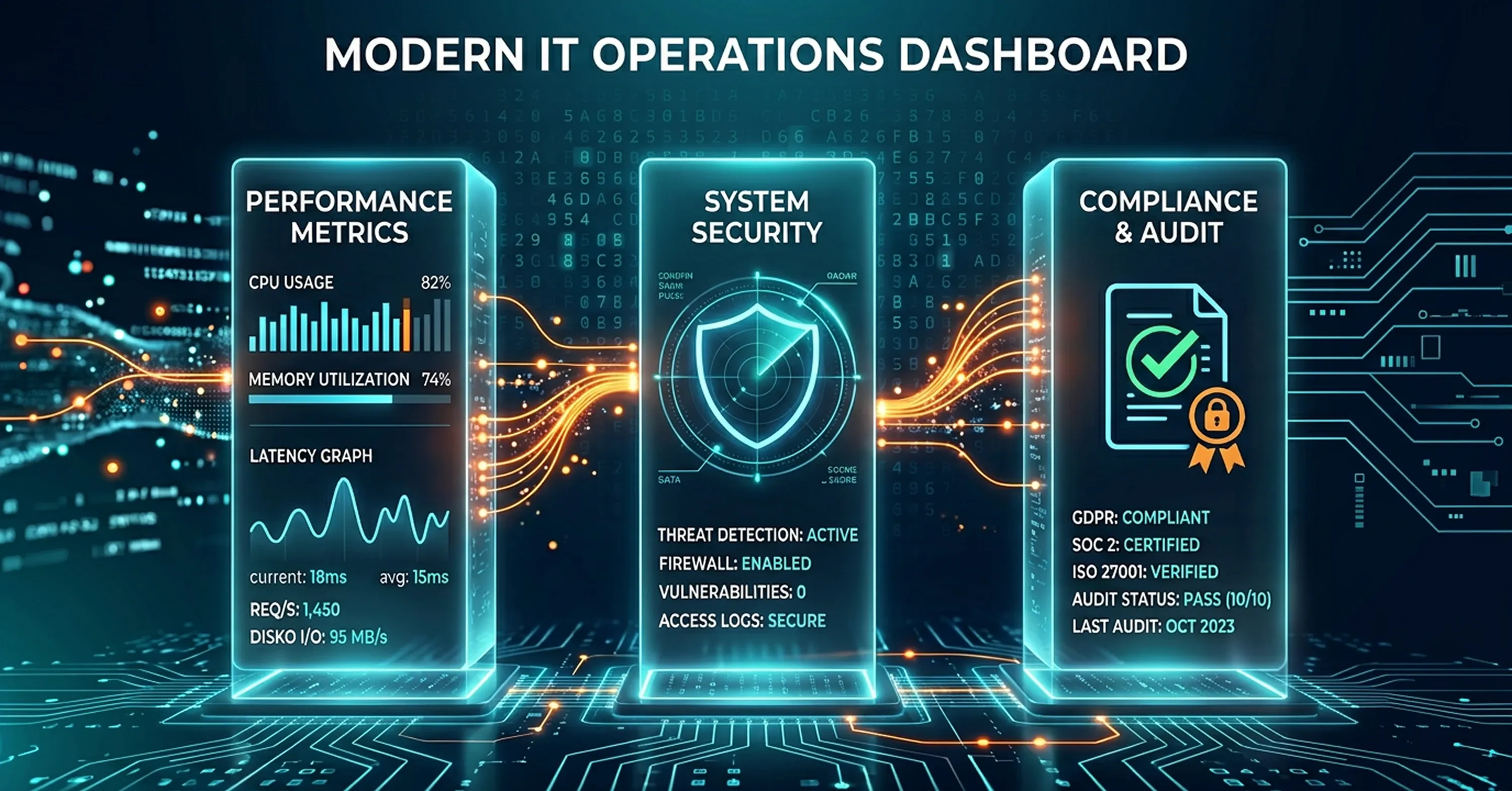
Effective CI/CD monitoring rests on three non-negotiable pillars. Ignoring any one of them creates a vulnerability that can either crash the system, leak data, or invite regulatory fines.
Performance is the most visible pillar. It tracks throughput (how much data moves through the system) and latency. However, modern stacks also require automated continuous monitoring for security and compliance. This ensures that every deployment is not just fast, but also safe and legal.
A balanced monitoring strategy addresses these three critical areas:
-
Performance Observability: Tracking metrics like CPU load, error rates, and response times to prevent degradation.
-
Security Scanning: Analyzing dependencies for known vulnerabilities and detecting anomalous traffic patterns immediately after deployment.
-
Compliance Auditing: Automatically verifying that data handling practices meet legal standards like GDPR or HIPAA before and after code ships.
Research highlights that 58% of organizations have deployed security monitoring capabilities as part of a broader observability solution. For hands-on practices that embed security into every DevOps stage, read DevSecOps Explained: How to Build Security into Every Stage of Development.
The Compliance Gate
A healthcare SaaS provider serving hospitals in multiple regions implemented automated continuous monitoring to handle patient data. Their CI/CD pipeline included a compliance bot. One day, a developer accidentally committed code that logged patient names in plain text to a debug file. The monitoring tool scanned the code changes for patterns matching personally identifiable information (PII). It flagged the violation immediately, paused the deployment, and alerted the security lead. This prevented a HIPAA violation that could have resulted in massive fines and reputational damage.
These three pillars form the foundation of a resilient infrastructure. When performance, security, and compliance are monitored in unison, the organization gains a complete picture of its digital health.
Regional Priorities: FinOps in North America vs. Data Sovereignty in the GCC
While the technical tools for CI/CD monitoring are similar globally, the business drivers differ significantly by region. Engineering leaders must adapt their monitoring strategies to align with local priorities, specifically the focus on cost in North America and data sovereignty in the Gulf Cooperation Council (GCC) countries.
In North America, the primary driver is often FinOps, or financial operations. The goal is to monitor cloud waste and curb spiraling infrastructure costs. With the DevOps market projected to be worth $25.5 billion by 2028, spending is exploding. Organizations are realizing that unchecked auto-scaling can burn through budgets quickly. In fact, 67% of organizations spend at least $1 million per year on observability alone.
For a comprehensive view on cloud cost reduction, FinOps, and embedding financial accountability into engineering workflows, see Cloud Cost Optimization: How to Cut Costs and Improve Cloud Performance.
Conversely, in the GCC region (including Saudi Arabia, UAE, and Qatar), the dominant concern is data residency. Governments here enforce strict laws requiring sensitive data to remain within national borders. Monitoring tools must prove that data is not routed through foreign servers. To dive deeper into compliance, data residency, and strategies for regulated environments, check out The Sovereignty Shift: Navigating Data Residency and Corp IT Solutions in a Borderless Cloud.
Key regional monitoring differences include:
-
North America (FinOps Focus): Monitoring idle resources, over-provisioned instances, and storage costs to improve margins.
-
GCC (Sovereignty Focus): tracing data packets to ensure they do not cross borders and validating that encryption keys are stored locally.
-
Global Commonality: Both regions rely on observability tools, but they configure their dashboards to answer different questions.
Cross-Border Banking
A global bank operates branches in both Toronto and Riyadh. For their Canadian operations, their CI/CD monitoring dashboard highlights "Cloud Spend vs. User Traffic," allowing them to shut down unused development servers at night to save money. For their Riyadh branch, the dashboard is configured completely differently. It triggers a critical alert if any database transaction attempts to route through a data center in Europe, ensuring strict adherence to Saudi data residency laws.
Understanding these geopolitical nuances is essential for CTOs operating across borders. Monitoring is not just about server health; it is about business viability and legal safety. Effective CI/CD monitoring protects release velocity, customer experience, cloud cost control, and regulatory posture at the same time.
Filtering the Noise: The Value of Actionable Intelligence
One of the biggest complaints from DevOps teams is alert fatigue. When automated continuous monitoring is set up incorrectly, it can generate thousands of emails and Slack notifications per day. Most of these are "noise" - minor anomalies that do not require human intervention.
When engineers receive too many alerts, they start ignoring them. This is dangerous because critical warnings get lost in the flood. The true value of modern monitoring, and often where Managed Service Providers (MSPs) add the most value, is in filtering this noise. A leading provider of managed IT services, offering comprehensive solutions for infrastructure management, cloud computing, cybersecurity, and business technology optimization, typically configures these systems to suppress low-priority warnings and bundle related alerts into a single incident report.
To see how managed DevOps and predictive analytics keep monitoring focused and actionable, explore Cloud Support: How Managed DevOps Keeps Your Business Online 24/7.
Effective noise reduction strategies involve:
-
Intelligent Thresholds: setting alerts based on dynamic baselines (what is normal for this time of day) rather than static numbers.
-
Deduplication: Grouping 50 alerts from a single failing router into one ticket.
-
Automated Remediation: allowing the system to restart a stuck service automatically without waking an engineer.
The impact of getting this right is measurable. Elite teams who master this capability recover from failures 2,293 times faster than low performers. They spend their time fixing the root cause, not acknowledging notifications.
Turning Alert Fatigue into Operational Clarity
An e-commerce platform was suffering from a flooded inbox. Every time CPU usage spiked above 60%, the team got an email. During a flash sale, this rule generated 1,500 emails in two hours, burying a critical security warning about a failed firewall update. By engaging a managed service partner to re-architect their observability stack, they implemented AI-driven noise suppression. The next sale generated zero CPU emails (as scaling was automated) but instantly flagged a single database connectivity error. The team fixed the issue in minutes.
Turning down the volume allows engineers to focus on the signal. This is how monitoring evolves from a nuisance into a strategic asset.
CI/CD monitoring is the automated process of tracking the health, performance, security, and compliance of software applications throughout the continuous integration and deployment pipeline. Unlike traditional monitoring that watches only live production servers, this approach integrates observability tools directly into the development lifecycle. It analyzes code commits, build status, automated test results, and deployment metrics to provide immediate feedback to developers. This ensures that issues are resolved before they reach the end user, reducing downtime and accelerating the release of high-quality software.
Business Outcomes of Effective CI/CD Monitoring
Beyond technical improvements, effective CI/CD monitoring delivers measurable business outcomes. When monitoring systems provide clear, actionable signals instead of noise, engineering teams can release software with greater confidence while reducing operational risk.
Organizations that implement mature observability practices often experience several key benefits:
-
Fewer failed deployments due to early detection of performance or configuration issues
-
Faster MTTR (Mean Time to Recovery) when incidents occur
-
Greater release confidence as health checks and monitoring gates validate deployments
-
Lower cloud waste by identifying inefficient infrastructure usage
-
Improved audit readiness through automated compliance monitoring
-
Reduced manual investigation thanks to structured telemetry and automated alerts
-
Higher developer productivity as engineers spend less time troubleshooting infrastructure issues
-
Stronger customer uptime and trust through faster detection and resolution of incidents
These outcomes demonstrate why CI/CD monitoring has become a strategic capability rather than a purely operational tool.
Monitoring Cloud Cost Observability
As observability platforms grow more complex, organizations are also beginning to monitor the financial impact of monitoring itself. CI/CD monitoring increasingly includes cloud cost observability to ensure that telemetry systems provide operational value without generating unnecessary expenses.
Engineering teams commonly monitor several cost-related signals:
-
Costs after deployments, which helps teams understand how new releases affect infrastructure spending
-
Over-instrumentation, where excessive metrics or traces increase observability platform costs without improving insights
-
Log retention policies, which can significantly increase storage costs if not managed properly
-
Noisy traces with little operational value, generating large volumes of telemetry data without actionable insights
-
Idle non-production resources, such as staging or development environments running outside working hours
Combining operational monitoring with cost visibility helps organizations align DevOps performance with FinOps discipline, ensuring that faster deployments do not lead to uncontrolled cloud spending.
Technology Stack for CI/CD Monitoring
Effective CI/CD monitoringrelies on an integrated toolchain spanning observability, security, and automation rather than a single platform.
-
Observability: Datadog, New Relic, Prometheus, Grafana, OpenTelemetry
-
Security & Compliance: Snyk, Prisma Cloud or Wiz, Falco, SIEM platforms such as Splunk or Sentinel
-
CI/CD & Automation: GitHub Actions, GitLab CI, Jenkins, Kubernetes, Argo CD, Terraform
Together, these tools create a continuous feedback loop that detects performance issues, security risks, and compliance violations throughout the development lifecycle, enabling teams to act before problems reach production.
As CI/CD environments grow more complex, many organizations benefit from periodically reviewing their monitoring and observability practices. Conducting a CI/CD monitoring assessment or reviewing your current observability stack can help identify performance gaps, reduce alert fatigue, and ensure your monitoring strategy supports reliable and cost-efficient software delivery.
Conclusion
The role of CI/CD monitoringhas expanded far beyond simple uptime checks. It has become the central nervous system of modern software delivery, providing the intelligence needed to balance speed with stability. Whether the priority is reducing cloud waste in North America or ensuring data sovereignty in the GCC, the core principle remains the same: you cannot manage what you do not measure.
By implementing automated continuous monitoring, organizations protect themselves against performance degradation, security breaches, and compliance failures. The shift from reactive firefighting to intelligent, data-driven engineering allows teams to deploy faster and recover quicker. For IT leaders, the path forward involves selecting the right observability tools and partners to filter the noise, ensuring that when an alert does trigger, it matters.