Futuristic cloud automation dashboard displaying connected data pipelines, workflow orchestration, analytics monitoring, and system integrations within a server infrastructure environment

Inside the DevOps & Platform Engineering Role : Bridging People and Platforms

Content authorBy Irina BaghdyanPublished onReading time12 min read

T****he DevOps specialist role in 60 seconds

  • DevOps specialists connect development and operations to business through automation, pipelines, observability, and cloud platform discipline.

  • The role exists to standardize deployment, make complex environments predictable, and reduce friction between teams.

  • The role succeeds when treated as a platform and delivery function, not as a reactive infrastructure support position.

A DevOps specialist is the engineer who connects development and operations to business delivery through automation, pipelines, observability, and cloud platform discipline. The role exists to standardize how software ships and reduce friction between teams so complex environments become predictable. Done well, it produces measurable gains in deployment speed and uptime as operational maturity rises.

The DevOps specialist role centers on delivery system ownership

These specialists design and maintain the systems and practices that move code from a developer's machine into production safely and repeatedly. The day-to-day work spans pipeline design, infrastructure-as-code, deployment orchestration, monitoring, incident response, and the quiet political work of aligning engineering teams around shared practices.

The role is not a renamed sysadmin position, and it isn't a ticket queue for broken builds. According to Puppet's State of DevOps Report, 79% of high-maturity organizations favor hybrid DevOps-platform engineering delivery models compared to 45% lower-maturity organizations. This signals that delivery engineering is now a permanent function.

That permanence changes what leaders should expect from the role. A DevOps specialist is accountable for the throughput of the entire delivery system. If you measure them against ticket closure rates, you've already misread the job. For leaders deciding to hire, build, or outsource this function, this is the right place to start.

Modern cloud environments made delivery coordination a dedicated function

Five years ago, a release engineer and a capable operations team were enough. Today, the same product runs across managed Kubernetes, three cloud accounts, a dozen third-party APIs, and a release cadence measured in hours.

The gap between top and bottom performers remains structurally large. The 2025 DORA research continues to show a clear separation in software delivery performance, with top-performing teams deploying on demand, recovering from incidents in under an hour, and maintaining significantly lower change failure rates than low performers. These differences are consistent across multiple years of DORA data and reflect differences in engineering practices rather than tooling alone.

Without that ownership, complexity wins. Drift accumulates, and engineers spend more time fighting the pipeline than building features as releases slow down. The DevOps specialist exists to stop that drift before it compounds.

Four technical foundations define DevOps effectiveness

They are: automation, CI/CD fluency, observability, and cloud platform depth. Each one is straightforward in isolation. The skill is in combining them so the delivery system behaves predictably under load and under change.

These capabilities are patterns of thinking. A specialist who understands automation but treats CI/CD as someone else's problem will produce brittle pipelines. One who knows AWS deeply but ignores observability will ship fast and debug slowly. The combinations matter more than any single competency, which is why hiring for a long tool list rarely produces a strong outcome.

The subsections below break down each capability, what it looks like in practice, and where it produces the most leverage for the business.

Automation creates scalable delivery capacity

When provisioning and deployment are codified with testing inside the same path, the team stops paying the same setup cost on every release. Infrastructure-as-code with Terraform and pipeline-driven deployments push manual work out of the critical path. Configuration management with Ansible or Puppet supports the same goal.

The payoff shows up in survey data. Puppet's latest research found that standardized automation is one of the strongest predictors of platform engineering success, with security benefits compounding when automation is built in from the start. Manual processes become the single largest source of production errors as scale increases.

CI/CD fluency is non-negotiable?

Every delivery improvement depends on a working pipeline. CI/CD is where code quality checks, security scans, tests, and deployment logic actually run. If the pipeline is slow or inconsistent, every team downstream pays for fragility on every commit.

The DORA research makes the stakes clear. Lean TECHniques' analysis of DORA's elite cohort shows those teams deploy code 973 times more frequently and recover from incidents 6,750 times faster than low performers. None of that happens without disciplined pipelines.

A specialist with strong CI/CD habits shortens the feedback loop between writing code and learning whether it works in production, which is the loop that drives every other improvement.

Observability reduces recovery time and operational guesswork

It turns incident response into a disciplined practice. Logs tell you what happened, while metrics and traces show frequency and the location of the problem in a distributed call path. Without all three, on-call engineers fall back to intuition, which doesn't scale past a handful of services.

A strong DevOps specialist treats observability as a system design requirement. They define service-level objectives, instrument critical code paths, set alert thresholds that reflect user impact, and continuously reduce noisy signals that create alert fatigue. The 2025 DORA research highlights that elite-performing teams recover from service incidents significantly faster than low-performing teams, often in under an hour. That level of recovery speed depends on observability systems that don’t just collect telemetry, but actively surface root cause signals quickly enough to guide remediation.

Cloud platform depth shapes cost and architectural decisions

Knowing how to launch an EC2 instance is table stakes. Knowing when to choose ECS over EKS and when a managed database is cheaper than a self-hosted one at your scale is the actual job. So is knowing where IAM policies create blast radius.

Cost is a particularly underrated dimension. The FinOps Foundation's State of FinOps 2026 report found that cost optimization and waste reduction continue to rank among the most important priorities for FinOps practitioners as cloud adoption matures. A DevOps specialist who can read cloud billing signals and connect them to architectural and workload decisions helps prevent the gradual accumulation of unused capacity and inefficient scaling that quietly erodes margins. Platform depth across AWS/Azure/GCP is what separates a specialist from a tool operator.

Organizational influence determines whether DevOps practices scale

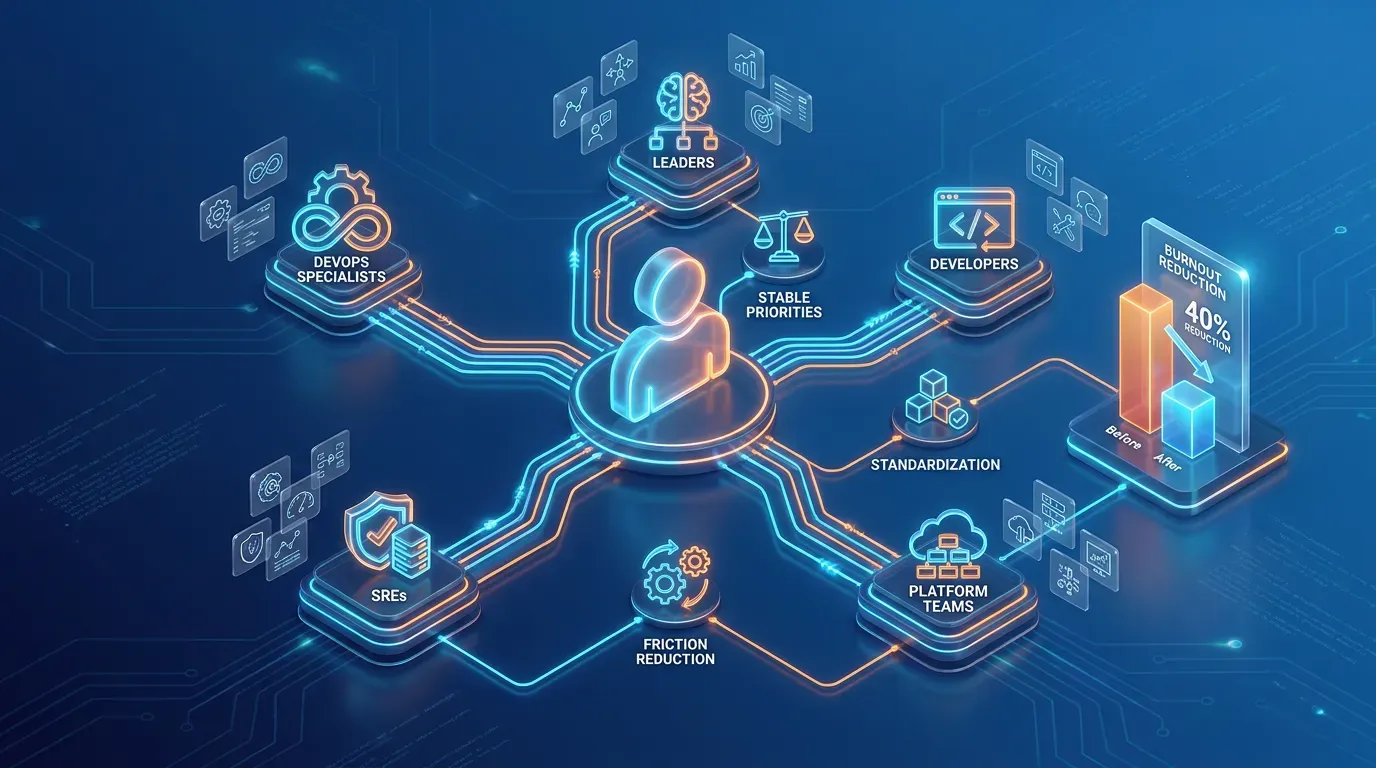
A neon-lit network diagram in a blue digital space, featuring a 3D human icon and glowing nodes for various tech roles, with a bar chart showing 40% burnout …

The human side shapes impact more than most leaders expect, because DevOps is fundamentally a coordination problem dressed up in technology. The best pipelines in the world don't help if developers route around them, and the cleanest infrastructure-as-code repository becomes useless once teams stop trusting it.

A DevOps specialist spends a surprising amount of time in conversations with backend engineers about flaky tests and with product managers about release windows; SRE alert design often requires the same kind of discussion. The technical artifacts they produce are downstream of those conversations.

Leaders evaluating candidates or services should weigh communication and influence at roughly the same level as tooling competence. A specialist who can build a pipeline but can't convince two engineering managers to adopt it produces shelfware. The role is closer to internal product management than to traditional infrastructure work, and that reframing changes hiring and measurement, with structure treated as part of the same decision.

Shared workflows reduce operational friction

DevOps specialists turn the unwritten rules into pipelines and self-service paths, with runbooks available when a developer needs a clear operating procedure, so a developer doesn't need a Slack thread to ship a change.

Friction reduction is the highest-leverage contribution of the role. Puppet's research highlighted that developer support from platform teams is critical to delivery outcomes, which lines up with what specialists see in practice. When the path of least resistance is also the correct path, teams stop negotiating every release.

Shared ownership changes how teams operate in production

This means engineers stay with their code from commit to production through on-call rotations and post-incident reviews. The specialist's job is to make that practical by providing the tooling and guardrails that let developers operate their services through clear dashboards, without needing deep infrastructure expertise.

The DORA data on transformational leadership reinforces this pattern. Teams with stable priorities and supportive leadership reported less burnout than teams with shifting priorities. Shared ownership only works when the system around it is stable enough that developers aren't punished for owning their code.

Standardization creates repeatable engineering systems

A new service inherits logging, alerting, deployment, and security policies by default, instead of relying on each team to rediscover them.

Kapil Tandon, VP of Product Management at Puppet by Perforce, noted that security is becoming a core component of platforms from the start. Standardization is what makes that possible, because security controls embedded in a template apply everywhere without manual enforcement. Without that codification, growing organizations drift into inconsistency within a year.

Strong DevOps practices improve delivery speed, reliability, and operational scale

These outcomes are what leadership actually buys when they fund the role, and they're the right yardsticks for measuring whether the investment is paying off.

The outcomes connect directly. Faster delivery without reliability is reckless. Reliability without delivery speed is a museum. Managing complexity without either is academic. The specialist's value is in advancing all three together, which is why isolated metrics can mislead. A team that doubles deployment frequency while change failure rates triple has not improved.

Leaders should expect quarterly evidence on each dimension and treat regressions as signals to investigate process.

Faster delivery comes from removing structural bottlenecks

The DORA performance clusters published by Octopus Deploy show elite teams deploying on demand with lead times under a day, while low performers wait one to six months between deployments.

That gap reflects pipeline design, with test discipline and comfort with small, frequent changes shaping the same outcome. A DevOps specialist accelerates delivery by shrinking batch sizes and removing manual approvals where automated checks already cover the risk; queue time between handoffs becomes visible too. Velocity gains follow from those structural changes.

Reliability improves through standardized operational systems

A combination of high speed and low failure rate is the hallmark of standardized practice. When every deployment runs through the same validated pipeline, with the same observability hooks and the same rollback mechanism, failures become smaller and more recoverable. Reliability stops being the result of any individual's vigilance and becomes a property of the system itself.

Platform maturity keeps complexity from overwhelming teams

Without a specialist, every new service adds a marginal cost in cognitive load. With one, new services slot into existing patterns and the cost stays roughly flat.

Recent DORA research positions platform engineering less as a productivity optimization and more as a prerequisite for scalable AI-assisted delivery, especially in organizations trying to improve developer velocity without increasing operational instability. The implication is that complexity management is a long game. Short-term throughput dips can show up while the platform is being built, but the durable operating maturity that follows is what separates companies that scale cleanly from those that grind to a halt at the next inflection point.

Organizational structure determines whether the role succeeds

The role is most effective when treated as an operating model with executive backing and clear ownership, supported by modern tooling underneath it. It's least effective when bolted onto an existing structure as a job title with no authority to change how teams work.

A specialist who reports into a single application team will optimize for that team and leave the rest of the organization unchanged. A specialist embedded in a platform group with a clear charter and access to engineering leadership will reshape how the whole company ships. The structural choice matters more than the individual's skill.

Strong outcomes usually depend on three organizational conditions:

  • Engineering leadership that treats delivery as a product

  • Application teams that own services in production

  • Tooling investments aligned with platform responsibilities

When those conditions are missing, even a strong hire stalls. The role's effectiveness is a function of the system around it.

Common misconceptions about the role

The most common misconception is that a DevOps specialist is a deployment technician who pushes releases on demand. That framing reduces the role to button-pushing and ignores the design work that makes deployments safe in the first place. A specialist who spends the day deploying for other teams becomes a bottleneck when the role should amplify delivery across teams.

Two other misreadings come up often. The first is treating the specialist as a single point of contact for every infrastructure question, which collapses the role into a help desk and crushes their capacity to do architectural work. The second is hiring a specialist as a substitute for cultural change. Tools don't fix incentives. If application teams aren't accountable for production behavior, no pipeline will close that gap.

The Spacelift 2026 DevOps statistics roundup reinforces this view by citing strong demand for DevOps engineers who combine technical depth with collaboration skills. Treat the role as part engineer, part internal product owner, and the misconceptions sort themselves out.

Build delivery maturity with ABS Technologies

If you're evaluating how to strengthen delivery performance without absorbing the full cost of building a platform team in-house, ABS Technologies provides specialist DevOps expertise integrated with cloud operations and managed services, with security built into the engagement. The work covers automated deployments, monitoring and observability setup, configuration management, and the standardization practices that make growing environments easier to operate over time.

ABS engagements are scoped around the outcomes discussed throughout this article: faster and more consistent releases and stronger uptime through disciplined incident response, with complexity kept manageable as services and teams expand. The team works alongside your existing engineers, which is what makes the technical investments stick after the engagement ends.

To discuss how a DevOps specialist engagement fits your current delivery model and where the highest-leverage improvements land, contact ABS Technologies for a scoping conversation. Bring your current deployment metrics and the operational pain points you most want to address, and the first conversation will be useful regardless of what you decide next.

Start with Linux fundamentals and Git-based development, because both sit underneath modern delivery work. After that, learn one scripting language and container basics. Choose one cloud platform next, then practice building a small pipeline that tests code and deploys an app with logs.

A DevOps specialist focuses on the delivery path from code to production, while a site reliability engineer focuses on production reliability targets. The roles overlap in monitoring and incident response. The distinction matters because DevOps work usually changes how teams ship software, while reliability work sets and protects service health goals.

A startup should hire one when releases depend on manual steps or cloud setup work blocks planned product work. The earlier warning sign is repeated incidents from the same deployment or configuration pattern. Before hiring, document release time, failure causes, and hours lost to operational work.

Yes, a DevOps specialist can work without Kubernetes. Kubernetes is a platform choice, not a requirement for DevOps practice. Managed app services or serverless platforms fit teams that need simpler operations, while Kubernetes fits teams that need tighter control over scheduling and service networking.

Small teams don't always need a full-time DevOps specialist. One engineer can own delivery standards part time when the system is simple. A full-time role makes sense once platform work delays product tasks or on-call repeats the same fixes across services. Cloud cost ownership can be added to the same charter.

Schedule a Meeting

Book a time that works best for you and let's discuss your project needs.

You Might Also Like

Discover more insights and articles

Close-up of a futuristic high-performance processor chip with glowing data pathways and illuminated circuitry representing advanced computing, AI processing, and next-generation semiconductor technology

DevSecOps in Action: Building Security into Every Line of Code

DevSecOps is the operating model that builds security checks and policy enforcement into every stage of the software delivery pipeline, with monitoring handled as part of the same release process. It makes security a shared responsibility across development and operations, supported by automation inside CI/CD so teams ship faster with lower exposure and remediation cost.

Futuristic CI/CD orchestration platform inside a high-tech data center with glowing data streams connecting servers, deployment pipelines, and DevOps monitoring systems

Dedicated DevOps Teams: The Missing Link in Cloud Success

Cloud infrastructure doesn't fail at the moment of migration. It fails six months later, when deployment pipelines diverge, incidents stack up, and no one owns the problem end to end.

Futuristic CI/CD pipeline visualization in a glowing server environment showing commit, build, test, deploy, and monitoring stages with high-speed data streams flowing through illuminated gateways

Fast CI/CD Pipeline Setup: Building for Scale and Speed

Setting up a CI/CD pipeline is straightforward. Building one that still works when your codebase has tripled and three more teams are shipping through it - that is a different problem entirely.

Futuristic visualization of an automated CI/CD deployment pipeline with glowing data streams, integration, testing, and deployment stages

Automate or Fall Behind: The Case for CI/CD Pipeline Automation

Software teams are shipping more code, to more environments, under more pressure than ever before. Yet many organizations still rely on manual steps, handoffs, and scripts held together by tribal knowledge to push releases into production. The question is no longer whether to automate CI/CD pipelines. It is why automate CI/CD pipelines now, before the cost of waiting gets any higher.