When hiring an internal team is the wrong move (and an MSP is the right one).
A strategist who only ever sells you the biggest project isn't serving you. Plenty of teams that feel this pain don't need a dedicated internal platform engineering function. But "don't build a team" isn't the same as "do nothing." For organizations in the 50–300 developer range, the honest choice usually is internal team vs. MSP.
For a small engineering org with a handful of services, a few well-made reusable pipeline templates in a shared scaffolding repository, or a bought tool that handles environment provisioning, will remove most of the pain. Developer self-service at small scale can rely on three good templates and a README.
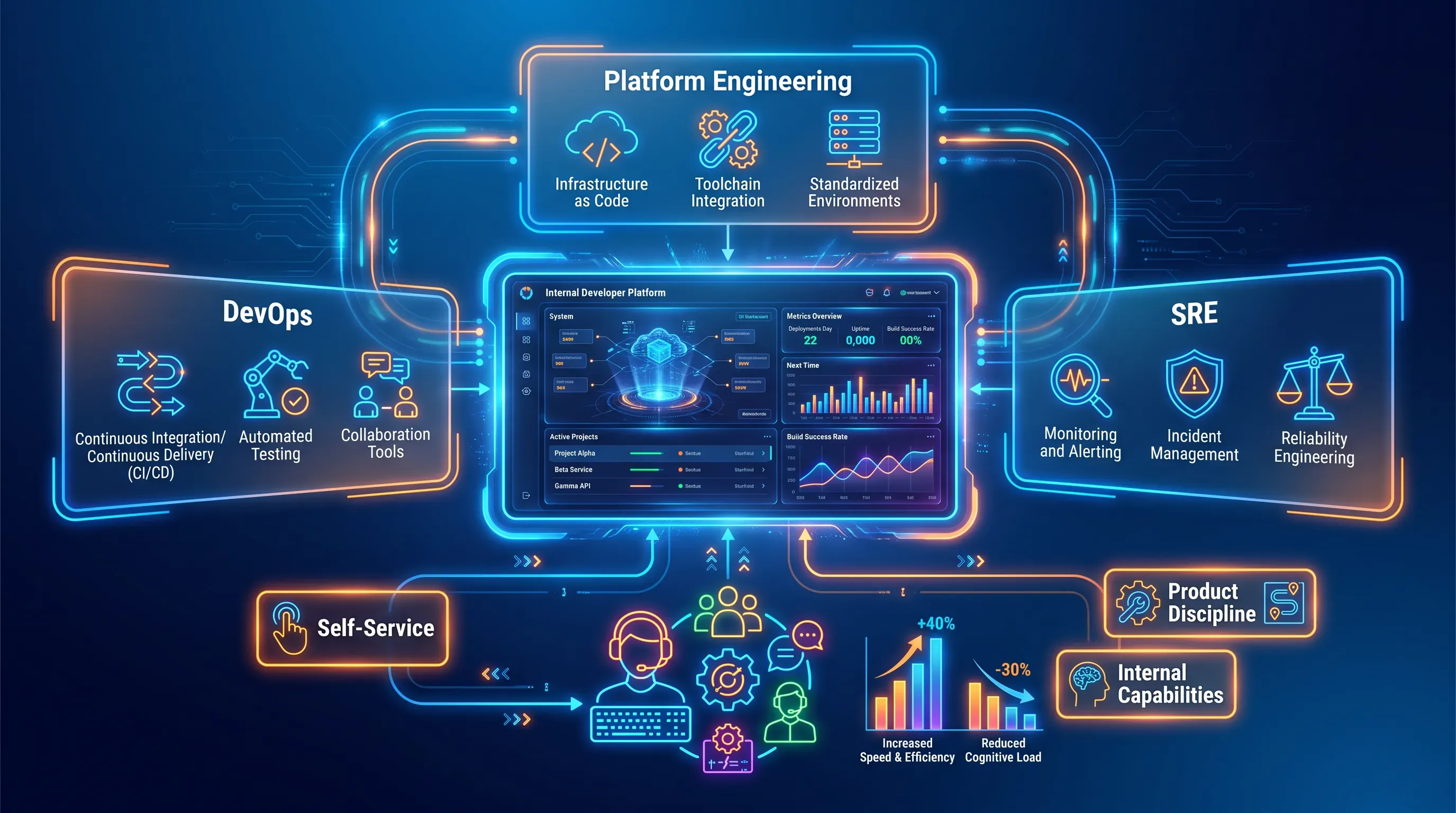
Once you're past that scale, a lightweight fix and a full internal build both stop being the right answer. This is the gap an MSP is built to close: the same golden paths, service catalog, and guardrails a dedicated internal team would build, delivered and operated by a team that already has the expertise, without you carrying the hiring, ramp-up, or Day 2 operations cost internally.
The reason to be careful about the internal build is cost structure. A real internal developer platform is a multi-month build and a permanent cost center after that, because a platform product needs ongoing ownership. The pain has to justify that standing commitment.
A useful gut check before you commit to any path:
-
Do the same infrastructure requests repeat often enough that automating them saves real, recurring hours?
-
Would targeted automation or an off-the-shelf tool solve 80% of the problem for a fraction of the cost?
-
Is the friction spread across enough teams that a shared solution beats each team fixing it locally?
-
Is the gap between "templates aren't enough" and "we can staff a 5-person platform team" where you actually are? If so, that's the MSP-sized problem.
If the honest answers point to a lightweight fix, take the lightweight fix. If they point to the middle ground, an MSP is usually the faster, cheaper route to the same outcome as a full internal build.
Anti-patterns that sink platform engineering
The failure modes here are well documented, and they repeat because the underlying mistake repeats. Learn to recognize them because you'll be overseeing this effort.
The first is the ivory tower platform. DORA calls the related trap "build it, and they will come," where a team builds on assumptions without user research and produces an elegant thing nobody adopts. Developers hit a tool that adds friction, and they route around it with workarounds and shadow IT, which defeats the standardization the platform was meant to deliver.
The second is treating the portal as if it were the platform. The portal is the front door. If you polish the interface while the capabilities behind it are thin, you get a pretty catalog of stale data. Spotify's own VP of Engineering noted that while Backstage adoption is high internally, it often stalls in other organizations, because the fundamentals underneath were never solved.
The third is mandate-driven adoption. Forcing teams onto the platform by decree produces resistance and resentment, which undermines use. The State of Platform Engineering report found that 36.6% of adoption remains mandate-driven, a sign many teams never escaped this trap. Adoption has to be earned through usefulness.
The fourth is underinvesting in the boring essentials: ownership and documentation. It also underinvests in support. The common thread across all four is the same failure. Someone skipped the developer research and forgot the platform is a product with users who get to decide whether it lives.
The fifth is the DIY trap. Teams sink 12 months building a custom internal developer portal from scratch. It leaves the team owning the maintenance of a bespoke portal indefinitely, on top of everything else on this list. Leveraging a proven framework gets the same capability in weeks instead of a year, without inheriting a second unmaintained system.
A minimum viable platform engineering rollout
Start small, because a thin but usable platform can ship in weeks while a full one takes many months. The State of Platform Engineering Report Vol. 4 found that 35.2% of teams deliver measurable value within the first six months, and the teams that do use an iterative minimum viable platform approach.
Lead with research. Shadow and interview your developers to identify the single highest-friction path they walk every day. Then build one excellent golden path for that path and nothing else yet. Ship it, then use adoption to determine whether that first path has earned its keep.
The build-versus-buy decision belongs here, and it comes down to a few honest questions:
-
How mature is the team you'd put on this, and can they own a bought tool as readily as a built one?
-
How genuinely unique are your requirements, or are they the same needs a commercial internal developer platform already covers?
-
What is the true maintenance cost of building, carried for years, against the license cost of buying?
-
Which route gets a working golden path in front of developers faster?
Whatever you decide, name a platform product owner from day one and treat the platform as a product. The State of Platform Engineering report is explicit that the most successful enterprises have a dedicated Platform Product Manager with full-time attention. Without an owner accountable for adoption and developer self-service, the effort drifts back into an internal tools project that quietly stalls.
Metrics that prove it worked
You'll need numbers to justify continued investment to your own leadership, and the good ones map straight back to the friction you started with. The DORA metrics are the industry standard, and platform engineering moves them. DORA's research found that elite teams deploy far more often than low performers while maintaining lower change failure rates, which broke the old assumption that speed and stability trade off against each other.
Track these outcome measures together:
The telltale sign of a platform quietly failing is a healthy-looking catalog with a low adoption rate. If engineers are routing around the golden paths, the DORA numbers won't move no matter how polished the portal looks. Watch adoption and satisfaction as closely as delivery speed, because a platform nobody uses fails silently.
Deciding your next move on platform engineering
You now have enough to decide. Assess whether your delivery is stable enough to support a discovery effort. If your foundations are still shaky, defer and fix delivery first. And if the pain is real but small, solve it with targeted automation instead of a permanent team. Use the anti-patterns as a final gut check: start with research and earn adoption. Give the platform a real owner.
ABS Technologies runs platform discovery and builds cloud and DevOps guardrails beneath your internal developer platform, including security controls. Book a free platform engineering consultation with ABS to map your highest-friction path and a sensible first golden path.