Overview
This article explains what defines a high-performance DevOps system design. It presents DevOps as a system-level discipline where architecture, automation, observability, and continuous improvement operate as a unified model and shows what breaks when they don't.
You will learn how strong DevOps design enables faster delivery without sacrificing stability, how modern teams balance autonomy with governance, and why visibility and feedback loops are critical to long-term performance. The article also highlights common design failures, from poorly governed automation to fragmented observability, and explains how high-performing organizations avoid them. By the end, you will have a clear framework for evaluating your current DevOps setup and identifying the structural gaps that limit speed, reliability, and scalability.
Architecture That Supports Flexibility and Resilience
A great system DevOps design starts with how you structure the systems themselves. If your architecture is rigid or tightly coupled, no amount of automation will compensate. The foundation has to support independent movement.
This means designing services as self-contained components. When teams can deploy, test, and scale their services without triggering failures elsewhere, speed and safety coexist. Designing services with self-contained components enables decoupled infrastructure and high team-level autonomy, allowing different teams to deploy at different speeds without system-wide risk.
Key architectural traits of a strong DevOps framework include:
-
Loosely coupled services that can be updated independently
-
Infrastructure defined as code, so environments are reproducible and auditable
-
Clear service boundaries that reduce unintended side effects during deployments
-
Scalable resource allocation that adjusts to demand without manual intervention
What teams typically underestimate here is the governance overhead. Loosely coupled services multiply the number of machine identities, API keys, and service accounts in your environment. Without centralized identity governance, you trade deployment coupling for a sprawling, ungovernable attack surface. Platform engineering teams increasingly own this problem, maintaining internal developer platforms with golden paths that encode both architectural standards and security policy into every new service from the start.
The trade-off is real: you gain deployment independence but give up the simplicity of a monolithic release process. Teams must now own their own service health, which requires investment in observability tooling and on-call maturity that many organizations aren't prepared for.
To avoid costly architectural mistakes and discover how resilient DevOps teams approach distributed, modern environments, see Cloud Architecture Design: Building Scalable and Secure Cloud Architectures.
Architecture in Practice: How Structural DevOps Changes Deliver Measurable Results
Nationwide, the financial services company, redesigned its DevOps architecture and achieved a 70% reduction in system downtime and 50% improvement in code quality. Those gains came from rethinking how systems were structured and how teams interacted with them, not from swapping one CI server for another.
This kind of architectural discipline sets the stage for the next critical element: consistent, reliable automation.
Automation That Reduces Friction and Improves Consistency

Architecture provides the structure. Automation makes that structure operational. In a great DevOps design, automation isn't about speeding things up. It's about removing inconsistency, reducing human error, and making repeatable processes truly repeatable.
The most impactful automation targets the steps teams perform most often: code integration, testing, environment setup, and deployment. Continuous Integration involves merging code with the larger code base frequently, often many times a day, with automatic testing each time. This practice catches problems early and keeps the codebase healthy.
Equally important is standardization. Standardizing tools, processes, and practices across teams reduces errors, improves knowledge sharing, and is a prerequisite for automation. Without it, automation fragments. Each team builds its own scripts and workflows that no one else can maintain.
A well-designed automation layer typically includes:
-
CI/CD pipelines running on every commit, with automated build, test, and deploy stages
-
Automated provisioning of infrastructure and test environments
-
Policy-as-code guardrails that enforce security and compliance standards without slowing releases
-
Self-service capabilities that let developers deploy without filing tickets
To see how automation, Infrastructure as Code, and real-time metrics enable frictionless, high-speed delivery, explore Tech-Driven DevOps: How Automation is Changing Deployment.
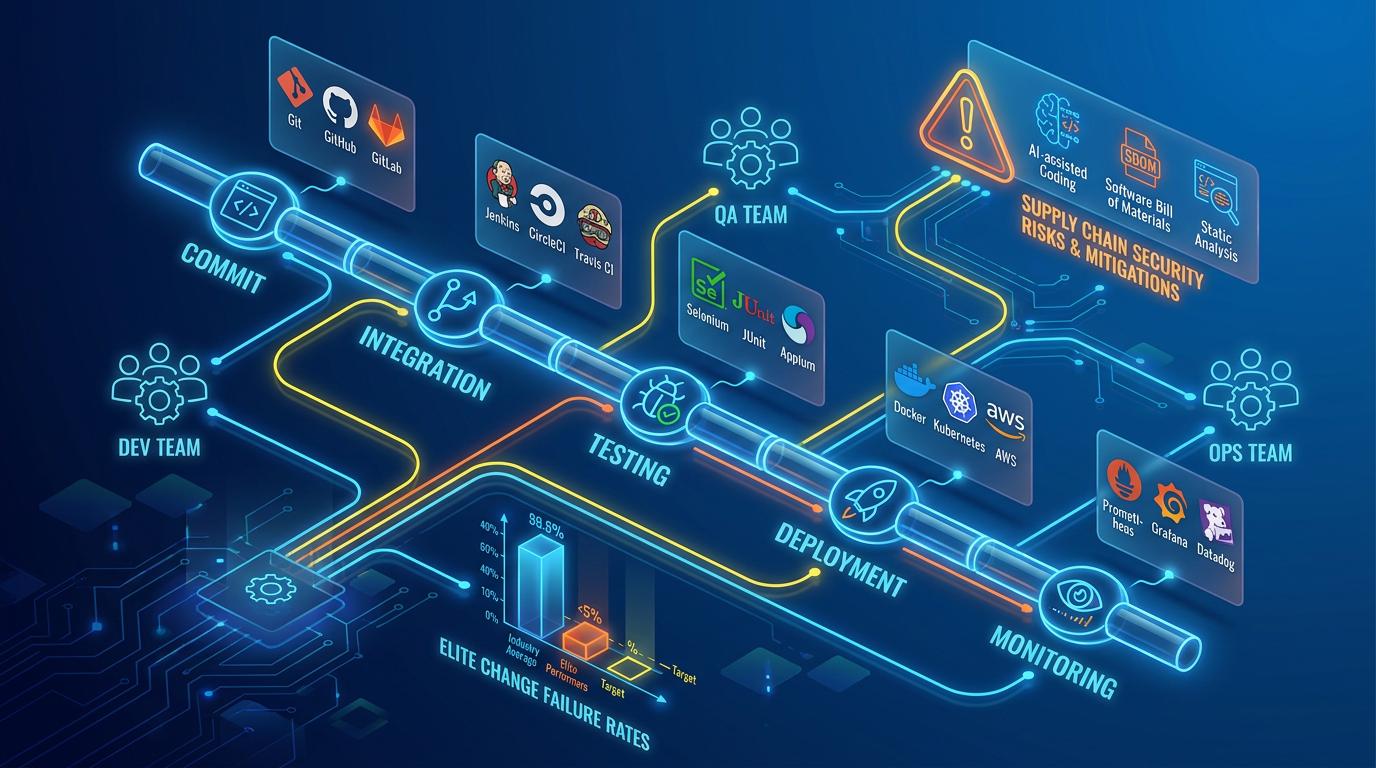
But here's what commonly goes wrong: automation without guardrails creates automated failures. A misconfigured Terraform module that passes CI will cheerfully destroy a production database. Mature teams build explicit rollback triggers, drift detection, and blast-radius controls into their pipelines. They define policy-as-code rules that block destructive changes before they execute, not after. The metric to watch is change failure rate. DORA research targets a rate below 15% for elite performers. If your automated pipelines are failing more than that, you don't have an automation problem. You have a guardrails problem.
Supply Chain Security in the Pipeline
Automation also introduces supply chain risk that most teams overlook until it bites them. Every dependency pulled during a build is a trust decision. Generating and validating a Software Bill of Materials (SBOM) at build time should be a pipeline stage, not an afterthought. This is especially urgent now that AI-assisted coding tools generate code that pulls in dependencies developers never explicitly chose. LLM-generated code needs its own scanning layer: static analysis tuned for the patterns that language models produce, including outdated libraries, hallucinated package names, and insecure defaults.
For an in-depth look at CI/CD pipelines, test automation, release strategies, and how these reduce risk throughout modern delivery, see CI/CD Automation: How CI/CD Pipeline Automation Powers Modern Software Delivery.
Monitoring and Observability That Drive Confident Decisions
A great DevOps framework doesn't just deploy fast. It sees fast. Observability, the ability to understand a system's internal state from its outputs, gives teams the visibility needed to maintain performance and respond to issues before they escalate.
This goes well beyond uptime dashboards. Strong observability combines:
-
Distributed tracing across services to pinpoint where failures or slowdowns originate
-
Real-time log aggregation that surfaces patterns and anomalies
-
Performance metrics tied to business outcomes, not just server health
-
Alerting systems that reduce noise and highlight what actually needs attention
For practical, comprehensive insight into building full-stack observability, managing telemetry costs, and aligning monitoring with DevOps success, see CI/CD Monitoring: Continuous Monitoring for Performance, Security, and Compliance.
When extending the DevOps model to integrate application development, operations, and IT infrastructure, organizations have seen a 25-30% increase in capacity and greater than 50% reduction in failure rates. A significant portion of those gains comes from better visibility into what's happening across the stack.
The hard part in 2025 isn't collecting telemetry it's managing cost and extracting signal from noise. Telemetry governance means deciding what to collect, what to sample, and what to drop. The shift is from "instrument everything" to "instrument what matters for decisions." Teams that skip this step watch their observability bills grow 30-40% year over year with no corresponding improvement in incident response. RASP adds a production-layer safety net: pre-deploy scanning catches known vulnerabilities, but RASP detects and blocks attacks at runtime, where static analysis can't reach.
How Observability Reduces Costs and Improves System Efficiency
Organizations that combine DevOps with standardized and fully virtualized infrastructure have seen IT costs drop by as much as 25%. Much of this savings comes from eliminating redundant monitoring tools, reducing incident response times (MTTR under four hours is the target for elite teams, per DORA benchmarks), and catching performance issues earlier in the pipeline.
Monitoring isn't the final step. It's the input for something more important: the ability to learn and improve.
Continuous Improvement as a System Design Principle
What truly separates high-performing DevOps environments from the rest is their relationship with change. Great system DevOps design treats every deployment, incident, and performance signal as an opportunity to refine the system itself.
This means building feedback loops directly into the workflow:
-
Post-incident reviews that identify root causes and produce actionable improvements
-
Deployment metrics that track lead time, change failure rate, and recovery speed
-
Regular retrospectives where teams adjust processes based on real data, not assumptions
At scale, this kind of learning culture compounds. DevOps at scale has helped companies reduce software defects by up to 70% and release new code 100 to 200 times more frequently. Those numbers reflect organizations that built systems designed to get better over time, not organizations that set up pipelines and walked away.
Modern platform engineering makes these feedback loops practical. For a look at how platform teams create golden paths and centralize guardrails to enable team-level accountability in DevOps, explore From Pipelines to Platforms: How Cloud Fuels DevOps Innovation.
The ownership shift is the part that catches organizations off guard. Continuous improvement only works when teams own their own metrics. If a central DevOps team is responsible for everyone's deployment frequency and change failure rate, you've recreated the old ops bottleneck with a new title. The mature model is a platform engineering team that provides the tooling and golden paths, while product teams own their own delivery performance. This requires clear accountability boundaries and a willingness to let teams make (and learn from) their own mistakes.
What You Gain and What You Give Up
Once you build a system that surfaces problems in real time, you're committing to fixing them in real time. Teams that aren't staffed for that responsiveness will experience continuous improvement as continuous pressure. Budget for it explicitly, or don't start.
What makes a great system DevOps design? It is a structured approach where architecture, automation, monitoring, and continuous improvement work together as a unified system, enabling faster releases, more stable operations, better team collaboration, and sustained performance at scale.
Conclusion
High-performance DevOps is achieved by designing a system where architecture, automation, observability, and ownership reinforce each other at every stage of delivery. Organizations that get this right don’t just move faster. They reduce failure rates, control costs, and create environments where teams can ship confidently without introducing systemic risk. More importantly, they build systems that improve over time, where every deployment, incident, and metric becomes input for better decisions.
The gap between average and high-performing DevOps environments is rarely technical. It is structural. It comes down to how well the system is designed, how clearly ownership is defined, and how consistently feedback is turned into action.
In the end, a great DevOps framework is not about speed alone. It is about building a delivery system that scales with the business, adapts under pressure, and continues to perform as complexity grows.