CI/CD pipeline visualization showing automated build, test, and deployment workflow across cloud infrastructure and DevOps environments.

From Pipelines to Platforms: How Cloud Fuels DevOps Innovation

Software teams everywhere face the same pressure: ship faster, break less, and scale without burning out. Yet many organizations still wrestle with slow release cycles, fragile environments, and a gap between what development builds and what operations can reliably run. The question at the center of this tension is not whether cloud helps - it does. The real question is how: cloud does not automatically create DevOps maturity; it removes infrastructure friction so that teams can build the practices that do.

Content authorBy Irina BaghdyanPublished onReading time10 min read

What This Article Covers

This article explores how cloud infrastructure removes delivery bottlenecks - from provisioning and CI/CD to observability and team collaboration - and what it takes to make those gains stick.

Why Traditional Infrastructure Slows DevOps Down

Before we can appreciate what cloud brings to DevOps, it helps to understand the friction it replaces. In a traditional on-premises setup, requesting a new server or test environment can take days or even weeks. Procurement, rack-and-stack, OS configuration, networking, these steps add up. Every delay in getting a working environment means a delay in writing, testing, or releasing code.

This bottleneck creates a ripple effect across the entire delivery workflow:

  • Developers wait for environments, so they batch more changes into fewer releases.

  • Fewer, larger releases carry more risk and require more manual testing.

  • Operations teams spend most of their time on maintenance instead of improving reliability.

The result is a cycle where slow infrastructure breeds slow software delivery, which breeds organizational frustration. Cloud computing breaks this cycle by making infrastructure programmable, disposable, and available on demand.

Faster Provisioning Unlocks Faster Delivery

A large European bank found itself trapped in exactly this pattern. Updates to its online banking application moved slowly through layers of manual provisioning and approval. After adopting DevOps practices on cloud infrastructure, the bank reported efficiency improvements of up to 25% in developing those same updates. The environment that once took weeks to prepare could now be spun up in minutes, letting developers iterate far more quickly.

That speed advantage is just the starting point. Once the infrastructure barrier falls, teams can redesign how they build, test, and release software.

How Cloud Changes Provisioning, CI/CD, and Environment Consistency

Continuous integration and continuous delivery (CI/CD) is the backbone of modern DevOps: developers merge code frequently, automated builds and tests run on every commit, and CD extends that automation all the way to production. Cloud makes this practical at scale through ephemeral environments and immutable infrastructure - build servers and test environments spin up on demand, are never modified in place, and disappear when done. The result is not just speed, but deployment consistency and release reliability: every environment behaves the same way, every time.

Key ways cloud strengthens CI/CD:

  • Parallel testing: Cloud lets you spin up dozens of test environments simultaneously, cutting test suite run times from hours to minutes.

  • Consistent environments: Infrastructure-as-code tools ensure that every environment, whether for development, staging, or production, is identical, eliminating the classic "it works on my machine" problem.

  • Faster feedback loops: When builds and tests complete in minutes instead of hours, developers catch bugs earlier and fix them while the context is still fresh.

Many organizations see materially shorter cycle times and more reliable deployments when cloud provisioning and CI/CD automation are designed together - features that once took months to reach users start shipping in days.

For a deeper dive into building automated cloud pipelines, best practices, and hybrid DevOps workflows, see Tech-Driven DevOps: How Automation is Changing Deployment.

One mid-sized SaaS company, previously deploying monthly, moved to daily releases after migrating its pipelines to cloud. Each deployment was smaller and faster to roll back - reducing not just cycle time but the risk embedded in every release. That kind of continuous delivery only works, though, if teams can see what is happening across their systems.

Why Observability Is Required for Safe Speed

Shipping code faster is only valuable if you can detect problems just as fast. Observability - the ability to understand the internal state of a system through its outputs like logs, metrics, and traces - is not just a monitoring tool. It is operational feedback for engineering decisions. Teams use it to track the DevOps KPIs that matter most: deployment frequency, change failure rate, MTTR, and service reliability. Observability does not just help teams detect outages; it helps them understand whether their delivery model is improving reliability or silently increasing risk.

Most major cloud providers offer built-in monitoring, logging, and alerting services that integrate directly with the infrastructure your applications run on. Instead of stitching together a patchwork of self-hosted monitoring tools, teams get a unified view of performance, errors, and resource usage from day one.

This matters because:

  • Faster incident response: When an alert fires, engineers can trace the issue across services using centralized dashboards, cutting mean time to resolution.

  • Data-driven decisions: Real-time metrics on deployment frequency, failure rates, and recovery times help teams measure their DevOps maturity with precision.

  • Proactive capacity planning: Cloud monitoring tools can flag trends, like steadily rising memory usage, before they become outages.

For comprehensive guidance on full-stack observability, monitoring best practices, and aligning monitoring with operational outcomes, check out CI/CD Monitoring: Continuous Monitoring for Performance, Security, and Compliance.

Cloud-native observability strengthens SRE and DevOps by giving teams continuous visibility into application and infrastructure health. AWS describes observability as the ability to collect, correlate, aggregate, and analyze telemetry across networks, infrastructure, and applications, while Microsoft’s Azure Well-Architected Framework treats monitoring and alerting as a core part of reliability design. In practice, that visibility helps teams detect issues earlier, respond faster, and operate cloud environments with greater confidence.

Nationwide, a UK financial services company, saw a 70% reduction in system downtime and a 50% improvement in code quality after investing in DevOps monitoring. Better observability gave their teams the confidence to ship more often - and it reshaped how development and operations worked together, which is the cultural shift at the heart of DevOps.

Why Shared Platforms Improve Engineering Flow
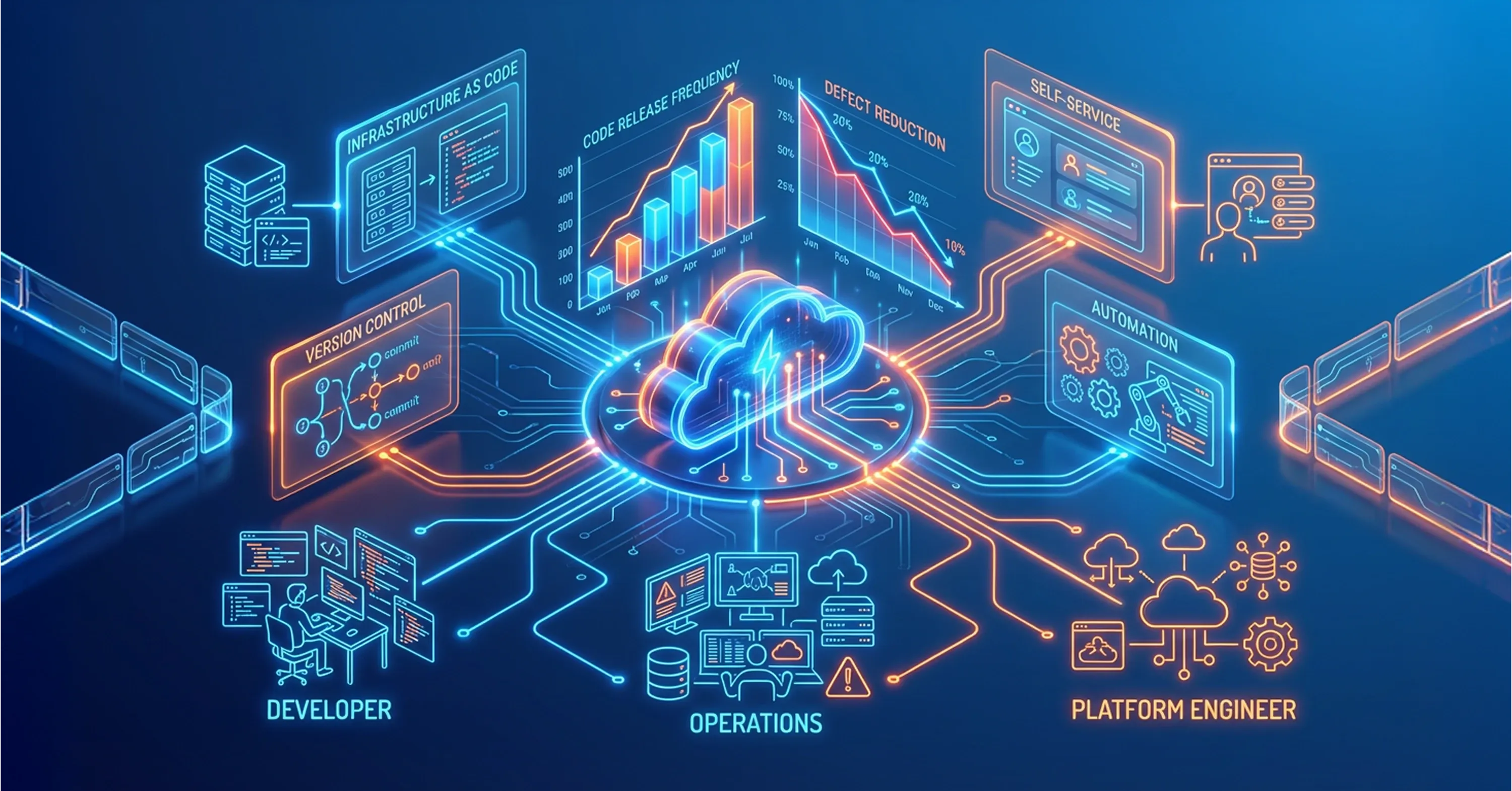
Cloud DevOps platform engineering diagram showing CI/CD, infrastructure as code, automation, version control, and operations connected through a centralized cloud system.

DevOps has always been about collaboration as much as automation. The "Dev" and "Ops" in the name point to a cultural shift: developers and operations engineers sharing responsibility for the full lifecycle of a service, from code commit to production reliability. Cloud platforms support this by giving both sides a shared workspace.

Shared cloud platforms make collaboration concrete through a few key mechanisms. Infrastructure defined in code lives in the same version control systems developers already use - a platform engineer reviews an infrastructure change in the same pull request workflow used for application code. Shared pipelines give both sides visibility into every build, test, and deployment. Self-service environments let developers provision a database or configure a load balancer through a portal or API call, without filing a ticket. Pre-approved templates and platform guardrails keep those requests within safe boundaries - operations sets the rules, developers move freely within them.

To see real-world approaches for breaking down barriers and streamlining delivery, explore Tech DevOps: The Core Engine Behind Agile Businesses.

For organizations managing complex multi-cloud or hybrid environments, working with a managed IT services provider can simplify governance and ensure that cloud resources are configured securely and consistently, freeing internal teams to focus on delivery rather than infrastructure overhead.

At scale, DevOps on shared cloud platforms has helped organizations release 100–200 times more frequently while cutting defects by up to 70% - results that only come when development and operations share tooling, guardrails, and accountability. Even so, fast pipelines and good collaboration tools are not enough on their own. Those capabilities need structure behind them.

What Cloud Does Not Solve by Itself

It is tempting to treat cloud adoption as a silver bullet for DevOps maturity. But cloud is an enabler, not a replacement for good engineering culture. Without clear ownership, governance, and disciplined processes, cloud environments can become sprawling, expensive, and difficult to secure.

Governance, Ownership, and Platform Discipline

Teams that succeed with cloud-powered DevOps typically share a few traits:

  • Clear service ownership: Every service has a defined team responsible for its development, deployment, and reliability. No orphaned microservices drifting without accountability.

  • Cost governance: Cloud's pay-as-you-go model can spiral without budget awareness. Organizations that combine DevOps with standardized cloud infrastructure have seen IT costs drop by as much as 25%, but that requires active cost monitoring and right-sizing of resources.

  • Security built in: DevSecOps, integrating security checks into CI/CD pipelines, ensures that speed does not come at the expense of safety.

  • Process maturity: Automated pipelines need well-defined workflows behind them. Who approves a production deploy? What triggers a rollback? These questions need clear answers.

For proven cost management, governance, and DevSecOps strategies, see Balancing Cloud Computing and Cloud Security: Best Practices.

Cloud gives you the raw capability: on-demand infrastructure, scalable compute, integrated tooling. DevOps provides the methodology: automation, continuous delivery, shared responsibility. Neither delivers its full potential without the other.

Strategic Maturity

Cloud tools and DevOps practices only deliver lasting value when teams treat them as part of a broader maturity journey. Early gains come from automation and faster pipelines. Sustained gains come from building the organizational muscle to run, improve, and govern those systems over time. Teams that track DevOps metrics - deployment frequency, change failure rate, mean time to recovery - and act on them consistently are the ones that compound their early wins into long-term delivery advantage.

Actionability

For teams looking to move forward: start by identifying the biggest bottleneck in your current delivery process. If provisioning slows you down, invest in infrastructure-as-code and cloud environments first. If releases are infrequent and risky, prioritize CI/CD pipeline automation. If incidents take too long to detect and resolve, build observability before adding new features. Each improvement creates the foundation for the next. No organization needs to do everything at once - the goal is a clear direction and consistent forward motion.

Ready to Modernize Your Delivery Pipeline?

ABS Technologies helps engineering teams design and implement cloud-based DevOps workflows - from CI/CD automation and infrastructure-as-code to observability and platform governance. If you are evaluating cloud migration, assessing your current pipeline maturity, or preparing for a DevOps transformation, get in touch for a practical readiness review and a clear next step.

Conclusion

The path from traditional pipelines to modern delivery platforms runs through the cloud. Programmable infrastructure, automated CI/CD, real-time observability, and shared platforms give development and operations teams the speed and visibility they need to ship reliably at scale.

But cloud is a foundation, not a finish line. The organizations that see lasting gains are the ones that pair cloud capabilities with clear ownership, disciplined processes, and active governance. The cloud gives your teams the room to innovate — what they build in that room depends on the culture and structure you put around it.


Cloud empowers DevOps innovation by making infrastructure available on demand, removing the delays that slow down development and release cycles. Teams can spin up environments instantly, automate testing and deployment through CI/CD pipelines, and monitor production systems in real time. This reduces manual overhead, shortens feedback loops, and allows organizations to release software more frequently with fewer defects.

DevOps practices like automation, continuous integration, and shared ownership can be implemented on-premises. However, cloud significantly accelerates and simplifies adoption. On-demand provisioning, elastic scaling, and built-in monitoring services remove infrastructure friction that often limits how fast teams can iterate. Most organizations find that cloud is the most practical path to DevOps at scale.

The biggest risk is uncontrolled sprawl: rising costs, inconsistent environments, and security gaps. Without clear ownership of services, defined budgets for cloud resources, and security checks built into pipelines, teams may ship faster but introduce technical debt and vulnerabilities that are expensive to fix later.

Traditional monitoring typically relies on self-hosted tools that track predefined metrics like CPU and memory usage. Cloud-native observability goes further by integrating logs, metrics, and distributed traces into a unified platform. This gives teams a more complete view of system behavior, making it easier to diagnose issues across complex, distributed architectures.

A managed IT services provider helps organizations design, secure, and maintain their cloud environments so internal teams can focus on software delivery. This includes setting up governance frameworks, ensuring compliance, managing multi-cloud complexity, and providing expertise that may not exist in-house, particularly for organizations early in their cloud and DevOps journey.

Schedule a Meeting

Book a time that works best for you and let's discuss your project needs.

You Might Also Like

Discover more insights and articles

Futuristic cloud computing system visualized above a data center with CI/CD pipeline, data flows, and network infrastructure.

Cloud Computing + Cyber Resilience: The Ultimate Duo

When disruption hits, the real question is not whether an attack or outage will happen, but whether your organization can keep operating through it. That is where cyber resilience and cloud computing intersect: modern organizations depend on cloud infrastructure to absorb incidents, recover faster, and reduce operational impact - through redundancy, automated failover, backup isolation, and operational discipline built into the environment from the start.

Visual of legacy server infrastructure transforming into cloud computing environment, illustrating cloud migration, elastic scaling, and digital transformation with network and compute resources.

From Legacy to Cloud: The Shift to On-Cloud Operations

Most organizations know they need the cloud. The real challenge is turning that move into faster, more resilient, and more efficient operations. On-cloud solutions do more than replace legacy infrastructure. They change how teams provision, scale, monitor, and manage services day to day. This article explores what that operational shift looks like in practice, and why migration alone is not enough to deliver better outcomes.

Futuristic digital tunnel representing AI development pipeline with build and deploy stages in automation workflow.

Modern DevOps Meets the Cloud: A New Way to Build and Deploy

Today, cloud strategy is no longer a one-time infrastructure decision - it is a continuous delivery challenge. When a single provider cannot meet every operational need, deployment speed, reliability, and cost all suffer.

Futuristic circuit board illustrating CI/CD pipeline with agile triggers and DevOps automation processes

DevOps: The Core Engine Behind Agile Businesses

Many organizations adopt agile expecting faster delivery, but the actual pace of release often barely improves. Teams add standups, sprints, and new structures, yet software still takes too long to reach production. That usually happens because the planning model changes, but the delivery model does not.