A glowing neon infinity symbol represents the DevOps cycle, surrounded by futuristic digital elements in a high-tech blue server-room environment.

Tech-Driven DevOps: How Automation is Changing Deployment

Short release cycles promise faster value, but manual hand-offs still create risky delays. This article shows how an automation-first DevOps approach streamlines cloud pipelines end to end - and which tools bring the biggest gains.

Content authorBy Irina BaghdyanPublished onReading time7 min read

From Continuous Delivery Ideal to Automation Reality

Modern DevOps culture pushes for continuous delivery, but most organisations still juggle manual steps. According to the CD Foundation, 83% of developers already touch DevOps work State of CI/CD 2024. Toolchains are growing, environments are multiplying, and AI workloads are piling on top. Automation is the only viable way to scale.

Here is what you will learn next:

  • Why cloud pipelines and infrastructure automation matter to CEOs and founders
  • Concrete examples of tool stacks that shrink release times and error counts
  • How hybrid cloud, AI, and security trends shape tomorrow’s DevOps road map

By the end, you will know where to focus your next technology investments.

Why CEOs Care: Business Impact of Tech-Driven DevOps

Automation used to be an ops headache. Today it is a boardroom metric. Faster deployments mean quicker feedback loops, smaller opportunity costs, and happier customers.

  • Shorter cycle times: Elite DevOps teams deploy multiple times per day. Automation shaves hours of waiting per iteration.
  • Fewer outages: Consistent environments and automated rollbacks slash the blast radius of bad releases.
  • Lower cost per feature: Infrastructure as code (IaC) treats servers like software, reducing provisioning overhead.
  • Better talent leverage: Engineers spend time building features, not clicking through approvals.

IDC reports that cloud infrastructure spending jumped 61.5 % YoY to $42.9 B in Q2 2024 IDC Enterprise Infrastructure Tracker. Money follows value, and DevOps automation is the bridge.

Leading organisations often bring in a partner, such as a leading provider of managed IT services, to integrate tooling, manage cloud costs, and harden security while internal teams focus on product innovation. For an overview of how these strategies are implemented in practice, see Managed IT Services.

Building Blocks of an Automated Cloud Pipeline

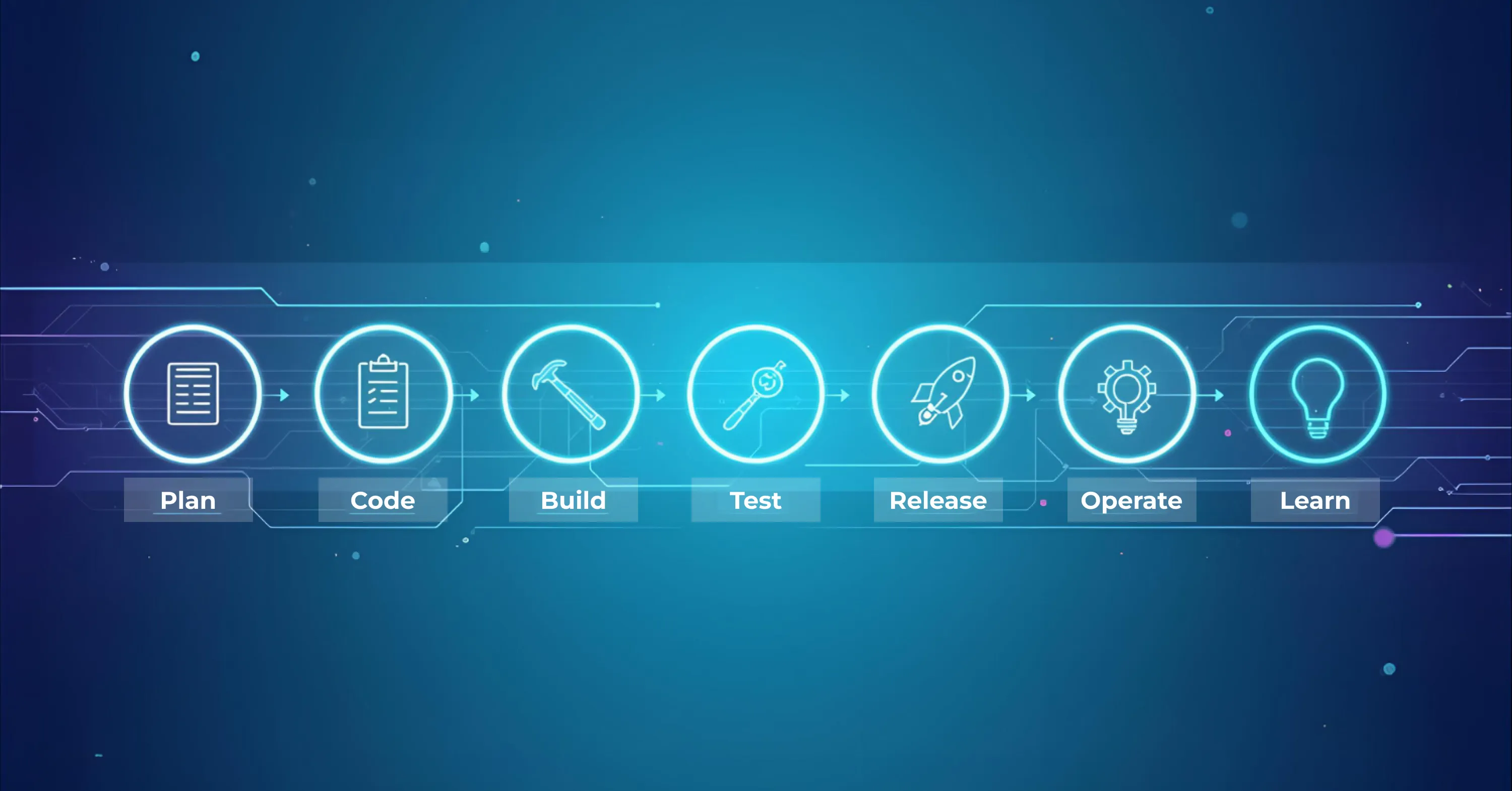
A glowing futuristic DevOps workflow diagram shows the stages Plan, Code, Build, Release, Operate, and Learn connected in a horizontal neon line.

Every automated pipeline follows the same high-level flow: plan, code, build, test, release, operate, learn. The devil is in the details, especially across hybrid estates.

1. Source Control and Issue Tracking

Version control is table stakes, but the integration layer makes or breaks traceability.

  • GitHub, GitLab, or Bitbucket with pull-request policies
  • Jira or Azure Boards auto-linked to commits
  • ChatOps bots surfacing status inside Slack or Teams

Tie code to business outcomes up front and the rest of the pipeline inherits that clarity.

2. Continuous Integration Engines

CI servers compile, scan, and unit-test each commit.

  • Jenkins: open and extensible, ideal for custom plugins
  • GitLab CI: integrated SCM, CI, and security scanning
  • CircleCI: cloud-native elasticity for spike workloads

Adopt containerised build agents to keep runtimes consistent and avoid the dreaded “works on my machine” syndrome.

3. Artifact Management

A central repository prevents “jar-file roulette” across teams.

  • Docker Hub or Amazon ECR for images
  • JFrog Artifactory or GitHub Packages for language-specific builds

Automate retention policies so stale images do not bloat storage bills.

4. Infrastructure Automation Layer

This is where tech devops shines. Declarative IaC plus orchestration brings environments up in minutes.

  • Terraform or Pulumi provision AWS, Azure, GCP, and on-prem VMs in one plan
  • Ansible or SaltStack configure OS-level settings, firewalls, and middleware
  • Kubernetes manifests or Helm charts spin up microservices anywhere

Stonebranch found 77% of enterprises now run hybrid estates spanning cloud, on-premises, containers, and even mainframes Global State of IT Automation 2025. Cross-platform orchestration is no longer optional. Explore more about scaling hybrid and multi-cloud environments with the step-by-step insights in Cloud Services and DevOps from ABS.

5. Continuous Delivery & Deployment

Deploy code automatically once tests pass, with guardrails for higher environments.

  • Spinnaker or Argo CD for progressive delivery (blue-green, canary)
  • GitOps model: desired state lives in Git, agents reconcile it
  • Policy-as-code gates via Open Policy Agent ensure compliance

Stonebranch also reports that 94% plan to automate human approvals via workload automation in the next year, underscoring the shift away from email-based sign-offs.

For practical guidance on building robust automation layers and the business case for managed pipelines, refer to ABS’s Cloud Services and DevOps overview.

6. Observability & Feedback

Automation is incomplete without data loops.

  • Prometheus or Datadog metrics feed dashboards
  • OpenTelemetry traces map request paths across services
  • PagerDuty or Opsgenie route alerts to the right team, with auto-generated runbooks

Close the loop by pushing incident data back into retrospectives and Jira tickets.

Each layer on its own saves minutes. Together they cut days off release timelines.

Integrating Security and Compliance Without Slowing Down

Security teams fear speed, but automated DevSecOps flips that narrative.

  • Static Application Security Testing (SAST) kicks off during CI, blocking high-severity flaws.
  • Dynamic testing and container scans run on ephemeral test environments, then teardown.
  • Secret-scanning bots prevent hard-coded keys from ever hitting Git.

GitLab’s 2024 survey shows 78% of DevSecOps pros already use or plan to use AI to further automate code review and remediation suggestions Global DevSecOps 2024.

When controls are codified, compliance becomes a settings file, not a month-end scramble. To see how to embed robust security from day one, check out Information Security.

Multicloud and Hybrid Complexity: Orchestrating the Moving Parts

IDC notes that 88% of cloud buyers run hybrid strategies and 79% use multiple providers Ten Trends That Shaped the Cloud Market 2024. Reasons range from data residency laws to price arbitrage.

Here is how tech-driven DevOps teams tame the sprawl:

  • Abstract providers with Terraform modules or Crossplane composites
  • Central schedulers like Stonebranch, Control-M, or Azure Automation drive workflows across on-premises and cloud
  • Unified logs via OpenTelemetry pipelines feeding a single data lake
  • Cost tagging mandatory in CI templates so finance can slice spend by feature or product

Done right, teams move workloads where it makes sense without rewriting pipelines. For proven ways to unify hybrid and multi-cloud operations, see Managed IT Services.

Practical Case Snapshot

A fintech scale-up wanted to push new features weekly instead of quarterly and support both AWS and a private OpenShift cluster for regulatory reasons.

Actions taken:

  1. Standardised Terraform modules for VPC, RDS, and Kubernetes add-ons
  2. GitLab CI/CD templates baked in SAST and license compliance checks
  3. Argo CD managed manifests across clusters, with canary rules tied to error budgets
  4. Prometheus metrics and Jaeger traces shipped to Grafana Cloud, with automatic rollbacks if latency spikes >10 %

Results after six months:

  • Mean lead time fell from 14 days to 2 days
  • Release failure rate dropped from 12% to 3%
  • Audit prep time cut by 40% thanks to policy-as-code logs

The leadership team could track each deployment against customer impact dashboards, turning DevOps into a strategic advantage.

What Is Tech-Driven DevOps?

Tech-driven DevOps is an automation-first approach that combines cloud pipelines, infrastructure as code, and AI-enhanced tooling so that software moves from commit to production with minimal human hand-offs, fewer errors, and real-time feedback across hybrid or multicloud environments.

Conclusion

Tech-driven DevOps aligns speed with stability by embedding automation into every layer, from code commit to cloud infrastructure. As hybrid estates grow and AI workloads surge, consistent pipelines and policy-as-code will separate market leaders from laggards. Start small, codify each manual step, and watch deployment errors fade as delivery velocity climbs.

Infrastructure automation treats environment definitions as declarative code that is version-controlled, peer-reviewed, and idempotent. Traditional scripts are often imperative, one-off, and prone to configuration drift. IaC tools like Terraform or Pulumi can recreate entire stacks reliably on any provider. For real-world industry solutions, see [Cloud Services and DevOps](https://abs.am/en/services/cloud-services-and-devops/).

No. They shift operations focus from manual deployments to platform engineering, observability, and reliability engineering. Ops still owns uptime, incident response, and capacity planning, but automation handles repetitive tasks.

Multicloud reduces vendor lock-in, meets regional data laws, and lets teams pick best-fit services. IDC reports that 79 % of organisations already use more than one provider, and hybrid approaches support legacy workloads alongside cloud-native apps.

Key indicators include deployment frequency, mean lead time for changes, change failure rate, and mean time to recovery. Correlate these with customer outcomes, such as churn or NPS, for executive-level insight.

Yes, adoption is accelerating. GitLab found 78 % of DevSecOps professionals already use or plan AI for code reviews and vulnerability triage within two years. AI augments human reviewers, reducing backlog and surface risk earlier in the cycle.

Schedule a Meeting

Book a time that works best for you and let's discuss your project needs.

You Might Also Like

Discover more insights and articles

Futuristic secure data center corridor visualizing cloud infrastructure, cybersecurity architecture, and high-performance digital systems with blue and orange circuit patterns

Institutional-Grade Ops: Getting 24/7 SRE Resilience Without the Silicon Valley Price Tag

Mid-sized fintech, healthcare, and e-commerce firms in the GCC and Canada have a quiet, dangerous habit: they rely on a single in-house guru who “knows the cloud.” When that person is on holiday or leaves, revenue stalls. A managed IT support company can remove that single-point-of-failure and give you the same always-on reliability the big Valley brands enjoy, but without the premium price tag.

A quick look at the numbers explains why this matters. Nearly76 % of SMBs already lean on an MSP for at least some IT functionsand67 % plan to increase spending in the next 12 months(JumpCloud). They do it because downtime bleeds cash and damages trust.

Abstract visualization of interconnected data streams representing digital marketing automation, data integration, and performance-driven decision systems

Why Outsourcing Your DevOps Platform is 2026’s Smartest OpEx Move: managed it services and support

Leading CFOs have a new line item keeping them up at night: the spiraling cost of in-house DevOps. Salaries keep climbing, outages remain unforgiving, and security demands never sleep. The question is no longer “do we need DevOps?” but “do we still need to build it ourselves?”

This article walks through the facts, the math, and the risk calculus behind the Build-vs-Buy decision, showing why a managed DevOps model delivers nonstop expertise, lower exposure, and smoother cash flow for less than one senior engineer’s payroll.

The image depicts an advanced enterprise AI chip embedded in a digital circuit board, visualizing neural network processing and high-performance computing architecture

Cyber-Resilience: Why 2026 Boards are Trading Protection for Immunity

Modern boards are staring at a blunt truth: threat actors now move faster than any human response plan. A single ransomware strike can wipe decades of data, paralyze revenue, and sink market value overnight. Buying more perimeter tools will not calm the boardroom. Ensuring the business never stops will.

Below is a practical roadmap for CISOs, IT Directors, and Business Continuity Managers who need to move their IT and business services from brittle protection to digital immunity before the next quarterly review.

The image shows a high-performance AI processor chip on a circuit board with flowing data streams, representing neural computing and modern enterprise IT architecture

The Sovereignty Shift: Navigating Data Residency and Corp IT Solutions in a Borderless Cloud

In 2026, the question is no longer just whether your data is in the cloud, but exactly which legal jurisdiction that cloud inhabits. For Chief Information Officers and Risk Officers, particularly in regions like the Gulf Cooperation Council (GCC) and Canada, the physical location of a server now carries as much weight as its uptime or security.

This article examines the critical transition from general public cloud strategies to the era of the Sovereign Cloud. We will explore how mid-market firms and large enterprises can navigate strict data laws in Saudi Arabia, the UAE, and beyond. You will learn how to design hybrid architectures that keep sensitive information within national borders while still leveraging global innovation, ensuring yourdigital enterpriseremains compliant and competitive.