modern data center with glowing network connections and cloud computing infrastructure visualization

Cloud Support After Migration: The Often-Ignored Success Factor

Finishing a cloud migration often feels like a major milestone—but it’s not the end of the journey. It marks a transition into a new phase where maintaining performance, controlling costs, and ensuring security become ongoing priorities. The real challenge isn’t getting to the cloud; it’s operating effectively once you’re there.

Content authorBy Irina BaghdyanPublished onReading time10 min read

Overview

Once workloads are live in the cloud, the focus shifts from implementation to continuous management. Without a structured approach to cloud support, issues like inefficient resource usage, degraded performance, and security vulnerabilities can emerge over time.

This article explores the role of post-migration cloud support and why it’s essential for sustaining value. It covers key areas such as monitoring, cost control, security practices, and incident response—and how each contributes to long-term stability and return on investment.

Migration Is a Milestone, Not a Finish Line

Organizations frequently mistake migration for a project with a clear end date. Once workloads are running in the cloud, teams celebrate and move on. That moment is precisely when a new set of challenges begins.

Once applications are live, dependencies between systems become visible in ways they weren't before. Performance expectations increase. Users expect consistent speed, uptime, and reliability. The cloud environment itself introduces new variables: resource scaling, configuration drift, evolving pricing models, and shared responsibility for security.

The gap between "migrated" and "well-managed" is where many businesses stumble.

Without structured post-migration support, environments gradually become harder to control:

  • Costs creep upward as unused or oversized resources go unnoticed. Mature FinOps teams track cost per workload and cost per business transaction, not just aggregate monthly spend. Without that granularity, waste hides in plain sight.

  • Security configurations weaken without regular review. This includes drift from intended baselines, something policy-as-code frameworks catch automatically but manual reviews miss for weeks.

  • Performance degrades as workloads shift but architectures remain static.

  • Incident response slows because no one owns the operational layer. Teams that measure MTTR (mean time to recovery) typically target under one hour for critical services. Without clear ownership, MTTR stretches to days.

IDC highlights post-migration metrics and KPIs as one of four critical topics organizations must address, alongside disaster recovery planning, FinOps, and skills development. That emphasis reflects a growing recognition: what happens after migration defines whether the investment pays off.

The Four Dimensions of Post-Migration Health

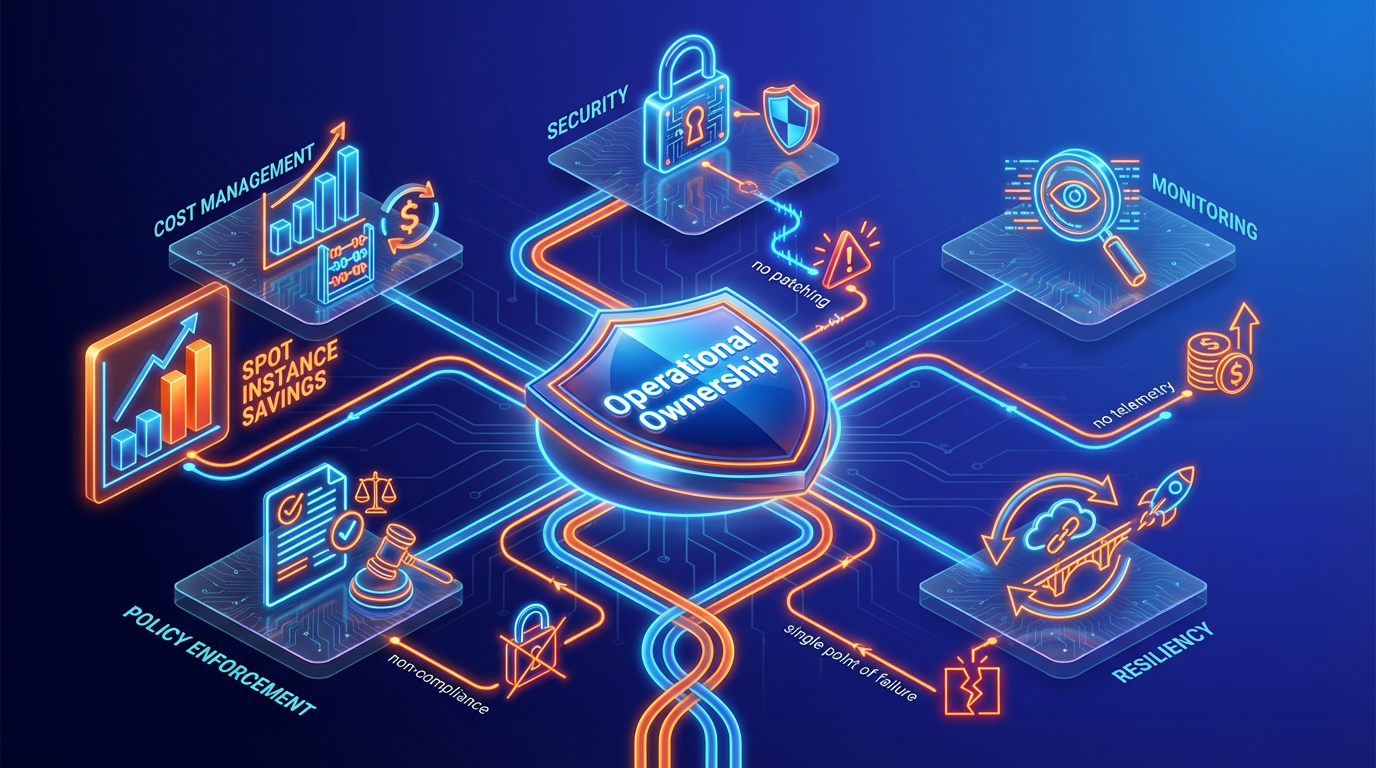
A neon-tech network diagram with a central 3D shield labeled 'Operational Ownership' and five floating operational clusters.

Once workloads are running in the cloud, organizations still need to manage uptime, resource efficiency, service reliability, user experience, and compliance. These responsibilities don’t sit in isolation—they fall into three core pillars that define effective post-migration support.

Operational Excellence

This pillar focuses on keeping systems reliable, performant, and resilient. Infrastructure monitoring and performance tuning sit at its core. Cloud environments are dynamic: workloads fluctuate, traffic patterns shift, and what worked on day one may not hold on day sixty. Continuous monitoring helps teams detect issues early, while performance tuning ensures resources align with real demand.

However, telemetry itself can become a cost and complexity trap. Over-instrumentation leads to massive volumes of unused metrics, increasing storage and ingestion costs without improving insight. The goal isn’t collecting more data—it’s identifying the signals that actually drive action.

Once workloads are running in the cloud, organizations still need to manage uptime, resource efficiency, service reliability, user experience, and compliance. These require daily operational attention across several practical areas. For actionable strategies in monitoring, predictive analytics, and reliability, see Cloud Support: How Managed DevOps Keeps Your Business Online 24/7.

Fiscal Discipline (FinOps)

Cloud pricing is usage-based, which means costs evolve continuously, often without explicit decisions. Effective cost management requires more than periodic reviews—it demands a FinOps mindset that connects infrastructure behavior to business value.

This includes identifying idle resources, optimizing reserved capacity, and leveraging pricing models like spot instances or preemptible VMs for fault-tolerant workloads. Mature teams go further by focusing on unit economics—understanding the cost of a single user action or transaction—so that scaling decisions improve both performance and cost efficiency rather than inflating spend. To master cloud cost control and embed FinOps discipline, check out Cloud Cost Optimization: How to Cut Costs and Improve Cloud Performance.

Security and Governance

The third pillar ensures systems remain secure, compliant, and aligned with intended architecture over time. This includes access reviews, vulnerability scanning, runtime protection, and continuous compliance checks. It also extends to supply chain verification—maintaining SBOMs for dependencies and scanning for risks introduced through third-party or AI-generated code.

Configuration drift detection and policy-as-code enforcement (using tools like Open Policy Agent or HashiCorp Sentinel) help prevent environments from deviating from standards. Backup and disaster recovery testing, along with consistent patching, ensure that resilience is not just designed but proven in practice. For a complete guide to drift detection, policy-as-code, and automation guardrails, read Infrastructure as Code (IaC): How Infrastructure as Code Automates Cloud Deployments.

Platform and Enablement

The final dimension is often overlooked: enabling teams to work effectively in the cloud. This includes building internal developer platforms (IDPs), defining golden paths, and establishing clear ownership models.

Rather than acting as gatekeepers, platform teams create systems that let developers move faster with built-in guardrails. Without this layer, organizations accumulate operational friction—slowing delivery, increasing risk, and undermining the benefits of the cloud itself. Moving to the cloud can significantly improve stability compared to on-premises environments by offering faster recovery time, more flexibility, and sophisticated resiliency capabilities. Those benefits only materialize when organizations design and implement the right resiliency patterns, something that requires sustained effort well beyond migration day.

The Hidden Risk: When No One Owns Cloud Operations

A healthcare company migrated patient-facing applications to Azure but didn't establish a regular patching schedule for its cloud workloads. Six months later, a routine audit revealed several unpatched vulnerabilities in its web application layer, exposing sensitive data to unnecessary risk. A disciplined post-migration support model with automated patch compliance reporting would have caught these gaps within weeks.

These operational demands naturally raise a broader question: who owns all of this once the migration team disbands?

The Organizational Side of Ongoing Cloud Success

Technical gaps are only half the problem. The organizational side is just as likely to derail post-migration outcomes, and it gets far less attention.

When migration projects wrap up, the specialized teams that led them typically move on. What's left behind is often an internal operations team that wasn't deeply involved in the migration itself and may lack the cloud-specific skills needed to manage the new environment. This makes post-migration support a leadership challenge, not just a technical one.

Clear ownership is essential. Someone, whether an internal team, a managed services partner, or a combination of both, needs to be accountable for cloud operations on a daily basis. Without that clarity, issues fall through the cracks. Why Businesses Worldwide Are Switching to Managed Cloud explores how managed cloud models clarify ownership and relieve post-migration burnout while maintaining resilience and security.

What commonly goes wrong here: organizations assume their existing IT ops team can absorb cloud operations alongside their current responsibilities. They can't. Cloud operations require different skills (IaC fluency, provider-specific networking knowledge, container orchestration) and a different cadence (continuous optimization versus periodic maintenance). The role shift is significant. Traditional sysadmins become platform engineers. Help desk workflows become incident response runbooks tied to observability dashboards. If leadership doesn't acknowledge and resource this transition explicitly, the team burns out and the environment deteriorates.

Many organizations are shifting post-migration efforts toward building internal developer platforms (IDPs). These platforms provide ‘golden paths’—pre-approved infrastructure templates and workflows that let application teams self-serve safely, without requiring deep cloud expertise. Rather than acting as a gatekeeper, platform engineering creates a foundation that enables developers to move faster while maintaining governance, security, and consistency by design. This approach requires dedicated platform engineering investment. For organizations that aren’t ready to build and operate an internal platform team, managed cloud services can provide similar capabilities, offering structured environments that balance speed with control.

Providers like ABS, which offers managed IT services spanning infrastructure management, cloud computing, and cybersecurity, can bridge the skills gap while internal teams build capability. Managed Cloud Companies: The Unseen Force Behind Enterprise Success shows how best-of-breed partners deliver reliability and cost control that internal teams struggle to match alone.

When Internal Teams Become the Bottleneck

A retail company completed its migration to Google Cloud but relied entirely on its existing IT team for ongoing management. Within four months, the team was overwhelmed by ticket volume and configuration requests they hadn't been trained to handle. After engaging a managed services partner for monitoring, incident response, and optimization, mean time to resolution dropped by 40% and cloud-related escalations fell significantly.

Why is cloud services support critical post-migration? Because migration moves your systems to the cloud, but only sustained operational support, covering monitoring, cost control, security, performance tuning, and clear ownership, keeps them running efficiently, securely, and aligned with business goals over time.

Future-Proofing: Automation Guardrails & Drift

One area that deserves specific attention: the automation set up during migration often becomes a liability afterward. Infrastructure-as-code templates, auto-scaling policies, and deployment pipelines all assume conditions that change over time. Without guardrails, automated systems can amplify problems faster than manual processes ever could—operationally and financially.

Effective post-migration automation requires built-in controls: rollback triggers when deployment error rates spike (DORA benchmarks suggest keeping change failure rates below 15%), drift detection to continuously compare live infrastructure against its declared state, and policy-as-code to enforce security and compliance. At the same time, teams need to evolve their FinOps approach from simply reducing spend to understanding unit economics—the cost of a single user action or transaction. Scaling policies, for example, directly shape cost per request, making automation a key driver of both performance and cost efficiency.

Finally, CI/CD pipelines should be audited for AI governance gaps. As LLM-assisted coding becomes standard, pipelines need checks for patterns linked to AI-generated vulnerabilities—such as insecure defaults, hallucinated API calls, and dependency confusion risks. This is not a future concern; it’s already part of the current risk landscape.

Conclusion

A successful migration doesn't fail on Day 1; it fails quietly over the following six months. It fails through configuration drift, unoptimized spend, and the burnout of teams forced to "absorb" cloud operations without the right tools. True cloud maturity is found in the discipline of Day 2: the automated guardrails that prevent human error and the telemetry governance that turns data into insight. Whether managed internally through platform engineering or supported by a strategic partner, ongoing operations must be recognized as a specialized discipline. In the cloud, stability isn't a state you reach—it’s a standard you maintain.

Organizations that treat post-migration support as optional almost always pay for it later, through higher costs, slower incident response, and increased exposure to risk. Those that invest early build environments that are not only stable, but continuously improving.

If your cloud environment isn’t actively monitored, optimized, and owned, it’s already underperforming. The sooner you address that gap, the faster you unlock the efficiency, resilience, and scalability your migration was meant to deliver.

Post-migration support is critical because cloud environments are dynamic and require continuous attention. Without ongoing monitoring, cost management, security oversight, and performance tuning, organizations risk rising costs, degraded performance, and operational blind spots that undermine the value of the migration itself.

The most common risks include uncontrolled cost growth from unused or oversized resources, security vulnerabilities from unpatched systems or configuration drift, slower incident response due to unclear ownership, and gradual performance degradation as workloads evolve without corresponding architecture adjustments.

Migration is a time-bound project focused on moving workloads. Post-migration support is an ongoing operational discipline that includes infrastructure monitoring, cost optimization, security management, disaster recovery testing, and continuous improvement of the cloud environment.

Ownership should be clearly defined, whether it falls to an internal cloud operations team, a managed services provider, or a hybrid model. The critical factor is that someone is explicitly accountable for day-to-day cloud performance, security, and cost efficiency.

Planning should begin during the migration itself, not after. Defining support models, training internal staff, establishing monitoring frameworks, and assigning operational ownership before go-live prevents the common gap where migrated environments lack adequate oversight from day one.

Schedule a Meeting

Book a time that works best for you and let's discuss your project needs.

You Might Also Like

Discover more insights and articles

Glowing blue and orange digital data streams flowing through a futuristic network infrastructure environment

DevOps-as-a-Service: Streamlining IT Operations for the Cloud Era

Most organizations know they need DevOps. Fewer have the internal talent, tooling maturity, or operational bandwidth to build and sustain it on their own. That gap between ambition and execution is exactly where DevOps-as-a-Service (DaaS) enters the picture.

Futuristic DevOps system visualizing automated data flow through an integrated software pipeline

Building a High-Performance System DevOps Framework

What makes a great system DevOps design? It’s a question that comes up in every engineering leadership discussion, yet the answer rarely comes down to better tools or faster pipelines. Most organizations treat DevOps as a set of tools. High-performing teams treat it as a system design discipline, where architecture, automation, monitoring, and continuous improvement work as one operating model. Get it right, and you enable speed, stability, and scale. Get it wrong, and you accumulate technical debt that no tool can fix.

Visualization of a DevOps CI/CD pipeline showing build, test, and deploy stages with directional data flow

DevOps Solutions: The Innovation Engine of Modern Tech

Great ideas alone don't create competitive advantage. The ability to move those ideas from concept to production, quickly and reliably, is what separates organizations that innovate from those that simply plan to.

visualization of data flowing through layered digital system architecture with arrows and analytics interfaces

Why CFOs Love Managed IT Services

Technology spending has become one of the fastest-growing line items on corporate budgets, yet most CFOs still struggle to connect those costs to measurable business outcomes. The question is no longer whether to invest in IT, but how to structure that investment so it delivers predictable returns without constant financial surprises.