Overview
This article explains why dedicated DevOps teams have become essential for enterprise cloud success, how these specialized teams create measurable value through automation, operational consistency, and cross-functional coordination, and what commonly goes wrong when organizations try to scale cloud operations without them. The same challenges apply to mid-market teams that have outgrown their informal DevOps setup and need to operate at a higher standard.
Cloud Adoption Without DevOps Creates a Dangerous Gap
Enterprises invest heavily in cloud platforms expecting speed, flexibility, and cost efficiency. But platforms alone don't deliver those outcomes. What sits between a cloud subscription and real business value is an operating model: the people, processes, and automation that turn infrastructure into a reliable delivery engine.
Without dedicated DevOps teams, cloud operations tend to fragment. Different application teams build pipelines their own way. Monitoring is inconsistent. Release processes vary across environments. Manual steps creep in. The result is an environment that looks modern on paper but behaves unpredictably in production.
This problem has gotten worse in 2025 and 2026 as AI-assisted development accelerates code output. Teams using LLM-generated code are shipping faster, but often without proper supply chain validation or vulnerability scanning of what the model produced. Without a dedicated DevOps function enforcing pipeline-level controls, including SBOM generation and automated dependency checks, AI-generated code can introduce risks that no one catches until production.
The risk compounds in enterprise settings, where dozens of applications, multiple compliance frameworks, and distributed teams all share the same infrastructure. Ad hoc cloud operations cannot scale safely under those conditions.
-
Cloud migration alone does not guarantee faster delivery or better uptime. Organizations without dedicated DevOps typically see change failure rates above 30%, compared to the sub-15% target set by DORA benchmarks.
-
Fragmented ownership across teams increases operational risk. When no one owns the deployment pipeline end-to-end, mean time to recovery (MTTR) stretches from minutes to hours.
-
Manual processes and inconsistent tooling slow down releases and recovery.
-
Compliance and governance gaps widen without centralized operational discipline, particularly as machine identities proliferate across services and environments.
Cloud gives you capability. DevOps gives you control. At enterprise scale, control is what separates resilient operations from costly chaos.
Build vs. Buy: A Decision Most Organizations Face Too Late
Building an internal DevOps team gives you full ownership and deep context. It also takes 12–18 months to hire, onboard, and reach operational maturity - time most enterprises don't have after a cloud migration. Partnering with a managed DevOps provider compresses that timeline significantly and brings established tooling, processes, and on-call coverage from day one. The right answer depends on your existing talent, timeline, and how critical delivery speed is right now. Many organizations start with a managed provider to stabilize operations, then build internal capability incrementally around it.
From Cloud Subscription to Cloud Performance
Deutsche Börse, the German stock exchange operator, runs around 30% of its total compute capacity in the public cloud, including several critical applications. To make this work, the organization invested in a single DevOps stack with native container support that enabled scaling and deploying services in minutes rather than days. Without that dedicated DevOps foundation, cloud alone would not have delivered the speed or resilience required for financial-market workloads.
Understanding why the gap exists is the first step. The next question is what dedicated DevOps teams actually do to close it.
What Dedicated DevOps Teams Actually Deliver

A dedicated DevOps team is a specialized group focused on building and maintaining the systems that make software delivery fast, consistent, and reliable. These teams own the automation, observability, and release processes that connect development to production.
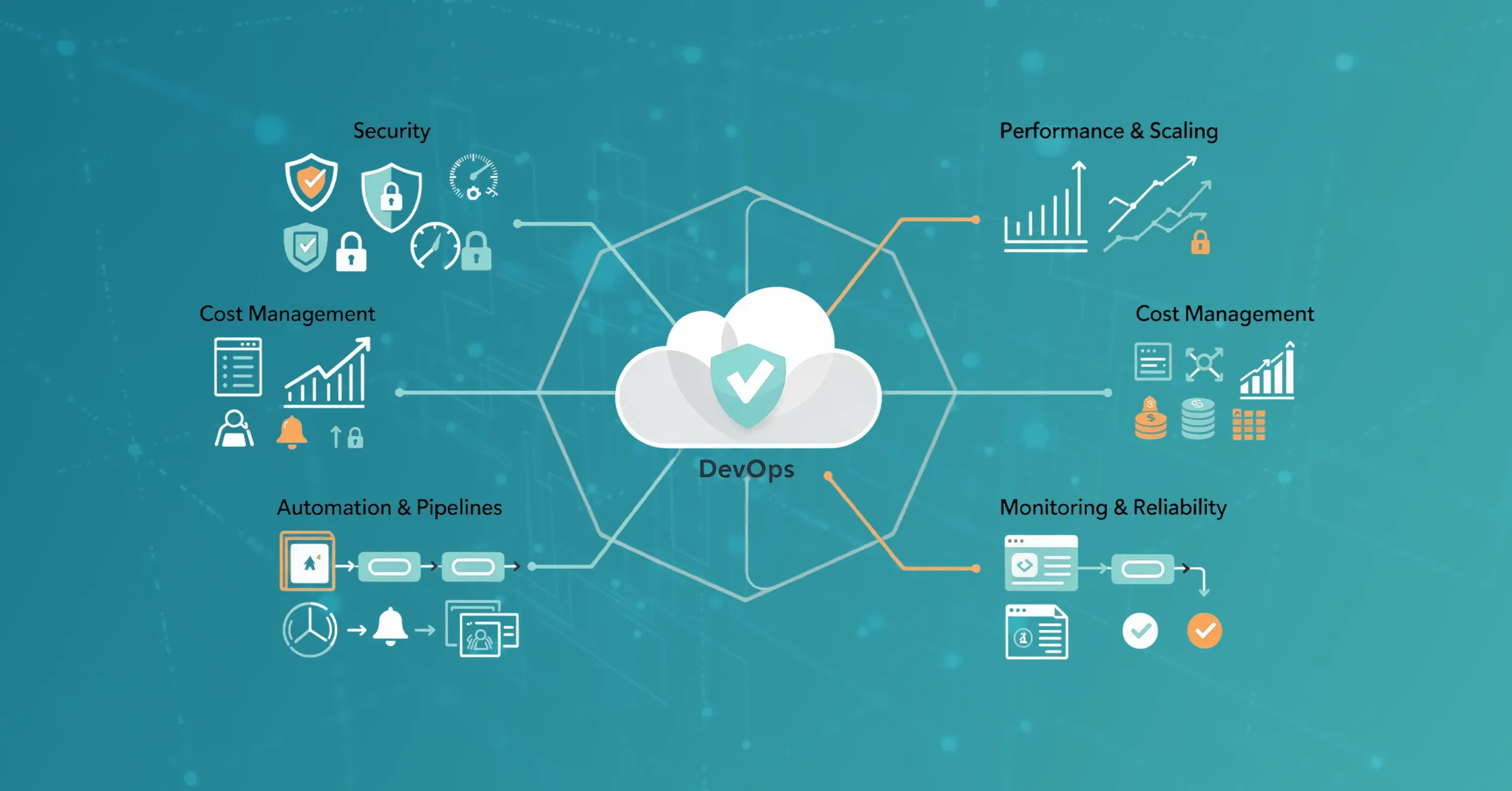
In practical terms, a dedicated DevOps team creates value across several areas:
-
CI/CD pipeline design and management, ensuring every code change follows a consistent, automated path from commit to production. This includes scanning for vulnerabilities in AI-generated code and third-party dependencies before anything reaches a live environment.
-
Infrastructure as Code (IaC) with policy-as-code guardrails, meaning infrastructure is defined in version-controlled templates with automated compliance checks that prevent misconfigurations from being deployed. This eliminates drift between environments, a problem that silently compounds until something breaks.
-
Observability and incident response, where teams build telemetry into systems from the start so issues are detected and resolved before users notice. Mature teams practice telemetry governance, deciding what data to collect and retain rather than drowning in metrics that generate noise without insight. For pragmatic tactics for continuous monitoring and rapid recovery, visit Cloud Support: How Managed DevOps Keeps Your Business Online 24/7.
-
Release reliability with automated rollbacks, enforcing deployment standards and drift detection that reduce change failure rates. When a deploy does go wrong, pre-configured rollback triggers bring services back within minutes, not hours.
-
Cross-functional coordination, bridging development, security, and operations so these groups work from shared processes rather than competing priorities.
These are the operational backbone that determines whether cloud infrastructure performs or breaks under pressure.
Beyond day-to-day operations, dedicated DevOps teams play a design role that often goes unrecognized. They define how code moves across environments, establish the standards that govern every deployment, and build the delivery architecture that the rest of engineering depends on. Without that design function, organizations end up with pipelines that were never built to scale.
One large personal-insurance company demonstrated this clearly. After deploying an integrated DevOps platform on its private cloud, the organization achieved a 10% decrease in production errors across 12 critical application-development teams. That translates directly to fewer incidents, lower MTTR, and more predictable delivery cycles.
Mature DevOps teams also bridge the gap between engineering execution and business expectations. Deployment frequency becomes a conversation about release confidence. MTTR maps directly to customer experience and revenue impact. Change failure rates translate into predictability that leadership can plan around. This translation layer is what makes DevOps a strategic function, not just an operational one.
Hundreds of Deploys a Day, Zero Exceptions
Netflix's cloud architecture allows developers to launch hundreds of software changes a day, with hundreds of microservices each maintained by a dedicated DevOps team. That level of deployment frequency, measured against DORA's benchmark of multiple deploys per day, is the product of dedicated team structures, not the cloud platform alone.
With the "what" established, the critical question for enterprise leaders is why this matters disproportionately at scale.
Why Enterprise Environments Need Dedicated DevOps Most
Small organizations can sometimes manage cloud operations informally. Enterprises cannot. The complexity of multi-application landscapes, regulatory requirements, distributed teams, and high-availability expectations makes dedicated DevOps a structural requirement.
Consider what enterprise cloud environments typically involve:
-
Multiple cloud providers or hybrid configurations
-
Hundreds of microservices with interdependencies
-
Strict compliance and audit requirements across regions
-
Teams spread across geographies and time zones
-
Business-critical systems where minutes of downtime carry measurable financial impact
Fragmented or part-time DevOps coverage is dangerous in this context. Dedicated teams reduce that risk by introducing automation-first workflows, stronger governance, and more resilient system design.
The data supports this. Companies that outperform in cloud migration are 57% more likely to hire for advanced skill sets such as DevOps and FinOps. Organizations adopting platform-based IT structures have seen productivity increases of 25% to 50%, time to market compressed from 2-3 years to 3-12 months, and DevOps automation reducing provisioning activities by 90%.
Those FinOps hires matter more than most organizations expect. Dedicated DevOps teams increasingly own cost-per-workload visibility, tracking unit economics like cost-per-transaction or cost-per-active-user rather than just total cloud spend. Without this discipline, enterprises routinely overspend by 20-30% on cloud resources they cannot map to business outcomes.
For enterprise organizations, this operational discipline directly supports business continuity. When infrastructure is automated, monitored, and governed by a dedicated team, the organization can absorb disruption - whether that is a sudden shift to remote operations, a compliance audit, or an unexpected traffic spike - without losing delivery momentum or stability.
For enterprises evaluating how to structure their cloud operations, ABS offers dedicated DevOps team models that combine infrastructure management, pipeline ownership, and cloud operations discipline into a single cohesive structure. The goal is not just to keep systems running, but to build the operational foundation that makes cloud performance predictable and scalable over time.
When Disruption Hits, DevOps Holds
When the COVID-19 pandemic forced Deutsche Börse to switch to fully decentralized operations, its DevOps model ensured developer productivity was not impacted. That kind of operational continuity under sudden disruption is only possible when dedicated teams have already built the automation, monitoring, and deployment systems that keep everything running regardless of where people sit.
What Organizations Underestimate When Building Dedicated DevOps
The benefits of dedicated DevOps are well understood. What catches most organizations off guard is the implementation.
-
Ownership shifts are politically difficult. When a dedicated DevOps team takes control of CI/CD pipelines, deployment standards, and infrastructure definitions, application teams lose autonomy they previously had. Developers who built their own deployment scripts may resist adopting golden paths defined by a platform engineering team. Leadership needs to explicitly back the DevOps team's authority over shared infrastructure, or the team becomes advisory rather than operational.
-
You are trading speed of local decision-making for system-wide consistency. Individual teams may deploy slightly slower through a standardized pipeline than through their custom scripts. The payoff is lower change failure rates across the organization and faster incident recovery, because every service follows the same patterns. But that trade-off is real, and teams will push back on it.
-
Tooling consolidation takes longer than expected. Most enterprises have three to five CI/CD tools in active use when they start this transition. Getting to a single internal developer platform with enforced standards is typically an 18-24 month effort, not the six months that leadership budgets.
-
Automation without guardrails creates new failure modes. A fully automated pipeline that can deploy to production in minutes can also push a bad config to production in minutes. Dedicated DevOps teams need to invest in automated rollback triggers, canary deployments, and drift detection from day one. Policy-as-code frameworks like Open Policy Agent (OPA) become essential, encoding deployment rules that prevent automated systems from doing damage at machine speed.
-
Security responsibilities shift left, and someone has to own that. When DevOps teams own the pipeline, they inherit responsibility for supply chain security, SBOM generation, container image scanning, and, increasingly, scanning for vulnerabilities introduced by AI code-generation tools. This is a different skill set than traditional infrastructure operations. Hiring or training for it takes time.
For a complete guide on how process discipline, ownership clarity, and platform consolidation fuel organization-wide DevOps transformations, see Tech DevOps: The Core Engine Behind Agile Businesses.
In short: dedicated DevOps teams for enterprise cloud are specialized groups responsible for automating infrastructure, managing deployments, ensuring system reliability, and coordinating across development and operations, turning cloud platforms into stable, scalable, high-performing environments. Getting there requires navigating real organizational friction around ownership, tooling consolidation, and the expanding scope of what "operations" means in 2026.
What Comes Next
Dedicated DevOps is not a nice-to-have for enterprise cloud. It is the difference between infrastructure that performs under pressure and infrastructure that fails when it matters most. If your organization runs cloud at enterprise scale without a dedicated DevOps team or with one that lacks clear ownership over pipelines and infrastructure standards start here:
-
Audit your pipeline sprawl. Count how many CI/CD tools, deployment scripts, and provisioning methods are actively in use. If that number exceeds two, consolidation comes first. Use DORA benchmarks as your baseline: elite performers deploy on demand with a change failure rate below 15% and MTTR under one hour.
-
Define ownership explicitly. Decide who owns the internal developer platform, who controls infrastructure golden paths, and where application teams have autonomy versus where they must conform. Document it. Get leadership alignment. Ambiguity is what kills these initiatives before they deliver.
-
Prepare for AI-era pipeline risks. If your developers use LLM code-generation tools, your pipeline needs automated SBOM generation, dependency scanning, and policy-as-code gates. This is no longer a future consideration.
Prefer to have an expert run this audit for you? ABS offers a complimentary cloud DevOps review - contact ABS.
Organizations that move on these three steps see it in the numbers: fewer failed deployments, lower MTTR, reduced cloud waste, and audit readiness that does not require a crisis to achieve. The ones that wait tend to learn the cost of delay through an incident they could have prevented.