Crafting a Cloud Strategy That Actually Works

Content authorBy Irina BaghdyanPublished onReading time12 min read
Title:
Crafting a Cloud Strategy That Actually Works

Meta description:
See What defines a successful cloud strategy in 2026? You learn how to tie cloud choices to cost, control, and business goals.

This article frames cloud strategy as a business transformation framework. It explains why so many cloud programs underdeliver and shows how modern strategy connects deployment models with operating disciplines based on business requirements.

Why most cloud programs stall

Successful cloud strategy is no longer answered by whether you move to the cloud. You already did that. The harder problem now comes after the workloads are migrated: the bills keep climbing while the value leadership expected stays off the scoreboard. If you have lived through one cloud project, you know the symptoms before anyone names them.

The technology rarely fails. PwC's 2026 Digital Trends in Operations survey found that 89% of respondents gave at least one reason their tech investments hadn't fully delivered, with integration complexity and adoption topping the list. The gap sits between what the technical team built and what the business actually needed, and that gap is a strategy problem.

The 2026 context raises the stakes. Gartner projects global public cloud spending at $850 billion this year, driven partly by AI workloads rebuilding infrastructure demand. At the same time, a cloud reset is underway. Flexera's 2026 report shows 73% of organizations now run hybrid estates, and repatriation is rising as teams pull workloads back for cost and control. When spend balloons and the architecture itself is in flux, getting the strategy right matters more than it did five years ago.

What defines a successful cloud strategy in 2026

A successful strategy is the one that functions as a business transformation framework grounded in business outcomes. It starts from organizational priorities and operational requirements shaped by the growth the business is trying to fund, then works backward to the technical choices that serve them. The order matters. When the technical choices come first, the business outcomes become something you hope to discover later.

The determining factor in long-term success is alignment between the people who build the cloud and the people who depend on it. Maturity depends as much on processes and organizational alignment, with skills behind both, as on the technology you pick. That's worth sitting with, because most postmortems on stalled programs point at architecture when the real fault line ran between IT and the rest of the business. The three failure modes below let you self-diagnose before the next budget review forces the question.

Unclear objectives and missing metrics

Commands like "migrate everything" and "be cloud-first" are directions of travel with no destination, and a program launched without defined business outcomes drifts into activity for its own sake. You ship migrations and close tickets, yet at the end of the quarter nobody can say whether the investment moved the business.

The absence of measurable goals makes the spend impossible to judge. Good objectives attach cloud work to business KPIs. Instead of counting workloads moved, you tie the work to outcomes like these:

  • Reduce the cost to serve a customer transaction by a defined percentage within a set timeframe

  • Cut time-to-market for a new product feature from weeks to days

  • Improve service availability for a revenue-generating application to a specific uptime target

Flexera's 2026 State of the Cloud report found that the share of organizations tracking value delivered to business units as their primary cloud success metric jumped 12 percentage points in a single year, reaching 64%. Counting migrations is easy. Counting business value is the discipline that separates a program from a project.

Weak governance and runaway spend

Cloud bills balloon when no one treats cloud strategy as a question of spend ownership. After five years of decline, Flexera reports wasted cloud spend rose to 29%, which reversed the trend as AI and new services added cost complexity. For a company spending ten million a year, nearly three million evaporates into idle and over-provisioned resources.

For a CTO or VP of Engineering, the real cost of weak governance isn't the invoice. It's the meeting afterward, when the CFO wants to know why margins moved and nobody has an answer. Tagging resources fixes visibility, not accountability. What actually converts chaotic, variable cloud spend into a predictable, managed operating expense is a partner who enforces strict cost governance and continuously optimizes architecture, not one who simply reports on the damage after the fact. That's the difference between explaining a surprise and presenting a forecast.

The link between absent guardrails and unpredictability is direct. When provisioning has no policy behind it and no one reconciles the forecast against reality, the monthly report becomes a surprise. Gartner's survey of 200 IT leaders found 69% experienced budget overruns in their cloud spend during 2023. That unpredictability is what pushes some organizations toward repatriation, and OpenText's 2025 data shows 67% have already repatriated some workloads. Repatriation is a governance failure wearing the costume of a cost decision.

Need IT Support?

Book a free consultation with ABS Technologies experts we'll help you find the right managed IT, cloud, or security solution for your business.

Book a Free Consultation

Skill gaps and stakeholder misalignment

Hiring the senior DevOps talent needed to close this gap is a liability in its own right. A single senior hire can take months to source, commands a premium salary before benefits and overhead are even counted, and carries real turnover risk the moment they're onboarded, leaving you exposed exactly when you can least afford it. Partnering with a managed service provider replaces that single point of failure with immediate access to a full bench of experts, mature operational processes, and 24/7 coverage, typically for less than the fully burdened cost of one internal senior engineer.

The human side undermines architectures that are technically sound, and nowhere is that friction sharper than between a CEO pushing for faster feature releases and a CISO or board demanding strict compliance. When the technical team and the business units operate from different definitions of success, the cloud delivers exactly what one side asked for and disappoints the other. A managed DevOps partner can act as the bridge between those two demands, baking international quality standards and specialized protocols for brand and email integrity directly into the automated pipeline. Outsourcing here achieves enterprise-grade compliance without slowing the internal team's release cadence. IDC estimates more than 90% of organizations will face IT skills shortages by 2026, and cloud roles sit near the center of that gap.

Finance wants predictability while security wants control, and when no one reconciles those priorities with product's need for speed into a shared definition of success, the cloud quietly serves whichever group shouts loudest. Revature's 2025 survey found 77% of organizations were already impacted by the IT skills gap, which means the people equipped to close this gap are the ones in shortest supply.

Core elements of a modern strategy

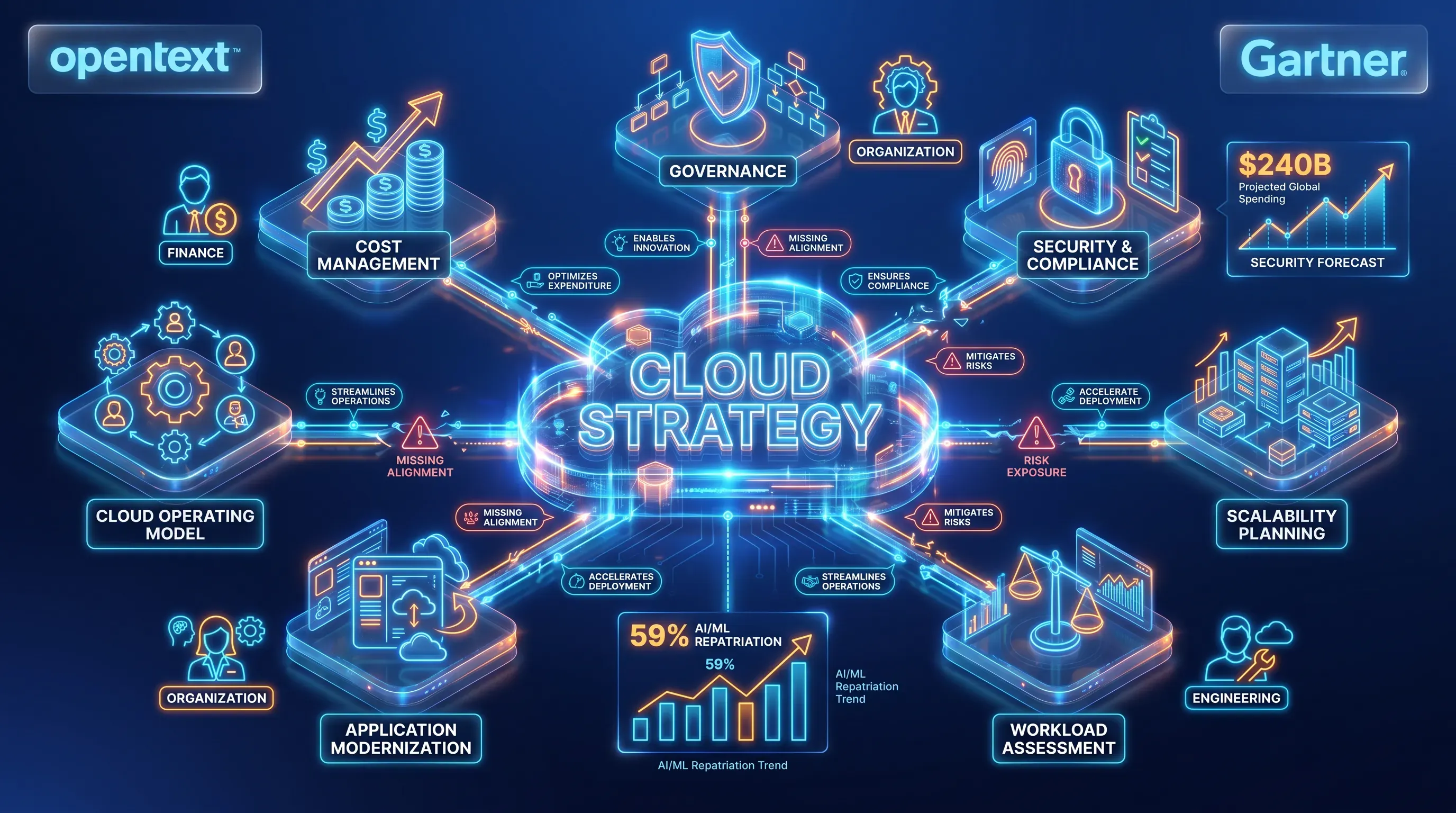
A vibrant neon infographic illustrating a 'Cloud Strategy' core with interconnected clusters for governance, security, and more, on a deep blue background.

A complete strategy is a set of building blocks that work as a system. Neglect one and the others weaken, because governance without cost discipline produces clean policies and dirty bills, and security bolted on after modernization slows everything it touches. Use the list below to audit what your own program is missing, then read past it for how the pieces connect.

  • Workload assessment that classifies applications by business value and technical fit before anything moves

  • A cloud operating model that defines provisioning authority and spend responsibility

  • A governance framework with policy enforced as code

  • Security and compliance designed into the architecture from the start

  • Cost management with ownership attached to every spending decision

  • Scalability planning that matches capacity to demand

  • Application modernization sequenced by the value it unlocks

Workload assessment is where cloud strategy becomes a design question grounded in business outcomes. When you classify applications by business contribution, the modernization sequence writes itself. The high-value, high-change applications justify the engineering, and the stable, predictable ones cost less to leave where they are. That decision connects directly to the repatriation question, because OpenText found AI/ML-intensive databases at 57% were the workloads teams most often judged better suited to private environments.

Governance and cost management are the elements organizations most consistently underbuild, and they reinforce each other. A governance framework that enforces tagging and provisioning policy is what makes cost data trustworthy enough to act on. Without it, finance receives a bill it can't decompose and engineering receives a budget it can't explain. Security and compliance carry similar weight, since Gartner forecasts information security spending of $240 billion in 2026, and regulatory pressure has turned that line from discretionary into mandatory.

Need IT Support?

Book a free consultation with ABS Technologies experts we'll help you find the right managed IT, cloud, or security solution for your business.

Book a Free Consultation

Choosing the right deployment model

Different deployment models each solve different problems, and the common mistake is copying another organization's model because it worked for them. Your workloads and regulatory context create a cost structure specific to you. Flexera's data confirms hybrid is now the default, with 73% running hybrid estates and organizations averaging multiple public providers, which tells you the single-model era is over.

Concrete factors drive the decision. Data sovereignty and regulatory pressure decide where certain data is legally allowed to live, and Gartner expects sovereign cloud IaaS spending of $80 billion in 2026 as geopolitical tension makes location a board-level concern. Cost predictability favors private or on-premises for steady, high-volume workloads, which is why GEICO cut compute costs by 50% per core after repatriating from a public cloud bill exceeding $300 million a year. Performance and AI workload demands pull in their own direction, since GPU economics and token-based billing change the math entirely.

Walk the decision in this order, workload by workload:

  1. Identify the regulatory and sovereignty constraints that remove options before you weigh anything else.

  2. Model the cost profile around steady-state workloads and bursty ones, because elasticity you don't use is elasticity you overpay for.

  3. Weigh performance and proximity to data, especially for AI workloads where placement drives both cost and speed.

Every real cloud architecture depends on tradeoffs, so treat any universal blueprint from a vendor or peer that claims to have "a successful cloud strategy" with suspicion. The right answer is the one your specific workloads and constraints produce.

Operating disciplines that keep cloud sustainable

A migration is an event. A sustainable cloud program handles it through a set of ongoing disciplines with ownership and process behind them. Four disciplines separate the two, and they reinforce one another as a system. For a tech leader, building that platform from scratch is often the biggest distraction from building the actual product, the smarter move is treating platform engineering as an ROI question for your developers.

Platform engineering builds the internal developer platform that abstracts complexity so application teams provision infrastructure without becoming infrastructure experts. Gartner predicts 80% of large software engineering organizations will have platform teams by 2026, up from 45% in 2022, because the alternative is every team reinventing the same guardrails badly. The payoff is efficient resource utilization and faster delivery, since the platform encodes good decisions once and reuses them everywhere. Outsourcing the underlying platform architecture gives in-house developers that same paved road to deploy code seamlessly, the benefits of an enterprise-tier platform without having to hire the rare, expensive talent it takes to build one.

FinOps and observability close the loop on cost and resilience, with automation as support for both. FinOps now moves left into developer workflows, and the FinOps Foundation reports that platform engineering teams increasingly join as cost decisions move into the build stage. Observability and cost data now live together, and a report from the CNCF describing the convergence of cloud operations into unified frameworks places cost alongside performance metrics. The question worth asking is which discipline to invest operational maturity in next:

  • If your bills surprise you, FinOps with cost ownership comes first.

  • If incidents catch you blind, observability that ties cost to performance comes first.

  • If teams wait on infrastructure, platform engineering and automation come first.

Each discipline ties back to an outcome. FinOps buys cost predictability and observability buys resilience, while automation keeps resource utilization efficient as the estate grows.

Aligning cloud investment with business outcomes

This is the payoff the rest of the article builds toward. Cloud decisions connect to business value through four structural moves. Establish success metrics that read in business terms and prioritize workloads by the value they create; then assign decision ownership and build governance that balances flexibility with control.

Start with metrics, because they discipline everything downstream. A metric like cost per transaction or revenue per cloud dollar forces the conversation onto ground both finance and engineering can stand on. Then prioritize workloads by business value, which means the application that drives revenue gets the modernization budget before the one that merely runs. Ownership comes next, and it has to be explicit, because shared ownership of cloud spend reliably becomes no ownership at all. Governance mechanisms then hold the balance: teams get freedom inside policy guardrails enforced as code, and the program avoids waste.

The collaboration this requires is a structural requirement. IT leaders and the business units have to include finance and security stakeholders in the same definition of success, because the misalignment described earlier is precisely what this framework exists to fix. Flexera reports 85% of cloud leaders name managing spend as their top challenge, and that challenge is rarely solved inside IT alone. It's solved when finance and engineering read the same dashboard and agree on what it means.

Treating strategy as a living program

A cloud strategy is never really finished. Business priorities shift and regulations tighten as AI reshapes demand faster than any annual plan anticipates, which means the program that delivers value is the one that keeps adapting. Overemphasis on migration speed or technology adoption is what quietly undermines long-term outcomes, because the fast migration to the wrong model just reaches the wrong place sooner.

Judge your own program against a few criteria. Do your metrics read in business terms, and does someone own every spend decision while the deployment model follows your workload requirements? Close the most pressing gap first, whether it is governance or cost discipline.

You shouldn't have to pull your best engineers off product development to manage infrastructure drift or chase compliance audits. Where modernization or managed operations exceed your internal capacity, ABS Technologies provides the architectural foundation, 24/7 observability, and baked-in security, so your team can focus entirely on shipping features.

Need IT Support?

Book a free consultation with ABS Technologies experts we'll help you find the right managed IT, cloud, or security solution for your business.

Book a Free Consultation

Review your cloud strategy at least quarterly, and after any major product, compliance, or cost change. Cloud usage changes faster than annual planning cycles, especially when AI workloads or new regions are added. A quarterly review keeps workload placement, budgets, and security controls tied to current business priorities.

The useful metrics are business metrics, such as cost per transaction, release cycle time, uptime for revenue systems, and forecast accuracy. What defines a successful cloud strategy in 2026? It’s the ability to show that cloud spending improves measurable outcomes rather than only increasing migrated workload counts.

Yes, you can use public cloud for regulated data if the provider, region, controls, and contracts meet the rules that apply to your industry and location. Start with data classification and residency requirements. Then confirm encryption, access logging, retention, and audit controls before the workload moves.

Repatriate only when the workload’s cost profile and control requirements support the move. Steady, high-volume systems with predictable demand are better candidates than bursty applications that benefit from public cloud elasticity. Compare three-year operating cost, migration effort, staffing needs, and performance requirements before deciding.

Start by narrowing the work to one high-value gap, such as cost controls or DevOps pipelines, instead of trying to rebuild the whole estate at once. Assign an internal owner and document decisions. If capacity is the blocker, ABS Technologies can handle architecture, guardrails, and managed cloud operations through a free consultation →

Schedule a Meeting

Book a time that works best for you and let's discuss your project needs.

You Might Also Like

Discover more insights and articles

Title:
Designing Cloud Architecture That Grows with Your Business

Meta description:
See How to build cloud architecture for growth and security? You can plan cloud choices that scale while keeping ri

Designing Cloud Architecture That Grows with Your Business

This article is a strategic guide on designing cloud architecture that scales with a business without sacrificing secure control or resilience. It walks through scalable design, including the resilience and governance layers that keep growth manageable, plus the organizational realities that decide whether an architecture actually holds up. By the end, you will be able to assess your current setup and prioritize the decisions that let it evolve instead of forcing a rebuild.

Title:
How do businesses fast-track Azure deployment? What actually speeds rollout

Meta description:
So, how do businesses fast-track Azure deployment? You learn to build reusable foundations and aut

How do businesses fast-track Azure deployment? What actually speeds rollout

This article is for teams that have committed to Azure and keep watching dates slip. It compares the levers that genuinely shorten an Azure rollout against the shortcuts that look fast on a slide but create rework later. The distinction matters: fast rollout does not mean skipping governance or avoiding assessment. It means automating governance so it runs inside the pipeline and making assessment reusable and wave-based. The levers below are built on that principle.

Title:
AWS Setup for Startups: From Zero to Cloud Launch

Meta description:
Curious about What’s the right way to set up AWS for startups? You will discover how to configure accounts to prevent mistak

AWS Setup for Startups: From Zero to Cloud Launch

A few AWS decisions made on Day 1 are the ones most expensive to reverse later. This is a Day-1 blueprint for technical founders and their first engineers who are about to run AWS for a real product. It walks you from a clean first account to a foundation designed to support early growth and avoid the common rework that appears before Series A, and it flags where a partner saves you time.

Title:
Continuous Monitoring: The New Rule of Cloud Compliance

Meta description:
To protect your data, answer this: Why is continuous monitoring non-negotiable today? You will learn to stop cloud dri

Continuous Monitoring: The New Rule of Cloud Compliance

Continuous monitoring is now the baseline requirement for cloud compliance because cloud environments change faster than any audit cycle can track. A control that passed last quarter can drift out of compliance within hours. Control effectiveness today depends on ongoing, timestamped visibility captured across the full operating period.