A close-up of a futuristic server or network interface with glowing orange ports and neon turquoise circuitry, symbolizing high-speed data processing and advanced IT infrastructure

The Cloud Cost Paradox: Why Migration Spikes Your Budget - And How a FinOps Solutions System Fixes It

Cloud migration is sold as the fastest route to smaller IT invoices, yet many teams watch costs climb the moment the last server rack powers down. The pain is real, but the culprit is not the cloud itself. It is the way we run the cloud as if it were still a private data center. A FinOps-driven solutions system breaks this pattern, links spend to revenue, and helps technology leaders regain financial control without slowing innovation.

Content authorBy Irina BaghdyanPublished onReading time7 min read

What You Will Learn

This article unpacks the budget shock that greets most cloud newcomers, shows why lift-and-shift thinking keeps bills high, and explains FinOps, short for Financial Operations. You will see how FinOps reframes the problem from “cutting costs” to “paying only for capacity that creates value.” Along the way, we will map the three pillars of a modern solutions system, connect them to business IT systems and integration services, and finish with a checklist that can trim 20–30% of your monthly cloud spend in the next quarter.

The Surprise Spike: Why Cloud Bills Rise Instead of Fall

Moving to the cloud promises elasticity and pay-as-you-go pricing. So why do invoices often double in the first six months? The answer lies in three intertwined habits that come from years of running physical servers.

Teams copy their entire on-prem environment into a cloud account, keep the same sizing, and rarely shut anything off. The result is a static fleet of virtual machines that remain powered on day and night, whether users are active or not. Network traffic, block storage, and backup snapshots add silent but material dollars every hour.

  • Lift-and-shift twins every existing server rather than redesigning workloads for cloud-native services.

  • Over-provisioning continues because guessing peak demand still feels safer than resizing weekly.

  • Shared accountability blurs, so no engineer sees the direct cost of an idle cluster.

When finance pulls the first detailed usage report, sticker shock sets in. Yet the platform is blameless. Treating elastic cloud resources like fixed, capitalized hardware guarantees an unpleasant surprise.

The global appetite for outside help is growing: spending through systems integrators hit $863.8 billion in 2024 as organizations seek fresh operating models. Cloud cost control is top of that list.

Lift-and-Shift in Practice: A Costly Cloud Migration Example

An enterprise software vendor mirrored 700 on-prem virtual machines straight into AWS during a weekend cut-over. Within 90 days its compute bill ballooned 58% beyond the old data-center run rate. Once the team mapped idle development servers and resized test databases, monthly spend dropped by 22% with zero impact on release velocity. This example shows the hidden tax created by lift-and-shift and sets the stage for a smarter approach. The cloud is innocent, but managing it like a rack of servers is expensive. Next, we explore the operating model that prevents this trap.

FinOps: From Cost Cutting to Cloud Unit Economics

FinOps is a discipline that blends engineering, finance, and product to ensure every dollar spent buys measurable business value. Unlike simple “rightsizing,” FinOps focuses on unit economics: cost per customer, cost per API call, or cost per streamed minute. Those metrics tell leaders which workloads drive margins and which drain them.

FinOps also formalizes a feedback loop:

  • Visibility: real-time spending data broken down by team, feature, and environment.

  • Accountability: shared dashboards so engineers see dollars the same way finance sees technical risk.

  • Optimization: automated policies that scale resources up and down in near-real-time.

This model aligns neatly with modern business IT systems. When a workload spans multiple clouds, integration services such as iPaaS knit cost data together. That market is hot: analysts peg the space at $15.63 billion in 2025 and racing toward $78.28 billion by 2032.

FinOps is therefore less a budgeting exercise and more a continuous improvement loop that keeps spending proportional to revenue growth.

Real-World Example

A payment processor tied each microservice to a Kafka topic and used tags to map cost per transaction. When traffic surged after a marketing campaign, autoscaling tripled compute capacity but margins remained intact because each additional dollar of spend corresponded to $4.10 in new revenue. When costs line up with value drivers, finance welcomes higher bills.

Building a FinOps Solutions System: Three Pillars
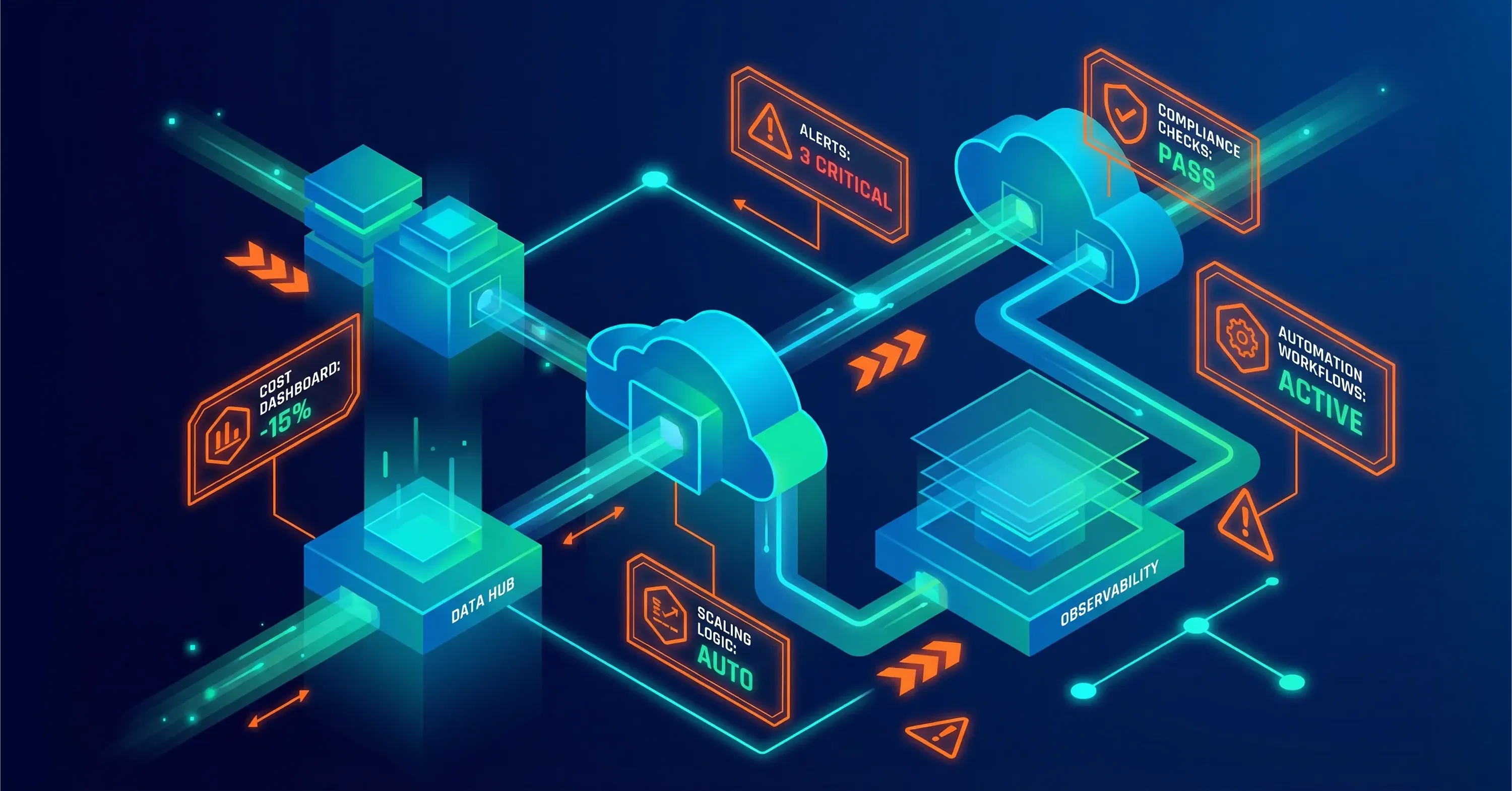
A futuristic cloud and data pipeline diagram shows interconnected systems for cost monitoring, compliance checks, automation workflows, scaling logic, and observability, highlighted with neon turquoise flows and orange alerts

To put FinOps into practice you need a solutions system that combines data, culture, and automation. Think of it as an operating fabric draped across all business IT systems.

Visibility

  • Attach consistent tags or labels to every resource at launch.

  • Feed usage and price data into a central warehouse or observability stack.

  • Present near-real-time dashboards that show cost by feature, environment, and business unit.

Accountability

  • Embed spend alerts in chat and ticketing tools so engineers see costs as code changes ship.

  • Set shared Key Performance Indicators: cost per user session, cost per gigabyte streamed.

  • Review variances weekly, not quarterly, and empower teams to act without red tape.

Automation

  • Use Infrastructure as Code so changes are versioned, tested, and peer-reviewed.

  • Enable auto-scaling rules that react to demand curves within minutes.

  • Schedule non-production environments to sleep at night and on weekends.

Integration services help stitch data from multiple clouds, SaaS logs, and finance ledgers. The MuleSoft Connectivity Benchmark shows that 80% of organizations name data integration as their biggest hurdle. A robust solutions system addresses that gap up front.

For a broader blueprint of what a next-gen cloud platform looks like - and how it brings continuous automation and cost control into modern business IT - take a look at Be Cloud: The Next-Gen Platform for Scalable Business.

Three Immediate Actions for 20–30% Savings

Ready to see impact this quarter? Focus on idle capacity, right-sizing, and smart scaling. These steps work across AWS, Azure, and Google Cloud.

Audit Idle Resources

  • Pull a list of instances with CPU below 5% for 14 days.

  • Flag unattached volumes and stale snapshots.

  • Terminate or archive after a short grace period.

Implement Rightsizing and Reservations

  • Downsize over-provisioned instances to smaller types.

  • Purchase one-year Savings Plans or Reserved Instances for steady workloads.

  • Monitor performance to ensure user experience stays flat.

Enforce Autoscaling and Scheduling

  • Set minimum replica counts to zero for batch and dev clusters.

  • Use scheduled start/stop for testing environments.

  • Tie scaling thresholds to meaningful business metrics such as active users, not CPU alone.

Teams that apply these best practices often combine them with platform-level Cloud Services and DevOps solutions to maximize results across multi-cloud estates. Well-run teams often capture 20–30% within 90 days by following this checklist, then reinvest the savings in innovation.

What Is a FinOps Solutions System?

A FinOps solutions system is a cross-functional framework that tags every resource, surfaces real-time cloud spend to both engineers and finance, and automates resizing and scheduling so a company pays only for computing power that directly supports revenue. It couples visibility, accountability, and automation to cut costs without slowing delivery velocity.

Conclusion

Cloud sticker shock is not a failure of the platform but of mindset. Treating virtual machines like hardware locks you into round-the-clock billing. A FinOps solutions system flips the script by linking spend to business value and automating capacity as demand shifts. Build on the three pillars - visibility, accountability, automation - start with an idle-resource audit, and enforce intelligent scaling. Capture the first 20–30% in savings, then let continuous feedback keep your budget and growth in balance.

For more on automated cloud operations and the power of DevOps-driven cost control, explore Tech-Driven DevOps: How Automation is Changing Deployment.


FinOps is the practice of managing cloud costs through shared visibility and rapid feedback so that each team pays only for the capacity that drives customer value.

Traditional models track spend after the fact, while a solutions system embeds cost data into daily engineering workflows and automates changes, making savings continuous and measurable.

Organizations that audit idle resources and implement autoscaling often see 20–30 % reductions within the first three months.

While many companies succeed in-house, 81 % of technology buyers plan to increase reliance on consultants, and a leading provider of managed IT services can accelerate tagging, data integration, and automation. For a hands-on breakdown, see how [Managed IT Services](https://abs.am/en/services/managed-it-services/) drive value for cloud-first enterprises.

No. While FinOps originated in large-scale cloud environments, its principles apply to any organization where cloud spend grows faster than visibility. Even mid-sized teams benefit once they run multiple environments, use autoscaling, or support variable traffic. The earlier FinOps practices are introduced, the easier it is to avoid cost spikes later.

Schedule a Meeting

Book a time that works best for you and let's discuss your project needs.

You Might Also Like

Discover more insights and articles

Futuristic secure data center corridor visualizing cloud infrastructure, cybersecurity architecture, and high-performance digital systems with blue and orange circuit patterns

Institutional-Grade Ops: Getting 24/7 SRE Resilience Without the Silicon Valley Price Tag

Mid-sized fintech, healthcare, and e-commerce firms in the GCC and Canada have a quiet, dangerous habit: they rely on a single in-house guru who “knows the cloud.” When that person is on holiday or leaves, revenue stalls. A managed IT support company can remove that single-point-of-failure and give you the same always-on reliability the big Valley brands enjoy, but without the premium price tag.

A quick look at the numbers explains why this matters. Nearly76 % of SMBs already lean on an MSP for at least some IT functionsand67 % plan to increase spending in the next 12 months(JumpCloud). They do it because downtime bleeds cash and damages trust.

Abstract visualization of interconnected data streams representing digital marketing automation, data integration, and performance-driven decision systems

Why Outsourcing Your DevOps Platform is 2026’s Smartest OpEx Move: managed it services and support

Leading CFOs have a new line item keeping them up at night: the spiraling cost of in-house DevOps. Salaries keep climbing, outages remain unforgiving, and security demands never sleep. The question is no longer “do we need DevOps?” but “do we still need to build it ourselves?”

This article walks through the facts, the math, and the risk calculus behind the Build-vs-Buy decision, showing why a managed DevOps model delivers nonstop expertise, lower exposure, and smoother cash flow for less than one senior engineer’s payroll.

The image depicts an advanced enterprise AI chip embedded in a digital circuit board, visualizing neural network processing and high-performance computing architecture

Cyber-Resilience: Why 2026 Boards are Trading Protection for Immunity

Modern boards are staring at a blunt truth: threat actors now move faster than any human response plan. A single ransomware strike can wipe decades of data, paralyze revenue, and sink market value overnight. Buying more perimeter tools will not calm the boardroom. Ensuring the business never stops will.

Below is a practical roadmap for CISOs, IT Directors, and Business Continuity Managers who need to move their IT and business services from brittle protection to digital immunity before the next quarterly review.

The image shows a high-performance AI processor chip on a circuit board with flowing data streams, representing neural computing and modern enterprise IT architecture

The Sovereignty Shift: Navigating Data Residency and Corp IT Solutions in a Borderless Cloud

In 2026, the question is no longer just whether your data is in the cloud, but exactly which legal jurisdiction that cloud inhabits. For Chief Information Officers and Risk Officers, particularly in regions like the Gulf Cooperation Council (GCC) and Canada, the physical location of a server now carries as much weight as its uptime or security.

This article examines the critical transition from general public cloud strategies to the era of the Sovereign Cloud. We will explore how mid-market firms and large enterprises can navigate strict data laws in Saudi Arabia, the UAE, and beyond. You will learn how to design hybrid architectures that keep sensitive information within national borders while still leveraging global innovation, ensuring yourdigital enterpriseremains compliant and competitive.