A glowing digital cloud icon connected to multiple circuits inside a blue-lit server room, symbolizing cloud infrastructure and data connectivity.

Be Cloud: The Next-Gen Platform for Scalable Business

Cloud has become the backbone of modern business - not just a hosting option, but the foundation for innovation and growth. “Be Cloud” means building on it first, with scalability, automation, and reliability at the core, so every system and process moves faster, smarter, and more resiliently.

Content authorBy Irina BaghdyanPublished onReading time6 min read

Overview

By the end of this article you will know:

  • The core components and mindset behind a next-gen cloud platform
  • Why scalable infrastructure and continuous automation are now table stakes
  • How hybrid and multi-cloud integration boosts business agility
  • Practical steps to turn theory into day-to-day operations

We will also break down industry data, highlight common missteps, and answer the questions leaders ask most often.

Why the Cloud Mindset Shift Matters

Most firms already run something in the cloud. Yet IDC’s Cloud Pulse shows 60% of buyers say their infrastructure still needs major transformation. The old “lift and shift” model stalls because:

  • Legacy apps remain silos
  • Capacity planning lags demand spikes
  • Manual processes choke innovation

A next-gen platform flips the script. Instead of treating the cloud as another data center, you assume all new services launch there first. That shift unlocks faster releases, global reach, and measurable savings.

At its heart, Be Cloud is not a product logo. It is a commitment to:

  • Elastic, pay-as-you-grow resources
  • Seamless hybrid and multi-cloud operations
  • AI-powered automation from code to cost control

Keep those pillars in view as we explore each area.

Market momentum you cannot ignore

If the cloud is now business as usual, the question becomes: Are you using it to leap ahead, or just to tread water?

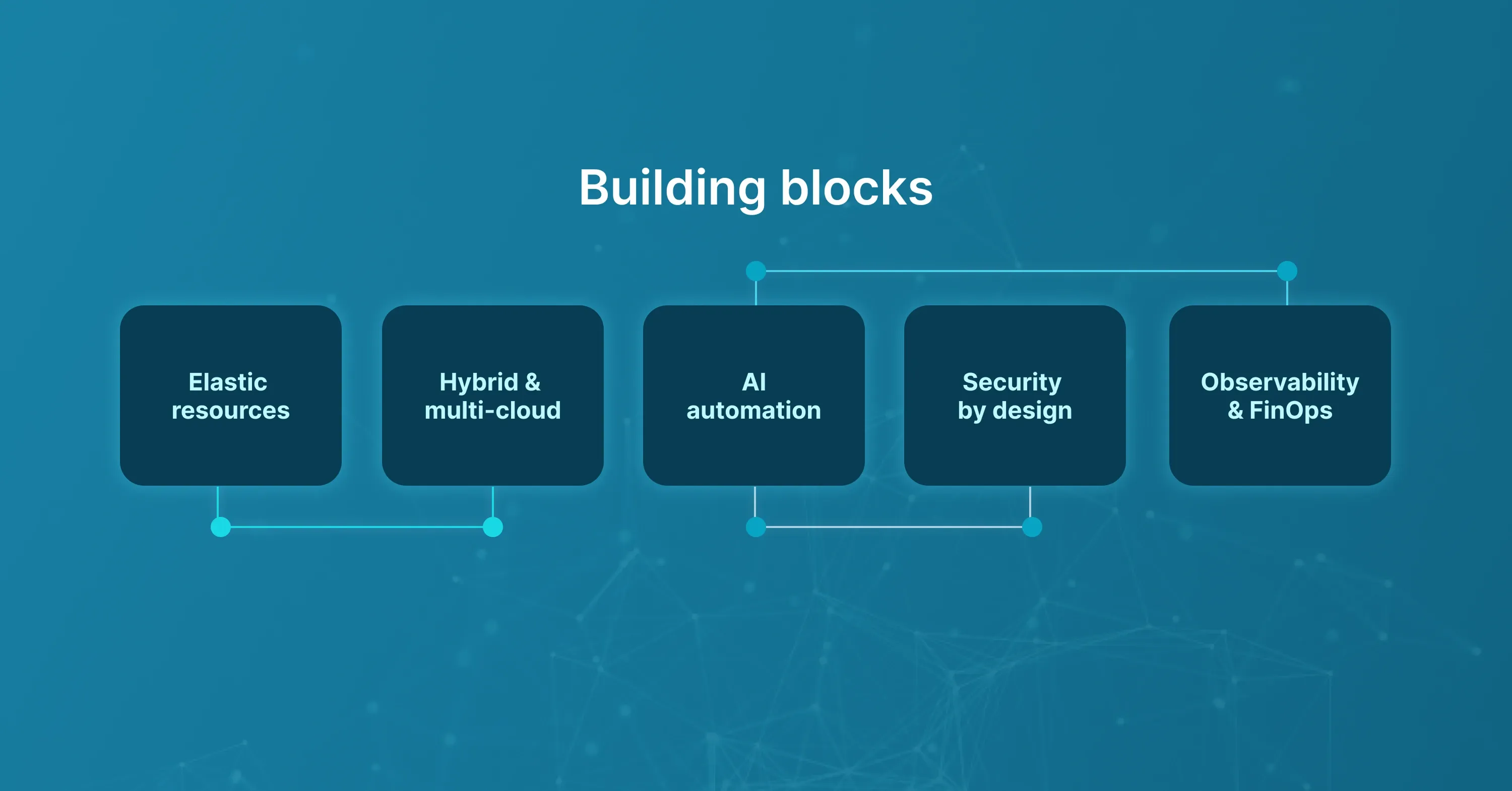
Building Blocks of a Next-Gen Platform

A blue infographic titled “Building blocks” showing five connected blocks: Elastic resources, Hybrid & multi-cloud, AI automation, Security by design, and Observability & FinOps.

Before drafting roadmaps, nail down the technical cornerstones. Each component propels scalable infrastructure and keeps complexity in check.

1. Elastic Compute, Storage, and Networking

Elastic resources let workloads expand during holiday traffic or contract overnight.

  • Auto-scaling groups add or remove VMs by policy
  • Container orchestration (Kubernetes) scales microservices in seconds
  • Object storage tiers shift cold data to cheaper classes automatically

Smart capacity means developers stop guessing size, and finance pays only for what is used.

Elasticity alone is not enough. You also need consistency across clouds. For more on scalable cloud environments, see our Cloud Services and DevOps solutions.

2. Hybrid and Multi-Cloud Fabric

Hybrid connects on-prem systems with cloud resources. Multi-cloud adds two or more public providers. Together they offer resilience and choice.

Key enablers:

  • Unified identity and access management
  • Low-latency connectivity (direct links or SD-WAN)
  • Common observability stack for logs, metrics, and traces

A business agility boost comes from deploying workloads where they perform best or where compliance requires.

With fabric in place, you are free to place each service on its optimal platform. Learn how Managed IT Services can help you unify and manage complex, multi-cloud landscapes.

3. AI-Powered Automation

Gartner’s Sid Nag notes AI is “accelerating the role of cloud computing.” Automation now extends from build pipelines to self-healing operations.

  • ML-driven capacity forecasting prevents overspend
  • Policy engines remediate misconfigurations in minutes
  • Chatbots surface cost anomalies for FinOps teams

Outcome: Fewer incidents, tighter budgets, and happier customers - all driven by predictive operations and intelligent monitoring.

4. Security and Compliance by Design

Hybrid models increase the attack surface. Bake controls into code.

  • Infrastructure-as-Code templates embed encryption and least privilege
  • Continuous compliance scans flag drifts before audits
  • Centralized key management and secrets rotation

When security shifts left, releases move right on time. Discover best practices for proactive cyber defense with our Information Security services.

5. Observability and FinOps

Visibility without action is vanity. FinOps couples monitoring with spending insights.

  • Tagging standards map every dollar to a product team
  • Usage dashboards reveal zombie resources
  • Alert thresholds prevent crossing budget lines

Flexera found 61 % of large enterprises now deploy multi-cloud security tools and 57 % use dedicated FinOps platforms. Follow their lead to avoid bill shock. If you're looking for holistic operational support, explore the breadth of our Services designed for cloud-driven organizations.

Marry these five blocks and you get an architecture that scales with demand, not with headcount.

Turning Theory into Daily Practice

Technologies are essential, but culture drives sustained results. Let’s translate platform ideals into workflows your teams use every day.

Continuous Delivery as Default

Start with a short overview: Release speed is the ultimate metric of agility. Weekly or daily deployments outpace rivals still shipping quarterly.

  • Adopt trunk-based development and short-lived feature branches
  • Automate build, test, and deploy pipelines end to end
  • Gate every merge with security, performance, and cost checks

When code flows freely, new features reach customers faster - often before competitors even spot the opportunity. For teams, that means smoother releases, fewer delays, and a stronger connection between innovation and delivery.

Cloud FinOps Rituals

Cost control is not a once-a-month spreadsheet review. Make it a collaborative habit.

  • Daily cost anomaly alerts in chat channels
  • Weekly optimization stand-ups with engineering and finance
  • Quarterly reserved instance and savings plan evaluations

Flexera reveals 29% of companies spend over $12M annually on cloud infrastructure.Regular FinOps rhythms shrink that number without hurting innovation.

Site Reliability Engineering (SRE)

SRE bridges dev and ops, focusing on service levels.

  • Define clear SLOs (availability, latency) for each service
  • Use error budgets to balance release velocity and stability
  • Hold blameless postmortems and track toil elimination

Result: Systems stay reliable while teams keep moving fast.

Partnering with Experts

Even with mature teams, outside help can accelerate progress. A leading provider of managed IT services can step in to manage infrastructure, strengthen cybersecurity, and steer modernization projects so in-house staff focus on core products. Choose partners with the industry breadth and expertise found in our Industries coverage.

Choose partners who treat your goals as their own and transfer knowledge along the way.

What is Cloud Solutions?

Cloud solutions are on-demand computing resources and services - such as servers, storage, databases, and software - delivered over the internet. They let organizations add or remove capacity instantly, pay only for what they use, and tap global infrastructure without owning physical hardware.

Conclusion

Be Cloud is more than just a slogan - it’s a strategic mindset that treats cloud as the foundation for sustainable growth. By uniting elastic resources, hybrid flexibility, AI-driven automation, and disciplined FinOps, businesses gain both agility and efficiency. The transformation requires technical evolution and cultural alignment, but the reward is a resilient platform built to scale, adapt, and thrive in any market condition.

A next-gen platform goes beyond basic virtual machines. It offers native container services, AI-driven automation, integrated security, and built-in FinOps tooling. These features let teams innovate faster while controlling cost and risk.

Hybrid cloud blends on-prem hardware with at least one public cloud. Multi-cloud uses two or more public providers. Companies often combine both approaches to keep sensitive data on-site while running scalable workloads across several vendors.

Not always. While variable pricing can reduce capital expense, poor governance and over-provisioning will inflate bills. FinOps practices, rightsizing, and commitment discounts are vital for actual savings.

AI analyzes telemetry to predict demand surges, detect security anomalies, and recommend cost optimizations. It augments human engineers, enabling faster decisions and reducing incident response time.

Yes. Managed services and platform abstractions remove complexity, so smaller teams can launch globally, compete with larger rivals, and scale without hiring vast operations staff.

Schedule a Meeting

Book a time that works best for you and let's discuss your project needs.

You Might Also Like

Discover more insights and articles

Abstract visualization of interconnected data streams representing digital marketing automation, data integration, and performance-driven decision systems

Why Outsourcing Your DevOps Platform is 2026’s Smartest OpEx Move: managed it services and support

Leading CFOs have a new line item keeping them up at night: the spiraling cost of in-house DevOps. Salaries keep climbing, outages remain unforgiving, and security demands never sleep. The question is no longer “do we need DevOps?” but “do we still need to build it ourselves?”

This article walks through the facts, the math, and the risk calculus behind the Build-vs-Buy decision, showing why a managed DevOps model delivers nonstop expertise, lower exposure, and smoother cash flow for less than one senior engineer’s payroll.

The image depicts an advanced enterprise AI chip embedded in a digital circuit board, visualizing neural network processing and high-performance computing architecture

Cyber-Resilience: Why 2026 Boards are Trading Protection for Immunity

Modern boards are staring at a blunt truth: threat actors now move faster than any human response plan. A single ransomware strike can wipe decades of data, paralyze revenue, and sink market value overnight. Buying more perimeter tools will not calm the boardroom. Ensuring the business never stops will.

Below is a practical roadmap for CISOs, IT Directors, and Business Continuity Managers who need to move their IT and business services from brittle protection to digital immunity before the next quarterly review.

The image shows a high-performance AI processor chip on a circuit board with flowing data streams, representing neural computing and modern enterprise IT architecture

The Sovereignty Shift: Navigating Data Residency and Corp IT Solutions in a Borderless Cloud

In 2026, the question is no longer just whether your data is in the cloud, but exactly which legal jurisdiction that cloud inhabits. For Chief Information Officers and Risk Officers, particularly in regions like the Gulf Cooperation Council (GCC) and Canada, the physical location of a server now carries as much weight as its uptime or security.

This article examines the critical transition from general public cloud strategies to the era of the Sovereign Cloud. We will explore how mid-market firms and large enterprises can navigate strict data laws in Saudi Arabia, the UAE, and beyond. You will learn how to design hybrid architectures that keep sensitive information within national borders while still leveraging global innovation, ensuring yourdigital enterpriseremains compliant and competitive.

Futuristic digital network illustration showing cloud infrastructure with glowing data flows, interconnected circuits, and real-time processing across a modern IT system

How to Build a Cloud Services Support Model That Scales

Cloud leaders love the flexibility of the public cloud, yet many still struggle to support thousands of fast-changing workloads without hiring armies of engineers. By 2026, operational excellence will be judged by a single metric: the Engineer-to-Instance ratio. The lower the ratio, the more resilient the platform—and the more strategic the IT budget.

Below is a practical, end-to-end playbook for CTOs, CIOs, and FinOps leaders who want a cloud services support operation that grows automatically with the business instead of linearly with headcount.