Why Legacy Environments Create Operational Drag
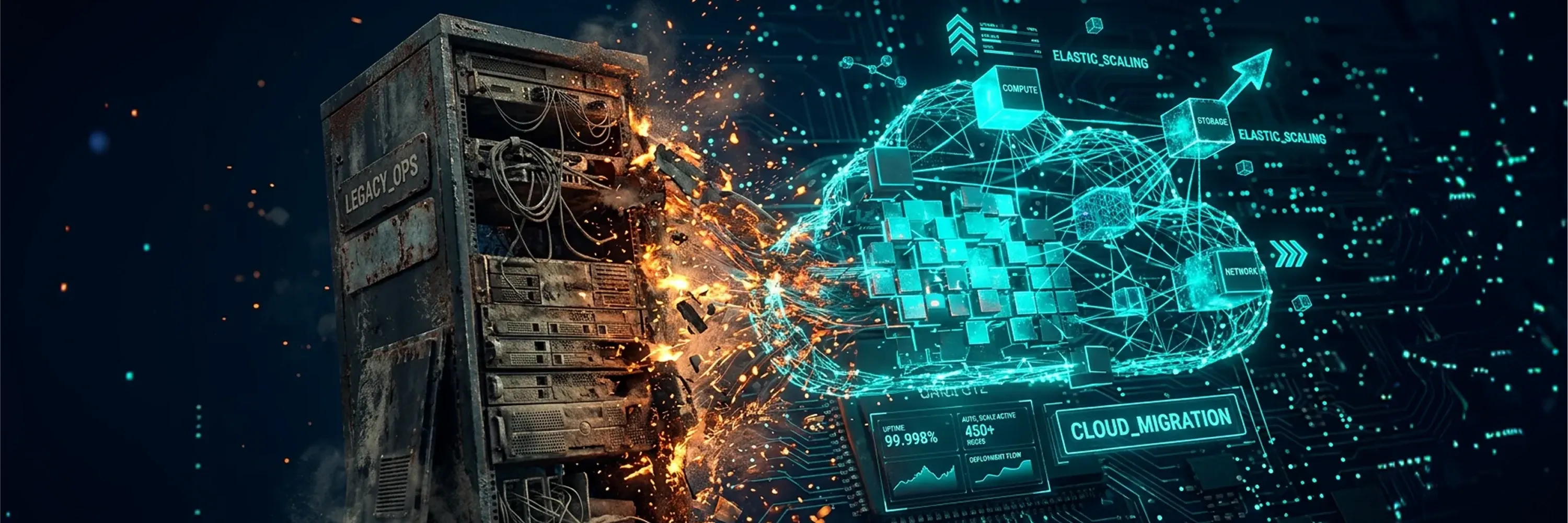
Before exploring how on-cloud solutions change things, it helps to understand why legacy environments hold organizations back. Legacy infrastructure, meaning older systems built around physical servers, fixed licensing, and manual configuration, was designed for predictability. It was never built for the pace and complexity of modern business.
Teams running legacy environments often face a common set of constraints:
-
Provisioning new capacity takes weeks or months, not minutes
-
Scaling up requires purchasing and installing physical hardware
-
Maintenance windows create regular service disruptions
-
Patching, monitoring, and incident response depend heavily on manual effort
-
Integrating new tools or services with rigid architectures is slow and expensive
These limitations do not just slow IT down. The entire business slows with it. When infrastructure cannot keep pace with demand, product launches stall, customer experience suffers, and teams spend more time maintaining systems than improving them.
This is precisely where on-cloud solutions enter the picture, not as a simple replacement for old hardware, but as a different way of running operations altogether. For organizations seeking a foundational understanding of cloud options, migration pitfalls, and practical operating models, see What Is Cloud Infrastructure? A Beginner’s Guide to Cloud Computing.
What Organizations Usually Underestimate
Most organizations underestimate how much the cloud transition affects people and processes, not just technology. Teams assume that once workloads move, operations improve automatically. In practice, the opposite often happens first: new tooling exposes gaps in ownership, decision-making, and accountability that legacy environments had obscured for years. Cloud infrastructure moves fast; organizations that have not redesigned their operating model to match will find that speed creates chaos rather than efficiency.
How Operating Responsibilities Change
In legacy environments, infrastructure teams own the stack end to end - hardware, networking, storage, and deployment. In cloud environments, that model breaks down. Platform teams shift to building and governing shared services, while product and application teams take on direct responsibility for deploying, monitoring, and scaling their own workloads. This handoff is one of the most common sources of friction during migration: ownership boundaries that were clear on-premises become ambiguous in the cloud until new operating agreements are established.
How Teams Measure Success
Legacy operations are typically measured by uptime and ticket resolution time. Cloud operations require a different set of metrics. The most mature cloud teams track: deployment frequency, change failure rate, mean time to recovery, infrastructure provisioning time, cloud cost per workload, and environment consistency and drift rate. Without these metrics in place, it is difficult to know whether cloud operations are actually improving or simply running on newer infrastructure.
How On-Cloud Solutions Reshape Day-to-Day Operations
The most important thing to understand about cloud operations is that the value is not in the infrastructure itself. It is in the operating model that cloud infrastructure enables. When teams move to on-cloud solutions, they gain the ability to manage workloads, deploy services, and respond to change in fundamentally different ways.
Cloud-based operations introduce several practical shifts:
-
Faster provisioning: New environments spin up in minutes through automation, removing bottlenecks that once took weeks
-
Elastic scaling: Resources grow and shrink based on real-time demand, so teams stop over-purchasing capacity "just in case"
-
Reduced maintenance overhead: Cloud providers handle hardware upkeep, patching, and much of the underlying security, freeing internal teams to focus on higher-value work
-
Greater visibility: Centralized dashboards and monitoring tools give operations teams a clear view across all environments, whether cloud-native, hybrid, or multi-cloud
-
Built-in redundancy: Cloud platforms offer automated failover and disaster recovery capabilities that are expensive and complex to build on-premises
These changes are not abstract. They affect how teams coordinate across development, operations, security, and business functions every single day. Cloud computing enables faster time to market, simplified innovation and scalability, and reduced risk compared to legacy platforms, while giving organizations access to advanced analytics that older systems simply cannot support.
The result is an operating model where responsiveness replaces rigidity. Teams can deploy services faster, experiment with less risk, and adjust resource allocation without filing procurement requests. To understand how modern DevOps teams are using cloud as a delivery strategy - balancing rapid deployments with observability and automation across environments - read How Are DevOps Teams Using the Cloud Differently Today?.
Planning and Executing the Migration Without Disruption

Understanding the benefits is one thing. Getting there without breaking what already works is another. Many organizations operate in hybrid or transitional states for months or even years during a cloud migration. This makes planning, workload assessment, and integration strategy critical.
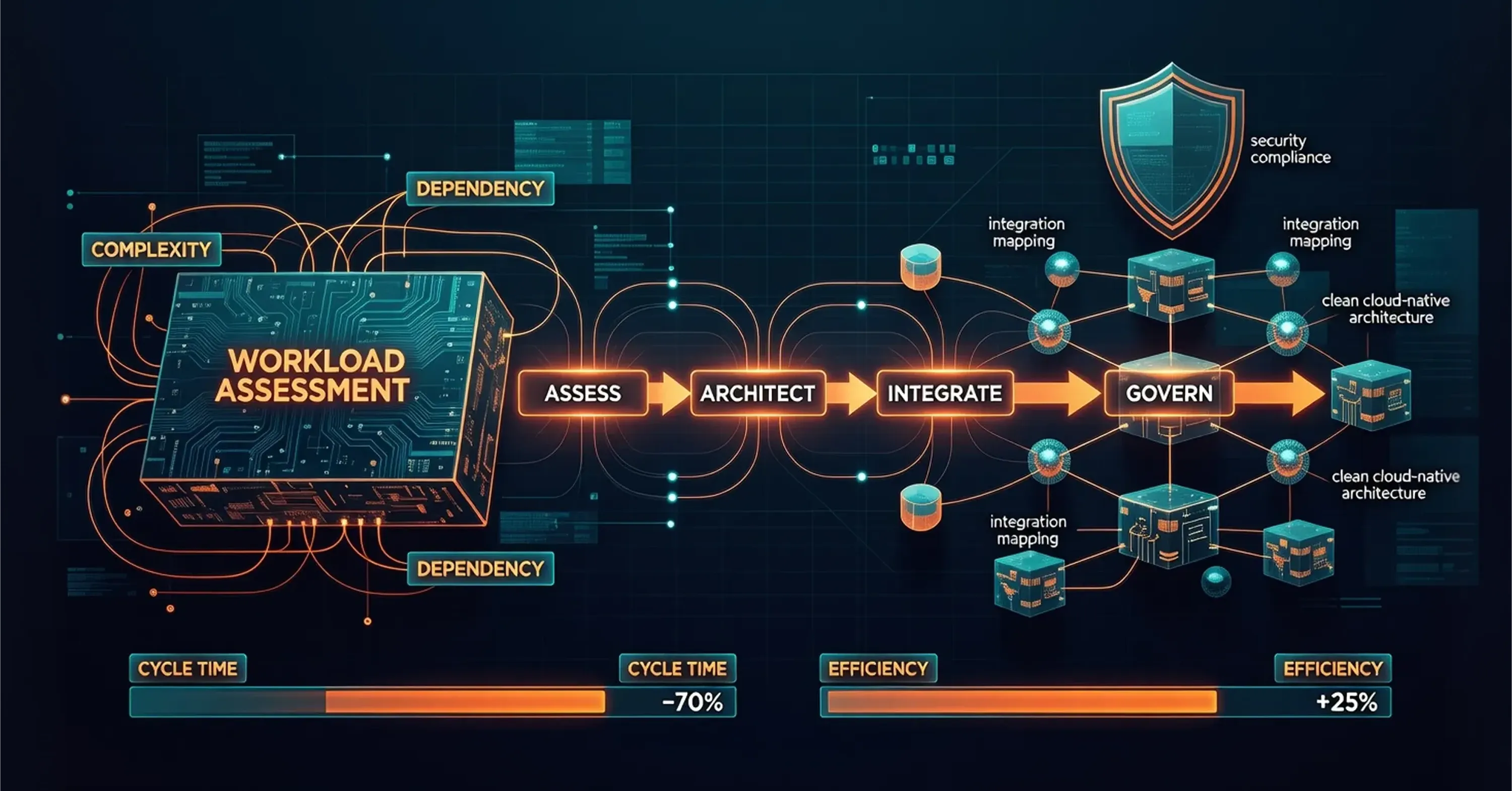
A well-executed migration typically follows a structured sequence:
-
Workload assessment: Not every application belongs in the cloud. Teams evaluate each workload based on complexity, dependencies, performance requirements, and business criticality.
-
Architecture decisions: Some applications can be "lifted and shifted" with minimal changes. Others need to be refactored, meaning redesigned to take advantage of cloud-native capabilities like containerization and microservices.
-
Integration mapping: Cloud services must connect reliably with existing systems, databases, and business-critical processes. Poor integration leads to data silos and broken workflows.
-
Governance and security: Moving to the cloud does not eliminate the need for controls. Organizations must define policies around access, data residency, compliance, and cost management from the start.
One common mistake is treating migration as a purely technical project. In practice, the organizations that see the strongest results are those that transform their operating model alongside the migration itself. Companies that do both can increase operational efficiencies by 20 to 25%, reduce cycle times up to 60 to 70%, and improve resilience and security of their applications by more than 30%.
For a robust breakdown of workload assessment, cloud architecture decisions, and steps to avoid the pitfalls of cloud transitions, explore Cloud Architecture Design: Building Scalable and Secure Cloud Architectures.
This is where partners with deep infrastructure and cloud expertise become valuable. A managed IT services provider, for instance, can help organizations navigate workload assessments, design integration architectures, and maintain business continuity during complex transitions, reducing the risk that migration creates more problems than it solves.
Migration Models: Choosing the Right Approach
Not all workloads move the same way. The four most common migration patterns are: rehost (lift and shift - move the workload as-is), replatform (make targeted optimizations without redesigning), refactor (redesign for cloud-native capabilities like containers), and retain (keep certain workloads on-premises where migration does not yet make sense). Choosing the wrong model for a given workload is one of the most common and costly migration mistakes.
Hybrid environments deserve particular attention. Running workloads across on-premises and cloud simultaneously creates operational complexity that is easy to underestimate. Teams must manage two sets of tooling, two security perimeters, and two sets of processes. Organizations in extended hybrid states need explicit governance over who owns what, how incidents are triaged across environments, and how costs are tracked.
Building Resilience, Observability, and Long-Term Adaptability
Once workloads are running in the cloud, the operational focus shifts from migration to optimization. This is where many organizations discover the deeper advantages of on-cloud solutions: improved observability, stronger disaster recovery, and the ability to adapt continuously.
Observability, meaning the ability to understand what is happening inside your systems based on their outputs, is significantly easier in cloud environments. Cloud platforms provide native logging, tracing, and monitoring tools that give operations teams real-time insight into performance, errors, and resource usage across distributed systems.
Disaster recovery also improves substantially. Cloud-based backup and replication services allow organizations to recover from outages faster and with less data loss than traditional on-premises approaches. In many cases, recovery processes can be automated entirely, reducing the human error that often compounds incidents.
For a deeper look at how cross-cloud architectures and modern platforms power truly resilient, observable, and scalable operations, see Be Cloud: The Next-Gen Platform for Scalable Business.
Perhaps most importantly, on-cloud operations support long-term adaptability. As business needs change, cloud environments can be reconfigured, expanded, or restructured without the capital expense and lead times that legacy infrastructure demands. This flexibility extends to emerging capabilities as well: 42% of respondents in a recent survey reported that cloud migration helped introduce AI or machine learning into their innovation processes, showing that the cloud also serves as a platform for future capability.
None of this happens automatically. Resilience, observability, and adaptability require intentional architecture decisions, disciplined governance, and ongoing investment in operational maturity.
What On-Cloud Operations Actually Look Like
On-cloud operations look different from legacy management in ways that go beyond technology. Ownership shifts: platform and infrastructure teams move from maintaining hardware to governing policies, guardrails, and shared services that product teams consume on demand. Operating processes change too - instead of change management boards approving deployments over weeks, teams ship through automated pipelines with built-in testing and rollback.
Success is measured differently as well. Metrics like deployment frequency, mean time to recovery, and change failure rate replace uptime SLAs as the primary indicators of operational health. Organizations that struggle most in this transition are typically those that adopt cloud tooling without redesigning these underlying processes - replicating old approval chains and manual handoffs inside a new environment.
The most common failure points are predictable. Teams migrate workloads without updating ownership agreements, leaving no clear owner when incidents happen. Monitoring is treated as an afterthought rather than a requirement, so problems surface only after users report them. Cost management is ignored until cloud bills arrive, at which point sprawl is already difficult to reverse. And security controls that worked on-premises are not automatically carried over - organizations that skip this step often discover the gap during an audit or an incident, not before.
Mature cloud operations require sustained investment in three areas: automation that eliminates repetitive manual work, observability that surfaces problems before they become incidents, and a culture where teams own their services end to end rather than handing off between siloed functions.
Conclusion
A mature cloud operating model has a few recognizable characteristics. Deployments happen frequently and with low risk, because automation handles testing and rollback. Incidents are detected and resolved quickly, because observability is built into every service. Teams own their services end to end, without handoffs between siloed functions. Infrastructure costs are visible and attributed to specific workloads.
Organizations that reach this state did not get there by migrating faster. They got there by treating the operating model as the product, and investing in it with the same discipline they apply to the applications running on top of it.