Automating IT Scaling: The Future of Elastic Infrastructure

Content authorBy Irina BaghdyanPublished onReading time14 min read
Title:
Automating IT Scaling: The Future of Elastic Infrastructure

Meta description:
Discover unclustered methods to automate your IT scaling so you can reduce cloud waste and maintain speed under he

Automated scaling turns capacity management from a human-triggered task into a continuous system that watches live conditions and allocates resources in real time according to policy. It reads signals like latency and queue depth, then adds or removes capacity in seconds. That shift makes infrastructure respond at machine speed instead of ticket speed.

How does automation transform infrastructure scaling?

Automation converts scaling from a reactive chore into a policy-driven capability that runs on its own, so capacity matches demand as conditions change. Instead of an engineer using a dashboard to provision after the fact, the system evaluates live signals against defined rules and acts before performance suffers. The decision loop closes without a human in it.

The distinction that matters here is the operating model. A pile of scaling scripts still depends on someone to run and tune them. An automated scaling system encodes intent through capacity ceilings, with target utilization goals tied to response thresholds, then enforces that intent continuously. Datadog's 2025 State of Containers and Serverless report found that 64% of Kubernetes organizations use Horizontal Pod Autoscaling, and 86% of those users run it across most or all of their clusters.

That adoption pattern tells you something the raw number doesn't. Teams widen automation after trying it because the operational cost of manual intervention grows with every new service. Treating elastic scaling as a governed capability rather than a convenience is what separates infrastructure that keeps up from infrastructure that falls behind.

Why does manual scaling fail modern workloads?

Manual provisioning fails because human-speed decisions cannot track machine-speed demand shifts, which produces delayed responses and chronic overprovisioning at the same time. When capacity planning happens on a quarterly cycle and provisioning runs through tickets, the infrastructure is always sized for a guess about the past, never for the load arriving now. You either pad for peak and pay for idle, or you size lean and degrade under spikes.

Containerized and hybrid environments make this worse because workloads shift in seconds. A person cannot watch queue depth across dozens of services and react before users feel it. The financial evidence is direct. Flexera's 2026 State of the Cloud Report found that 29% of cloud spend is wasted: the first increase in five years, following a steady decline from 32% in 2021. Overprovisioned and idle compute remain leading categories, a gap AI-driven workload complexity is now widening rather than closing.

What that consistency reveals is telling. Waste at that level year after year is the structural outcome of static planning applied to dynamic load. As long as capacity decisions run on human cycles, the gap between what you provision and what you use stays baked in. That's the case for change you can take to a budget conversation.

There's a cost above the compute bill, too. The engineers capable of hand-tuning scaling scripts and firefighting capacity incidents are the same people a CTO can least afford to lose to that work: senior infrastructure talent is scarce, expensive, and meant to be building the product features that generate revenue, not babysitting thresholds at 2 AM. Every hour a senior engineer spends manually adjusting capacity is an hour not spent on the roadmap. Framed as a build-vs-buy decision, the choice isn't really "build our own automation or buy someone else's" — it's whether your best engineers are doing infrastructure maintenance or product work. Handing the scaling layer to a dedicated partner is the fastest way to get that capacity back.

What technologies enable automated elastic infrastructure?

f4pale9awefszbsicmijqud1xvqw3_c2e1ac20ad.webp

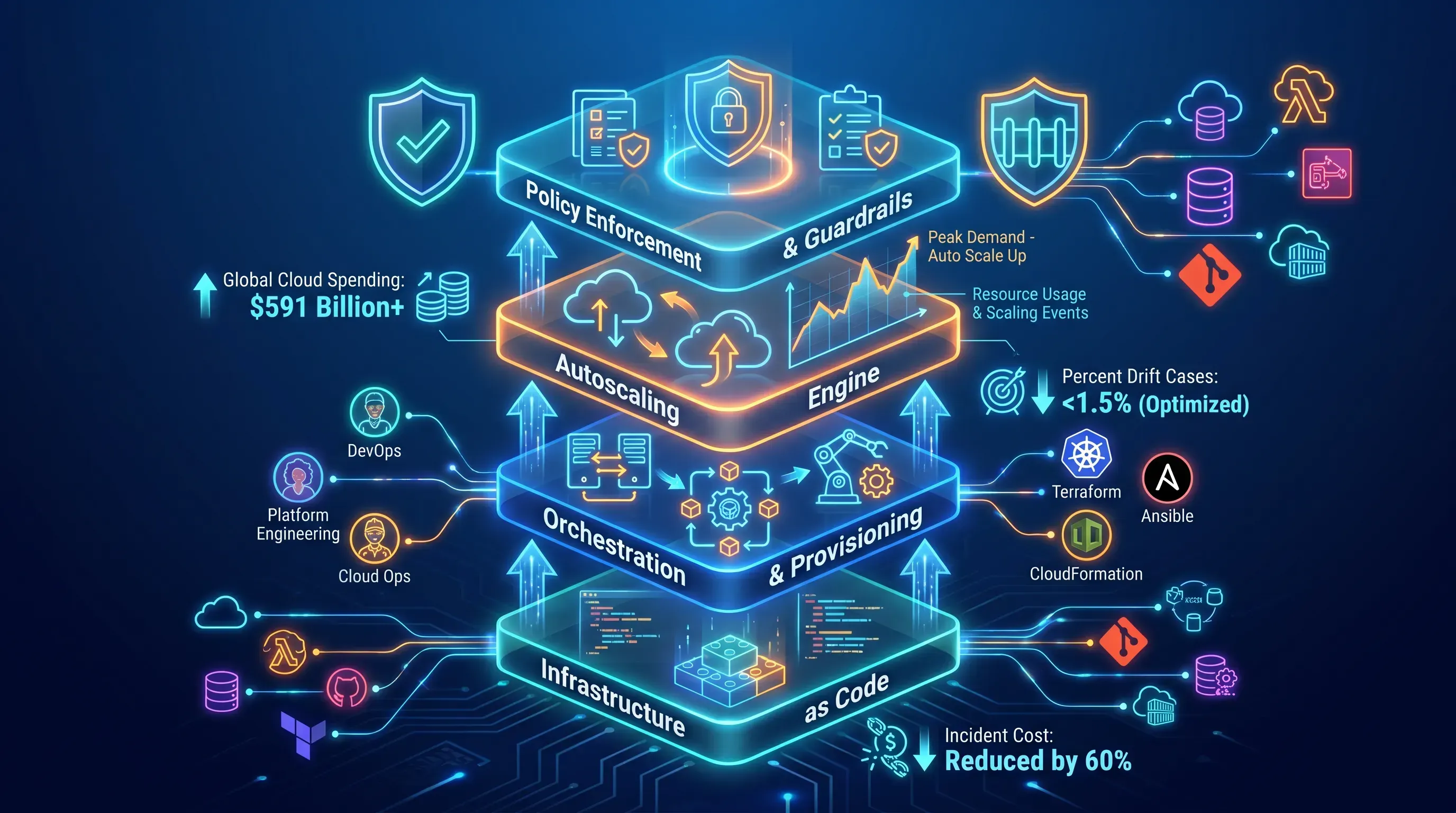
Elastic infrastructure rests on a coordinated stack where provisioning and orchestration work with policy enforcement across cloud-native services rather than one product. Each layer handles a distinct job. Provisioning defines what capacity looks like, while orchestration adds or removes it within policy boundaries. Remove any layer and the others lose their footing.

The stack matters because scaling quality depends on how these pieces coordinate. Gartner forecasts worldwide public cloud spending at $723.4 billion in 2025, up 21.5% year over year, which means the coordination problem now carries real financial weight at scale.When you map your own environment, treat each capability below as a decision you own rather than a default you inherit.

  • Infrastructure as Code defines capacity and autoscaling configuration in version control.

  • Orchestration platforms watch runtime signals and adjust capacity against policy.

  • Policy-based automation encodes governance directly into scaling behavior.

The practical read here is that buying a managed autoscaler solves one layer of the system. Teams that skip the provisioning and policy layers end up with fast scaling and no guardrails, which is how automation turns expensive.

Need IT Support?

Book a free consultation with ABS Technologies experts we'll help you find the right managed IT, cloud, or security solution for your business.

Book a Free Consultation

How does Infrastructure as Code support scaling?

Infrastructure as Code (IaC) makes scaling repeatable and auditable by defining capacity and autoscaling configuration as version-controlled code deployed through continuous integration and continuous delivery (CI/CD) pipelines. When your scaling policy lives in a repository, every change is reviewed and reversible from the change record, which removes the manual console edits that quietly break consistency.

That control directly attacks configuration drift, the slow divergence between intended and actual state. Env0 estimates direct human changes through cloud consoles account for nearly 90% of drift cases, a pattern known as ClickOps. If most drift comes from manual intervention, then defining scaling behavior as code and enforcing it through pipelines closes the largest opening for it. The lesson for teams already using IaC is to bring autoscaling parameters under the same version control as everything else, because a scaling policy edited by hand is the exact failure mode IaC exists to prevent.

ClickOps usually happens because teams are understaffed and the console edit is faster than opening a pull request under deadline pressure. That's a staffing problem as much as a discipline problem, and it doesn't resolve itself by writing a stricter policy; it resolves by removing the pressure that causes the shortcut in the first place. Outsourcing the foundational infrastructure layer to a dedicated team addresses this directly: a partner whose entire mandate is infrastructure has no deadline pressure pulling them toward a console shortcut, so IaC discipline holds by default instead of eroding under load. That's an instant maturity gain an internal team under-resourced for the task can't easily replicate on its own.

What role do orchestration and autoscaling play?

Orchestration platforms and autoscaling mechanisms watch runtime signals like CPU, while request count feeds the same policy checks as queue depth, then add or remove capacity without anyone touching a console. This is where scaling actually happens at runtime. Cluster autoscaling adjusts the node pool, and event-driven scaling reacts to signals like message backlog. Horizontal scaling handles replica count changes.

The depth of adoption shows this works in production. Datadog's 2025 State of Containers and Serverless report found that among organizations using Horizontal Pod Autoscaling, 86% run it across most or all of their clusters. Teams don't extend a mechanism that broadly unless it holds up under real load. For teams running containers, the practical move is choosing the scaling type that fits the workload's behavior, because CPU-based horizontal scaling and queue-based event scaling solve different problems and mixing them up produces slow reactions.

Why does policy-based automation matter?

Policy-based automation keeps scaling safe by encoding governance directly into scaling behavior through guardrails like enforced upper bounds and scale-in protection on stateful tiers. Consistency here is engineered. A maximum instance cap stops a runaway loop from launching hundreds of nodes, and scale-in protection keeps automation from tearing down capacity that stateful services depend on.

The cost of missing guardrails is concrete. As Opsolute illustrates, a misconfigured scaling policy with no spending limit can launch hundreds of instances overnight. A single faulty health check triggering continuous replacements is enough to produce a $50,000 bill.

That scenario makes the point that automation without bounds amplifies mistakes at machine speed, but the inverse is just as important for technical leaders weighing risk. Guardrails aren't only cost control; they're how compliance gets built into the architecture instead of bolted on afterward. When scaling limits, approval boundaries, and audit trails are encoded as policy rather than left to individual judgment calls, an organization can meet and maintain standards like ISO 9001 without adding a manual review step that slows every deployment down. That's a meaningful signal about an MSP's maturity: a partner who designs scaling architecture with governance built in from day one is operating at enterprise standard by default, not retrofitting controls after an incident forces the issue.

How do telemetry and observability trigger scaling?

Real-time telemetry and observability platforms supply the metrics that trigger scaling actions, which means scaling quality is only ever as good as the signals feeding it. The monitoring layer captures latency and saturation, while throughput and error rate also feed the autoscaler for evaluation against policy. Bad signals produce bad scaling, no matter how well the rest of the stack is built.

The choice of trigger metric shapes accuracy more than most teams expect. Google's SRE guidance shows that a simple average obscures tail latency, where a typical request finishes in about 50ms while 5% of requests run 20 times slower. If you scale on average CPU, you miss the tail that users actually feel, which is why latency-based triggers respond to real experience earlier than CPU thresholds do. The implication is that your trigger selection is a design decision with user-facing consequences, and defaulting to CPU because it's the easy metric leaves you scaling on the wrong signal.

The maturity gap here shows up less in which metrics you track and more in how continuously you act on them. Automated scaling is preventative medicine. This of it as a routine blood-pressure check that catches a problem while it's still trivial to fix. Manual intervention is the 3 AM emergency-room visit: the same underlying issue, caught only once it's a crisis, and handled under far worse conditions. The difference isn't the health of the patient at any single moment; it's whether someone was watching continuously enough to act early. That continuous watch is also where internal teams burn out fastest: someone has to own the pager, and eventually every anomaly starts to look like a threat. A strategic partner that owns the monitoring layer absorbs that load directly, so your team sees the signal, not the noise.

Need IT Support?

Book a free consultation with ABS Technologies experts we'll help you find the right managed IT, cloud, or security solution for your business.

Book a Free Consultation

How does AI enable predictive scaling?

AI and machine learning move scaling from reactive to proactive because models learn usage patterns and forecast demand so capacity is provisioned ahead of a surge instead of after it. Reactive autoscaling waits for a threshold breach, then scales, which leaves a gap where performance degrades. Predictive models close that gap by reading historical load and scaling out before the spike lands.

The requirements are specific, and architects should plan around them. Amazon's documentation states that predictive scaling needs at least 24 hours of historical data to begin forecasting and analyzes up to the past 14 days to find patterns before it generates an hourly forecast for the next 48 hours. What that data dependency tells you is where predictive scaling fits and where it doesn't. It models recurring patterns, daily and weekly cycles, extremely well, but a brand-new service or a sudden unpredictable event gives it nothing to learn from. That's why the strongest setups pair predictive scaling for known rhythms with reactive scaling for the spikes no model saw coming.

What does automation handle without human intervention?

Once automated, elastic infrastructure provisions resources and balances workloads while failure recovery sustains availability across cloud and hybrid environments that include containers. The daily operational load that used to fill an engineer's queue shifts to the system: capacity adjustments and utilization tuning run continuously without a ticket, as do health-based replacements and traffic distribution.

This breadth is why the operational category behind it is growing fast. Market.us valued the U.S. AIOps market at $4.86 billion in 2024 with a projected 26.7% compound annual growth rate, driven by demand to reduce downtime and automate routine tasks. Growth at that rate signals that the shift from manual toil to automated execution is already the direction of the market. The practical takeaway is that the tasks moving to automation are the repetitive, time-sensitive ones humans do worst, which frees your team for the architecture and design work only they can do.

What business outcomes does elastic infrastructure deliver?

Intelligent automation delivers faster response to demand and better application performance, while operational overhead falls and costs become more predictable as engineers move out of infrastructure firefighting. These outcomes connect directly to the technical mechanisms already covered. Policy-driven scaling cuts the idle capacity that drives waste, and predictive models protect performance during surges. Observability-triggered actions reduce the incidents that pull teams off roadmap work.

The cost outcome is the most measurable one for a business case. Flexera's 2026 data puts average cloud waste at 29%, but well-managed organizations can reduce that even further through rightsizing and autoscaling. Cutting waste by roughly half is a line item a finance team can verify against the bill.For a decision-maker building the case, that's the number to lead with, because it translates a technical capability into recovered budget that funds the next initiative rather than paying for idle compute.

Where does automated scaling go wrong?

Automated scaling goes wrong when poor policy design and inaccurate telemetry create instability, with excessive automation able to drive runaway costs or cascading failures. Architecture sets the intent that automation executes, so a flawed policy fails faster and larger than a human ever would, and bad telemetry makes the whole system react to signals that don't reflect reality.

The most common failure is thrashing, where capacity oscillates up and down in tight cycles. Modern autoscaling platforms address this by using cooldown and warm-up periods that prevent short-lived demand fluctuations from immediately triggering scale-in events. AWS, for example, recommends tuning scale-in cooldowns conservatively because overly aggressive scale-in behavior can lead to unnecessary capacity churn, cold starts, and increased latency. Rather than relying on a fixed delay, the cooldown should reflect how long your application needs to stabilize after a scaling event.

  • Test scaling policies under realistic load before trusting them in production.

  • Validate telemetry accuracy, because scaling on bad signals amplifies bad decisions.

  • Keep human oversight on caps and cooldowns, with stateful protections included.

Effective elastic infrastructure depends on governance and continuous monitoring, which means the goal is a supervised operating model, never a set-and-forget switch.

How to build resilient elastic infrastructure with ABS

The next step for adopting intelligent scaling without the failure modes above is a partner who covers the full stack, from provisioning and policy through telemetry and oversight. Elastic infrastructure works when architecture and automation are built under governance, which is where a managed services approach earns its place rather than leaving your team to assemble the layers alone.

ABS Technologies is a managed IT services provider whose Cloud Services and DevOps expertise, supported by AI-enabled operations, maps to exactly the stack discussed here: Infrastructure as Code and automated deployments, with monitoring tied to configuration management. Its engagement model starts with assessment, then uses benchmarking during ongoing support, so scaling policies are validated against your real workloads before they run unattended. The vendor-independent, security-focused approach means recommendations fit your environment rather than a single provider's catalog, and governance stays intact as you scale.

If you're modernizing infrastructure operations and want elastic scaling you can trust to run on its own, work with ABS Technologies as a long-term partner to build infrastructure that stays resilient and responsive under real load as it scales. Start with an assessment of your current scaling posture.

Need IT Support?

Book a free consultation with ABS Technologies experts we'll help you find the right managed IT, cloud, or security solution for your business.

Book a Free Consultation

Choose a metric that tracks the bottleneck users or workers feel first. For web apps, latency or request rate often works better than CPU alone. For worker services, queue age or backlog per worker gives a more useful signal. Review incident history and pick the metric that rose before past slowdowns.

No, automated scaling doesn’t replace capacity planning. It changes the planning task from exact server counts to limits, budgets, and failure boundaries. Teams still need forecasts for large events, regional capacity limits, licensing costs, and database growth, since autoscaling can’t add capacity that a provider or dependency doesn’t have.

Use scheduled scaling when demand changes at known times, such as a nightly batch job or a planned product launch. It’s simpler than predictive scaling because it follows a calendar. Predictive scaling fits recurring patterns that shift in size, such as weekday traffic that rises at different rates.

Prevent autoscaling from overwhelming databases by limiting app replicas, using connection pools, and setting per-service connection caps. A web tier can scale faster than a database accepts new connections. Test scale-out events with production-like traffic and watch query latency, lock waits, and connection count before raising limits.

No, don’t autoscale every workload by default. Short-lived stateless services, queue workers, and web front ends are good candidates because extra copies can start and stop safely. Fixed-size databases, licensed software, and jobs with long warm-up times need stricter controls or manual approval before capacity changes.

Schedule a Meeting

Book a time that works best for you and let's discuss your project needs.

You Might Also Like

Discover more insights and articles

Title:
Server Management Services: Keeping Critical Business Systems Reliable

Meta description:
See how server management services help you find upkeep gaps and keep business systems dependable.

Art

Server Management Services: Keeping Critical Business Systems Reliable

This article explains what server management services actually cover and how the individual disciplines connect into systems you can depend on. It walks through the core server-maintenance disciplines so you can audit your own environment and see which areas are handled well and which are quietly exposing the business.

Title:
Crafting a Cloud Strategy That Actually Works

Meta description:
See What defines a successful cloud strategy in 2026? You learn how to tie cloud choices to cost, control, and business goals.

Crafting a Cloud Strategy That Actually Works

This article frames cloud strategy as a business transformation framework. It explains why so many cloud programs underdeliver and shows how modern strategy connects deployment models with operating disciplines based on business requirements.

Title:
Designing Cloud Architecture That Grows with Your Business

Meta description:
See How to build cloud architecture for growth and security? You can plan cloud choices that scale while keeping ri

Designing Cloud Architecture That Grows with Your Business

This article is a strategic guide on designing cloud architecture that scales with a business without sacrificing secure control or resilience. It walks through scalable design, including the resilience and governance layers that keep growth manageable, plus the organizational realities that decide whether an architecture actually holds up. By the end, you will be able to assess your current setup and prioritize the decisions that let it evolve instead of forcing a rebuild.

Title:
How do businesses fast-track Azure deployment? What actually speeds rollout

Meta description:
So, how do businesses fast-track Azure deployment? You learn to build reusable foundations and aut

How do businesses fast-track Azure deployment? What actually speeds rollout

This article is for teams that have committed to Azure and keep watching dates slip. It compares the levers that genuinely shorten an Azure rollout against the shortcuts that look fast on a slide but create rework later. The distinction matters: fast rollout does not mean skipping governance or avoiding assessment. It means automating governance so it runs inside the pipeline and making assessment reusable and wave-based. The levers below are built on that principle.