Digital illustration of gears integrated into a circuit board representing AI automation and machine learning systems

IT Infrastructure Automation: How to Scale IT Infrastructure with Cloud Automation

Modern enterprises are overwhelmed by manual tickets, ad-hoc server builds, and late-night incident responses. The result is fragile infrastructure that struggles to scale when business demand suddenly increases. As organizations rely more heavily on cloud platforms and scalable storage services such as Amazon S3 to handle growing volumes of data - building on earlier cloud storage concepts introduced by services like Amazon Cloud Drive - the need for automated infrastructure becomes unavoidable. How can teams shift from constant firefighting to intelligent orchestration? This guide explains how to design an automated cloud backbone that scales in real time, allowing engineers to focus on architecture and innovation instead of repetitive operational tasks.

Content authorBy Irina BaghdyanPublished onReading time10 min read

Overview

You will learn a seven-step framework that starts with a frank audit of your current environment and ends with AI-assisted optimization loops. Along the way we will cover AWS cloud account setup, event-driven triggers, Infrastructure as Code (IaC), and how cloud platforms - supported by services such as Amazon S3 for scalable object storage, enabling infrastructure to grow dynamically with business demand. We will also explore the human shift from administrators to strategic architects. By the end, you will know exactly how to let your infrastructure scale at the pace of demand - without ballooning headcount or operational risk. Traditional infrastructure teams operate in reactive administration mode, responding to tickets and incidents. Automation transforms this model into proactive orchestration, where systems react automatically to real-time signals and business demand.

1. Audit and Map Your Current Environment

Before racing to automate, you need a precise map of what already exists and why.

  • List every application, its dependencies, and current scaling pain points

  • Capture performance baselines such as average latency, throughput, and error rates

  • Identify “snowflake servers”: machines configured by hand that nobody dares to rebuild

These details reveal where automation will offer the fastest win and where technical debt lurks.

Skipping an audit means you simply replicate chaos at higher speed. End this phase with a single source of truth - often a lightweight CMDB or an export from your AWS Config resource inventory - so every stakeholder sees the same diagram.

For a broader blueprint of what a next-gen cloud platform looks like and how it brings continuous automation and cost control into modern business IT, take a look at Be Cloud: The Next-Gen Platform for Scalable Business.

2. Design an Event-Driven Foundation on AWS Cloud

Traditional scale-out scripts run on schedules. In 2026, latency spikes or queue depth should instantly open the throttle.

Begin by defining business-level Service Level Objectives (SLOs) such as “p99 latency under 200 ms.” Then link those SLOs to measurable metrics inside Amazon CloudWatch.

  • Use Amazon EventBridge to capture threshold breaches

  • Trigger AWS Lambda functions that provision new nodes or shift traffic

  • Adopt AWS Auto Scaling groups with target tracking so capacity follows load, not the clock

Ending this step, you have a living system that reacts to user demand in seconds instead of hours.

To explore how elasticity and unified monitoring underpin event-driven scaling, see Breaking the Infrastructure Bottleneck: The Cloud Solution Behind a Unified Approach.

Event-Driven Scaling in Action

During a Black Friday campaign, a retailer set EventBridge rules so any API latency above 180 ms launched an extra cluster in the nearest AWS Region. Sales peaked at triple the previous year while infrastructure costs stayed flat because capacity shrank again overnight.

The design work here establishes the real-time nerve system your automation will rely on in later steps.

3. Secure and Standardize Your AWS cloud account setup

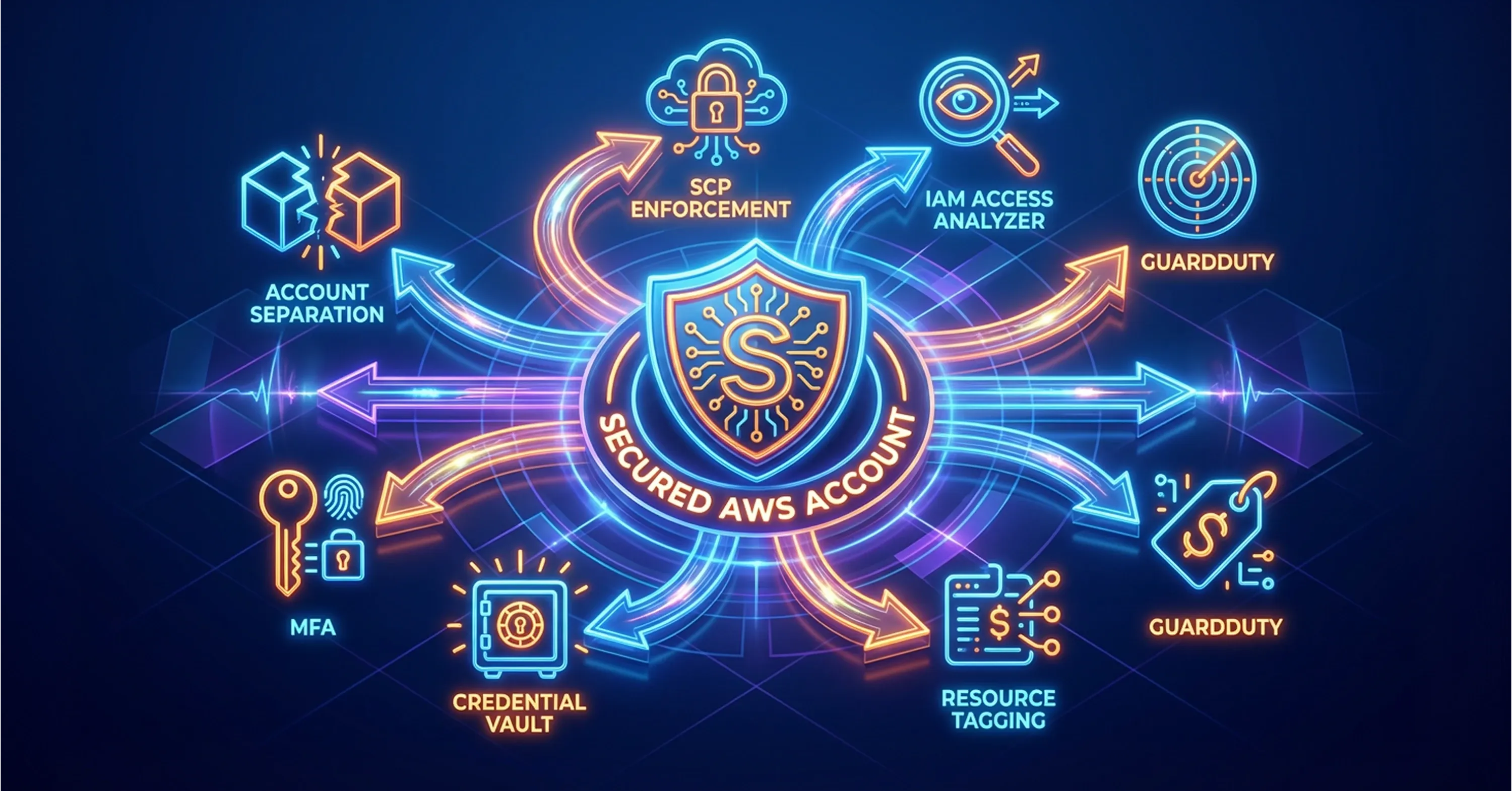
AWS cloud security architecture diagram showing account protection, IAM access analyzer, SCP enforcement, MFA, GuardDuty, and credential vault

Automation without governance simply spreads risk faster. Treat the AWS cloud account setup as code too.

  • Create separate AWS accounts (or Organizational Units) for dev, test, and prod

  • Enforce Service Control Policies (SCPs) that block forbidden services like public S3 buckets

  • Activate AWS IAM Access Analyzer and AWS GuardDuty for continuous security checks

  • Tag every resource with owner, environment, and cost center

Finish by sealing root user credentials in a hardware vault and enabling multi-factor authentication for every human user.

For a detailed look at unified security best practices, zero trust, and compliance for cloud accounts, see Cloud Managed Security: Unified Security Strategy for Cloud and Hybrid Environments.

4. Codify Infrastructure with Terraform and AWS CloudFormation

Manual clicks are the enemy of repeatable scale. Infrastructure as Code (IaC) tools let you declare what the environment should look like and let the engine figure out the “how.”

  • Store Terraform modules or CloudFormation templates in a shared Git repository

  • Use pull requests for peer review to catch misconfigurations early

  • Embed security linters (tfsec, cfn-nag) so issues never reach production

  • Version every module, allowing safe rollbacks instead of hot fixes

When a template changes, your Continuous Integration pipeline runs terraform plan or cfn-diff, shows the delta, then applies automatically if approved.

For a complete guide to automating infrastructure with code, tackling drift, and integrating AI into IaC pipelines, read Infrastructure as Code (IaC): How Infrastructure as Code Automates Cloud Deployments.

Build Guardrails Before You Scale

Infrastructure automation increases speed and consistency, but without guardrails it can also spread mistakes faster. Before extending automation across production environments, organizations need to ensure that every automated change is controlled, reviewable, and reversible.

Change safety should come first. Automated infrastructure updates need to pass through peer review, policy checks, testing, and approval gates before reaching production. Speed alone does not create resilient operations. Stability depends on reducing failed changes and restoring service quickly when something goes wrong.

Rollback and recovery should also be designed from the beginning. Every deployment should be tied to versioned Infrastructure as Code, backed by automated rollback paths, tested restore procedures, and the ability to rebuild environments predictably across regions or accounts.

Teams also need to verify that production continues to match the intended design over time. Drift detection, policy-as-code, and continuous compliance checks help prevent manual exceptions or undocumented changes from slowly weakening the environment.

Finally, automation at scale depends on strong identity and operating controls. Secrets should never be hardcoded, access should be role-based and time-limited, and teams should clearly define who approves changes, manages policies, responds to failed automations, and reviews AI-generated actions. The objective is not only faster automation, but safer and more reliable automation.

5. Replace Cron Jobs with Event Routing

Cron jobs poll on fixed intervals, wasting resources between fires. Shift to policy-based actions that fire precisely when needed.

  • Route CloudWatch alarms to EventBridge buses

  • Use AWS Step Functions for multi-step remediation like failover plus cache flush

  • Employ Amazon SNS for cross-account or on-call notifications

Decommissioning legacy schedulers not only cuts costs but also removes the guesswork from scaling rules.

6. Introduce AI Ops Agents for Continuous Optimization

By 2026, Large Language Models (LLMs) can generate and audit automation scripts in real time.

  • Feed Terraform plans to an LLM-powered agent to flag deprecated instance types

  • Integrate Amazon Bedrock with performance logs to recommend rightsizing actions

  • Let the agent auto-generate Ansible playbooks for patching based on the latest CVE feeds

Human engineers approve or tweak suggestions, focusing on business fit rather than syntax.

For a practical look at automating IT support and optimization with AI-driven tooling, see How to Build a Cloud Services Support Model That Scales.

AI-Driven Optimization in Infrastructure Automation

A streaming platform connected an LLM agent to its GitHub repository. The agent proposed converting 42 EC2 workloads to Graviton-based instances, saving 20% on compute costs. Engineers accepted 90 percent of the changes with minor edits.

AI augmentation means your automation matures daily, learning from fresh data and emerging threats.

7. Measure the Human ROI and Upskill Your Team

Automation is not a layoff strategy; it is a promotion engine.

Track metrics such as:

  • Tickets closed per engineer

  • Mean Time To Recovery (MTTR) before and after each automation milestone

  • Percentage of effort spent on design work versus repetitive tasks

Celebrate freed hours by funding training in cloud architecture, security, or FinOps. Many organizations partner with a leading provider of managed IT services that offers workshops and shared playbooks, accelerating the cultural shift. Learn how Managed IT Services Empower Business Growth in real-world contexts.

Business Impact of IT Infrastructure Automation

After rolling out full automation, a logistics company reassigned three system admins to a new “Cloud Architecture Guild.” Within six months, the guild launched a serverless tracking API that cut shipment lookup time by 45%. People are the lasting asset; automation simply removes the toil that once buried their creativity.

AWS still leads the market with 32% of global cloud infrastructure share in Q3 2025, making it the logical platform for this journey. The stakes are high: 70% of CEOs admitted their environments were built by accident, yet cloud spending keeps climbing. Building an automated foundation today positions you for the $806.41 billion migration wave forecast for 2029, as highlighted in AWS’s enterprise strategy analysis.

The 7 Stages of IT Infrastructure Automation

IT infrastructure automation typically follows seven stages: audit the current state, design event-driven architecture, secure and standardize AWS cloud account setup, codify resources with Terraform or CloudFormation, route events instead of running cron jobs, add AI-powered optimization agents, and finally measure the human ROI to reinvest in higher-value work. Follow these steps and your capacity will scale with real-time demand, not with frantic tickets.

Industry Research on Infrastructure Automation

The shift from reactive infrastructure management to proactive orchestration is supported by growing industry research. According to Gartner, organizations adopting AIOps platforms can reduce Mean Time to Resolution (MTTR) by up to 40%, significantly accelerating incident detection and remediation through automated analysis and event correlation.

At the same time, AI adoption across enterprise operations continues to grow. McKinsey’s global AI survey shows that 78% of organizations now use AI in at least one business function, reflecting a broader shift toward AI-augmented workflows and infrastructure operations.

Research across the industry indicates that AI-driven automation can reduce incident resolution times by 30–70%, enabling faster recovery and more reliable cloud systems.

Together, these findings reinforce a key architectural principle: modern cloud infrastructure is moving toward autonomous, policy-driven systems that adapt to real-time demand. For organizations pursuing architectural agility, automation is no longer optional - it is the operational foundation of scalable cloud environments.

Conclusion

Scaling infrastructure once meant throwing more people at more servers. Today, IT infrastructure automation allows cloud environments to scale automatically based on real-time demand rather than manual intervention. By auditing reality, designing event-driven triggers, securing and standardizing AWS cloud account setup, codifying infrastructure with modern IaC tools, and integrating AI-driven optimization, organizations can build platforms that scale at the speed of business demand.

Cloud ecosystems built on services like AWS, including storage layers such as Amazon S3 and Amazon EFS, enable companies to centralize data, automate workloads, and support real-time application scaling without manual intervention. Earlier consumer storage services such as Amazon Cloud Drive demonstrated the growing demand for scalable cloud storage, but modern enterprise infrastructure now relies on highly scalable services like Amazon S3 to power automated platforms.

Automation is no longer a luxury. It is the foundation of architectural agility in modern cloud environments and the only sustainable way to operate infrastructure at global scale in 2026 and beyond.

Event-driven infrastructure responds instantly to actual demand signals, such as latency spikes or queue depth, instead of guessing based on time. This precision reduces over-provisioning and improves user experience because capacity appears exactly when the load arrives.

No. You can succeed with either tool. Terraform shines in multi-cloud scenarios, while CloudFormation integrates deeply with AWS managed services. Some teams use Terraform for core resources and CloudFormation for niche AWS features, but that is optional.

LLM-driven agents are limited to read-only access during analysis, and any recommended change goes through the same pull-request approvals as human code. You still control merges, so policies and reviews remain intact.

Yes. Even stable workloads benefit from rightsizing and immediate remediation of inefficient patterns, like unused development environments or oversized instances. Automation continuously evaluates these opportunities and can shut down or resize resources automatically.

Focus on cloud architecture design, FinOps for cost governance, and security engineering. These areas gain importance once day-to-day provisioning shifts to automated pipelines.

Schedule a Meeting

Book a time that works best for you and let's discuss your project needs.

You Might Also Like

Discover more insights and articles

AI-powered cloud data center infrastructure visualizing real-time data processing, connected servers, and digital cloud computing networks

Cloud Architecture Design: Building Scalable and Secure Cloud Architectures

Modern enterprises run on software, yet many leadership teams still see their cloud footprint growing faster than their ability to control it. When 70% of CEOs admit their environment evolved “by accident, rather than design,” the need for intentional cloud architecture could not be clearer. Strong cloud architecture in cloud DevOps and a resilient cloud server architecture are now essential for secure, scalable, and cost-efficient growth through 2026.

AI-powered cloud computing infrastructure visualizing connected data nodes, cloud servers, and real-time digital data processing

Multi-Cloud Strategy: Building a Winning Cloud Strategy for 2026 and Beyond

Enterprise technology leaders have spent the last decade racing to the cloud. The new race is subtler: shaping a multi cloud strategy that keeps costs predictable, avoids vendor lock-in, and still lets teams tap the newest services across providers. How do you mature from “lift-and-shift” to a modular cloud ecosystem built for the next decade?

Advanced AI data analytics dashboard displaying system health, CI/CD pipeline metrics, CPU usage, and real-time performance monitoring

CI/CD Monitoring for Cloud and DevOps Teams: Performance, Security, and Compliance in Production

Deploying code is only half the challenge in modern software engineering. Teams must also understand how that code performs, how secure it is, and whether it complies with regional regulations once in production. Without this visibility, organizations are essentially operating blind. This article explains how CI/CD monitoring turns raw operational data into actionable intelligence. It explores deep observability across performance, security, and compliance, how monitoring integrates into the development pipeline, why alert fatigue matters, and how priorities differ by region - from FinOps in North America to data sovereignty in the GCC.

AI-powered data center with network engineer managing real-time data processing and high-speed server infrastructure with glowing data streams

Infrastructure as Code (IaC): How Infrastructure as Code Automates Cloud Deployments

Modern cloud estates grow and mutate daily. Manual clicks in a console cannot keep up, budgets spiral, and outages last longer than they need to. Infrastructure as Code (IaC) promises to break that cycle by turning infrastructure into version-controlled, testable, repeatable code. Below is a clear, end-to-end guide for cloud architects, platform engineers, DevOps and SRE leads, and CTOs who want to move from isolated scripts to an AI-assisted, self-healing cloud platform.