A glowing futuristic cybersecurity scene with a neon shield hovering above circuitry, surrounded by holographic public, private, and hybrid cloud icons.

Cloud Managed Security: Unified Security Strategy for Cloud and Hybrid Enviroinments

Modern enterprises move to the cloud for speed, but their security often lags behind. Inconsistent policies, visibility gaps, and complex compliance across hybrid environments create openings for attackers. This article shows how a unified cloud managed security strategy closes those gaps and delivers continuous protection.

Content authorBy Irina BaghdyanPublished onReading time7 min read

Why ad-hoc controls crumble in hybrid and multi-cloud setups

Moving workloads to multiple public clouds, retaining on-prem systems, and embracing SaaS creates a maze of policies and consoles. Each platform ships its own firewall rules, IAM quirks, and logging formats. The result is uneven coverage and slower incident response.

  • Conflicting policies: A port blocked in AWS might remain open in Azure, giving attackers an easy pivot.
  • Visibility gaps: Native dashboards often show only their slice of the estate. Lateral movement across platforms goes unnoticed.
  • Skill overload: Security teams must learn dozens of vendor-specific tools, increasing training cost and burnout.
  • Audit headaches: Proving compliance to PCI DSS, HIPAA, or CMMC across mixed infrastructures becomes a spreadsheet nightmare.

According to a market report, the global cloud security market is projected at USD 19.71 billion in 2025 and will grow rapidly in the coming years. Spending is rising because organizations realise piecemeal defences no longer work.

Proper managed cloud security aggregates these controls into one strategy, slashing complexity and sealing cracks before attackers find them.

The pillars of a unified managed cloud security posture

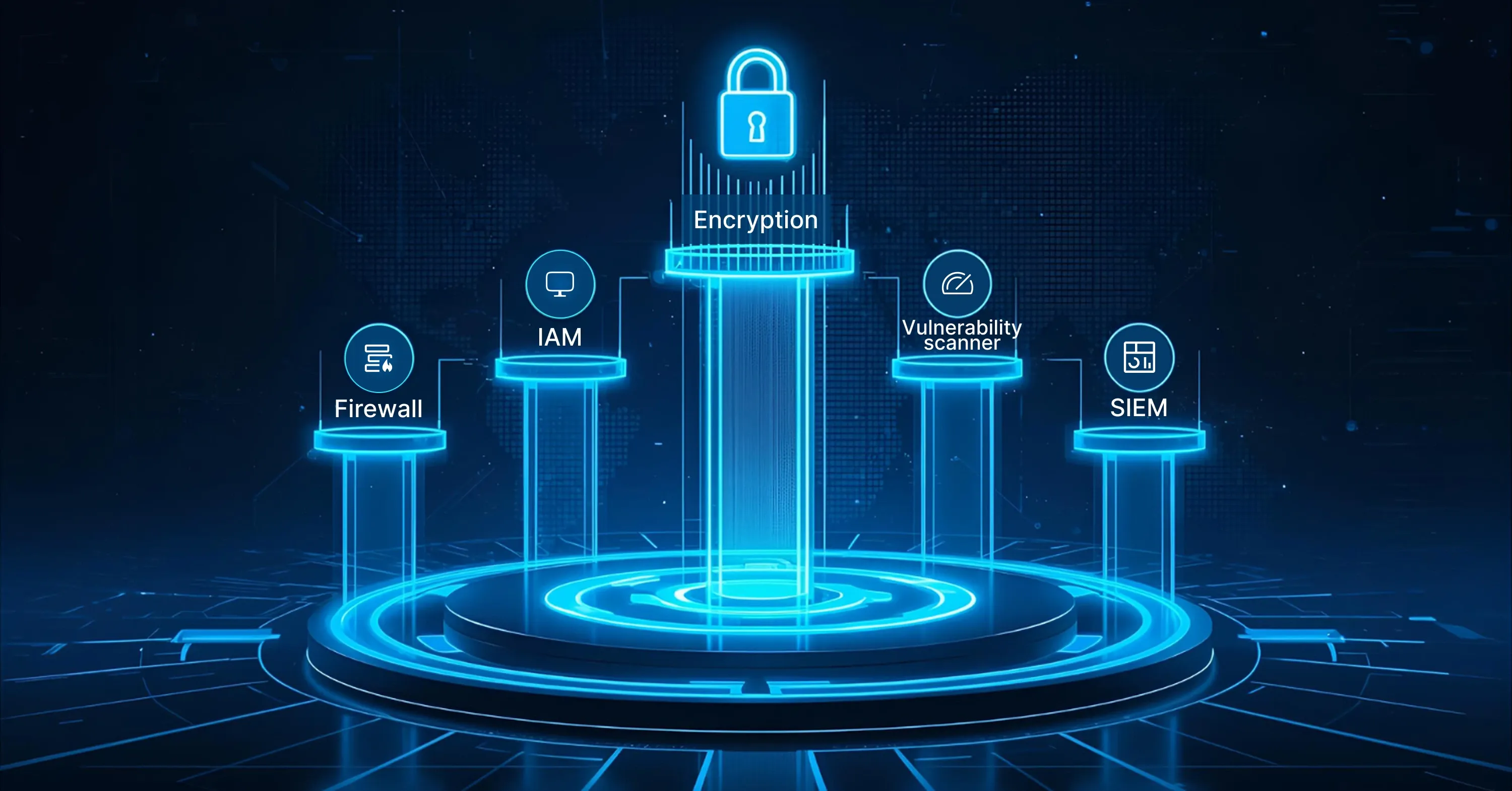
A glowing futuristic cybersecurity platform displays pillars labeled Firewall, IAM, Vulnerability Scanner, and SIEM surrounding a central Encryption lock hologram.

A holistic program blends technology, process, and expertise. Below are the key building blocks every cloud architect and C-level stakeholder should look for.

Managed firewalls and micro-segmentation

Even in serverless and containerized apps, network segmentation matters.

  • Cloud-native firewalls centrally administered for all VPC/VNet subnets
  • Layer-7 inspection to spot malicious payloads inside allowed ports
  • Policy templates that match compliance frameworks out of the box
  • Integration with SD-WAN to extend controls to branch offices

Keeping policies consistent prevents the classic “open port in one region, closed in another” mistake and provides a baseline for zero trust architecture.

Endpoint protection and EDR

Workstations, VMs, and Kubernetes nodes remain prime targets.

  • Cloud-delivered agents offer real-time malware and ransomware defense
  • Behavioral analytics detect suspicious scripts and container escapes
  • Automated isolation kicks in before human analysts can react

Integrated monitoring pipelines feed endpoint telemetry into a 24×7 analysis platform for rapid triage.

Identity and access management (IAM)

Credentials drive 80% of cloud breaches. A robust IAM setup should include:

  • Single sign-on (SSO) across SaaS, IaaS, and on-prem apps
  • Just-in-time access with automatic revocation
  • Privileged access management (PAM) vaults
  • Federation with HR systems so departures instantly remove access

These steps support a zero trust mindset: never assume users or devices are safe purely because they are “inside” the network.

Data encryption and tokenization

Encrypt everything in transit and at rest, then go further.

  • Customer-managed keys to satisfy sovereignty rules
  • Field-level tokenization for payment or health data
  • Bring your own key (BYOK) integration with major cloud KMS platforms

With consistent key management, teams avoid the trap of enabling encryption in one workload while forgetting another.

Vulnerability management and patch orchestration

Regular scanners often miss container images, serverless code, or forgotten test VMs.

  • Continuous scanning across clouds, containers, and traditional servers
  • Risk-based scoring so teams fix items that truly matter
  • Auto-patch pipelines that tie into CI/CD for zero-touch remediation

Pairing these tools with centralized monitoring and expert review ensures critical CVEs get patched before exploitation.

SIEM, log management, and centralized monitoring

Centralized analytics are the glue that unites all pillars.

  • Normalization of AWS CloudTrail, Azure Monitor, GCP Audit Logs, and on-prem syslog into one schema
  • Machine-learning detection of anomalies, insider threats, and supply-chain attacks
  • 24×7 automated alerting and predefined incident workflows ensure that only verified, high-severity events reach the internal team

A leading provider of managed IT services can shoulder this workload, giving overstretched analysts room to focus on strategic initiatives. Explore more on Cloud Services and DevOps capabilities.

Backup and disaster recovery

Security is incomplete without the ability to bounce back.

  • Immutable backups stored in separate cloud accounts
  • Hourly snapshots for mission-critical databases
  • Automated failover runbooks tested quarterly
  • Ransomware-resistant storage tiers with write-once protections

This final layer ensures that, even if attackers succeed, the business survives with minimal data loss. For end-to-end guidance on backup, DR, and rapid root cause analysis, consider the recommendations laid out in our Сloud Services and DevOps.

Together, these pillars create a single security fabric that follows workloads wherever they live.

Industry-specific considerations

Regulated sectors cannot adopt a one-size-fits-all model. Below are examples of tailored needs.

Finance

  • PCI DSS requires quarterly ASV scans and centralized log retention for at least one year.
  • Real-time fraud analytics must ingest card telemetry without breaching customer privacy.
  • Separation of duty is paramount, so IAM policies block developers from moving code to production without an approver.

Healthcare

  • HIPAA and HITECH mandate encryption in transit and at rest for electronic protected health information (ePHI).
  • Audit logging must track who touched every record, which drives SIEM storage costs.
  • Disaster recovery objectives often cap RPO at 15 minutes for critical imaging systems.

Government

  • Many agencies pursue zero trust due to the OMB M-22-09 mandate. 67% feel confident in meeting requirements, according to a Security Magazine article.
  • FedRAMP authorization influences cloud provider selection and dictates regular pen-tests.
  • Secure enclaves and air-gapped backups protect classified data.

Customizing controls for each vertical keeps audits smooth and reduces the chance of fines. For broader coverage of complex compliance and multi-industry support, visit Industries.

Centralized Monitoring and Incident Response

According to Gartner, worldwide spending on information security is projected to reach USD 213 billion in 2025, up from USD 193 billion in 2024. A centralized cloud-focused monitoring layer gives organizations three advantages:

  • 24×7 visibility into cloud and hybrid workloads
  • Faster investigation with predefined playbooks and expert responders
  • Continuous tuning of detection rules as environments evolve

This model helps teams maintain strong security outcomes without the complexity of operating multiple disconnected tools.

Measuring ROI and compliance benefits

Security spending must prove value to CFOs.

  • Lower breach likelihood: Consolidated controls reduce exposure surface and potential fines.
  • Faster audits: Central evidence collection cuts prep time by weeks.
  • Reduced staffing costs: Automated monitoring workflows and integrated patching lessen headcount needs.
  • Business continuity: Immutable backups minimize revenue impact during an incident.

When presenting to executives, translate these points into hard numbers. For example, calculate the cost of one hour of downtime, then show how managed disaster recovery shrinks outage windows.

What is managed cloud security?

Managed cloud security is a subscription-based service model where a third-party provider designs, deploys, and operates unified security controls - such as firewalls, endpoint protection, IAM, zero trust policies, vulnerability scanning, SIEM, and backup - across public cloud, private cloud, and on-prem environments. The provider’s 24×7 SOC monitors events, responds to incidents, and ensures compliance, giving organizations consistent protection and visibility without the complexity of managing multiple point tools.

Conclusion

A patchwork of security tools cannot defend rapidly evolving hybrid infrastructures. By embracing a unified managed cloud security strategy - anchored by centralized monitoring, zero trust architecture, and consistent controls -enterprises gain the visibility, agility, and assurance they need to protect data and satisfy regulators.

SOC-as-a-service delivers continuous threat monitoring, investigation, and response using cloud-native analytics platforms. Traditional MSSPs often forward logs to a remote center but stop at alerting. The SOC-aaS model goes further by providing hands-on response playbooks, threat hunting, and integration with DevOps pipelines.

Yes. Many zero trust components, such as multifactor authentication, device posture checks, and micro-segmentation, are available as cloud subscriptions. SMBs can adopt them incrementally, starting with high-risk applications. Gartner found 63 % of organizations worldwide have at least partially implemented zero trust, showing it is not limited to large enterprises.

Frameworks that demand continuous controls and detailed evidence—PCI DSS, HIPAA, GDPR, ISO 27001, and FedRAMP—see the greatest benefit. Managed providers supply policy templates, automated scans, and audit-ready reports that shorten certification cycles.

Often yes. Reputable providers integrate with popular endpoint agents, SIEMs, and cloud-native controls. During onboarding they map current investments, identify gaps, and recommend consolidation where it saves cost or reduces complexity.

Most organizations gain unified visibility within the first 30 days, as log collectors, firewalls, and IAM integrations come online. Incident response maturity and compliance reporting typically stabilize in 90 days, delivering measurable risk reduction and audit readiness.

Schedule a Meeting

Book a time that works best for you and let's discuss your project needs.

You Might Also Like

Discover more insights and articles

The image depicts an advanced enterprise AI chip embedded in a digital circuit board, visualizing neural network processing and high-performance computing architecture

Cyber-Resilience: Why 2026 Boards are Trading Protection for Immunity

Modern boards are staring at a blunt truth: threat actors now move faster than any human response plan. A single ransomware strike can wipe decades of data, paralyze revenue, and sink market value overnight. Buying more perimeter tools will not calm the boardroom. Ensuring the business never stops will.

Below is a practical roadmap for CISOs, IT Directors, and Business Continuity Managers who need to move their IT and business services from brittle protection to digital immunity before the next quarterly review.

The image shows a high-performance AI processor chip on a circuit board with flowing data streams, representing neural computing and modern enterprise IT architecture

The Sovereignty Shift: Navigating Data Residency and Corp IT Solutions in a Borderless Cloud

In 2026, the question is no longer just whether your data is in the cloud, but exactly which legal jurisdiction that cloud inhabits. For Chief Information Officers and Risk Officers, particularly in regions like the Gulf Cooperation Council (GCC) and Canada, the physical location of a server now carries as much weight as its uptime or security.

This article examines the critical transition from general public cloud strategies to the era of the Sovereign Cloud. We will explore how mid-market firms and large enterprises can navigate strict data laws in Saudi Arabia, the UAE, and beyond. You will learn how to design hybrid architectures that keep sensitive information within national borders while still leveraging global innovation, ensuring yourdigital enterpriseremains compliant and competitive.

Futuristic digital network illustration showing cloud infrastructure with glowing data flows, interconnected circuits, and real-time processing across a modern IT system

How to Build a Cloud Services Support Model That Scales

Cloud leaders love the flexibility of the public cloud, yet many still struggle to support thousands of fast-changing workloads without hiring armies of engineers. By 2026, operational excellence will be judged by a single metric: the Engineer-to-Instance ratio. The lower the ratio, the more resilient the platform—and the more strategic the IT budget.

Below is a practical, end-to-end playbook for CTOs, CIOs, and FinOps leaders who want a cloud services support operation that grows automatically with the business instead of linearly with headcount.

Futuristic cloud security and compliance dashboard visualizing FinOps and GreenOps metrics, cost optimization, and energy-efficient cloud infrastructure

The Green Cloud: Why Carbon-Aware DevOps is the Secret to 2026 Compliance

New EU and US climate rules are about to turn every container image, lambda call, and SQL query into an auditable emission line item. Platform teams must now prove that the way they build and run software is affordable and planet-friendly, or risk fines and reputational damage.

This article explains how carbon-aware DevOps connects cloud cost management (FinOps) with environmental accountability (GreenOps), why the two goals are inseparable, and what engineers need to change before the 2026 reporting deadlines arrive.