Why does manual infrastructure slow deployment down?
Manual infrastructure slows deployment because each environment is built by hand, the knowledge sits in people and runbooks, and every server, network rule, and permission becomes a discrete task someone has to remember and repeat correctly.
A 2025 SecurEnds case study of a mid-sized healthcare provider found that automating provisioning cut onboarding time from days to hours and eliminated over 90% of provisioning errors that manual processes had been generating. That error rate is the part most teams underestimate. The delay from building by hand is visible and budgeted for, but the rework loop it creates stays hidden until a release stalls. When a deployment fails because production was configured differently from staging, you pay twice: once to build it slowly and again to debug why the build doesn't match. That second cost is what quietly sets the ceiling on how fast you can ship.
What breaks at modern release speed?
The problem only gets worse with the modern release frequency. Ship weekly across four environments and you've turned one careful build into dozens. While the effort multiplies, the human throughput doesn't.
The gap is measurable. The DORA State of DevOps Report found elite performers deploy more frequently than low performers. Manual provisioning can't produce that cadence, because human throughput doesn't scale with deploy count. Once your release rhythm outpaces how fast people can hand-build environments, the pipeline waits on the slowest human step, and every added environment widens that gap rather than closing it.
The cost of configuration drift
Configuration drift introduces reliability and compounding security risk. Undocumented manual changes cause environments to diverge, and when something fails in production that worked in staging, the cause stays invisible. There's no trail to follow, so the failure looks random and as something you can't fix or prevent.
The security exposure is just as serious. Each out-of-band change is a configuration that hasn't been reviewed, tested, or approved, which can be exploited or triggers a compliance finding. Automated drift detection inside the deployment flow surfaces these deviations before they reach production, shifting the control left rather than discovering the problem during an incident.
What does treating infrastructure as code actually mean?

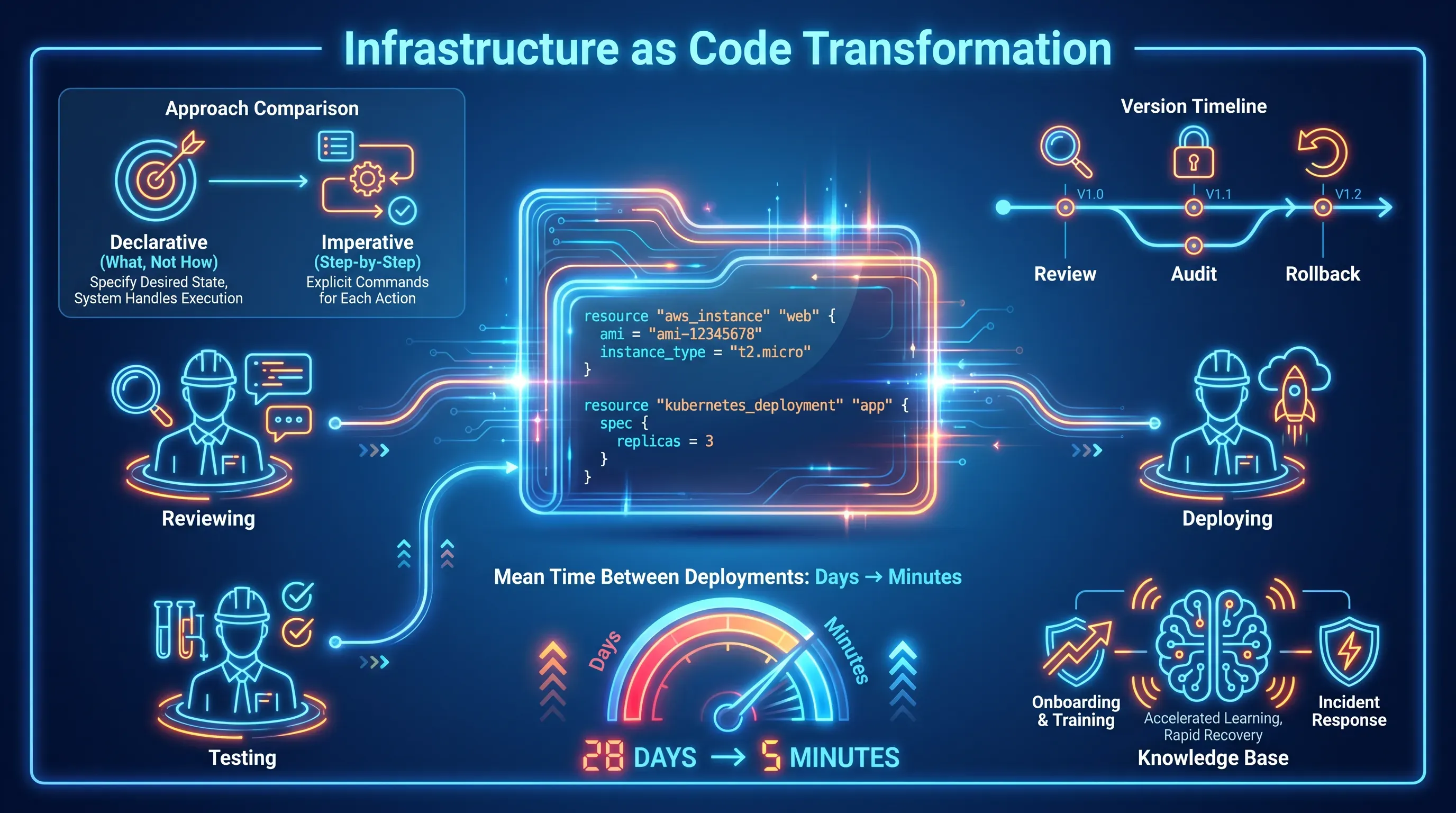
Treating infrastructure as code means defining your infrastructure in files that are reviewed, tested, versioned, and deployed through the same workflows as application code, which makes infrastructure a software asset with one source of truth. The definition stops living in someone's head and starts living in a repository.
This is the conceptual shift that the speed depends on. A 2025 guide in the World Journal of Advanced Engineering Technology and Sciences notes that IaC manages infrastructure through machine-readable definition files rather than interactive configuration, which in many cases reduces mean time between deployments from days to minutes. The word that matters there is "file." Once infrastructure is a file, it inherits everything software engineering already solved: peer review, history, automated testing, and rollback. That's why IaC isn't another automation script. A script automates one task you still own manually. IaC turns the whole environment into an artifact you can reason about, diff, and reproduce on demand.
Declarative vs imperative approaches
The difference is that declarative tools let you define the end result and reconcile to it, while imperative approaches script each action step by step. Declarative wins for repeatability, because you describe what you want and the tool figures out how to get there from wherever the environment currently sits.
This is why declarative tools dominate. Run a declarative definition against a clean account or a half-built one, and you land in the same final state, which means you stop writing fragile logic to handle every possible starting condition.
The impact of version control
Version control changes everything because every infrastructure change gains a history and rollback path, so silent console edits become auditable, peer-reviewed events. The change you made at 2 a.m. is now a commit with your name on it.
Microsoft's CI/CD guidance describes how each merge to a repository triggers an automated build and tests, so defects are caught before code reaches the main branch. Apply that to infrastructure and the review gate moves left, before anything touches a live system. The quieter benefit is institutional memory. When infrastructure lives in version history, the reasoning behind a firewall rule or instance size survives the engineer who set it, so onboarding and incident response both get faster.
Where do the deployment time savings come from?
The deployment time savings come from four specific levers: removing manual intervention, cutting setup time through reusable templates, replicating environments instantly, and enabling self-service so teams stop waiting on tickets. Each one attacks a different stall point in your current process.
The raw automation gain is dramatic on its own. A Walden University dissertation citing Sandobalín et al. found that deployment using IaC strategies takes an average of 60 seconds versus 600 seconds for manual approaches, regardless of cloud provider. That tenfold cut is only the per-action figure, though. The larger savings come from the levers stacking. When you use templates to give developers identical environments, you remove the provisioning queue and the rebuild/debug cycle that used to follow. That's how minutes-not-days becomes real across a full release rather than a single command.
Reusable templates cut setup time
Reusable templates cut setup time because you define an environment once and reuse it, so spinning up a new one becomes a single command instead of a multi-day build. The effort of getting it right happens once and then amortizes across every future use.
Scale Computing notes that with IaC, the same code can be reused whether you're deploying to a single site or a thousand. The compounding effect is what makes this matter. A template carries forward every fix and security hardening you've added, so each new environment starts from your current best configuration rather than from scratch.
Self-service provisioning removes bottlenecks
Self-service provisioning removes bottlenecks because codified, governed templates let developers provision approved infrastructure on demand. This deletes the queue that used to sit between a request and an active environment. The operations ticket stops being the gate.
Resolve describes self-service provisioning as an automated approach that lets users activate infrastructure resources independently without manual intervention. The strategic shift here is that governance moves into the template. Once policy is baked into what developers can request, you can hand over speed without handing over control, which is the trade most teams assume they can't make.
Release speed accelerates with environment replication
Environment replication speeds releases because reproducing development, testing, staging, and production from the same code eliminates the late-stage failures that stall delivery. The "works in staging, breaks in production" problem disappears when both come from one definition.
Instead of investigating environment differences during a release, you investigate actual code defects, which are the problems worth your time. The release pipeline stops absorbing infrastructure noise and starts moving features.
IaC in CI/CD and DevOps workflows
IaC fits into CI/CD by letting infrastructure changes ship alongside application updates in the same pipeline, tested and approved through the same gates, so a release provisions or updates its own infrastructure in a controlled, auditable way. Infrastructure stops being a separate pre-step and becomes part of the deploy.
Pipeline progression is gated on a successful Terraform apply, so if the infrastructure step fails, the deployment doesn't run. That gating is the part that converts speed into safety. Because the same trigger that builds your app also builds what it runs on, you can't accidentally deploy code into an environment that was never updated to support it. The pipeline enforces the order for you. This is why IaC belongs inside DevOps rather than beside it. It closes the gap where application and infrastructure changes used to drift out of sync between separate teams and separate tools.
Business outcomes follow faster deployment
Faster deployment with IaC produces shorter deployment times, quicker time to market, higher deployment confidence, better operational efficiency, and easier scaling, with stronger collaboration between development and operations. These are the outcomes a budget owner will fund, translated from the mechanics above.
The headline number for a business audience is time to market. Faster releases only help if they're also stable, and IaC delivers both at once, because the same consistency that speeds the build also lowers the failure rate. That combination is what lets a business ship a feature ahead of a competitor without trading reliability to do it, which is the outcome that justifies the investment to people who never touch the pipeline.
IaC tools alone don't fix everything
IaC tools alone don't fix everything because tooling without governance, documentation, testing, and skills introduces new failure modes: drift from out-of-band changes, risky automated actions running without approval, and code complexity that outgrows the team. Buying Terraform doesn't buy the discipline that makes Terraform safe.
The automation that speeds you up also magnifies mistakes. Misalignment between code and live infrastructure degrades security, compliance, and reliability as it accumulates. Here's the trap. The same single command that builds a hundred servers correctly will build a hundred broken ones just as fast if the code is wrong and nothing gates it. So IaC raises the stakes on process. Without review and testing, you've automated your way to faster failures rather than faster deployments, which is a worse position than the manual one you left.
Governance and testing
The practices that must come first are policy-as-code, drift detection, approval gates, code review, and infrastructure testing, because these capture speed without sacrificing control. They're the guardrails that let you safely hand provisioning to a pipeline.
You automate the repeatable work so human judgment lands only where it changes the outcome, at the approval gate before production.
What skills does the team actually need?
The team needs people who can write, review, and maintain infrastructure code and operate the pipeline, because without these skills the tooling stalls or produces fragile configurations. IaC turns infrastructure work into software work, and that demands software skills your ops team lacks today.
The gap is well documented. According to a Spacelift figure cited across the industry, 37% of IT leaders say the lack of DevOps and DevSecOps skills is the biggest technical gap in their teams. That shortage explains why so many IaC adoptions disappoint. The tool gets bought, but the people who can structure modules, review changes, and debug a failed apply aren't there, so the code rots into something more fragile than the manual setup it replaced.
Security and compliance
IaC strengthens security and compliance by embedding change control, audit trails, and access governance into your infrastructure workflow. It enables consistent, secure baseline configurations, standardizes backup and monitoring processes, and supports adherence to frameworks like ISO 27001. These capabilities transform infrastructure governance from reactive manual checks into proactive, automated controls aligned with regulatory requirements.
How to move your infrastructure to code with confidence
Moving to IaC with confidence starts with treating it as a governed adoption, not a tool purchase, because the speed only shows up when the governance, testing discipline, and skills are in place alongside the tooling. The article above names those prerequisites for a reason: they're where most adoptions succeed or stall.
ABS Technologies is an Armenia-based managed IT services provider, founded in 2011, whose Cloud Services and DevOps practice helps businesses adopt IaC through a structured engagement of assessment, agreement, technical benchmarking, and ongoing support. The recommendations are vendor-independent, so the approach fits your environment rather than a brand's roadmap. That structure maps directly to the gaps this article identified. ABS supplies the review discipline, the drift detection, and the infrastructure-code skills that turn faster deployment from a promise into a measurable result, while your team stays focused on the product. If slow, manual provisioning is setting the ceiling on how fast you ship, book a call with ABS to scope what IaC realistically changes for your delivery cycle and what to put in place first.