Why do performance and cost feel like opposing goals?
Unstructured environments create the tradeoff that teams attribute to cloud economics. When teams cannot see where compute is going, the safe default is to overprovision, which inflates the bill without fixing the underlying performance ceiling. The slowdowns and the overspend share the same cause: capacity decisions made without data.
Flexera's 2025 State of the Cloud Report, based on responses from more than 750 technical professionals, found that 84% of organizations consider managing cloud spend their top cloud challenge, while cost efficiency remains the leading metric used to assess cloud goals. That combination is telling. If cost were a pure pricing problem, finance teams would solve it through contracts. The fact that it persists alongside performance complaints points to operational design as the real lever, which is why disciplined optimization improves both numbers together.
What actually drives cloud overspending?
Most cloud overspending is structural. Environments expand faster than the controls around them, so waste accumulates in places nobody is watching. Without consistent optimization practices, unused resources, overprovisioned capacity, and fragmented infrastructure decisions compound into a growing baseline of waste.
Three patterns account for most of that loss:
-
Capacity provisioned for peak conditions and left running through normal ones
-
Resources nobody owns because tagging and accountability were never enforced
-
Architectures built for fixed load running inside an elastic billing model
Each of these has a different fix, but they share a single diagnostic: leadership cannot point to who is responsible for the dollar being spent. Until that question has an answer at the team level, cost reduction efforts will keep regressing, because the conditions that produced the waste remain in place.
Overprovisioned and idle resources
A common FinOps misconception is that sustained low utilization often indicates overprovisioned infrastructure. In reality, tools like AWS Compute Optimizer and Azure Advisor analyze historical utilization patterns to create rightsizing recommendations. They do not rely on fixed thresholds. However, when workloads remain well below capacity for extended periods, organizations are likely carrying idle or oversized resources.
Regular utilization reviews and rightsizing cycles, prevents unused capacity from becoming a part of the baseline cost.
Lack of visibility and ownership
Cloud costs grow unnoticed when no team owns the bill at the resource level. The FinOps Foundation's Cloud Cost Allocation Guide makes the point bluntly: tags cannot be applied retroactively, so any resource launched without a Cost Center or Environment tag becomes orphaned spend from that moment forward.
What this means operationally is that tagging policy has to be enforced at provisioning time through automated checks before quarterly cleanup campaigns become necessary. If finance receives a bill where 30% of line items map to no owner, optimization decisions get made by guesswork. Cost allocation is the precondition for every other discipline in this article.
Static architectures in dynamic conditions
Fixed configurations fail in elastic environments because they pay for headroom that elastic services were designed to remove. A monolithic application sized for Black Friday traffic runs at Black Friday cost in February. The architecture was never wrong for its original on-premises context, but the billing model changed underneath it.
A documented Karpenter migration on Amazon EKS produced a 70% reduction in monthly compute costs and cut pod scheduling latency from three minutes to 20 seconds. Both numbers came from the same change. Static-to-elastic redesign isn't only a cost project, because the same architectural patterns that adapt capacity to demand also remove the queuing delays that static sizing creates during traffic spikes.
How does rightsizing improve both speed and cost?

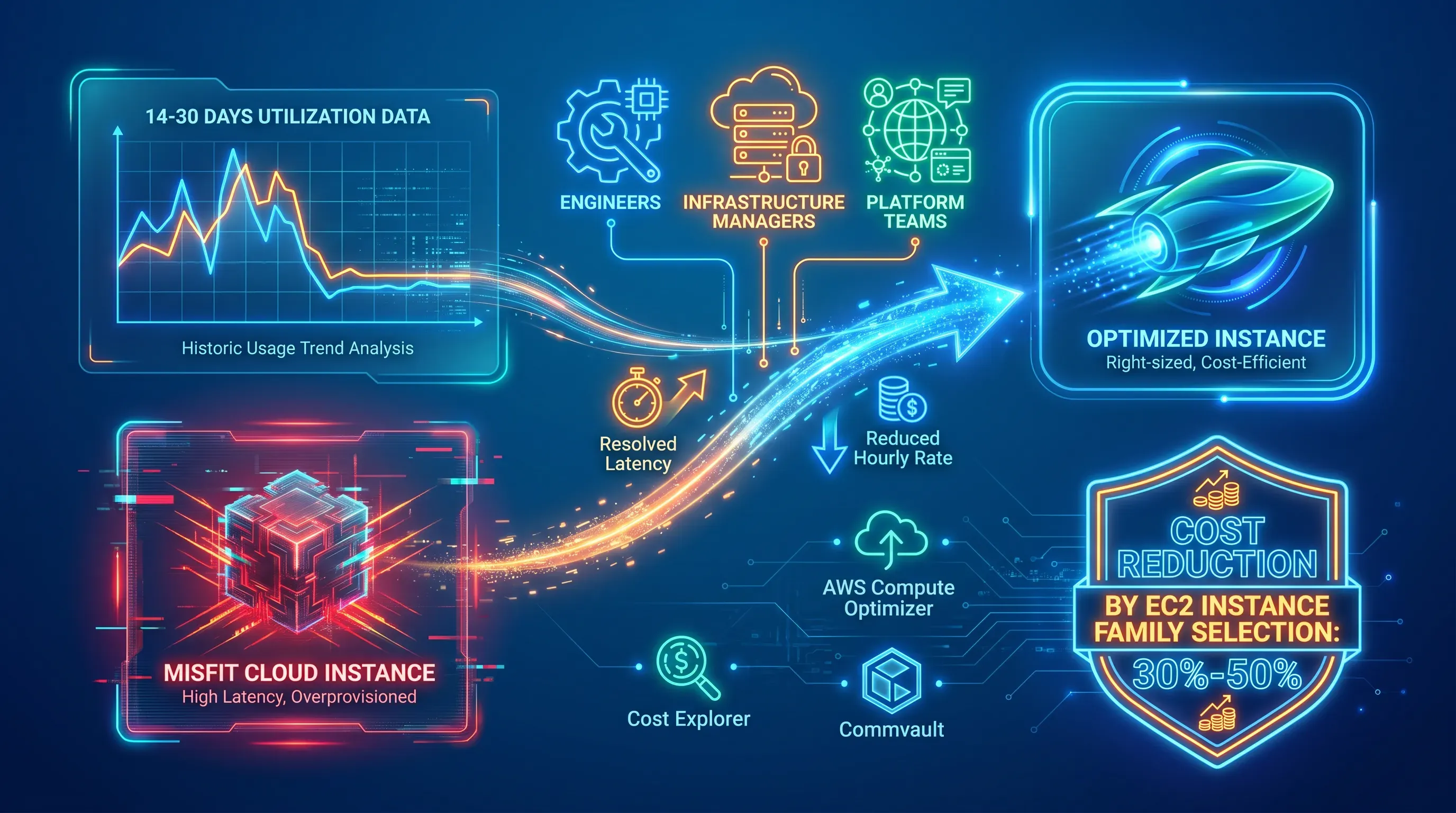
Rightsizing matches instance types to workload behavior, which fixes performance and cost at the same source. A database constrained by memory on a CPU-heavy instance is both slow and expensive, because the bottleneck masquerades as a capacity problem and prompts engineers to scale up rather than switch families. Moving to a memory-optimized type resolves the latency and reduces the hourly rate.
According to Commvault's AWS optimization guidance, EC2 instance family selection can reduce costs by 30% to 50% when teams use AWS Compute Optimizer and Cost Explorer to base decisions on 14-30 days of utilization data rather than initial sizing assumptions. The deeper point for infrastructure managers is that rightsizing is a performance practice that happens to lower the bill, which is why it belongs to platform teams rather than finance.
What role does automation play in optimization?
Automation enforces optimization decisions at machine speed, which is the only speed that matches how fast cloud environments change. Manual review catches yesterday's waste. Automated policy prevents tomorrow's. Hykell's documented work with AWS customers shows automated scaling and rightsizing delivering 40% or more in savings without performance degradation, and the savings hold because no human has to remember to apply them.
Three automation surfaces matter most for sustaining efficiency over time, and each addresses a different failure mode in the manual model.
Dynamic scaling based on real demand
Autoscaling adjusts capacity to actual workload patterns instead of forecasted peaks. Forecasts are wrong by definition, so capacity built against them is either wasteful on the low side or insufficient on the high side. Real-time scaling removes the forecast from the equation.
AWS predictive scaling uses 14 days of CloudWatch data to anticipate hourly demand 48 hours ahead, which lets capacity arrive before traffic does rather than chasing it. For ephemeral workloads like CI runners and review environments, the same logic applies in reverse: tear them down when they aren't running tests. The deletion side recovers most of the budget.
Automated incident and anomaly response
Automated remediation catches waste and performance issues before they grow into incidents. A runaway query on a production database costs money every second it runs, and the cost compounds when autoscaling responds to the symptom by adding capacity.
Cloud Cost Management correlates cost data with performance metrics. For operations leaders, that correlation is the practical value. The mean time to detect waste collapses from the monthly billing cycle to minutes.
Policy-driven governance
Policy-as-code enforces tagging and provisioning limits consistently across accounts, and the same model applies to shutdown rules. The alternative is wiki documentation that nobody reads and exception requests that nobody tracks. Encoded policies fail builds when a resource lacks a required Cost Center tag, which means the rule applies before the resource exists rather than after the bill arrives.
Tools like Open Policy Agent and AWS Config Rules embed governance into the provisioning lifecycle and version policies alongside infrastructure code, with an audit trail produced by default. The strategic implication is that governance becomes a property of the platform rather than a tax on the engineers using it.
Why is observability the foundation of optimization?
You cannot optimize what you cannot see, and unified visibility across cost and performance data, with usage context included, is what makes intelligent decisions possible. Without a single view, finance and engineering optimize different targets, and the two teams reach contradictory conclusions about the same workload.
Resource utilization monitoring, when analyzed alongside cost data, surfaces underutilized resources that can be downsized or terminated and turns generic dashboards into specific decisions. The conclusion that follows for CTOs: observability is the substrate every other optimization discipline runs on. A rightsizing recommendation is only as good as the telemetry behind it, and a policy is only enforceable if violations are visible. Treat the observability layer as foundational infrastructure and the rest of the optimization program becomes possible. Treat it as optional and the program will stall regardless of how many tools surround it.
How does performance tuning reduce waste?
Faster, leaner workloads consume fewer resources, so performance engineering is cost engineering by another name. An application that completes a request in 200 milliseconds instead of 800 uses a quarter of the compute time, which directly reduces the per-request cost in any usage-based pricing model. The same change improves user experience and lowers the bill simultaneously.
Continuous performance tuning can also reduce cloud spend, because the bottlenecks responsible for slow outputs are also the bottlenecks responsible for over-allocated capacity. For engineering leaders this reframes the performance backlog. Latency tickets and cost tickets are the same ticket viewed from two reporting structures, and treating them as one workstream is how teams stop trading off between them.
What governance habits sustain long-term efficiency?
Recurring reviews and shared accountability between engineering and finance prevent the slow drift back into waste. Optimization gains evaporate within two quarters when treated as a one-time project, because the conditions that produced the original waste, like growth and turnover, never paused.
The FinOps Foundation's 2025 State of FinOps Report, which represents organizations responsible for more than $69 billion in cloud spend, found that implementing governance and policy at scale has overtaken workload optimization as the top priority for the next 12 months. That signal matters because it reflects what mature practices learn the hard way: the cheap optimizations come first, then governance is what keeps them from unwinding.
Continuous review instead of one-time cleanup
One-off cost cuts don't last because cloud environments change daily. New services launch and traffic patterns shift, while engineers join teams without context on prior decisions. A quarterly cost review is already three months behind the environment it's reviewing.
The practical cadence combines weekly anomaly review at the team level with monthly utilization audits at the platform level, while quarterly architecture reviews happen at the leadership level. Each loop catches a different class of drift, and skipping any of them lets waste accumulate at that timescale. Treat optimization as an operational rhythm rather than an event on the project calendar.
Shared accountability across teams
Engineering and finance need shared visibility and shared incentives to balance performance against spending. When only finance sees the bill, engineering has no signal. When only engineering sees the architecture, finance has no leverage.
The FinOps Foundation framework describes a showback or chargeback model where costs are visible to the teams that incurred them, which makes the engineer who provisioned an oversized instance the same person who sees the line item. That alignment is what turns cost from a centralized problem into a distributed one, and distributed problems get solved faster because the people closest to the decision also see its consequences.
What business outcomes does disciplined optimization deliver?
Disciplined optimization produces faster applications and predictable spending, with stronger operational resilience tied to the same measurable business logic. Faster applications convert better and retain users longer. Predictable spending lets finance plan capital allocation against reliable forecasts rather than monthly surprises. Resilience reduces the revenue lost to incidents and the engineering hours spent firefighting them.
The quantified pattern across the references in this article is consistent. Mature FinOps organizations report 40% less waste than organizations at the early "Walk" stage of practice maturity. That gap is the prize. It's also the warning, because operational discipline separates organizations capturing it from organizations leaving it on the table. The disciplines described above compound when applied together and decay when applied in isolation, which is why optimization works as a program rather than a project.
Turning optimization strategy into action
Cloud optimization is most effective when it becomes part of day-to-day operations rather than a periodic cost-reduction initiative. Organizations that consistently improve both performance and spending tend to rely on the same foundations: observability, automation, governance, and regular review of how infrastructure aligns with business demand.
Most organizations fail at cloud optimization because building an in-house FinOps and cloud engineering function at the scale described above requires headcount and a years-long operating model for tooling investment plus cross-functional governance authority.
ABS Technologies exists to compress that timeline. If you want to know where your current environment stands before committing to a program, the first step is a cloud assessment. Contact ABS Technologies to schedule free assessment and see what a disciplined optimization program would deliver in your environment.