Business team in a modern glass office at sunset surrounded by glowing digital data overlays and holographic interface elements, symbolizing AI-driven collaboration and analytics.

How Managed DevOps and Cloud Support Keep You Online 24/7

Every second of downtime chips away at revenue, customer trust, and team morale. SREs and CTOs need proof that their environments are guarded around the clock yet flexible enough to ship new features on demand. That assurance comes from modern cloud support anchored in Managed DevOps.

Content authorBy Irina BaghdyanPublished onReading time6 min read

What You’ll Learn

Over the next few minutes you will see how three pillars - continuous monitoring and predictive cloud maintenance, rapid response with thorough recovery, and security baked into every commit - form a safety net for SaaS, FinTech, E-commerce, HealthTech, and Media workloads. You will also discover how Continuous Delivery (CD), Infrastructure as Code (IaC), and DevSecOps make 24/7 operations repeatable and cost-effective.

The High Stakes of Always-On Services

Customers expect a checkout page to load in milliseconds and a telehealth session to stay stable through an entire exam. Cloud outages turn those expectations into public support tickets and social media rants.

Those numbers show that companies are pouring resources into uptime guarantees rather than accepting outages as “normal.” The following pillars explain how.

What Is Cloud Support?

Cloud support is the combination of 24/7 monitoring, predictive maintenance, rapid incident response, and ongoing security hardening that keeps cloud workloads healthy, performant, and safe while freeing internal teams to focus on innovation. Discover more about our Cloud Services and DevOps offerings.

Pillar 1: Continuous Monitoring and Predictive Cloud Maintenance

Invisible issues create the loudest outages. A smart monitoring stack shines light on them before users notice.

  • Metrics: CPU, memory, disk I/O, latency, error rates
  • Tracing: request path across microservices
  • Logging: structured, aggregated, searchable in real time
  • Synthetic checks: simulate user flows every minute

Why predictive beats reactive

Traditional alerting shouts when a threshold is breached. Predictive analytics, powered by machine learning on historical data, whispers before things get critical.

Benefits

  • Fewer false positives because models learn normal baseline
  • Maintenance windows can be scheduled, avoiding user impact
  • Capacity planning becomes evidence based, cutting over-provisioning costs

Tools and Metrics to Watch

Popular choices include Prometheus, Grafana, AWS CloudWatch, Azure Monitor, and Google Cloud Operations Suite. Add custom business metrics - cart abandonment, video rebuffer rate - to align alerts with revenue.

A leading provider of Managed IT Services often bundles these tools, delivering dashboards that blend system health and business KPIs into a single cockpit.

Continuous monitoring plus predictive cloud maintenance means you rarely get surprised by a 2 a.m. pager. Instead, you adjust course during daylight hours.

Pillar 2: Rapid Response and Service Restoration

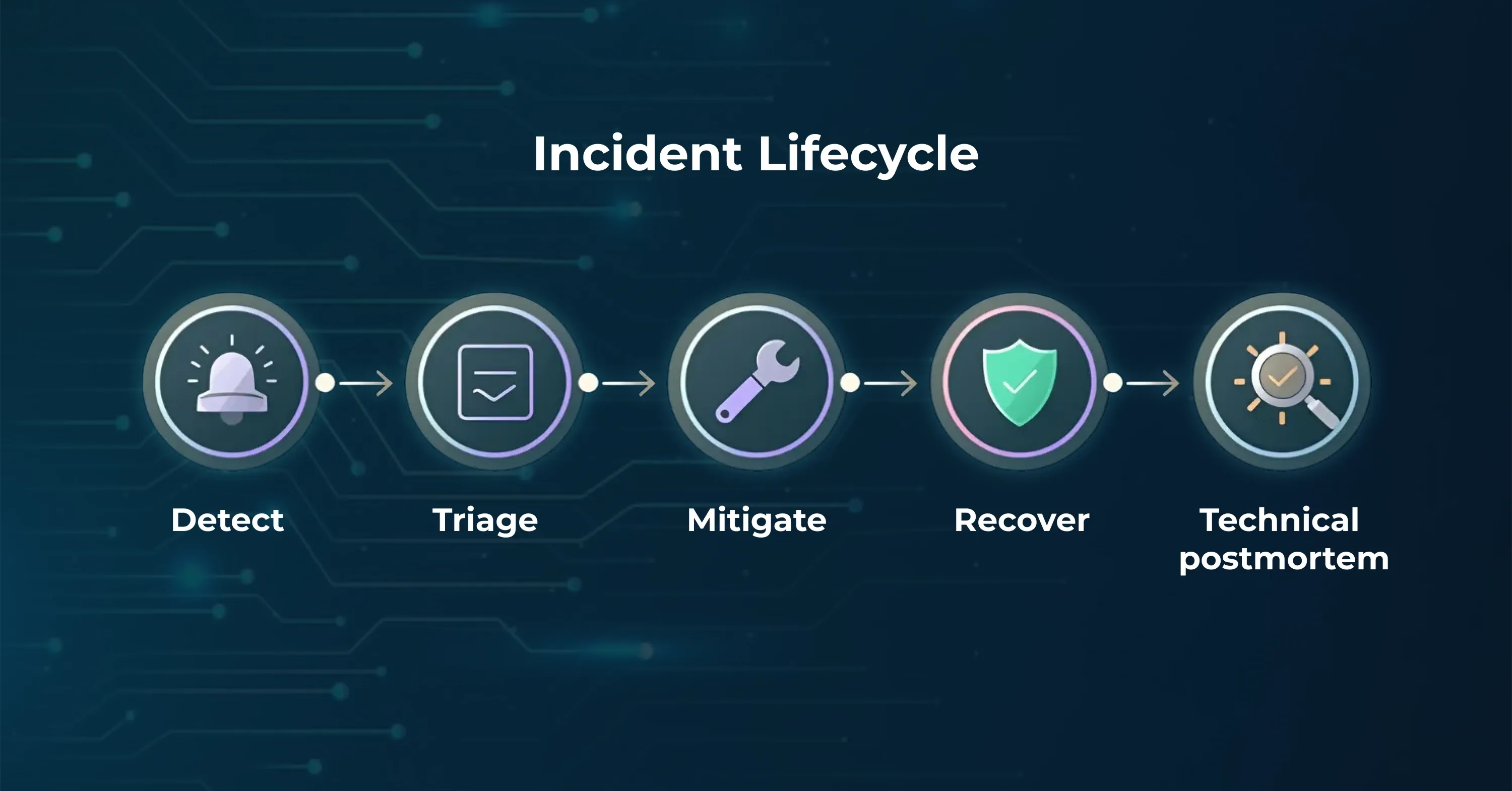
Diagram showing five stages of the incident lifecycle - Detect, Triage, Mitigate, Recover, and Postmortem - with icons and arrows on a dark tech background.

Even with stellar monitoring, incidents will strike. What separates leaders from laggards is the speed and clarity of their response.

Core components

  • Incident playbooks: step-by-step actions for the first 15 minutes
  • Auto-healing: health checks that restart unhealthy pods or VMs
  • Disaster recovery plans: clearly documented RTO/RPO targets
  • Immutable backups: daily snapshots pushed to a different region
  • Blameless postmortems: focus on the fix, not finger-pointing

Disaster Recovery, Backup, and Root Cause Analysis

Backup frequency and retention rules must suit data sensitivity - finance logs differ from media assets. Automated restores are rehearsed quarterly so everyone knows the drill.

Root Cause Analysis (RCA) digs below the surface:

  • Gather logs, metrics, timelines.
  • Identify the primary failure and any contributing factors.
  • Recommend code, config, or process changes.
  • Share findings across teams for collective learning.

Wrapping up: Rapid response backed by repeatable DR and RCA shrinks mean-time-to-restore (MTTR) and converts painful lessons into stronger architecture. For end-to-end guidance, explore our Services.

Pillar 3: Security Through DevSecOps and Regular Patching

Security lapses can be more damaging than downtime. DevSecOps threads safety checks throughout the delivery pipeline, catching misconfigurations and vulnerable libraries early.

Key practices

  • Shift-left scanning of Infrastructure as Code templates
  • Container image signing and vulnerability scanning
  • Automated security tests in CI/CD
  • Weekly patching cycles for OS and middleware
  • Least-privilege IAM policies with short-lived tokens

Regulatory-heavy sectors such as HealthTech and FinTech see added peace of mind. Continuous compliance reports satisfy auditors without manual spreadsheet marathons.

Takeaway: A strong security posture is not a side project. It is an everyday discipline that guards the uptime you work so hard to protect. See how Information Security services can help you stay secure.

Continuous Delivery and IaC: The Engine Behind 24/7 Changes

High availability is pointless if code deploys are painful. CD pipelines built on IaC make shipping safe and boring.

From Commit to Production Without the Drama

  • Developers push code to Git.
  • CI runs unit, integration, and security tests.
  • Approved builds trigger IaC tools like Terraform or AWS CloudFormation.
  • Blue/green or canary releases shift traffic gradually, limiting blast radius.
  • Rollbacks are a single command: the previous version still exists.

Because environments are defined in code, you can recreate them in minutes. This repeatability underpins 24/7 operations - no more weekend change freezes.

Final note: CD plus IaC turns infrastructure into a version-controlled asset, not a snowflake nobody dares to touch. To learn more, visit Cloud Services and DevOps.

Choosing a Partner for Cloud Support and Technical Support Services

Most organizations lack the bandwidth to staff round-the-clock rotations. External technical support services fill the gap.

Selection checklist

  • Proven SRE track record with similar workloads
  • Transparent SLAs: sub-5 minute response, defined escalation path
  • Tooling compatibility with your stack
  • Security certifications (ISO 27001, SOC 2)
  • Cultural fit: responders communicate clearly, own problems through resolution

A leading provider of managed IT services, offering comprehensive solutions for infrastructure management, cloud computing, and cybersecurity, meets those benchmarks while letting your engineers focus on product features.

The right partner extends your team, not replaces it, keeping uptime high and stress low. To see how we help businesses across sectors, check our Industries expertise.

Conclusion

Downtime is inevitable - but chaos isn’t. Managed DevOps transforms those tense 2 a.m. alerts into calm, predictable recoveries. By combining continuous monitoring, rapid restoration, and built-in security, your infrastructure stops being a liability and becomes a launchpad for innovation.

This is the shift from firefighting to foresight - where every patch, backup, and deployment is automated, tested, and trusted. Your team can finally focus on building what matters while experts keep your cloud always-on, secure, and ready for whatever comes next.

Cloud support handles distributed, elastic resources that can scale or move regions on command. Traditional support manages fixed hardware in a single data center. The cloud model demands automated monitoring, IaC, and rapid orchestration skills.

Weekly for patching and dependency updates, monthly for performance tuning, and quarterly for disaster recovery drills. Predictive analytics may adjust those cadences based on actual usage patterns.

No. Alerting thresholds, auto-healing scripts, and on-call rotations ensure humans are called only when machines cannot self-correct. Well-tuned systems wake engineers a fraction of the time.

Common targets include 99.9 % service availability, 15-minute first response, and under 60-minute resolution for P1 incidents. Verify exact metrics in the contract.

Security flaws often cause outages via exploits or forced shutdowns. Automated scans and fast patch pipelines prevent those events, maintaining consistent availability.

Schedule a Meeting

Book a time that works best for you and let's discuss your project needs.

You Might Also Like

Discover more insights and articles

The image depicts an advanced enterprise AI chip embedded in a digital circuit board, visualizing neural network processing and high-performance computing architecture

Cyber-Resilience: Why 2026 Boards are Trading Protection for Immunity

Modern boards are staring at a blunt truth: threat actors now move faster than any human response plan. A single ransomware strike can wipe decades of data, paralyze revenue, and sink market value overnight. Buying more perimeter tools will not calm the boardroom. Ensuring the business never stops will.

Below is a practical roadmap for CISOs, IT Directors, and Business Continuity Managers who need to move their IT and business services from brittle protection to digital immunity before the next quarterly review.

The image shows a high-performance AI processor chip on a circuit board with flowing data streams, representing neural computing and modern enterprise IT architecture

The Sovereignty Shift: Navigating Data Residency and Corp IT Solutions in a Borderless Cloud

In 2026, the question is no longer just whether your data is in the cloud, but exactly which legal jurisdiction that cloud inhabits. For Chief Information Officers and Risk Officers, particularly in regions like the Gulf Cooperation Council (GCC) and Canada, the physical location of a server now carries as much weight as its uptime or security.

This article examines the critical transition from general public cloud strategies to the era of the Sovereign Cloud. We will explore how mid-market firms and large enterprises can navigate strict data laws in Saudi Arabia, the UAE, and beyond. You will learn how to design hybrid architectures that keep sensitive information within national borders while still leveraging global innovation, ensuring yourdigital enterpriseremains compliant and competitive.

Futuristic digital network illustration showing cloud infrastructure with glowing data flows, interconnected circuits, and real-time processing across a modern IT system

How to Build a Cloud Services Support Model That Scales

Cloud leaders love the flexibility of the public cloud, yet many still struggle to support thousands of fast-changing workloads without hiring armies of engineers. By 2026, operational excellence will be judged by a single metric: the Engineer-to-Instance ratio. The lower the ratio, the more resilient the platform—and the more strategic the IT budget.

Below is a practical, end-to-end playbook for CTOs, CIOs, and FinOps leaders who want a cloud services support operation that grows automatically with the business instead of linearly with headcount.

Futuristic cloud security and compliance dashboard visualizing FinOps and GreenOps metrics, cost optimization, and energy-efficient cloud infrastructure

The Green Cloud: Why Carbon-Aware DevOps is the Secret to 2026 Compliance

New EU and US climate rules are about to turn every container image, lambda call, and SQL query into an auditable emission line item. Platform teams must now prove that the way they build and run software is affordable and planet-friendly, or risk fines and reputational damage.

This article explains how carbon-aware DevOps connects cloud cost management (FinOps) with environmental accountability (GreenOps), why the two goals are inseparable, and what engineers need to change before the 2026 reporting deadlines arrive.