What This Article Covers
This guide walks through how modern organizations build cloud environments that deliver both fast execution and dependable security, without treating one as a tradeoff for the other. You will learn why the tension between speed and security exists, where it breaks down in practice, and what specific strategies allow teams to ship faster while staying protected. These strategies range from security as code to centralized observability, from supply chain verification to AI governance.
By the end, you will understand how architecture decisions, automation, team alignment, and operational discipline work together to remove the friction between agility and safety. The focus is on real operational outcomes: shorter release cycles, fewer misconfigurations, better compliance readiness, and more resilient infrastructure overall.
Why the Speed-Security Tension Keeps Growing
Cloud adoption is no longer an emerging trend. Nearly two-thirds of industrial companies are actively using cloud solutions, and that number continues to climb across every sector. As organizations scale their cloud footprint, the number of services, endpoints, configurations, and teams involved multiplies quickly.
This growth creates a widening gap. Deployment speed increases as teams adopt containers, microservices, and infrastructure as code. But security processes often remain manual, sequential, and disconnected from delivery workflows. The result is predictable: security either slows releases down or gets bypassed altogether.
The core issue is structural, not tooling. When security is layered on after the fact rather than woven into how cloud infrastructure is built and operated, it becomes a bottleneck. And the problem is compounding: AI-assisted code generation is accelerating output while introducing vulnerabilities that traditional review processes were never designed to catch. Machine identities now outnumber human ones in most cloud environments, and governing them consistently across services is something most teams underestimate until an incident forces the conversation.
-
Speed increases come from cloud-native tooling and CI/CD pipelines (automated build, test, and deploy workflows).
-
Security gaps emerge when controls are applied manually or reviewed only at the end of a release cycle.
-
The more distributed the environment, the harder it becomes to enforce consistent policies without automation.
-
AI-generated code and rapidly scaling machine identities add new attack surface that manual processes cannot keep pace with.
Organizations solving this problem are not choosing sides. They are redesigning how speed and security interact from the ground up. That starts with embedding security directly into the cloud architecture itself. You can learn more about foundational best practices for secure cloud environments in Cloud Security: The New Backbone of Digital Infrastructure.
Embed Security Into Cloud Design From the Start: Why Security Must Be Built Into the Delivery Path

The most effective way to avoid the speed-versus-security conflict is to prevent it from forming. This means treating security as a design principle, not an approval gate. When security controls are part of the cloud architecture from day one, they do not slow teams down because they are already built into the path developers follow.
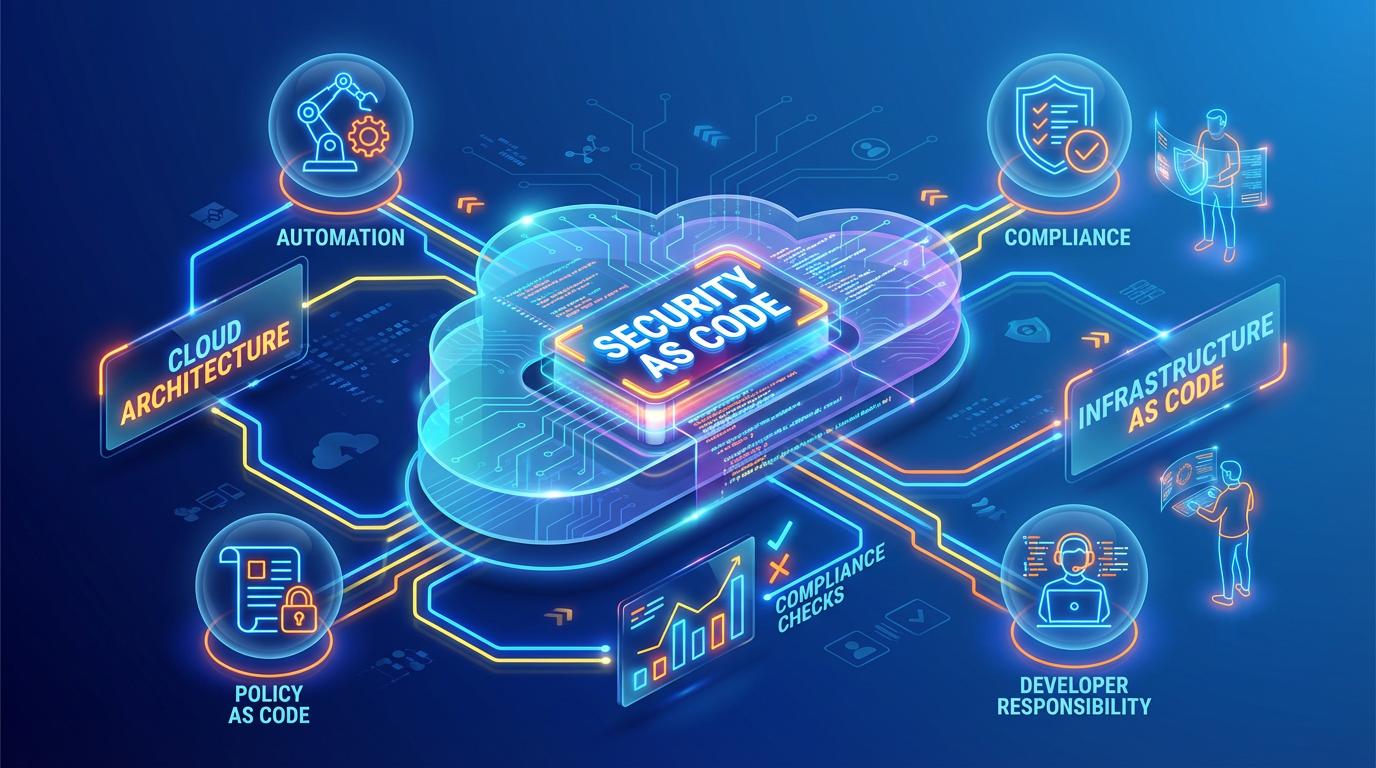
This concept, often called "security as code," defines policies, access rules, and compliance requirements in machine-readable formats and enforces them automatically during provisioning and deployment. Security as code (SaC) has been recognized as the most effective approach to securing cloud workloads with speed and agility because it removes the friction between moving fast and staying safe.
In practice, this looks like:
-
Defining security policies as templates that are version-controlled alongside application code.
-
Using infrastructure as code (IaC) tools to ensure every environment is provisioned with the correct configurations.
-
Automating compliance checks so they run during deployment, not weeks later in a manual review.
-
Establishing golden paths through an internal developer platform so that the default way to build and ship is also the secure way.
When security is expressed as code, it scales with the speed of delivery rather than against it. For practical details on this, see Infrastructure as Code (IaC): How Infrastructure as Code Automates Cloud Deployments.
What Teams Underestimate
The shift to security as code sounds clean on paper. In practice, it requires security engineers who can write policy code, not just assess risk in spreadsheets. It also shifts ownership: developers become responsible for security outcomes in their domain, which means they need context they may not have. Organizations that skip the training and role-clarity work end up with policies nobody maintains and exceptions that pile up until the whole system is decorative.
Integrate Security Controls Into CI/CD Workflows
Even with well-designed infrastructure, security can still become a drag if it sits outside the software delivery pipeline. The goal is to make security checks an automatic part of every build and release, so developers never have to stop and wait for a separate review.
This means inserting specific controls at key stages of the CI/CD pipeline:
-
Pre-commit and build stages: Scan for secrets, vulnerable dependencies, and misconfigurations before code is even merged. This includes LLM-generated code, which should pass through the same static analysis and dependency checks as human-written code. Teams using AI coding assistants without scanning pipelines tuned for AI-specific patterns (hallucinated packages, insecure defaults, phantom dependencies) are accumulating risk faster than they realize.
-
Software composition analysis and SBOM generation: Produce a software bill of materials for every build. Knowing exactly what is in your software and where it came from is no longer optional. Supply chain attacks targeting open-source dependencies have made SBOM generation a baseline expectation from auditors and customers alike.
-
Deployment gates: Run automated policy checks that validate infrastructure configurations against organizational standards. Policy-as-code engines like Open Policy Agent or HashiCorp Sentinel act as guardrails here, with defined rollback triggers if a deployment violates a threshold (for example, a drift rate above a set percentage or a new critical CVE in a dependency).
-
Post-deployment monitoring: Continuously verify that running environments match their intended state. This includes runtime application self-protection (RASP), which detects and blocks attacks during execution rather than relying solely on pre-deploy scanning. RASP is especially relevant for environments where code changes ship multiple times per day, because it closes the window between deployment and the next vulnerability scan.
When these checks run in seconds and provide immediate feedback, developers fix issues in context rather than weeks later. Security becomes part of the flow, not a disruption to it. For a technical breakdown of how DevSecOps pipelines work at every stage, see DevSecOps Explained: How to Build Security into Every Stage of Development.
Least-Privilege Access and Configuration Control
Two principles are especially important here. Least-privilege access means every user, service, or process gets only the minimum permissions needed to do its job. Configuration control means infrastructure settings are defined, tracked, and enforced through code, not manual changes. Together, these reduce the attack surface without creating friction for delivery teams.
The Trade-offs
Embedding security into CI/CD pipelines adds latency to each build. Not much if done well (seconds to low minutes), but teams accustomed to sub-minute builds will notice. The bigger cost is maintenance: policy rules need updating as architectures evolve, and someone has to own that work. Organizations that treat pipeline security as a "set and forget" project find their rules become stale within two quarters. Mature teams track this through change failure rate and rollback rate. DORA benchmarks suggest elite performers maintain a change failure rate below 15% with multiple deploys per day. If your change failure rate is climbing after adding pipeline controls, the rules may be too brittle rather than too strict.
Build Centralized Observability and Continuous Monitoring
You cannot protect what you cannot see. As cloud environments grow more distributed, spanning multiple providers, regions, and services, maintaining a clear, centralized view of what is running, how it is configured, and whether anything looks unusual becomes essential.
Centralized observability means collecting logs, metrics, and traces from every layer of the environment into a single platform where patterns can be identified and anomalies flagged. Continuous monitoring means these signals are evaluated automatically, not reviewed periodically by a human.
The operational benefits are concrete and measurable:
-
Faster incident response. Mature teams target a mean time to recovery (MTTR) under one hour for critical incidents. Without centralized observability, MTTR commonly stretches to six hours or more because engineers spend most of that time figuring out what happened, not fixing it.
-
Reduced drift. Running environments gradually diverge from their intended configuration unless deviations trigger automated alerts or corrections. Drift detection tied to policy-as-code engines can flag and remediate changes within minutes of occurrence.
-
Stronger compliance readiness. Audit evidence is generated continuously rather than assembled manually before a review.
Organizations that transform their operating model while migrating to the cloud can increase operational efficiencies by 20 to 25 percent, and a large part of that gain comes from better observability and monitoring practices. For an in-depth guide on aligning observability with performance, security, and cost, see CI/CD Monitoring: Continuous Monitoring for Performance, Security, and Compliance.
Telemetry Governance: The Hidden Cost
There is a catch. Telemetry at scale is expensive, and most teams drown in data without gaining insight. Collecting everything from every service at full fidelity can consume a significant portion of your cloud budget. The emerging discipline of telemetry governance, deciding what to collect, at what granularity, and for how long, is becoming a core responsibility of platform engineering teams. If your observability costs are growing faster than your infrastructure costs, you have a governance problem, not a tooling problem. Mature organizations define sampling strategies and tiered retention policies as part of their internal developer platform, so teams get the signals they need without generating noise they cannot afford.
Align Teams, Ownership, and Accountability
Many organizations have the right tools but still struggle because their teams operate in silos. Cloud engineers focus on uptime. Security teams focus on risk. DevOps teams focus on velocity. Without shared goals, shared standards, and clear ownership, even the best automation produces inconsistent results.
Balancing cloud speed and security requires structural changes in how teams work together:
-
Shared accountability models where security outcomes are part of every team's objectives, not isolated to the security team.
-
Cross-functional standards for configuration, access management, and incident response that all teams follow.
-
Regular, lightweight reviews where cloud, security, and DevOps leads discuss emerging risks and evolving policies together.
Platform engineering teams are increasingly becoming the organizational center of gravity for this alignment. By owning the internal developer platform, golden paths, and shared tooling, platform teams create the connective tissue between security policy and developer experience. When the secure path is also the easy path, adoption follows naturally. Discover how platform engineering bridges these gaps and strengthens collaboration in Tech DevOps: The Core Engine Behind Agile Businesses.
What Commonly Goes Wrong
The most common failure mode is declaring shared accountability without changing incentive structures. If the security team's performance review still hinges solely on audit findings and the DevOps team is measured only on deployment frequency, "shared accountability" is just a slide in a leadership deck. Real alignment requires joint metrics. For example, both teams co-own change failure rate and MTTR, and both teams participate in incident postmortems regardless of whether the root cause was a security misconfiguration or an infrastructure failure.
Another underestimated cost: cross-functional work is slower at first. Teams that have never collaborated closely will spend their first quarter building shared context and negotiating standards. Expect a temporary dip in velocity before the gains appear.
Organizations that adopt site reliability engineering (SRE) models alongside their cloud migration see measurable gains on both fronts. These models can reduce cycle times by up to 60-70% while simultaneously improving the resilience and security of applications and platforms by more than 30%.
Signs Your Cloud Team Has a Speed-vs-Security Problem
Most teams do not realize they have this problem until an incident, an audit finding, or a deployment freeze makes it impossible to ignore. These are the signals that typically appear first.
Security reviews are delaying releases. If developers are waiting days for security sign-off before shipping, security is operating as a gate, not a guardrail. The process was not designed for the pace of delivery.
Teams are overriding controls to move faster. When engineers routinely bypass policy checks, disable monitoring alerts, or request blanket exceptions, it means the controls are creating friction without providing value. That is a design failure, not a discipline failure.
Observability costs keep rising without better insight. If your telemetry bill is growing faster than your infrastructure footprint, you are collecting data you cannot act on. That is a governance gap, not a tooling gap.
Policies are inconsistent across environments. If production, staging, and development run under different rules, drift is not a risk - it is already happening. The question is whether you are measuring it.
AI-generated code is reaching production without additional review. LLM-assisted development accelerates output. It also introduces dependency hallucinations, insecure defaults, and configurations that pass standard linting while failing in runtime. If your scanning pipeline was not tuned after your team started using AI coding tools, your risk surface has grown without your awareness.
No single team owns the security-speed boundary. If a misconfiguration incident triggers a debate about whose responsibility it was rather than a clear escalation path, ownership is ambiguous. Ambiguous ownership is where most cloud security failures actually begin.
Recognizing these signals early means the fix is architectural and deliberate. Waiting until an incident forces it means the fix is reactive and expensive.
Conclusion
Speed and security are not opposing forces in the cloud - they only appear that way when systems, processes, and teams are misaligned. Organizations that continue to treat security as a checkpoint will keep slowing down or exposing themselves to risk. Those that embed it into architecture, automation, and daily operations remove that friction entirely.
The companies that succeed are not choosing between faster releases and stronger protection. They are redesigning how their environments are built and operated so both outcomes happen by default. Security becomes part of the delivery pipeline, visibility becomes continuous, and accountability is shared across teams rather than isolated.
For IT leaders, the challenge is no longer about finding the right tools, but about building the right operating model. In a cloud environment where change is constant and attack surfaces are expanding, the ability to move fast without losing control is not a competitive advantage anymore - it is a baseline requirement for staying resilient, secure, and scalable.