Secrets Management for DevOps: When HashiCorp Vault Is Worth the Operational Cost

Content authorBy Irina BaghdyanPublished onReading time17 min read
Futuristic digital system with connected components and data flows representing document workflow automation

The real shift in secrets management comes from long-lived, standing credentials to workload identity that issues short-lived ones on demand. HashiCorp Vault secrets management is one route to that shift, but it fits only some environments. This guide lays out the difference: where Vault earns its operational cost, when a simpler managed store is the better call, and how to sequence adoption without a disruptive cutover.

The problem that pushes teams toward Vault

HashiCorp Vault secrets management usually enters the conversation after something breaks. A credential sitting in Git history. A database password nobody dares rotate because four services read it from a config file. GitGuardian counted 28.65 million new hardcoded secrets in public GitHub commits during 2025, a 34% increase over the prior year. Verizon's analysis of 12,195 confirmed breaches put credential abuse at 22% of initial access, with a median of 94 days to remediate leaked secrets found in a repository.

The pattern is accelerating with AI-assisted development. GitGuardian found AI-service secrets grew 81% year over year, with more than 1.27 million AI-service credentials exposed in 2025, and traced leakage into AI-assisted development and MCP configuration files specifically. Faster software generation means more integrations, tokens, service accounts, agents, and machine identities. Secret lifecycle automation must scale at the same speed as software delivery, or it falls permanently behind.

Long before any of that turns into an incident, static credentials slow delivery. Rotation becomes a change-management project, and nobody can say with confidence which workload holds which key.

The secret lifecycle Vault fits into

It's tempting to treat Vault as the fix for secret sprawl. It isn't, by itself. Vault does not discover every secret already leaking across repositories, Slack, build systems, laptops, and legacy configuration. It only manages what gets brought under its control.

The lifecycle a mature program builds toward looks like this:

long-lived credential → workload identity → short-lived credential → ideally no persistent credential at all

A secrets manager solves the management half of that chain. Prevention and discovery are separate, ongoing effort that has to run alongside it, not be replaced by it.

When Vault fits

HashiCorp Vault secrets management earns its operational cost in a specific set of conditions. The strongest signal is hybrid or multi-cloud access, where one workload needs a database in your data center and an object store in AWS, and you want one control plane instead of two credential stores with different permission models. The second signal is dynamic secrets management, which is the reason most platform teams start the evaluation in the first place.

Look for these conditions before you commit engineering time:

  • Workloads span more than one cloud or cross between cloud and on-premises systems.

  • Controls differ per environment, so the same class of credential has three different rotation stories.

  • You need short-lived database or cloud credentials that expire without human action.

  • Audit needs a single, queryable record of who or what read which secret and when.

  • Machine identities outnumber human ones and get created by pipelines rather than people.

The case for HashiCorp Vault secrets management gets weaker as the picture simplifies. If everything runs in one cloud account, your secrets are mostly static API keys, and no team owns platform infrastructure, a managed cloud store will do the job for a fraction of the effort. HashiCorp Vault secrets management is a distributed system with upgrade cycles and a policy model somebody has to maintain. Without a named owner, that burden lands on whoever is on call.

HashiCorp Vault secrets management

Every request in HashiCorp Vault secrets management follows the same shape, and understanding that shape answers most architecture questions. A workload presents proof of identity issued by a platform it already trusts, such as a Kubernetes service account token or an AWS IAM role. Vault verifies that proof with the issuing platform.

What comes back is a token carrying one or more policies. The token is the right to ask for secrets, scoped to specific paths and capabilities, and it expires.

With that token, the workload reads a path. If the path belongs to a static store, Vault decrypts and returns the stored value. If the path belongs to a vault secrets engine that supports dynamic secrets management, Vault creates a credential that didn't exist a second earlier and hands it back with a lease attached. The lease is the contract: Vault promises validity for a stated duration, then revokes the credential automatically unless someone renews it.

Revocation is the part worth internalizing. Because Vault created the credential, it can delete it, and when a token is revoked, every lease created with that token goes with it. That's how a compromised workload becomes a bounded event instead of a rotation project.

Authentication and policies

Identity is where HashiCorp Vault secrets management either earns trust or creates friction. Human access should be federated through your corporate identity provider using OpenID Connect or SAML, so new authentication is disabled the moment a user's corporate identity is revoked. Short token lifetimes and prompt revocation procedures limit how long any already-issued session remains valid. Machines should authenticate using platform or workload identity rather than long-lived Vault credentials wherever possible.

Vault policies are deny-by-default, which sounds reassuring until you write the first one. The failure mode is the convenience policy, granted once to unblock a release, that ends up attached to forty applications. Design the path layout first, because policy quality follows naming: if secrets live under a predictable prefix per team and environment, a policy is three lines and onboarding a new service is a template change.

Token lifetime is the second lever. Vault issues leases with a 32-day default TTL if you never set one, and default_lease_ttl ships at 768 hours system-wide. Neither number belongs in production untouched. Tune them per mount, and keep administrative capability separate from application capability so the team that writes policy can't quietly read every application's credentials.

From secrets management to workload identity

The goal isn't to move every static password into a better-guarded database. It's to stop issuing long-lived credentials at all wherever a workload can instead prove who it is and receive something short-lived in exchange. Vault 2.0 pushes further in this direction with SPIFFE JWT-SVID support and workload-identity federation for Secrets Sync: mechanisms aimed at replacing standing credentials with identity-based trust, not just rotating the credentials faster.

Need IT Support?

Book a free consultation with ABS Technologies experts we'll help you find the right managed IT, cloud, or security solution for your business.

Book a Free Consultation →

Vault secrets engine choices

A Vault secrets engine is a plugin mounted at a path, and the choice of engine decides whether you get storage or lifecycle. Key-value is storage. It holds what you put there, versions it, and returns it, which suits configuration that no external system can generate for you.

Everything else generates. The database engine creates and drops users in PostgreSQL and MySQL. Cloud engines mint temporary IAM credentials. The PKI engine issues short-lived certificates, which is how teams retire the annual certificate scramble. The transit engine doesn't store the application data it encrypts or decrypts, that data passes through and is never persisted. What it does store and manage is the encryption keys themselves; HashiCorp describes this as encryption-as-a-service.

Pick each Vault secrets engine by three questions, answered in order. Does the target system support programmatic credential creation, because engines that support dynamic secrets management need an administrative account in the target to work at all? Can the consuming application tolerate a credential that expires? And who owns the mount when it breaks at 2 a.m.? Start with PKI and one database because the answers are clean, and leave the legacy systems with no credential API on key-value until they're replaced.

Dynamic secrets management

This is the part of Vault that changes application code, and the part teams underestimate. A dynamic credential arrives with a lease ID and a duration. Renewal extends it up to the mount's maximum, after which no amount of renewing helps and the application must request a fresh credential and reconnect.

Connection pools are where this bites. A pool opened with a credential that later expires keeps working until the database closes the session, and then the failure looks like an intermittent connection error. Applications consuming dynamic secrets management need three behaviors: renew before expiry, re-read on renewal failure, and rebuild connections when the credential changes. Vault Agent handles the first two outside your code, which is why most teams adopt it.

Rotation deserves its own attention. HashiCorp Vault secrets management can rotate the root credential that a vault secrets engine uses to administer a target system, and when that rotation fails, every dynamic issuance against that mount fails with it. Monitor lease revocation errors, not just Vault's health endpoint, because a cluster can be perfectly healthy while quietly failing to clean up credentials in a database that changed its password policy.

Namespaces and tenancy

Namespaces create isolated Vault environments inside one cluster, each with its own policies, auth methods, mounts, and identities. A platform team keeps the root namespace and delegates a child namespace per business unit, which lets that unit's admins create their own roles.

Namespaces are a Vault Enterprise capability, so this is a licensing decision. Before buying into it, check whether path-based separation and disciplined policy naming solve your problem in Community Edition. Namespaces pay off when the teams you're separating have genuinely different administrators or compliance scopes. They cost you when they're used to model environments that one team already runs, because you've then multiplied the number of places a misconfiguration can hide.

Design the deployment

HashiCorp Vault secrets management sits in the boot path of everything that depends on it, so its failure domain deserves more thought than most internal services get. Integrated storage using Raft removes the separate Consul cluster from the picture, and HashiCorp's reference architecture recommends five nodes across three availability zones, which survives the loss of two nodes or one full zone while keeping quorum.

Four decisions shape everything after that:

  1. Unsealing. Auto-unseal with a cloud key management service means a restarted node rejoins without a human assembling Shamir key shares at midnight. Keep the recovery keys split among named holders anyway.

  2. Transport. Terminate TLS on Vault itself, not at the load balancer, and keep cluster traffic on its own port and network path.

  3. Network boundary. Keep Vault reachable from workload networks and your identity providers, and from nothing else.

  4. Failure isolation. Don't place Vault's storage and its unseal key inside one dependency that can fail together.

Then choose an operating model. Self-managed Community Edition costs you nothing in license and everything in staffing. IBM's published rate for a managed Vault Dedicated small cluster is $1.57799 per hour on the Essentials tier plus $72.92 per month per authenticated client, which makes client count the number to model before you commit.

Enterprise adds disaster recovery replication and namespaces, and becomes relevant once your requirements depend on those capabilities rather than on regulatory status by itself. IBM closed its $6.4 billion acquisition of HashiCorp in February 2025, so plan procurement as an IBM relationship.

Secure CI/CD without long-lived deployment credentials

CI/CD systems are a common place for exactly the static-credential problem Vault exists to solve: a deployment key sits in an encrypted-variable store because that store exists, not because it's the right architecture. Don't store permanent cloud credentials in the CI/CD system just because it has somewhere to put them.

Where possible, the pipeline should authenticate using its own existing identity, receive short-lived credentials scoped to that run, perform the deployment, and let the credentials expire without anyone rotating them by hand. HashiCorp itself recommends OIDC-based trust and dynamic credentials for integrations such as HCP Terraform, in preference to long-lived static credentials.

Need IT Support?

Book a free consultation with ABS Technologies experts we'll help you find the right managed IT, cloud, or security solution for your business.

Book a Free Consultation →

Plan Kubernetes integration

Kubernetes is where HashiCorp Vault secrets management meets its hardest dependency question. The Kubernetes auth method has Vault validate a pod's service account token against the cluster's TokenReview API, then map that service account and namespace to a Vault role and its policies. Get the mapping wrong, and any pod in a shared namespace inherits another application's access. Vault Kubernetes roles can bind authorization to specific service-account names and namespaces, and can use namespace selectors, so use dedicated service accounts with tightly scoped role bindings. Namespace-per-team strengthens tenancy where it matches how your Kubernetes cluster is already organized, but it isn't a universal prerequisite.

Three delivery patterns exist, and HashiCorp's own integrations comparison is blunt about the trade-offs. The Agent Injector adds a sidecar that renders secrets to an in-memory volume and renews leases on its own. The CSI provider mounts secrets as ephemeral volumes through the vendor-neutral Secrets Store driver; current Vault CSI documentation includes dynamic lease caching and renewal handled by Vault Agent, and it also supports syncing secrets into native Kubernetes Secrets. The Vault Secrets Operator syncs into native Kubernetes Secrets, which suits GitOps workflows and applications you can't modify, at the cost of persisting secret data in etcd.

If you need dynamic credentials with automatic renewal, the sidecar is the honest choice. Whichever you pick, both the injector and the CSI provider make pod startup and autoscaling dependent on Vault availability. Running Vault in the same Kubernetes cluster it serves can still be valid, but Vault's own startup path must not depend on secrets that require Vault to already be available. Organizations with stricter failure-isolation requirements may choose a separate cluster or an external managed Vault service instead.

Plan phased adoption
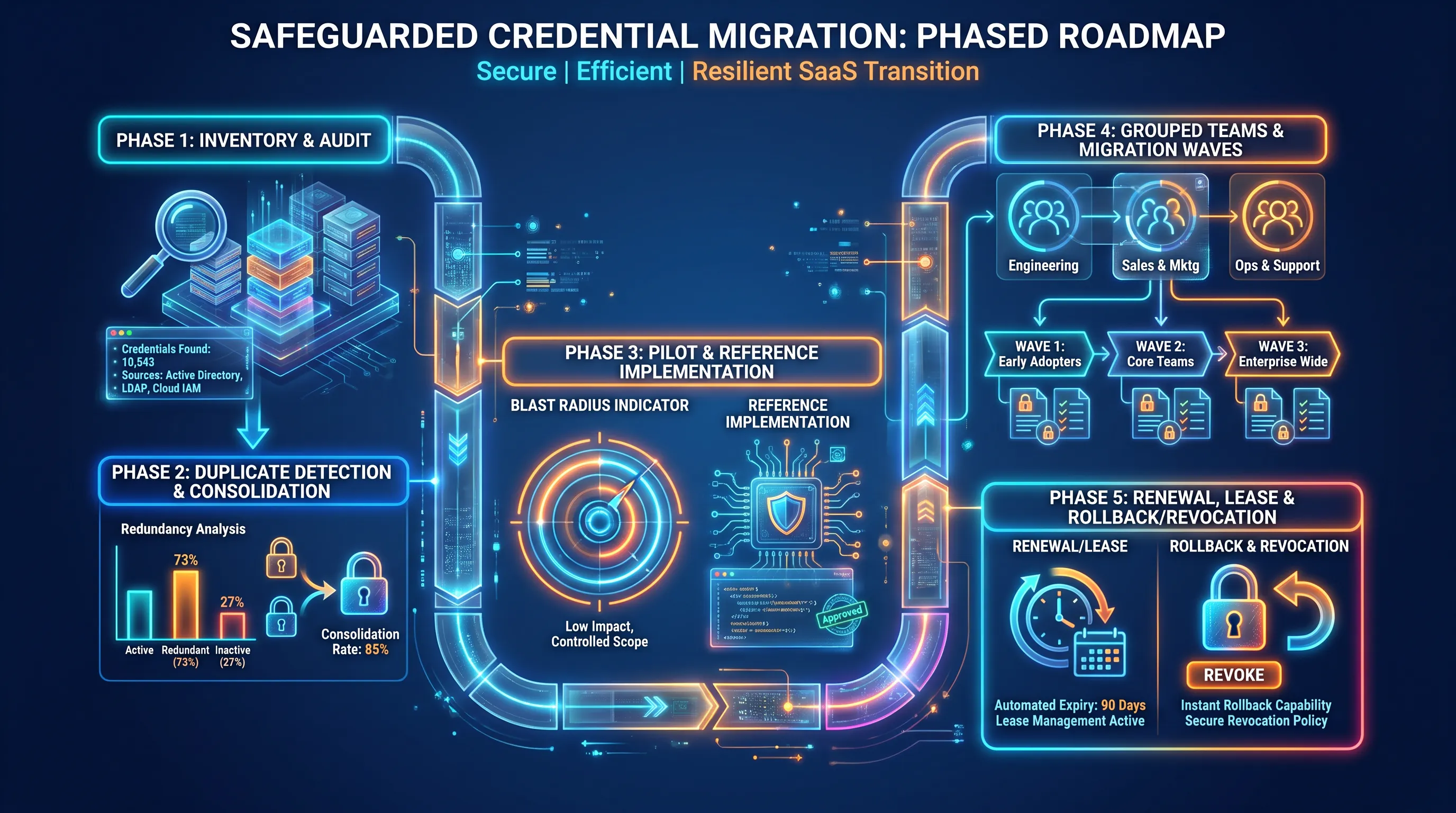
A vibrant neon infographic visualizing a credential migration process with segmented pathways, glowing icons, and brand colors on a deep blue background.

Adoption fails on sequencing. Start with an inventory, because you can't migrate what you can't name: every credential and which services read it. That exercise finds duplicate copies of the same database password in four repositories and two CI systems, and the count itself changes the migration plan.

Then pick one pilot with real value and bounded blast radius. A single service with dynamic database credentials proves the whole chain from workload identity through lease renewal, and it gives you a working reference the next ten teams can copy. Migrate in waves after that, grouped by pattern, so each wave reuses policy templates and delivery mechanics already in production.

Two rules keep waves from turning into outages. Every migrated application keeps a documented rollback to its previous credential source until it has run a full renewal cycle in production, and every wave ends with the old secret revoked. Skipping the second rule is how organizations end up paying for Vault while the static credentials it replaced remain valid for years.

Own the operational reality

A running HashiCorp Vault secrets management cluster is a product your platform team operates, and unowned products decay. Name the team accountable for upgrades and developer support. That last one is real work, because most Vault tickets are application teams asking why a lease expired.

On the audit and recovery side, the non-negotiables are short:

  • Enable audit devices before go-live. Vault refuses requests it can't log, which is a feature when you've configured a second device, and an outage when you haven't.

  • Forward audit logs to your Security Information and Event Management (SIEM) platform, and write them to storage the Vault operators themselves can't alter.

  • Back up integrated storage snapshots and store the unseal or recovery material somewhere separate from the backup.

  • Test restores on a schedule, since an untested snapshot is a hypothesis.

  • If you run Enterprise DR replication, rehearse promotion. Failover needs a DR operation token created in advance and stored outside Vault, and both clusters must run the same version.

Health-endpoint monitoring alone isn't enough. HashiCorp exposes metrics covering core cluster health, usage, storage, audit, resource consumption, and replication, and recommends continuous observability rather than a single up/down check. A production Vault service should monitor availability, storage, audit, authentication, dynamic secrets issuance, capacity, and replication.

Rehearse break-glass access. Someone has to be able to recover a cluster when the identity provider is down, and that path is documented and alerted on.

Compare cloud-native stores

Compare HashiCorp Vault secrets management against the cloud-native stores on the dimensions that decide operating cost, not on feature tables. AWS Secrets Manager charges per secret stored plus per API call, with every cross-region replica billed as its own secret. Azure Key Vault prices per operation. Google Secret Manager bills per active version plus per access operation. All three are cheap at small scale and tightly integrated with their own platform's identity model.

They diverge from HashiCorp Vault secrets management on four things. Scope, because each covers its own cloud well and the others poorly. Dynamic credential breadth, since Vault issues short-lived credentials for databases and certificates through one Vault secrets engine interface. Governance consistency, because one policy language across environments beats three that nearly agree. And lock-in, which cuts both ways: a cloud store ties your secrets model to one provider, while Vault ties you to a commercial roadmap plus the staffing to run it.

The choice in 2026 isn't always binary. Vault Enterprise supports Secrets Sync to third-party platforms including AWS, Azure, and GCP, and Vault 2.0 added workload-identity federation to reduce reliance on static credentials for that synchronization, which makes a third operating model available alongside the other two:

ModelBest fit
Cloud-native secrets onlyPrimarily one cloud, simple requirements, small platform team
Vault as primary secrets platformHybrid or multi-cloud, dynamic credentials, centralized policy and audit
Vault + native secret storesCentral governance needed, but some applications require provider-native secret consumption

The deciding question is staffing. If the platform team can't commit to upgrades, monitoring, and developer support, a cloud store you don't operate will deliver better security outcomes than a Vault cluster nobody maintains. If you already run distributed systems and need dynamic secrets management across more than one platform, the operational cost buys something the cloud stores don't sell.

Production-readiness checklist

Treat go-live as a gate with named owners against each item. Work through it with the application teams in the first migration wave, because half of these items depend on how their code behaves.

  • A named owning team and an on-call rotation.

  • Human authentication through the corporate identity provider and machine authentication through platform identity.

  • Least-privilege policies reviewed by someone who didn't write them, with administrative capability separated from application access.

  • TLS terminated on Vault and certificate renewal automated.

  • Auto-unseal configured, with recovery key shares distributed to named holders and their custody recorded.

  • Production topology sized to your availability and recovery objectives and a tested node-replacement procedure.

  • Encrypted snapshot backups with restores tested on a schedule, plus DR replication if your recovery objective demands it.

  • Audit devices enabled and forwarded to the SIEM.

  • Alerts on seal state and lease revocation failures.

  • Upgrades tested in a non-production cluster of the same topology, with a version-compatibility check against any replication partner.

  • Lease and renewal behavior verified under load, with credential expiry against live connection pools.

  • Break-glass access documented and alerted.

  • A rollback path for each migrating application, and a revocation step that retires the old credential once the new one holds.

Decide the next step

The signals are consistent. Multiple clouds and a platform team able to own a distributed system. When those hold, Vault repays the work. When they don't, a managed cloud store is the better answer.

Either way, prove it on one service before committing the roadmap. ABS Technologies designs and operates cloud and DevOps platforms for companies where software is the business, and we run bounded architecture reviews and migration-readiness assessments for HashiCorp Vault secrets management. Talk to our team about scoping one.


Need IT Support?

Book a free consultation with ABS Technologies experts we'll help you find the right managed IT, cloud, or security solution for your business.

Book a Free Consultation →

Vault can store a legacy credential in its key-value engine, but it can't rotate that credential automatically without an interface the target system supports. Treat the stored value as temporary, document manual rotation steps, and plan replacement of the legacy system rather than presenting static storage as dynamic secrets management.

An application should request a fresh credential, rebuild affected connections, and alert the owning team when lease renewal fails. Connection pools need explicit handling because existing sessions can continue until the database closes them, then fail with an error that appears unrelated to credential expiry.

Vault controls access and revocation before delivery, but it can't control a secret after an authorized application reads it. Keep values out of logs, error messages, crash dumps, and persistent files. Use short lease periods and narrow policies to reduce the impact of a compromised process.

Test the complete path in a non-production environment with the same authentication method, policy layout, delivery pattern, and connection-pool behavior. Force lease renewal, credential expiry, Vault unavailability, and rollback before production migration. Keep the previous credential source available until the application completes a production renewal cycle.

Choose a cloud store when workloads stay within one provider, static credentials meet the requirement, and no team owns distributed infrastructure. HashiCorp Vault secrets management fits better when you need dynamic credentials across environments and can fund operations. ABS Technologies can assess that choice through a bounded architecture review.

Schedule a Meeting

Book a time that works best for you and let's discuss your project needs.

You Might Also Like

Discover more insights and articles

Industrial automation control system with connected electrical components and data infrastructure

Software Supply Chain Security: Controls That Protect Code from Commit to Production

Every step between a developer's commit and a running production workload is a place an attacker can intervene: a poisoned dependency, a tampered build, a stolen pipeline credential, an unsigned image. Mapping these attack paths end to end shows which control interrupts each one and where a single control covers several paths at once. Because funding every control at once is rarely possible, a ranking method then orders the work by the risk each control removes, so limited budgets go first to the gaps attackers are most likely to use.

Business team viewing a digital technology network and interconnected data systems in a modern corporate environment

GitHub Actions Self-Hosted Runners: Secure Architecture and Autoscaling Patterns

Self-hosted GitHub Actions runners give teams control over cost and environment, but they also put build infrastructure inside the trust boundary, where a single compromised workflow can reach internal systems. A defensible architecture starts by naming the threats runners introduce, then applies controls that contain them: ephemeral runners, default-deny network isolation, and short-lived workload identity in place of stored cloud credentials. Scaling models sized to real demand keep capacity honest rather than padded. A cost model and a migration path off persistent runners complete the case, laid out so engineering and finance can review and approve it in a single meeting.

Abstract digital infrastructure with connected data blocks representing a document management system and automated workflow

Grafana vs Datadog: Open Observability Stack or Managed Platform?

The real question comes down to which observability operating model fits your engineering capacity, architecture, reliability requirements, and telemetry economics. Here's how self-managed Grafana, Grafana Cloud, and Datadog compare on architecture and three-year cost, plus a repeatable scoring model for your own telemetry volumes and staffing, and a proof-of-concept structure to test the shortlist before you commit.

Title:
Containers and Orchestration: The Future of Scalable Apps

Meta description:
Read: How are containers redefining scalability? You learn to deploy code faster and cut server costs.

Article:
# C

Containers and Orchestration: The Future of Scalable Apps

Most teams adopt containers expecting speed and simplicity. What they get is Kubernetes in production. The DORA research is direct about what happens next: migrating workloads to flexible cloud infrastructure without changing how you operate them can be more harmful than staying in a traditional data center. This article is an operational guide to what happens after adoption.