Overview
We will trace the historical “castle and moat” mindset, pinpoint where legacy firewalls miss critical traffic in AWS, Azure, and Google Cloud, and show how cloud security in information security programs now pivots around identity, context, and continuous verification.
You will learn:
-
Why perimeter thinking lingers inside modern SOCs
-
Where shared responsibility begins and ends
-
How Zero Trust and cybersecurity governance merge cloud controls with wider information security objectives
-
Practical steps and real case studies that CISOs, IT directors, and network engineers can use today
The Maginot Line Mindset: Why Perimeters Fail in the Cloud
The original Maginot Line was a concrete wall that France trusted too much. Organizations repeat the error when they rely solely on north-south firewall inspection.
-
Perimeter boxes only see traffic entering or leaving the VPC, not the millions of intra-cloud calls
-
Modern attackers pivot sideways once inside, exploiting unmanaged identities and misconfigured storage
-
The result: blind spots that last for months, raising dwell time and cleanup costs
Legacy hardware is valuable for edge control, but believing it is sufficient creates a false sense of security.
Security leadership must replace the “build a taller wall” reflex with a “assume breach” posture that inspects every request, everywhere.
Six Weeks Inside: How Lateral Movement Bypassed an Azure Firewall
A European retailer used a next-gen firewall at the edge of its Azure environment. After a developer exposed an internal API key in Git, attackers jumped from one microservice to another for six weeks before being noticed - by billing spikes, not the firewall. Lateral traffic stayed inside the virtual network, bypassing inspection completely.
The incident cost €4.2 million in lost sales and forensics. The board finally funded micro-segmentation and identity-aware proxies.
Where Legacy Firewalls Go Blind: East-West Traffic and APIs
Traditional appliances excel at IP filtering and port control, yet cloud traffic looks different.
-
Microservices often share the same subnet, so traffic never leaves the hypervisor
-
Kubernetes clusters generate dynamic IPs that change every few seconds
-
Serverless functions spin up and down on demand, evading static firewall rules
-
TLS termination often occurs inside the workload, making packet inspection impossible at the network edge
Security tools miss these flows, creating silent corridors for attackers.
Modern detection must instrument:
-
VPC flow logs streamed to SIEM
-
Runtime sensors in Kubernetes and container hosts
-
API gateways that enforce authentication, rate limits, and schema validation
Doing so turns “east-west” traffic into observable telemetry rather than a blind spot.
For a deep dive into network segmentation, cloud-native microsegmentation, and observability challenges, check out Cloud Managed Security: Unified Security Strategy for Cloud and Hybrid Enviroinments.
Invisible Lateral Movement: How a GCP IAM Role Enabled Token Abuse
A U.S. fintech stored tokenized payment data in Google Cloud. Internal gRPC calls moved tokens between services. A misconfigured IAM role let a compromised service request anyone’s tokens. The hardware firewall saw no anomaly; only deep observability caught the privilege escalation. Cloud-native detection saved 48 hours of potential exploit time.
From IPs to Identities: The New Foundation of Cloud Security

IP addresses are unstable in the cloud, so security controls must hinge on something that persists: identity.
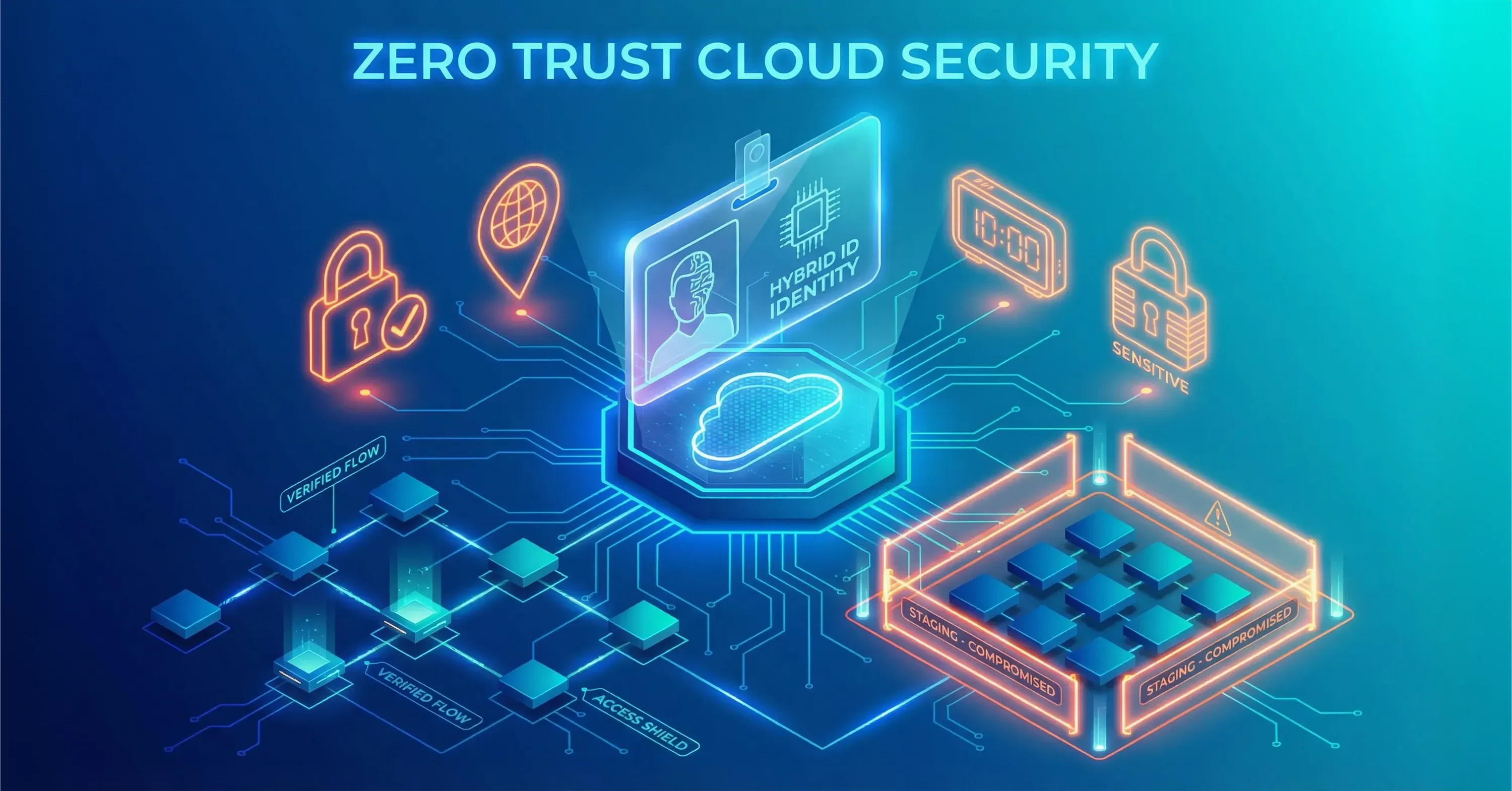
Zero Trust reframes access:
-
Verify every request: users, service accounts, and workloads all authenticate
-
Evaluate context: device posture, geolocation, time of day, and data sensitivity
-
Enforce least privilege: granular policies tied to just-in-time access, not static roles
Key building blocks:
-
Cloud Identity and Access Management (CIAM) with fine-grained permissions
-
Conditional access policies integrated with MFA
-
Micro-segmentation that uses labels or tags, not IPs, to permit traffic
Identity-centric design reduces blast radius by limiting what a compromised entity can touch.
For guidance on Zero Trust, access management, and security best practices in complex cloud setups, also see Information Security.
Zero Trust in Practice: Eliminating Blast Radius with Cloud Identities
A global manufacturer moved from shared admin accounts to workload identities signed by the cloud KMS. When an SRE accidentally leaked a token, the attacker received only staging-environment rights, preventing production access. The pivot to identities shrank potential damage from thousands of servers to zero.
Understanding the Shared Responsibility Model
Even seasoned teams confuse what the cloud provider secures and what customers own. In fact, only 49% of professionals were familiar with the model in a 2024 survey (Dark Reading).
Responsibility split:
-
Cloud provider: physical data centers, core infrastructure, and certain managed services
-
Customer: identity, data classification, configuration, and workload security
-
Overlap: monitoring, incident response, and compliance mapping
Ignoring this split fuels blind spots. Nick Franklin of Fortra notes the 100% ambiguity felt by cloud users about what is covered versus what is not.
Practical steps:
-
Map every service to its responsibility tier (IaaS, PaaS, SaaS)
-
Enable provider logging (AWS CloudTrail, Azure Activity Log, GCP Cloud Audit)
-
Layer customer controls on top: CSPM, CWPP, and CIEM
For more on how managed security services operationalize shared responsibility and ensure full-stack coverage, see the detailed industry breakdown in Cloud Managed Security: Unified Security Strategy for Cloud and Hybrid Enviroinments.
Merging Cloud Security and Cybersecurity Governance
Cloud security does not live in a vacuum. It sits inside the broader information security program that drives risk management, compliance, and board reporting.
Why governance matters:
A sound governance framework aligns:
-
Policies: map ISO 27001, NIST, or CIS controls to cloud services
-
Processes: integrate DevSecOps checks into CI/CD pipelines
-
People: conduct board-level drills and director education (up to 72% participation, NACD)
-
Platforms: select tools that aggregate logs and risk scores to reduce the 71% of teams juggling ten-plus cloud security tools (Check Point)
Organizations looking to tame complexity and unify cloud governance processes can explore strategies in The Danger of the 'Franken-Stack': Why Patchwork IT Will Kill Your Growth and How to Build a Secure, Scalable Foundation.
Many organizations partner with a leading provider of managed IT services that brings unified visibility across on-prem and multicloud estates, easing reporting demands and tool sprawl.
What Is Cloud Security in Information Security?
Cloud security in information security is the discipline of protecting data, identities, and workloads that run on cloud services by combining provider controls with customer-owned measures, guided by governance frameworks so the entire organization maintains visibility, control, accountability, and resilience.
Conclusion
Relying on legacy firewalls to secure cloud workloads is the digital equivalent of fortifying a medieval wall while attackers parachute in. By shifting from IP to identity, embracing the shared responsibility model, and embedding cloud controls into broader information security governance, organizations gain the visibility and control they assumed they already had. The castle may still have walls, but security now patrols every hallway inside as well.