The image depicts an advanced enterprise AI chip embedded in a digital circuit board, visualizing neural network processing and high-performance computing architecture

Cyber-Resilience: Why 2026 Boards are Trading Protection for Immunity

Modern boards are staring at a blunt truth: threat actors now move faster than any human response plan. A single ransomware strike can wipe decades of data, paralyze revenue, and sink market value overnight. Buying more perimeter tools will not calm the boardroom. Ensuring the business never stops will. Below is a practical roadmap for CISOs, IT Directors, and Business Continuity Managers who need to move their IT and business services from brittle protection to digital immunity before the next quarterly review.

Content authorBy Irina BaghdyanPublished onReading time8 min read

What You Will Learn

In the next few minutes we will show how digital immunity differs from classic cybersecurity, why automated recovery, immutable backups, and blast-radius containment form its backbone, and how a mid-sized enterprise can fund the shift by reframing “security spend” as a business continuity investment. Real-world cases and 2025 market data ground every step.

From Cybersecurity to Digital Immunity

Cybersecurity tries to keep every threat out. Digital immunity starts with the assumption that something will get in and designs the environment so it survives the breach.

Digital immunity rests on three pillars:

  • Automated recovery that brings systems back online without human tickets

  • Immutable backups that cannot be altered, deleted, or encrypted by attackers

  • Blast-radius containment that isolates infected workloads before lateral movement begins

The idea mirrors the human body. You still wash your hands, but you know germs slip through, so you rely on an immune system that detects, isolates, and repairs damage in minutes.

Boards are listening. The worldwide IT services market reached nearly US$1.50 trillion in 2025, yet more money is flowing into resilience projects than into fresh firewalls. Eighty-four percent of firms already report rising network outages that erode trust. Immunity has become the new uptime metric.

The next sections show how to build each pillar, one decision at a time. For a deep dive on how a unified security posture supports these pillars across cloud and hybrid environments, see Cloud Managed Security: Unified Security Strategy for Cloud and Hybrid Enviroinments.

How Immutable Backups Saved a Hospital

A regional healthcare chain suffered a ransomware hit that encrypted 40 TB of patient images. Immutable snapshots on a disconnected storage tier let them restore radiology services in 14 minutes, fast enough that clinicians never lost access. Patient appointments stayed on schedule, and the breach never made local news. Protection failed, but immunity kept the business alive. The following section explores the automation that made that 14-minute recovery possible.

Automated Recovery: Healing at Machine Speed
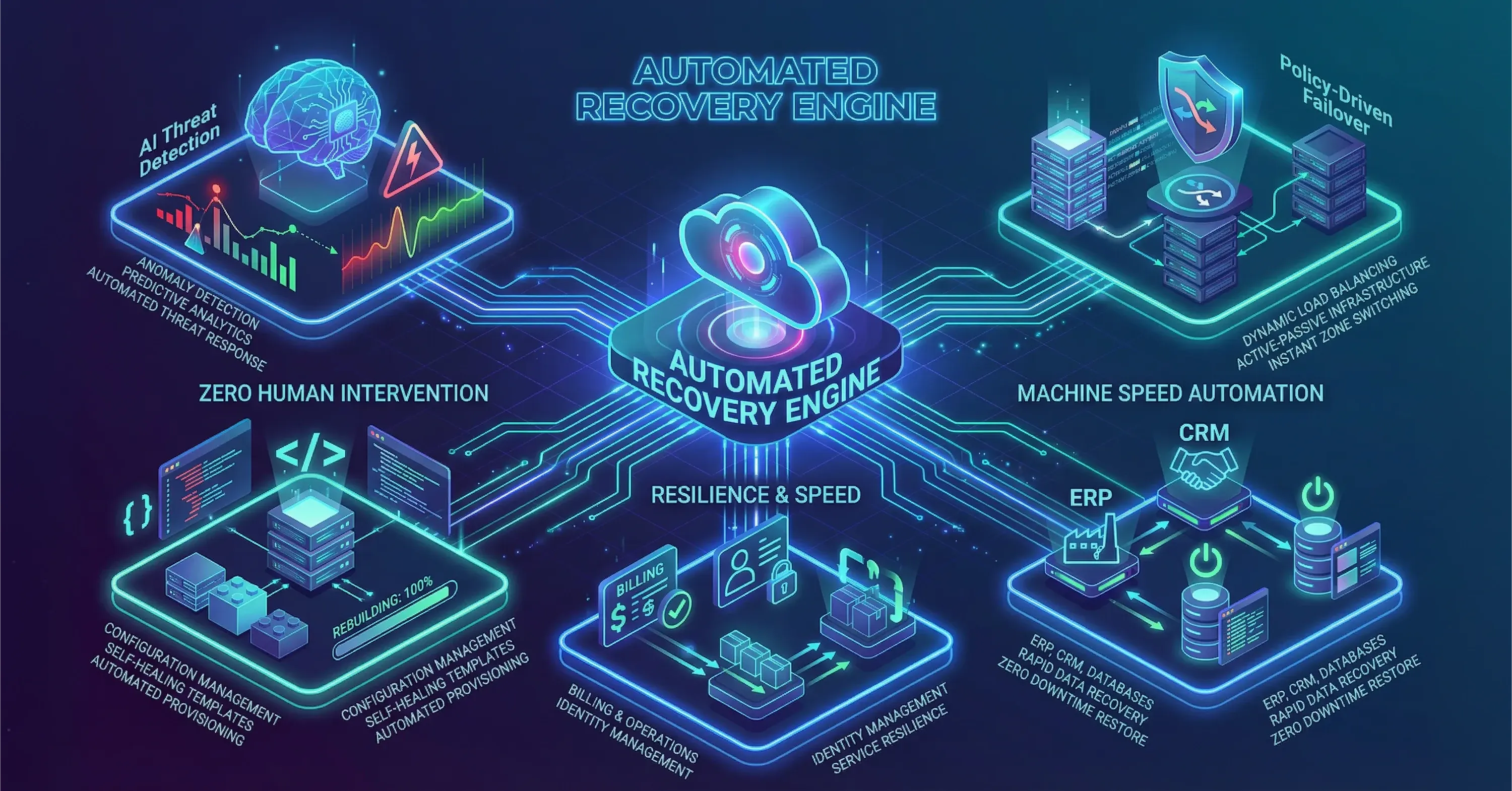
The image shows an automated recovery engine architecture with AI threat detection, policy-driven failover, and machine-speed restoration of ERP, CRM, and core business systems without human intervention

Humans do not type faster under stress. In 2026, adversaries script their attacks, so we script our defense.

Automated recovery combines:

  • Policy-driven failover that spins up clean virtual machines or containers in secondary zones

  • Infrastructure-as-Code templates stored in secure repositories, ready to redeploy a full stack on demand

  • AI detection models that trigger the workflow once abnormal behavior crosses a predefined threshold

Why the urgency? More than one-third of organizations lost US$1 million to US$5 million in outage-related revenue last year. Manual runbooks cannot preserve cash flow under that pressure.

For mid-sized enterprises, an attainable first step is to automate the restoration of core ERP or CRM systems, then extend the pattern across the portfolio.

Integration with IT and business services matters here. Recovery scripts must restore not only servers, but also service management queues, identity stores, and the billing platform that keeps invoices going out. Skipping those pieces means the lights are on yet revenue is still frozen.

A leading provider of managed IT services, offering comprehensive solutions for infrastructure management, cloud computing, cybersecurity, and business technology optimization, often bundles prebuilt recovery playbooks that clients can tailor, shrinking deployment time from months to weeks. For additional practical guidance on automating recovery, disaster restoration, and root cause analysis, read Cloud Support: How Managed DevOps Keeps Your Business Online 24/7.

Six-Minute Recovery Without Human Intervention

A logistics firm uses policy-driven snapshots for its warehouse management system. When an AI model flagged unusual database writes at 02:14 AM, the platform auto-switched traffic to a clean read replica, rebuilt the primary node from code, and resumed writes in under six minutes. Drivers never saw a delay in routing updates. Automation preserved the supply chain without waking an engineer. The next pillar ensures the data those scripts restore is untainted.

Immutable Backups and Blast-Radius Containment

If attackers can encrypt or delete your backups, recovery scripts have nothing to pull from. Immutable backups solve that by making every restore point read-only, versioned, and locked for a defined retention period.

Key design choices:

  • Write-once, read-many (WORM) storage or object-lock features in major clouds

  • Separate credentials so production admins cannot alter backups

  • Out-of-band replication to a secondary region or cloud account

Blast-radius containment complements immutability. The goal is to limit how far malware or a rogue script can travel.

Containment tactics:

  • Micro-segmentation that restricts east-west traffic inside the data center

  • Just-in-time access so privileged sessions expire automatically

  • Egress controls that block unexpected outbound connections

For a field-tested perspective on micro-segmentation, east-west containment, and the pitfalls of traditional defenses, explore Is Your Legacy Firewall Exposing Your Cloud? Cloud Security in Information Security.

Mid-sized companies often fear these tactics require hyperscale budgets, yet the market for outsourced expertise is exploding. The IT professional services sector is projected to grow by USD 657.9 billion between 2025 and 2029, which means competitive pricing and vertical-specific packages.


How Immutability Prevented Data Loss

A SaaS accounting vendor stores hourly database snapshots on object-lock buckets with a 45-day retention. When a disgruntled admin attempted to purge client ledgers, the system rejected the delete commands. Security then suspended the user account, and internal auditors confirmed no data loss. Customers never knew there was an incident. Immutability plus containment turned an insider threat into a non-event. Our final section explains how to position these investments as business continuity, aligning them with board priorities.

Turning Cost into Strategy: Business Continuity Metrics Boards Track

Boards approve budgets when they see an outcome tied to revenue. Cyber-resilience becomes a business continuity strategy when leaders express it in language a CFO trusts.

Translate technology into three metrics:

  • Maximum Tolerable Downtime (MTD): the longest a process can be offline before revenue impact turns critical

  • Recovery Time Objective (RTO): the targeted restoration window, measured in minutes or hours

  • Recovery Point Objective (RPO): the amount of data loss acceptable, often in seconds for financial systems

Framing resilience around MTD, RTO, and RPO connects IT alignment with corporate risk appetite. This echoes a TechRadar insight that CIOs are now “central influencers in digital transformation, responsible for aligning strategy, technology, and culture”.

Instead of endlessly adding point solutions, organizations are discovering the cost benefits of security delivered as a service. Why Security as a Service Is the Future of Cyber Defense unpacks the shift from tool sprawl to business outcome budgeting and predictable resilience investments.

Funding tips for mid-sized enterprises:

  • Reallocate part of the cyber-insurance premium toward automation tooling, lowering overall risk and future premiums

  • Consolidate overlapping security products, freeing operating budget for immutable storage

  • Use managed service contracts to convert capital expense into predictable monthly fees, leveraging the US$588.38 billion IT outsourcing segment recorded in 2025.

Done well, resilience planning supports not just security but broader business continuity, reducing the 3AM concerns that keep CEOs awake.

Turning RTO Into Revenue Protection

A regional retailer tied RTO improvements to projected weekend sales. Cutting the web-store RTO from four hours to 20 minutes protected an estimated $2.1 million in quarterly online revenue. That single metric unlocked board approval for immutable backup licensing and a managed recovery service.

What Is Digital Immunity? A Simple Definition for Business Leaders

Digital immunity is a cyber-resilience model that assumes breaches will occur and prioritizes three capabilities: automated recovery that restores systems without human intervention, immutable backups that attackers cannot alter or delete, and blast-radius containment that limits the spread of any compromise. The goal shifts from blocking every threat to ensuring business processes continue, which elevates cybersecurity from a cost center to a business continuity strategy.

Conclusion

Cyber-resilience is no longer about adding one more layer of protection. Boards in 2026 demand immunity: systems that heal, data that cannot be poisoned, and architectures that confine damage to a corner of the network. By combining automated recovery, immutable backups, and blast-radius containment - and by expressing their value in hard business continuity metrics - mid-sized enterprises can face AI-driven threats with confidence that the business will not stop, no matter what crosses the firewall.

Traditional cybersecurity focuses on keeping threats out through firewalls and signature updates. Digital immunity assumes some threats will get through, so it adds automated recovery, immutable backups, and containment controls to keep the business running even during an attack.

Not necessarily. Most major cloud platforms offer object-lock or write-once, read-many (WORM) features that can be enabled on existing storage tiers, turning a standard backup bucket into an immutable repository with minimal additional cost.

For critical revenue systems such as ERP or e-commerce, many mid-sized enterprises aim for an RTO between 15 and 30 minutes. Less critical workloads like internal file shares might target four hours or longer.

Scripts and templates should live in a version-controlled repository with strict access controls. Storing them in a separate management plane, coupled with multi-factor authentication, keeps attackers from modifying the recovery logic.

Yes. Many MSPs bundle immutable backup storage, automated orchestration, and 24 x 7 monitoring into fixed monthly subscriptions, allowing companies to adopt immunity without building all tooling in-house.

Schedule a Meeting

Book a time that works best for you and let's discuss your project needs.

You Might Also Like

Discover more insights and articles

The image shows a high-performance AI processor chip on a circuit board with flowing data streams, representing neural computing and modern enterprise IT architecture

The Sovereignty Shift: Navigating Data Residency and Corp IT Solutions in a Borderless Cloud

In 2026, the question is no longer just whether your data is in the cloud, but exactly which legal jurisdiction that cloud inhabits. For Chief Information Officers and Risk Officers, particularly in regions like the Gulf Cooperation Council (GCC) and Canada, the physical location of a server now carries as much weight as its uptime or security.

This article examines the critical transition from general public cloud strategies to the era of the Sovereign Cloud. We will explore how mid-market firms and large enterprises can navigate strict data laws in Saudi Arabia, the UAE, and beyond. You will learn how to design hybrid architectures that keep sensitive information within national borders while still leveraging global innovation, ensuring yourdigital enterpriseremains compliant and competitive.

Futuristic digital network illustration showing cloud infrastructure with glowing data flows, interconnected circuits, and real-time processing across a modern IT system

How to Build a Cloud Services Support Model That Scales

Cloud leaders love the flexibility of the public cloud, yet many still struggle to support thousands of fast-changing workloads without hiring armies of engineers. By 2026, operational excellence will be judged by a single metric: the Engineer-to-Instance ratio. The lower the ratio, the more resilient the platform—and the more strategic the IT budget.

Below is a practical, end-to-end playbook for CTOs, CIOs, and FinOps leaders who want a cloud services support operation that grows automatically with the business instead of linearly with headcount.

Futuristic cloud security and compliance dashboard visualizing FinOps and GreenOps metrics, cost optimization, and energy-efficient cloud infrastructure

The Green Cloud: Why Carbon-Aware DevOps is the Secret to 2026 Compliance

New EU and US climate rules are about to turn every container image, lambda call, and SQL query into an auditable emission line item. Platform teams must now prove that the way they build and run software is affordable and planet-friendly, or risk fines and reputational damage.

This article explains how carbon-aware DevOps connects cloud cost management (FinOps) with environmental accountability (GreenOps), why the two goals are inseparable, and what engineers need to change before the 2026 reporting deadlines arrive.

A futuristic cyber operations control room filled with holographic dashboards, glowing circuitry, and bright orange alert highlights surrounding a central system display, representing real-time monitoring and advanced IT security

From Hype to Hardware: Why Managed Cloud Computing Is the Missing Link for GenAI Integration

GenAI pilots look simple on paper, yet the first production job often stalls. The culprit is rarely the model license. It is the hardware, networks, and databases that were tuned for last decade’s traffic, not billions of tiny read-write calls made by modern AI agents.

Below is the playbook for CTOs and finance leads who must bridge that gap without ripping out everything they already own.