Cloud adoption alone does not guarantee resilience
Resilience is the product of how networks, compute, storage, redundancy, and segmentation are designed to work together, and weaknesses in any single layer pull the rest down with it.
The data backs this up. Recent ThousandEyes Internet and outage analyses highlight that configuration-related issues remain one of the main drivers of large-scale incidents across internet infrastructure, alongside failures in ISP networks and cloud service provider layers. Operators are accumulating complexity faster than they are accumulating discipline to manage it.
This article treats cloud adoption as a structural system. Each section below covers one building block and how it reinforces the others when something goes wrong.
The role of virtual networking in cloud infrastructure
Virtual networking is the connective tissue of a cloud environment. It decides where traffic can go and how the rest of the stack is exposed to the internet and to itself. Every other layer inherits the strengths and the weaknesses of the network design beneath it.
AWS guidance on security best practices for your VPC treats network design as the first control plane and calls for subnets across multiple Availability Zones, security groups on every instance, network ACLs at the subnet level, and Flow Logs for visibility. Those settings define the blast radius of any later mistake.
If the network is flat or permissive, no amount of compute autoscaling or storage replication compensates. That's the practical reason network architecture has to be the first decision.
Workload isolation through virtual networking
Isolation comes from layering Virtual Private Clouds (VPCs), subnets, route tables, and security groups so traffic only reaches what it is explicitly allowed to reach. Public subnets carry internet-facing components. Private subnets hold databases and internal services. Security groups act as stateful firewalls at the instance level, while network ACLs do the same at the subnet boundary.
A Verizon DBIR figure found that 15% of breaches involved cloud misconfigurations, and 70% of cloud resources were publicly exposed without adequate controls. Most of that exposure traces back to network rules left too open. Tight isolation at this layer is what keeps a compromised workload from becoming a compromised environment.
Network design affects performance
Performance problems blamed on "slow servers" frequently live in the network. Routing decisions, NAT gateway placement, load balancer tier, peering choices, and egress paths all shape latency and throughput before a single CPU cycle is spent. A service that crosses an Availability Zone unnecessarily on every request pays for that hop on every transaction.
The AWS US-EAST-1 incident in October 2025, which Charles Portz of InfraSight Software estimated at $500 million to $2 billion in direct losses, began with a single DNS misconfiguration that paralyzed 113 services. Network topology is performance topology. When the routing layer hiccups, every service downstream wears the consequences.
Compute layers deliver elasticity
A virtual machine behaves differently from a container or a serverless function, and elasticity comes from picking the right model and configuring it to expand and contract on signals that match the business.
Gartner's Predicts 2025 report, projects that more than 50% of all container deployments will use serverless container management services by the end of the decade, up from less than 25% in 2024. The market is moving toward managed elasticity precisely because hand-tuned capacity planning does not scale with modern workloads.
That said, defaulting every workload to one compute model is a common mistake. Different workload patterns have different cost and latency profiles. Treating them identically wastes capacity in one place and starves it in another.
Choosing between VMs, containers, and serverless
Match the model to the workload profile. Use virtual machines for long-running services with specific OS or kernel requirements and for software that expects a full host. Use containers for microservices and stateless web tiers that benefit from fast deployment and portability across environments. Use serverless for event-driven and bursty workloads where idle time is expensive and cold-start latency is acceptable.
According to Statista, 96% of organizations are using containers across development and production environments. That means most organizations now run a mixed estate, and the architectural question is which workload belongs where.
Autoscaling sustains performance under load
Autoscaling sustains performance by adding capacity horizontally as demand rises and removing it as demand falls, provided the workload is stateless or externalizes its state. Scaling policies tied to CPU alone are too crude. Request queue depth and latency percentiles give the controller a more honest signal of when to grow.
The CNCF 2025 annual survey found that 64% of organizations use serverless in production for a few applications, with 29% planning not to use it in the near term. Elasticity is not free. It requires stateless design and realistic scaling tests, because misconfigured policies can cost as much as they save.
Dependable storage architecture

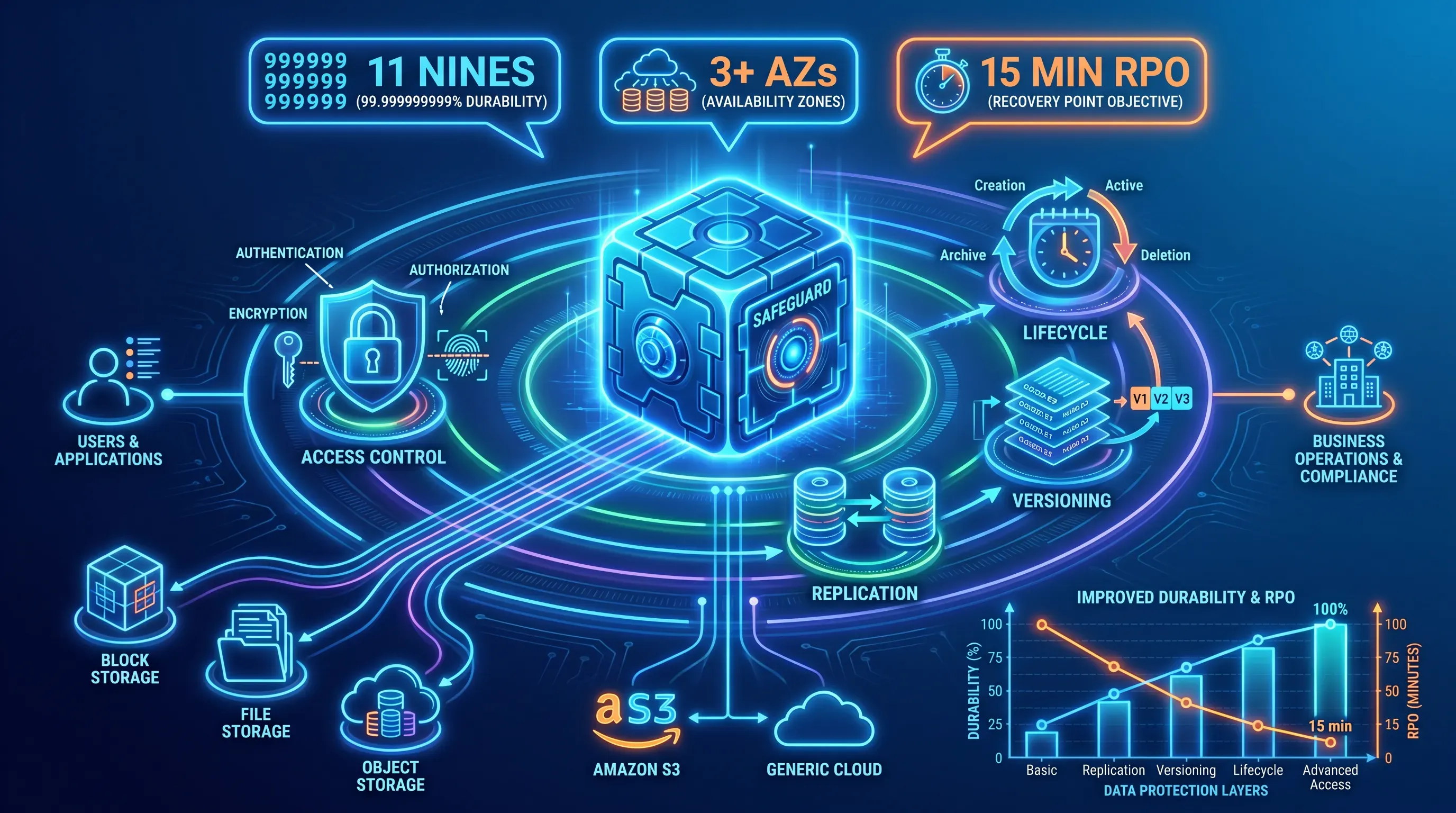
Dependable storage architecture pairs the right storage type with explicit policies for replication and access. There is no universal storage choice. Each storage format solves a different problem, and durability comes from combining the right formats with versioning and recovery targets that match how the business actually uses the data.
There are consequences for choosing the wrong format. For example, a media company that stores video assets in block storage instead of object storage, will pay 10x the cost per GB and hits IOPS limits during encoding spikes. Problems like these are easily avoidable when the format fits your needs.
Amazon S3 is engineered to exceed 99.999999999% (11 nines) data durability and stores data redundantly across at least three Availability Zones by default. That number describes the storage substrate alone. A bucket with eleven nines of durability and no versioning still loses data the moment someone deletes the wrong object.
Strong storage architecture treats durability as a shared responsibility. The provider guarantees the medium. You guarantee the policies that sit on top of it.
The difference between object, block, and file storage
Each format fits a different access pattern. Object storage holds large, unstructured data sets — images, backups, logs, model artifacts — and scales horizontally with flat namespaces and metadata-rich APIs. Block storage gives low-latency, high-IOPS volumes for databases and transactional workloads that expect a real disk. File storage exposes a shared filesystem for applications that need POSIX semantics across multiple compute nodes.
The lesson is that real systems combine storage types deliberately.
Data protection through replication and versioning
Replication, versioning, lifecycle policies, and access controls protect data over time. Replication handles hardware and zone failure. Versioning handles accidental overwrites and ransomware. Lifecycle policies handle cost by moving cold data to cheaper tiers without losing it. Access controls handle the human side, where most damage actually originates.
These mechanisms translate directly into Recovery Point Objective (RPO). Think of it as the maximum amount of data loss an organization can tolerate after a disaster, measured in minutes or hours. If your RPO is fifteen minutes, your replication and backup cadence has to match that number for the target to be architectural.
Redundancy and fault tolerance
Redundancy creates fault tolerance by ensuring that no single component is required for the system to keep running. It is a design discipline built on the assumption that drives, hosts, zones, and even entire regions will eventually fail. The job of the architecture is to make those failures invisible, or at least survivable, to the workloads on top.
The Uptime Institute, cited by Iowa State University research, found that more than half of major outages now cost over $100,000 and roughly one in five exceeds $1 million. The cost of building redundancy in is almost always lower than the cost of explaining its absence after an incident.
Redundancy without testing is theater, though. Failover paths that have never carried real traffic break the first time they're asked to.
Choosing between multi-zone and multi-region designs
Multi-zone design protects against localized failures inside a region, such as a power event or a network partition in one data center. Multi-region design protects against the loss of an entire region from correlated failures or large-scale natural events. The tradeoff is cost and complexity. Cross-region replication and consistency models get harder once a workload spans more than one geography.
Serverion cites JPMorgan Chase achieving 99.999% availability with a 28-second RTO across three AWS regions to meet financial-services compliance. Most workloads don't need that posture. Workload requirements should drive the topology.
RTO and RPO drive redundancy choices
Recovery Time Objective (RTO) and Recovery Point Objective (RPO) translate business tolerance for downtime and data loss into specific architectural requirements.
Those two numbers determine the redundancy bill. A four-hour RTO with a daily RPO can live with nightly backups and warm standby. A one-minute RTO with near-zero RPO demands active-active replication and traffic management that can fail over in seconds. Skip the business conversation and the architecture either overspends or under-protects.
Environment segmentation reduces risk and complexity
Environment segmentation matters because it keeps experimental work and production traffic from touching the same blast radius. Dev and production should use separate networks and separate identities, and staging should be isolated to the same standard. Inside production, microsegmentation limits how far any single compromise can spread.
It is generally recommended to split production, staging, and pre-production environments across different VPCs. The boundary is operational as well as protective. A misbehaving load test in staging that cannot reach production cannot break production.
Segmentation also makes change management honest. When the only way to push something to production is through a controlled path, the path itself becomes the audit trail.
Separate environments protect production
Separate environments allow untested code a place to fail safely. Developers need an environment that looks like production without being production. Staging needs to mirror configuration and integration points closely enough that release candidates are tested under realistic conditions, yet it should remain walled off from real customers and real revenue.
State of Kubernetes Security report, summarized by StationX, found that 90% of organizations experienced at least one Kubernetes security incident in the past year, with 45% caused by misconfiguration. Environment parity catches those misconfigurations before they reach customers. The pattern is consistent: incidents that get caught in staging are footnotes, while the same incidents in production become postmortems.
Microsegmentation limits blast radius
By enforcing identity-based, workload-level access controls inside production, a compromised service cannot reach systems it has no business touching. Traditional perimeter segmentation stops at the edge. Microsegmentation enforces least privilege between every pair of workloads, regardless of where they sit on the network.
Pairing microsegmentation with strong identity controls turns lateral movement from a brisk walk into a series of locked doors. Each lock buys defenders time, which is the scarcest resource during an incident.
How infrastructure layers work together in production
The layers reinforce each other under real operational pressure. A traffic spike hits the load balancer, which spreads load across zones. Stateless compute scales out against the spike while databases serve from replicated block volumes. Object storage absorbs new artifacts. Segmentation keeps a failing microservice from poisoning its neighbors. Replicated state and explicit recovery targets decide what happens if a whole zone goes dark.
None of that is visible without observability. Logs, metrics, traces, and well-tuned alerts are how teams find out whether the design holds before customers do.
The practical test of a cloud architecture is what happens during a partial failure:
-
Does traffic shift automatically when a zone degrades, or does someone have to wake up?
-
Does autoscaling absorb the spike, or does it amplify the failure by overwhelming a downstream dependency?
-
Does segmentation contain a compromised pod, or does the blast wave reach the database?
-
Do the dashboards tell the on-call engineer what is happening within seconds, or within hours?
If those answers are uncertain, the architecture has not been tested. Resilience is the byproduct of layers that have been exercised together.
Next steps for strengthening your cloud infrastructure
Durable cloud environments result from architectural discipline across networking, compute, storage, redundancy, and segmentation. The practical next step is an honest assessment of where each of those layers stands today and where the gaps will hurt most when something fails.
ABS Technologies is a vendor-independent managed IT partner that helps organizations design and operate cloud infrastructure across all the layers covered in this article. Its Cloud Services and DevOps practice works across the major hyperscaler platforms, so recommendations follow the workload. The engagement model is built around running the underlying architecture so internal teams can focus on the products and services the business actually sells.
If you want a structured review of your current cloud footprint across network design, compute elasticity, storage policies, recovery objectives, and segmentation posture, request a free cloud infrastructure assessment from ABS Technologies and use the findings to prioritize the work that will matter most under pressure.