Futuristic cloud computing system visualized above a data center with CI/CD pipeline, data flows, and network infrastructure.

Cloud Computing + Cyber Resilience: The Ultimate Duo

When disruption hits, the real question is not whether an attack or outage will happen, but whether your organization can keep operating through it. That is where cyber resilience and cloud computing intersect: modern organizations depend on cloud infrastructure to absorb incidents, recover faster, and reduce operational impact - through redundancy, automated failover, backup isolation, and operational discipline built into the environment from the start.

Content authorBy Irina BaghdyanPublished onReading time11 min read

What Cyber Resilience Actually Means (and Why It's Not Just Security)

Before connecting cloud computing to resilience, it helps to define the term clearly. Cyber resilience is not a synonym for cybersecurity. Security focuses on keeping threats out. Resilience assumes some will get in - and prepares the organization to keep operating anyway. Today, that means surviving supply-chain compromises, cloud misconfigurations, ransomware, and provider-side outages, not just the traditional disaster scenarios most recovery plans were built around.

More precisely, cyber resilience is the ability of an organization to continuously deliver intended outcomes despite adverse cyber events, with significant overlap to disaster recovery planning. It covers four core capabilities:

  • Absorbing the initial impact of an attack or failure without total service loss

  • Minimizing operational disruption across teams and customers

  • Recovering critical systems within defined time windows

  • Maintaining availability even while incident response is underway

This is a broader mandate than deploying firewalls or running vulnerability scans. It requires infrastructure that bends without breaking - and cloud is where that capability is built. Cloud strengthens cyber resilience through redundancy, failover, backup isolation, and operational discipline. But architecture alone is not enough. Resilience requires the same discipline in how systems are operated day after day as in how they are designed.

Why Prevention Alone Fails: Lessons from SolarWinds

The 2020 SolarWinds breach illustrates why prevention alone falls short. A compromised software update infected at least nine U.S. government agencies and 18,000 companies, spreading through trusted supply chain channels. Organizations that had resilience plans, including isolated backups and segmented environments, contained the damage far more effectively than those relying solely on perimeter defenses.

Understanding this distinction between security and resilience is essential, because it shapes how organizations should think about cloud architecture from the ground up.

How Cloud Infrastructure Directly Enables Resilience

Cloud computing doesn't just make organizations more agile. It provides the structural building blocks that resilience depends on. Traditional on-premises environments often concentrate workloads in a single data center, creating fragile, tightly coupled systems. When something breaks, everything breaks.

Cloud environments, by design, distribute workloads across regions, availability zones, and service layers. This distribution is not just a performance advantage. It's a resilience advantage.

The key cloud capabilities that support cyber resilience include:

  • Infrastructure redundancy: Running services across multiple data centers or cloud regions so that failure in one location doesn't take down the whole operation

  • Automated failover: Shifting traffic and workloads to healthy systems without manual intervention, reducing recovery time from hours to minutes

  • Distributed backup strategies: Storing backup copies in geographically separate locations, often with immutable storage that ransomware can't encrypt or delete

  • Real-time monitoring and alerting: Detecting anomalies quickly so teams can respond before incidents escalate

Cyber-resilient organizations rely on three interdependent levers for absorbing breach impact: redundancy, diversity, and modularity. Cloud platforms make all three achievable at scale. Redundancy comes from multi-region deployments. Diversity comes from mixing services and providers. Modularity comes from containerized, loosely coupled architectures where one failed component doesn't cascade into others. But what good architecture enables and what resilience management requires in practice are two different things. Teams that treat cloud as a resilience guarantee - rather than a resilience foundation - routinely discover the gap when it matters most: untested failover that fails, backups that exist but can't be restored, configuration drift that goes undetected until an incident exposes it.

For additional tips on building modern, resilient environments and understanding the scalability and reliability of cloud, see What Is Cloud Infrastructure? A Beginner’s Guide to Cloud Computing.

Automated Failover in Action: Cloud Recovery at Scale

PwC developed a disaster recovery orchestrator framework on AWS that automates failover of critical services to a healthy AWS region during an incident and failback to the original state, reducing dependency on supporting teams for testing. This kind of automated, cloud-native recovery is nearly impossible to replicate in traditional data center environments without significant cost and complexity.

These capabilities don't emerge by accident. They require deliberate architectural choices - and a clear split between what the cloud provider owns and what the customer must still manage. Identity and access management, backup policy enforcement, and recovery validation remain the customer's responsibility regardless of how sophisticated the underlying infrastructure is. That ownership clarity is what separates organizations that recover in hours from those that discover their gaps mid-incident.

Why Hybrid and Multi-Cloud Strategies Strengthen Resilience

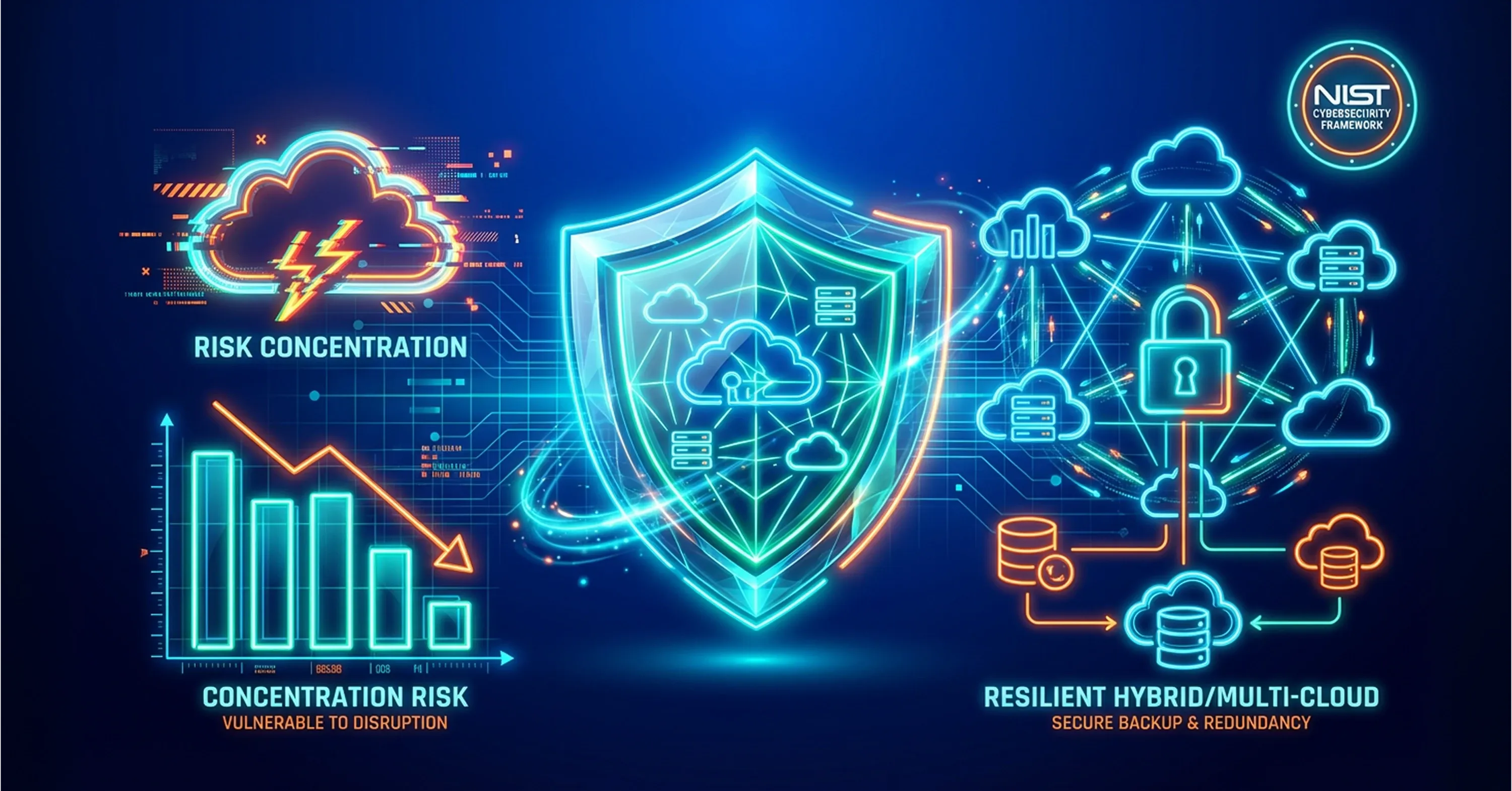
Illustration of hybrid multi-cloud security architecture with NIST framework, showing reduced risk concentration, data protection shield, and resilient cloud backup systems.

Relying on a single cloud provider creates a concentrated risk. If that provider experiences a regional outage, a misconfiguration, or a targeted attack, every workload running there is exposed. Hybrid and multi-cloud architectures address this by spreading risk across environments.

A hybrid approach combines on-premises infrastructure with one or more cloud platforms. A multi-cloud approach uses two or more public cloud providers. Both reduce single points of failure and give organizations more options when something goes wrong.

The resilience benefits of these strategies are specific and measurable:

  • Cross-region redundancy: Critical workloads can run in parallel across providers or regions, so an outage in one doesn't interrupt the other

  • Backup isolation: Storing backups on a separate provider or in air-gapped environments ensures recovery data survives even if the primary environment is compromised

  • Workload distribution: Splitting services across environments limits the "blast radius" of any single incident

  • Vendor independence: Avoiding lock-in means teams can shift workloads during prolonged outages or disputes

The concept of isolated, immutable backups deserves special attention. Leading recovery frameworks now recommend that critical information is isolated and immutable in a dedicated data vault with segregated, air-gapped data copies to enable swift recovery during catastrophic cyberattacks. This approach ensures that even in a worst-case ransomware scenario, clean recovery data exists outside the attacker's reach. One important trade-off: hybrid and multi-cloud architectures improve resilience but also increase management complexity. Poorly governed multi-cloud environments introduce new risks - inconsistent access controls, unmonitored attack surfaces, and configuration drift across providers. The goal is not more environments. It is better-controlled ones.

For a modern take on how resilient DevOps teams design distributed, multi-cloud environments to maximize uptime and recovery speed, see How Are DevOps Teams Using the Cloud Differently Today?.

These frameworks increasingly align with established standards. For instance, NIST guidelines for managing and mitigating risks serve as the foundation for many enterprise cyber recovery solutions, offering a structured way to assess and improve resilience posture.

The Risks Driving Resilient Cloud Design

The shift toward resilient cloud architecture isn't theoretical. It's a direct response to recurring, well-documented threats that have exposed the fragility of traditional IT environments.

Ransomware remains the most visible driver. Attacks now routinely target backups alongside production systems, making traditional recovery plans useless unless backup copies are isolated and stored outside the primary environment. Organizations without air-gapped or off-site backups often face a choice between paying the ransom or rebuilding from scratch. The metrics that separate prepared organizations from vulnerable ones are specific: recovery time objective (RTO), recovery point objective (RPO), restore success rate, and failover validation cadence. Without defined targets and regular testing against them, resilience exists on paper only.

Misconfigurations are another persistent risk. A single overly permissive storage bucket or misconfigured access policy can expose sensitive data or create entry points for attackers. In cloud environments, automated configuration scanning and policy enforcement help catch these errors before they're exploited.

Delayed recovery in traditional environments is a risk in itself. When disaster recovery depends on manual processes, physical hardware, or a single site, recovery windows stretch from hours to days. Cloud-native recovery, with automated failover and pre-staged environments, compresses that timeline dramatically.

Service disruption from non-malicious events also matters. Hardware failures, software bugs, and even well-intentioned updates can cause widespread outages. In 2024, a CrowdStrike patch inadvertently disrupted Windows endpoints worldwide, but some companies recovered quickly due to leaders' rapid understanding of scope, risk validation, mitigation, and aligned communications. The difference between organizations that recovered in hours and those that struggled for days came down to preparedness, not luck.

For a hands-on discussion of how immutability, backup isolation, and blast-radius containment turn ransomware from a nightmare into a manageable speed bump, see Cyber-Resilience: Why 2026 Boards are Trading Protection for Immunity.

What Cyber Resilience Looks Like in 2026

Understanding the risks is one thing. Knowing what a prepared organization actually looks like is another. In 2026, resilience is not a feature you enable - it is a state you maintain through continuous operational work.

Organizations that get this right share a common starting point: a resilience assessment that maps critical systems, defines recovery priorities, identifies dependencies, and sets concrete business recovery targets. Without that foundation, even well-designed cloud environments operate without a clear benchmark for what "recovered" actually means.

From there, the markers of a mature resilience posture are specific. Immutable backups stored outside the primary environment. Tested recovery playbooks, not just documented ones. Identity-first access controls that limit blast radius when credentials are compromised. Automated failover that has been validated under realistic conditions. And regular resilience drills that treat recovery as a practiced capability rather than a theoretical one.

The organizations that recover fastest are not the ones with the most sophisticated infrastructure. They are the ones that assessed their exposure honestly, set measurable recovery targets, and built the operational habits to meet them.

Building Resilience Into Cloud Operations

Designing a resilient cloud environment is one thing. Operating it day after day is another. Resilience fails without the operational discipline to back it up - and that discipline has a specific shape: defined recovery targets, tested failover procedures, verified backups, and clear ownership of who responds to what when an incident occurs. The most common failure patterns are not architectural. They are operational: failover that has never been tested, backups that exist but cannot be restored on time, and configuration drift that accumulates undetected until an attacker or an outage makes it visible.

Key operational practices include:

  • Regular disaster recovery testing: Simulating failures and attacks to validate that failover works as expected and recovery targets are met

  • Continuous infrastructure monitoring: Watching for configuration drift, unusual access patterns, and performance anomalies that could signal emerging problems

  • Backup verification: Periodically restoring from backups to confirm data integrity and recovery speed

  • Incident response coordination: Ensuring that technical recovery plans align with communication plans so teams know who does what during an event

This is an area where working with expert providers makes a measurable difference. For practical insights into always-on monitoring, rapid incident response, and ongoing resilience operations, check out Cloud Support: How Managed DevOps Keeps Your Business Online 24/7.

The thread connecting all of these practices is simple: resilience is earned through repeated operational discipline - tested recovery plans, verified backups, monitored infrastructure, and clear ownership at every layer. No cloud platform delivers that automatically. It requires intentional design, regular validation, and a team that treats continuity as a core operating responsibility, not an IT checkbox.

Conclusion

Cloud computing and cyber resilience are no longer separate conversations. Organizations that stay operational under pressure - through ransomware, misconfigurations, provider outages, and supply-chain failures - are the ones that built resilience into their infrastructure and then operated it with discipline. Cloud platforms provide the redundancy, automation, and recovery capabilities that make this possible. But those advantages only materialize when backed by deliberate architecture, tested recovery plans, and clear ownership at every layer.

From cross-region failover and isolated backups to continuous monitoring and workload distribution, resilient cloud design gives organizations the ability to absorb disruption, protect critical systems, and restore services faster when incidents occur. But design is only half the equation. The organizations that recover in hours instead of weeks are not the ones with the most tools. They are the ones that know their RTO and RPO, test their failover, verify their backups, and maintain clear ownership across every layer of their environment. Resilience requires that operational discipline - built in, practiced regularly, and treated as a core business requirement rather than an infrastructure afterthought.

Cloud computing provides the structural capabilities that cyber resilience depends on, including infrastructure redundancy, automated failover, distributed backups, and real-time monitoring. These features allow organizations to absorb cyber incidents, minimize disruption, and recover critical systems quickly, making cloud architecture a foundational element of any serious resilience strategy.

A multi-cloud approach spreads workloads and data across multiple providers, reducing single points of failure. If one provider experiences an outage or attack, services on other providers can continue operating. It also enables backup isolation, where recovery data is stored on a separate platform outside an attacker's reach.

No. Cybersecurity focuses primarily on preventing threats from reaching your systems. Cyber resilience assumes that some incidents will occur and focuses on the organization's ability to continue delivering services during and after those events. Resilience encompasses detection, response, recovery, and continuity, not just prevention.

Modern ransomware attacks frequently target backup systems alongside production data. If backups are stored in the same environment, they can be encrypted or destroyed during an attack. Isolated, immutable backups stored in air-gapped or separate cloud environments ensure that clean recovery data remains available, enabling faster restoration.

Most resilience frameworks recommend testing at least quarterly, though critical systems may warrant more frequent drills. Regular testing validates that automated failover works correctly, confirms backup integrity, and reveals configuration changes that may have introduced gaps since the last test.

Schedule a Meeting

Book a time that works best for you and let's discuss your project needs.

You Might Also Like

Discover more insights and articles

Visual of legacy server infrastructure transforming into cloud computing environment, illustrating cloud migration, elastic scaling, and digital transformation with network and compute resources.

From Legacy to Cloud: The Shift to On-Cloud Operations

Most organizations know they need the cloud. The real challenge is turning that move into faster, more resilient, and more efficient operations. On-cloud solutions do more than replace legacy infrastructure. They change how teams provision, scale, monitor, and manage services day to day. This article explores what that operational shift looks like in practice, and why migration alone is not enough to deliver better outcomes.

CI/CD pipeline visualization showing automated build, test, and deployment workflow across cloud infrastructure and DevOps environments.

From Pipelines to Platforms: How Cloud Fuels DevOps Innovation

Software teams everywhere face the same pressure: ship faster, break less, and scale without burning out. Yet many organizations still wrestle with slow release cycles, fragile environments, and a gap between what development builds and what operations can reliably run. The question at the center of this tension is not whether cloud helps - it does. The real question is how: cloud does not automatically create DevOps maturity; it removes infrastructure friction so that teams can build the practices that do.

Futuristic digital tunnel representing AI development pipeline with build and deploy stages in automation workflow.

Modern DevOps Meets the Cloud: A New Way to Build and Deploy

Today, cloud strategy is no longer a one-time infrastructure decision - it is a continuous delivery challenge. When a single provider cannot meet every operational need, deployment speed, reliability, and cost all suffer.

Futuristic circuit board illustrating CI/CD pipeline with agile triggers and DevOps automation processes

DevOps: The Core Engine Behind Agile Businesses

Many organizations adopt agile expecting faster delivery, but the actual pace of release often barely improves. Teams add standups, sprints, and new structures, yet software still takes too long to reach production. That usually happens because the planning model changes, but the delivery model does not.