A glowing turquoise gear sits at the center of a futuristic circuit board surrounded by bright neon circuitry and orange lights.

The Managed DevOps Cheat Sheet: DevOps Technology That Cuts Dev Time and Costs by 80%

Software releases used to drag on for weeks, inflating costs and slowing launches. Managed DevOps, built on modern devops technology, turns that into a fast, automated pipeline. This guide shows how SMBs cut development time and costs by up to 80%.

Content authorBy Irina BaghdyanPublished onReading time6 min read

What You Will Learn

We start with a plain-English definition of DevOps, then walk through continuous integration, agile infrastructure, Infrastructure as Code, and DevSecOps. You will see why managed services make DevOps an accelerator, not a cost center, and how AI-driven tools raise the bar again. By the end, you will have a step-by-step roadmap you can share with your CTO or Head of Product.

DevOps, CI/CD, and Why They Matter

DevOps combines development and operations into one lean machine. Instead of coding in silos and tossing builds “over the wall” to ops, teams collaborate from design through support.

Key result: Faster, safer releases that keep customers happy.

DevOps: Clear, Simple Definition

DevOps is an organisational approach that joins software development with IT operations, using automation, continuous integration and delivery, and shared accountability to deliver features to users faster while reducing defects.

Core Principles That Drive Results

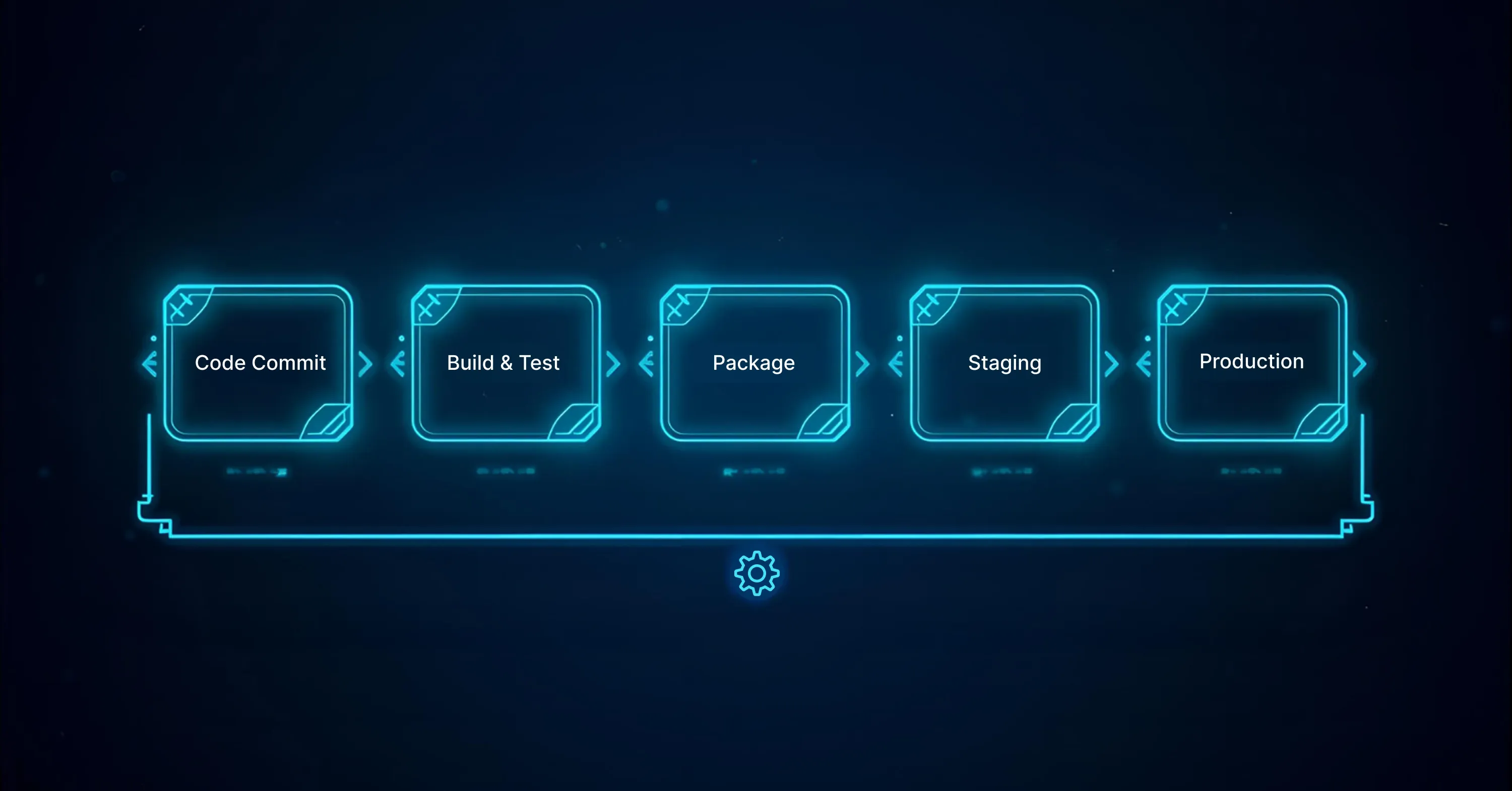
A glowing neon DevOps pipeline displaying the sequential stages Code Commit, Build & Test, Package, Staging, and Production, connected by arrows on a dark futuristic tech background.

DevOps is more than a toolset. It rests on a handful of ideas that anyone can understand.

  • Collaboration: shared goals, shared metrics, no finger-pointing
  • Automation: scripts and platforms perform repetitive tasks so humans focus on value
  • Continuous Integration and Continuous Delivery (CI/CD): every change is built, tested, and shipped in small batches
  • Agile infrastructure: servers, networks, and cloud resources are provisioned on demand, not by ticket queues
  • Monitoring and feedback loops: live metrics inform every decision

High-performing teams monitored by DORA-style metrics in 2025 deploy many times more frequently than lower-performing peers, and maintain change-failure rates of roughly 10-15% or below.

Building on this foundation, the next sections show you the concrete workflows that unlock the feared 80 % gap in time and money.

Set-It-and-Forget-It Workflows That Save 80 %

Manual hand-offs and waiting for approvals are the real budget killers. Automating them turns weeks into minutes.

Automated CI/CD Pipelines

A CI server checks out every commit, runs tests, and packages artefacts. A CD engine then deploys to staging or production automatically.

  • Code merged → build triggered → unit and integration tests run
  • If green, artefact pushed to registry and staged
  • Canary or blue/green deployment rolls out while monitoring errors

Result: Developers focus on features, not release gymnastics. Companies using mature CI/CD see a 60% reduction in mean-time-to-resolution (MTTR) for incidents.

For deeper insight into effective continuous delivery practices - and how they support round-the-clock business needs – see ABS Managed IT Services.

Infrastructure as Code Feeds Agile Infrastructure

Templates like Terraform or CloudFormation describe servers and networks in text files.

  • Version-control changes next to application code
  • Recreate entire environments in minutes for testing or scaling
  • Enforce the same configuration everywhere, eliminating “works on my machine”

To explore industry best practices and solutions for automated infrastructure management.

Integrated Security with DevSecOps

Security is baked into the pipeline.

  • Static code analysis and dependency scanning during CI
  • Policy as code blocks misconfigured resources before deployment
  • Runtime monitoring sends alerts when anomalies appear

By catching issues early, teams avoid the crippling cost of late-stage fixes, estimated at 100 times higher during production.

For further details on embedding security into your SDLC, see Information Security services.

These workflows are not theoretical. A leading provider of managed IT services implements them daily for SMB clients, bundling CI/CD, Terraform modules, and continuous security into a single subscription.

The takeaway: once the pipeline is scripted, you rarely touch it - yet it keeps saving hours every sprint.

Managed DevOps vs DIY: The Economics

“Should we hire DevOps engineers or outsource?” is the top budget question. Let us compare.

  • Hiring: Salaries, benefits, and ongoing training for two senior DevOps engineers easily exceed $300 000 per year.
  • Managed DevOps: Subscription models for the SMB and mid-market segment start near $5 000 per month - roughly 80% less outlay compared to hiring senior DevOps engineers in-house.
  • Opportunity cost: Internal hires ramp up slowly, while a specialist provider delivers a working pipeline in weeks.

Add the soft benefits - 24/7 monitoring, established runbooks, and access to niche experts - and managed DevOps stops looking like an expense line. It becomes the core engine that multiplies developer productivity.

DevOps Evolves in the Age of AI

Automation did not stop with scripts. AI now augments each step.

AI-Assisted Code Reviews

Large-language-model bots flag bugs, style violations, and even suggest unit tests before humans read the pull request.

  • Faster reviews
  • Fewer defects
  • Continuous learning as the model ingests past fixes

Smart Testing and Deployment Orchestration

Machine-learning algorithms predict the riskiest test cases to run first, trimming hours from the suite. Deployment tools analyse patterns to choose optimal rollout windows.

Predictive Analytics for Monitoring and Incident Response

Modern platforms mine logs and metrics, alerting teams about anomalies before users notice.

Organizations implementing predictive monitoring report significant reductions in critical incidents and unplanned downtime - in some cases achieving up to ~70% fewer failures.

AI does not replace engineers; it elevates them. A managed service that layers AI on top of your pipeline compounds the earlier 80 % saving.

Your 7-Step Roadmap to Managed DevOps

Ready to act? Follow these bite-size steps.

  • Map current pain points: release lead time, downtime, headcount.
  • Define goals: weekly releases, sub-30-minute rollback, or cost caps.
  • Inventory tools: source control, ticketing, cloud accounts.
  • Choose a managed partner or assemble an internal tiger team.
  • Implement CI first, then CD, keeping batch sizes tiny.
  • Codify infrastructure and security policies.
  • Measure results and iterate quarterly.

MarketsandMarkets reports that the global DevOps market size is expected to grow from US $10.4 billion in 2023 to US $25.5 billion by 2028, at a CAGR of ~19.7%.

Conclusion

DevOps replaces heroic, last-minute fire drills with calm, predictable delivery. When you combine automated CI/CD, agile infrastructure, integrated security, and modern devops technology - and have it all managed by seasoned experts - you unlock an 80% cut in both development time and cost. The sooner your organisation treats DevOps as an accelerator rather than a cost centre, the sooner you will outrun slower competitors and delight users with every release.

Continuous integration is one DevOps practice where code changes are automatically built and tested. DevOps is the broader culture and toolchain that also covers delivery, deployment, infrastructure, and monitoring.

Yes. When you swap six-month release cycles for weekly pushes and replace manual tickets with scripts, labour hours plummet. Outsourcing the platform further removes salary and tool overhead, often adding up to an 80 % total reduction in time and direct costs.

For a greenfield project, a managed provider can implement CI/CD, IaC, and monitoring in two to four weeks. Existing monoliths may require phased migration over one or two quarters.

No. You still own the code, cloud accounts, and strategic decisions. Managed partners supply the automation frameworks, 24/7 ops, and expertise while you keep governance.

AI tools must follow the same security checks as any component: code reviews, dependency scanning, and role-based access. When those safeguards are in place, AI can actually enhance security by catching threats faster than humans.

Schedule a Meeting

Book a time that works best for you and let's discuss your project needs.

You Might Also Like

Discover more insights and articles

Futuristic secure data center corridor visualizing cloud infrastructure, cybersecurity architecture, and high-performance digital systems with blue and orange circuit patterns

Institutional-Grade Ops: Getting 24/7 SRE Resilience Without the Silicon Valley Price Tag

Mid-sized fintech, healthcare, and e-commerce firms in the GCC and Canada have a quiet, dangerous habit: they rely on a single in-house guru who “knows the cloud.” When that person is on holiday or leaves, revenue stalls. A managed IT support company can remove that single-point-of-failure and give you the same always-on reliability the big Valley brands enjoy, but without the premium price tag.

A quick look at the numbers explains why this matters. Nearly76 % of SMBs already lean on an MSP for at least some IT functionsand67 % plan to increase spending in the next 12 months(JumpCloud). They do it because downtime bleeds cash and damages trust.

Abstract visualization of interconnected data streams representing digital marketing automation, data integration, and performance-driven decision systems

Why Outsourcing Your DevOps Platform is 2026’s Smartest OpEx Move: managed it services and support

Leading CFOs have a new line item keeping them up at night: the spiraling cost of in-house DevOps. Salaries keep climbing, outages remain unforgiving, and security demands never sleep. The question is no longer “do we need DevOps?” but “do we still need to build it ourselves?”

This article walks through the facts, the math, and the risk calculus behind the Build-vs-Buy decision, showing why a managed DevOps model delivers nonstop expertise, lower exposure, and smoother cash flow for less than one senior engineer’s payroll.

The image depicts an advanced enterprise AI chip embedded in a digital circuit board, visualizing neural network processing and high-performance computing architecture

Cyber-Resilience: Why 2026 Boards are Trading Protection for Immunity

Modern boards are staring at a blunt truth: threat actors now move faster than any human response plan. A single ransomware strike can wipe decades of data, paralyze revenue, and sink market value overnight. Buying more perimeter tools will not calm the boardroom. Ensuring the business never stops will.

Below is a practical roadmap for CISOs, IT Directors, and Business Continuity Managers who need to move their IT and business services from brittle protection to digital immunity before the next quarterly review.

The image shows a high-performance AI processor chip on a circuit board with flowing data streams, representing neural computing and modern enterprise IT architecture

The Sovereignty Shift: Navigating Data Residency and Corp IT Solutions in a Borderless Cloud

In 2026, the question is no longer just whether your data is in the cloud, but exactly which legal jurisdiction that cloud inhabits. For Chief Information Officers and Risk Officers, particularly in regions like the Gulf Cooperation Council (GCC) and Canada, the physical location of a server now carries as much weight as its uptime or security.

This article examines the critical transition from general public cloud strategies to the era of the Sovereign Cloud. We will explore how mid-market firms and large enterprises can navigate strict data laws in Saudi Arabia, the UAE, and beyond. You will learn how to design hybrid architectures that keep sensitive information within national borders while still leveraging global innovation, ensuring yourdigital enterpriseremains compliant and competitive.