Resilience and change
Set availability tiers and attach recovery time and recovery point objectives to each one, then test them. Veeam's survey of 1,300 organizations found that among those hit by ransomware, only 10% recovered more than 90% of their data. Anand Eswaran, CEO of Veeam, framed the gap this way: "As the nature and timing of attacks evolve, it is essential for every organisation to transition from reactive security measures to proactive data resilience strategies."
Change control in the cloud runs through infrastructure as code. Require that production infrastructure be defined in code and deployed through a pipeline that records who approved what. Configuration monitoring catches the drift that happens anyway, and the deployment record is your change evidence.
Pair guardrails with self-service
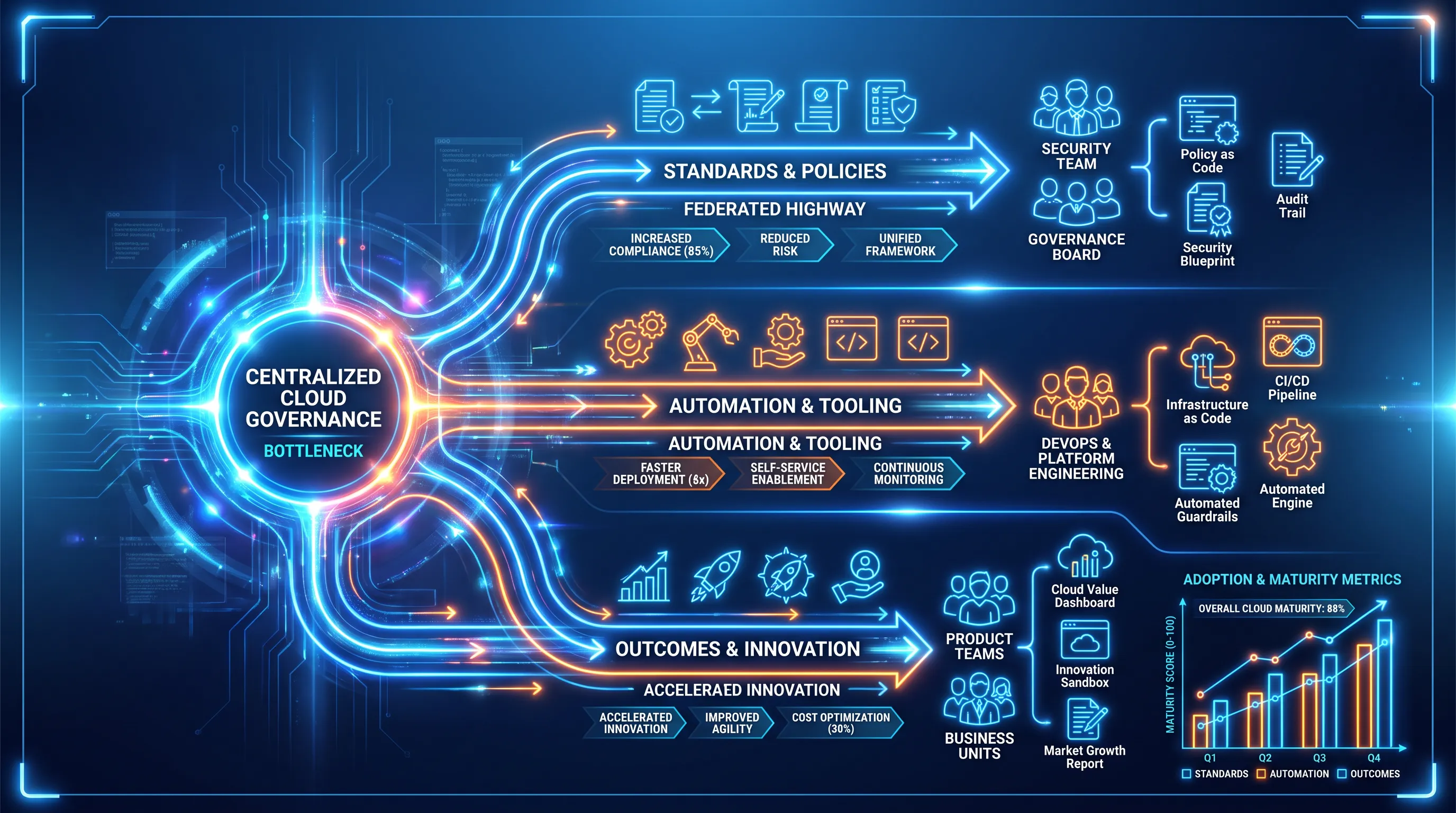
Governance that only says no produces shadow infrastructure. Governance that says yes through an approved path produces compliance as a side effect of the fastest route. That's the whole argument for pairing cloud policy guardrails with self-service provisioning.
The mechanism is policy as code. Open Policy Agent reached CNCF graduated status in February 2021 with production use at Goldman Sachs and Netflix, and the pattern it popularized, policy written and versioned like software, is now how a cloud governance framework gets enforced at machine speed instead of meeting speed.
Cloud policy guardrails
Three control types do different jobs, and choosing the wrong one for the risk is what makes a cloud governance framework feel like obstruction.
Preventive controls block the action before it happens. Use them where the consequence is severe and immediate: public exposure of regulated data and deployment to an unapproved region. The cost of a false positive is a frustrated engineer, and the cost of a miss can be the $10.22 million that IBM recorded as the 2025 US average breach cost, against a global average of $4.44 million.
Detective controls find the deviation after the fact and raise it. They suit situations where blocking would stall legitimate work or where the risk tolerance allows short-lived drift. Corrective controls go one step further and remediate automatically, which works well for low-judgment fixes like removing a public access setting or stopping an untagged instance after a grace period.
Pick preventive where failure is irreversible and detective where speed matters more than perfection. That calibration is what separates cloud policy guardrails from gates.
Build paved paths
A paved path is a pre-approved way to get something done that's faster than doing it yourself. Landing zones provide the account structure and policy baseline already configured. Service catalogs and templates give teams a database or a pipeline that arrives compliant.
When the catalog item carries the controls, approval stops being a conversation. Provisioning requests that match an approved pattern go through automatically, and only deviations need a human decision, which is how you cut lead time without loosening cloud policy guardrails.
DORA's research supports the design: developer independence, which is the ability to complete tasks without waiting on an enabling team, produced a 5% improvement in productivity at both individual and team level. Build for independence, and adoption takes care of itself. Build a platform that teams must queue for, and DORA's 14% drop in change stability is what you inherit.
Define minimum controls
The first goal is a defensible baseline, and it should be small enough to finish this quarter. These twelve controls form the minimum set worth enforcing before anything else in your cloud governance model:
-
A complete, automatically refreshed inventory across every provider and on-premises environment
-
A named owner and cost center on every account, subscription, and production resource
-
Federated identity with least privilege by default and just-in-time privileged access
-
Centralized, tamper-resistant logging for control plane and identity events
-
Encryption at rest and in transit as the enforced default, with managed keys for classified data
-
No unintended public network exposure, enforced preventively in production
-
Mandatory tagging, with untagged resources flagged within 24 hours
-
Budgets and alert thresholds per account, tied to the owner rather than a shared inbox
-
Backups for every tier-one workload, with immutability where the data is regulated
-
Vulnerability scanning with defined remediation windows by severity
Two more close the loop. Recovery testing on a fixed schedule, because 94% of organizations increased recovery budgets after the 2025 ransomware wave and budget without a tested restore proves nothing. And an exception register that is reviewed on cadence, since untracked exceptions silently redefine your baseline.
Build a maturity roadmap
Sequencing beats ambition. Start with a current-state assessment that produces real numbers rather than impressions: how many accounts exist and how many have owners.
-
Phase one, weeks 1 to 6: assess the estate and close the urgent risks, which means public exposure and standing admin access.
-
Phase two, months 2 to 4: standardize the foundations with a hierarchy and a charter that assigns decision rights.
-
Phase three, months 4 to 8: automate enforcement by converting the written baseline into policy as code, preventive where the risk justifies it and detective everywhere else.
-
Phase four, months 6 to 12: ship self-service through landing zones and a catalog, then extend cross-cloud reporting so cost and compliance are visible in one place.
After that it's continuous improvement, and you measure it. Control coverage as a percentage of in-scope resources. Open exceptions and how many are overdue. Allocated versus unallocated spend. Critical findings and how long they stay open. Change lead time and change failure rate, because a cloud governance framework that improves every risk metric while delivery slows down has traded one problem for another.
Watch the direction of travel more than the absolute number. A cloud governance model proves itself when coverage climbs quarter over quarter while lead time holds steady or falls.
Choose the next steps
Start with what you can measure this month. Count the accounts nobody owns and the production workloads without tested recovery, then add the spend you can't allocate. Those three numbers tell you where the risk sits and what sequence to fix it in.
ABS Technologies builds and operates cloud and DevOps platforms for software-led companies. The platforms include landing zones and CI/CD architecture. If you want an outside read on your estate and a phased plan for your cloud governance framework, reach out to our team through the contact page.