Cloud Security Posture Management: From Misconfiguration Alerts to Measurable Risk Reduction

Content authorBy Irina BaghdyanPublished onReading time12 min read
Futuristic digital data infrastructure representing secure document management software and connected information systems

Finding cloud misconfigurations is increasingly easy. Deciding which exposures matter, getting them to the right owner, and proving they were actually removed is the harder problem. Read about the ownership and prioritization work required to convert a raw posture backlog into exposure, and see the metrics that reveal whether that remediation effort is actually working.

The gap between finding and fixing

Most teams deploy cloud security posture management (CSPM) to get visibility across their accounts, and it works. The dashboard fills up. Then the backlog grows faster than anyone closes it as the compliance score hovers in the high eighties. Nobody can answer the one question leadership asks: are we less exposed than we were last quarter?

That gap is not a detection problem. Detection capabilities are mature; operationalizing those findings remains the harder problem. The part still unsolved is delivery, which means deciding which findings matter and attaching each one to a person who can fix it.

So this piece treats cloud security posture management as an operating model. Everything that follows builds toward one outcome: fewer critical exposures, closed faster, with evidence.

Cloud security posture management

Cloud security posture management is the continuous discovery of cloud resources and the assessment of their configuration against a defined baseline. The first word matters most. A quarterly audit describes an estate that no longer exists by the time the report circulates.

Dynamic estates force that continuity. Flexera's 2025 survey of more than 750 cloud professionals found that organizations run an average of 2.4 public cloud providers. Containers, serverless functions, CI/CD workloads and autoscaled compute can appear and disappear faster than traditional inventory cycles can capture them.

Cloud security posture management sits alongside workload protection and entitlement management, and the market has been folding those together. Gartner analysts Neil MacDonald, Charlie Winckless, and Dale Koeppen wrote that cloud-native application protection platforms (CNAPP) "consolidate a large number of previously siloed capabilities, including container scanning, cloud security posture management, infrastructure as code scanning, cloud infrastructure entitlement management, runtime cloud workload protection." A broader cloud security strategy still depends on the same discipline.

Why alerts fall short

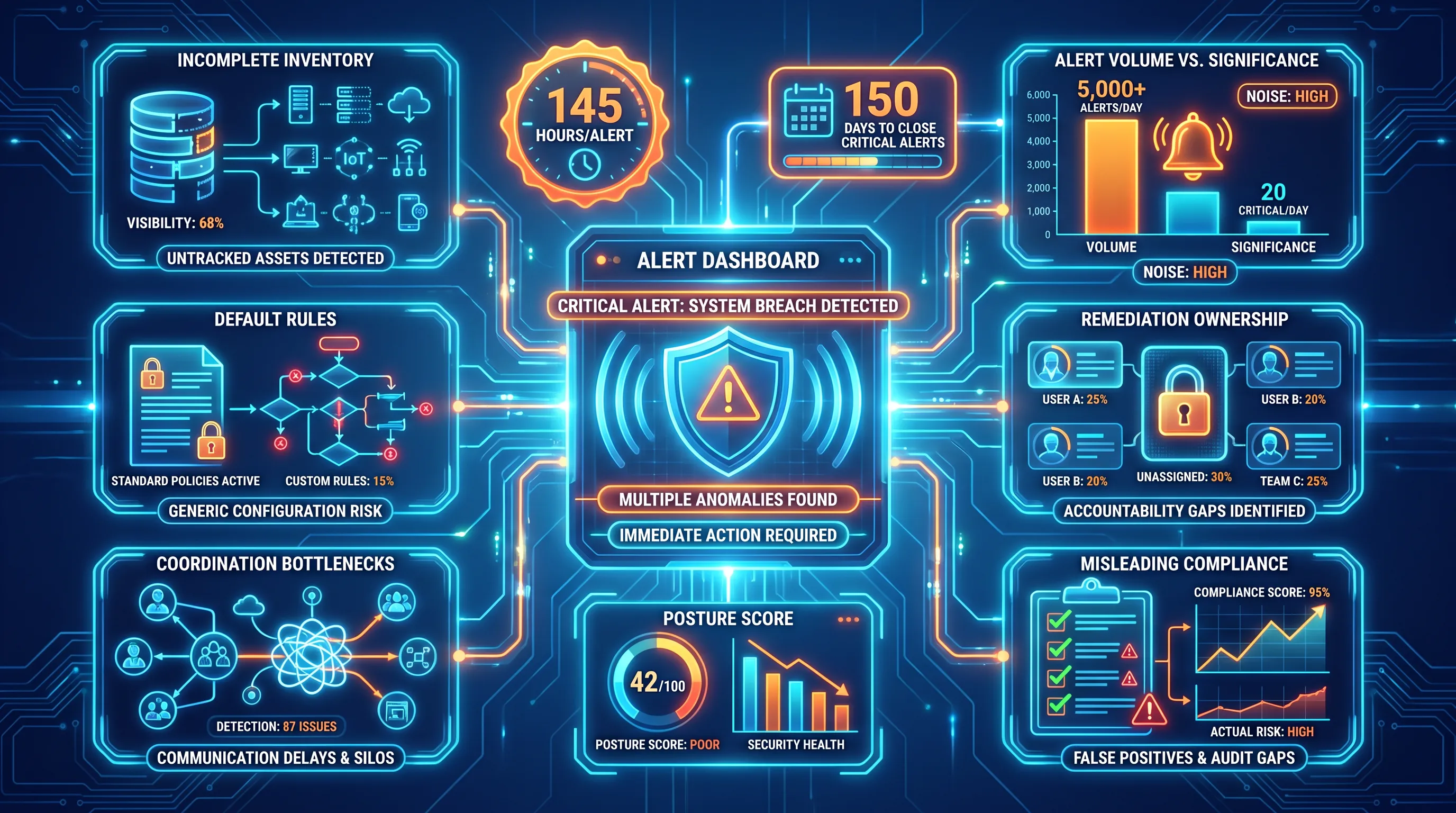
Futuristic neon infographic with a blue gradient background, featuring a central alert dashboard and six connected data clusters.

Start with inventory. If onboarding missed three AWS accounts from an acquisition, your posture score is calculated on a fiction, and the highest-risk resources in the company are the ones nobody is scanning. Every downstream number inherits that error.

Then there are the defaults. Out-of-the-box policy packs generate volume, but they don't drive results. Nobody tuned them to your architecture, so a development sandbox and a payment processing account produce the same severity label for the same finding.

Ownership is where the backlog actually stalls. Orca Security's survey of cloud practitioners found that 82% named the security team as responsible for remediating alerts and only 20% named development, which puts the fix in the hands of people who lack permission to deploy it. Coordination is the bottleneck.

And this is why compliance percentages mislead. A 91% score against a benchmark tells you how many checks passed, not whether the nine percent that failed includes a publicly reachable workload holding customer records. Finding counts behave the same way, since deleting a noisy policy improves both numbers without touching a single exposure. Cloud misconfiguration management earns its keep when it changes what an attacker can reach, and neither of those metrics measures that.

Cloud security posture management workflow

Treat cloud security posture management as a loop that runs continuously, with four stages that each hand work to the next. The loop has no owner-of-last-resort in the security team. Security defines what "bad" means, and the people who built the resource change it.

Discover assets and owners

Onboarding comes first, and it has to be enforced. Every new account gets connected to the platform at creation time through your landing zone automation, because an account that joins the estate outside that path will be discovered months later during an incident.

Continuous inventory then has to reach further than virtual machines. Identities and the short-lived resources that CI/CD pipelines create and destroy belong in scope. CSPM tools that poll once a day will show you yesterday's estate, which is a problem when 33% of Google Cloud VMs carry sensitive project permissions that an attacker inherits the moment a workload is compromised.

Raw inventory is not enough. Each asset needs business context attached and kept current:

  • Environment and application, so a finding in production can be separated from the same finding in a sandbox

  • A Critical CSPM finding should not mean merely “the scanner assigned Critical severity.” It should reflect technical exposure together with business context.

  • An accountable owner who is a named engineering team with deploy rights

Need IT Support?

Book a free consultation with ABS Technologies experts we'll help you find the right managed IT, cloud, or security solution for your business.

Book a Free Consultation

Cloud misconfiguration management

Assessment compares each resource against a baseline you can defend. Provider guidance is the floor, and the Center for Internet Security publishes the reference standard, with AWS Security Hub now supporting 40 automated controls from CIS AWS Foundations Benchmark v5.0. Layer your own rules on top, because generic benchmarks know nothing about your tenancy model or your data residency commitments.

Framework mappings matter for a narrower reason than most teams assume. Mapping a control to the NIST Cybersecurity Framework or to PCI DSS gives your auditor evidence, which saves real weeks during assessment season. Cloud misconfiguration management that stops at compliance mapping produces audit artifacts and leaves the exposure where it was, because a framework treats every control as equally mandatory. For broader guidance, review cloud security practices that connect governance to implementation.

Prioritize exposure and identity, not isolated findings

Ranking is the stage that decides whether anything gets fixed. The signals that move a finding up the queue are reachability from the internet and whether it runs in production with an exploitable vulnerability.

Identity deserves separate weight because it converts a small misconfiguration into a full account compromise. Datadog's study of thousands of organizations found 40% still use unmanaged users with long-lived credentials, and 59% of AWS IAM users hold an active access key older than a year. Andrew Krug, Head of Security Advocacy at Datadog, put it plainly: "The findings from the State of Cloud Security 2024 suggest it is unrealistic to expect that long-lived credentials can be securely managed."

Data sensitivity adds another prioritization signal. A publicly exposed storage service containing regulated, customer, or other sensitive data should not be treated the same as an equivalent resource containing non-sensitive test data. Where available, data security posture management (DSPM) or existing data-classification systems can enrich CSPM findings with information about what data an asset contains and how sensitive it is. CSPM and DSPM solve different problems, but combining their context produces more meaningful remediation priorities.

Group related findings before they reach a queue. Forty unencrypted volumes from one Terraform module are one ticket and one fix, and a policy deviation in a decommissioned test account is neither urgent nor worth an engineer's afternoon.

Remediate and verify

Work goes where engineers already work. That means Jira or GitHub issues with severity-based deadlines attached, because a finding that lives only in the security console competes with nothing and therefore loses to everything. Orca's telemetry showed organizations taking 18 days on average to fix an alert flagged as imminent compromise, and most of that is queue time rather than engineering time.

Prefer fixes that hold. Correcting a security group in the console fixes one resource until the next pipeline run overwrites it, while correcting the Infrastructure as Code (IaC) module that generated it fixes every resource downstream and prevents the next hundred. Cloud misconfiguration management that only touches running state guarantees recurrence.

Remove unnecessary credentials, replace long-lived credentials with temporary/workload identities where possible, and rotate only credentials that must remain. Anything that touches network paths or identity policy goes through human review with a rollback plan. Then verify closure by rescanning rather than by trusting the ticket status, and govern exceptions with an expiry date and a named approver so that "accepted risk" stops meaning "forgotten."

Need IT Support?

Book a free consultation with ABS Technologies experts we'll help you find the right managed IT, cloud, or security solution for your business.

Book a Free Consultation

Extending posture management to AI

Cloud security posture now covers more than accounts and workloads. It increasingly has to include Azure OpenAI and Foundry, AWS Bedrock, and Google Vertex AI deployments; the models running on them; the AI applications built on top; the data sources those applications reach; AI agents; the identities attached to all of it; and the model and library dependencies underneath. None of that fits cleanly into a traditional CSPM inventory, but it is inventory all the same.

AI security posture management (AI-SPM) is the emerging answer. Microsoft's current implementation is a useful reference point: Defender for Cloud continuously discovers AI workloads across Azure, AWS Bedrock and Google Vertex AI and correlates them with code, data, vulnerabilities and attack paths, applying the same discover-baseline-prioritize-remediate loop described above to models and agents instead of just VMs and storage buckets. The ownership question doesn't change either — an ungoverned AI agent with standing credentials is still an ownerless resource, just a newer kind.

Define the operating model

Three groups, three jobs. Security owns policy, which means it decides what counts as a violation and approves exceptions. The cloud platform team owns enablement, which means account onboarding and the integrations that move findings into engineering systems. Application and service owners own their own resources and remediate them.

Escalation has to be written down before it is needed. Critical exposures that exceed their remediation SLA should automatically escalate through the service owner's management chain according to the organization's approved risk and incident governance model.

Workflow tuning is a standing job. Review which policies generate the most volume each month and either fix the underlying pattern or retire the rule. Executive accountability closes the loop, because posture reporting that never reaches the people who fund engineering capacity will never get any.

Evaluate CSPM tools

Vendor feature matrices converge. What separates cloud security posture management platforms in practice is whether they fit the operating model you just defined, so test CSPM tools against that instead.

Run a proof of concept in your messiest account, not a clean one, and check these:

  1. Estate coverage and discovery fidelity: does it see every account you actually use and the ephemeral resources your pipelines create?

  2. Identity context: can it tell you which permissions a finding exposes and which identities can reach the resource?

  3. Policy customization: can you write, version, and test your own rules, or are you stuck with the shipped pack?

  4. Prioritization quality: does it group related findings and rank by reachability, or does it hand you a severity-sorted list?

  5. Integrations and closure validation: does it create tickets with the right owner attached and confirm a fix by rescanning?

Ask each vendor how their platform handles an ownerless resource, since that single answer tells you more than a demo. CSPM tools that cannot route work to a named team leave the entire remediation burden with security, which is the failure mode this whole exercise exists to avoid. A sound cloud architecture makes those ownership and integration requirements easier to validate.

Check CSPM readiness

Before you expand tooling, establish whether the surrounding conditions exist. Cloud security posture management fails quietly when one of these is missing:

  • Estate scope documented, with every account, subscription, and project accounted for, including acquisitions

  • Inventory quality verified by sampling against provider APIs rather than trusting the dashboard

  • Ownership metadata present on resources, with a tagging standard enforced at provisioning

  • Control baselines agreed and versioned, with deviations from provider defaults recorded and justified

  • Compliance obligations mapped so audit evidence comes out of the same system

  • Risk criteria defined, meaning you have written down what makes a finding critical in your environment

  • Ticketing and CI/CD integrations live, with findings created as work items and IaC scanned pre-merge

  • Remediation capacity committed, expressed as engineering hours per sprint rather than goodwill

  • Exception governance with approvers, expiry dates, and a review cadence

  • Executive sponsorship, meaning someone at the leadership table owns the exposure number

If ownership, remediation capacity, risk criteria, and workflow integration are missing, adding more detection can simply create a larger backlog.

Measure risk reduction

Don't use compliance percentage as the primary measure of cloud risk reduction. The metrics that show whether cloud security posture management is working are the count of critical exposures currently open and mean time to remediate by severity.

Add the operational measures that explain the outcomes. Ownership coverage tells you what share of resources have an accountable team attached. Service level agreement (SLA) attainment shows whether your deadlines are real. Policy coverage tracks how much of the estate is assessed against your full baseline, and pre-deployment prevention counts the misconfigurations your IaC scanning caught before merge. That last number is the one that shows cloud misconfiguration management maturing from cleanup into prevention.

Segment everything by cloud provider and owning team. Aggregate numbers hide the pattern you need, which is that one team or one legacy account carries most of the critical exposure. Verizon's 2026 DBIR reports that vulnerability exploitation has become the leading breach entry point at 31%, reinforcing why CSPM prioritization should combine configuration posture with exploitability and actual exposure rather than treating configuration findings in isolation. Those breaches trace back to specific accounts, and segmented reporting is how you find yours first.

Plan the next step

Before shortlisting another platform, map what you already have: account coverage and what you can prove you closed last quarter. That map tells you whether your constraint is detection or delivery. For most estates, it's delivery.

ABS Technologies has built and run cloud infrastructure since 2011, which includes account structure and security guardrails. If you'd rather hand this off than work it out account by account, book a free consultation with ABS to define a prioritized cloud security posture management roadmap.

Need IT Support?

Book a free consultation with ABS Technologies experts we'll help you find the right managed IT, cloud, or security solution for your business.

Book a Free Consultation

Record critical exposures, affected assets, owners, and severity at a fixed date before remediation begins. Keep the same scope and risk rules for each reporting period. This creates a comparable baseline and prevents an improved score from masking changes in account coverage or asset inventory.

Reconcile the tool’s inventory with provider billing records, organization directories, landing zone data, and identity reports. Investigate every mismatch before judging detection quality. Repeat the comparison after onboarding changes, because an integration that worked during testing can miss accounts added through a different provisioning path.

The accountable service owner should request the exception, while security confirms the risk and required controls. An approver with authority over that service should accept it for a defined period. Record the reason, compensating measures, expiration date, and review decision so the exception doesn’t become permanent.

Fix it in infrastructure as code when the configuration comes from a reusable template, module, or pipeline. Correcting the source prevents recurrence across resources created later. Make the change through normal code review, then rescan both the template and deployed resource to confirm that prevention and remediation worked.

Yes. ABS Technologies can review account coverage, ownership data, security guardrails, delivery workflows, and current evidence of closed findings. That review can separate detection gaps from remediation constraints and produce a prioritized handoff. Teams that prefer outside support can book a free consultation → to discuss the roadmap.

Schedule a Meeting

Book a time that works best for you and let's discuss your project needs.

You Might Also Like

Discover more insights and articles

Title:
Containers and Orchestration: The Future of Scalable Apps

Meta description:
Read: How are containers redefining scalability? You learn to deploy code faster and cut server costs.

Article:
# C

Containers and Orchestration: The Future of Scalable Apps

Most teams adopt containers expecting speed and simplicity. What they get is Kubernetes in production. The DORA research is direct about what happens next: migrating workloads to flexible cloud infrastructure without changing how you operate them can be more harmful than staying in a traditional data center. This article is an operational guide to what happens after adoption.

Futuristic digital infrastructure representing a document management system with connected data and secure information workflows

Pulumi vs Terraform: Choosing Infrastructure as Code for the Way Your Team Works

Most Pulumi vs Terraform comparisons stop at "HCL versus Python" and call it a day. That's the least useful part of the decision, because both tools converge on the same model: you declare a desired state, and the engine reconciles it against a resource graph. Provisioning itself is no longer the hard part; modern IaC can create and manage resources across every major cloud. The harder question is how your team manages state, credentials, secrets, policy, reusable infrastructure, approvals, testing, drift, and recovery as the environment grows. That's an operating-model question, not a syntax preference.

Title:
Cloud Development Environments: Faster Onboarding Without Losing Control

Meta description:
Discover how cloud development environments help you speed up developer onboarding and keep control o

Cloud Development Environments: Faster Onboarding Without Losing Control

Moving developer workspaces to the cloud is easy to sell and even easier to get wrong. Teams might commit for the wrong reasons, or skip the governance decisions that make it stick. Here's when the move actually earns its keep, the operating models on offer, and the governance calls to settle before you commit.

Title:
Blue-Green Deployment Strategy: Safe Releases, Fast Rollback, and Hidden Tradeoffs

Meta description:
Evaluate a blue green deployment strategy to help your team cut rollback times and prevent

Blue-Green Deployment Strategy: Safe Releases, Fast Rollback, and Hidden Tradeoffs

A second production environment is sold as insurance. In practice, it's only insurance if the automation underneath it is solid; otherwise it's just more surface area to get wrong. Here's when the redundancy earns its cost, which controls your platform team needs to automate first, and the failure modes that turn a fast rollback into a long incident.