Pulumi vs Terraform: Choosing Infrastructure as Code for the Way Your Team Works

Content authorBy Irina BaghdyanPublished onReading time21 min read
Futuristic digital infrastructure representing a document management system with connected data and secure information workflows

Most Pulumi vs Terraform comparisons stop at "HCL versus Python" and call it a day. That's the least useful part of the decision, because both tools converge on the same model: you declare a desired state, and the engine reconciles it against a resource graph. Provisioning itself is no longer the hard part; modern IaC can create and manage resources across every major cloud. The harder question is how your team manages state, credentials, secrets, policy, reusable infrastructure, approvals, testing, drift, and recovery as the environment grows. That's an operating-model question, not a syntax preference.

Where the decision actually sits

Most Pulumi vs Terraform comparisons stop at "HCL versus Python" and call it a day. That's the least useful part of the decision, because both tools converge on the same model: you declare a desired state, and the engine applies the delta against a state file.

What separates them shows up later. Who owns your state backend and how it gets locked. How secrets land on disk. Whether your policy checks run in the same pipeline as your tests. What happens when a provider you depend on lags six months behind a cloud service you need.

Those questions have different answers because they depend on how your team is staffed and what your auditors ask for. This piece works through them in order, then gives you a way to test your conclusion before you bet a year of platform work on it.

Pulumi vs Terraform basics

Terraform reads HashiCorp Configuration Language (HCL) files and reconciles a dependency graph against state. Pulumi does the same thing, except your program is written in a language that already has a package manager and a debugger. Pulumi supports TypeScript, Python, Go, .NET, Java, YAML, and HCL, and each one reaches the full surface of the provider registry.

That last detail matters more than the language list. The language runtime executes, and the engine handles planning. So a Python for loop over a list of subnets is a real loop, not a count meta-argument with its own indexing rules.

The declarative contract holds on both sides. terraform plan and pulumi preview both show you a diff before anything changes, and both will refuse to proceed if state is locked by another run. When comparing to Terraform, some teams might frame it as "declarative versus imperative," but that's actually a misread of how Pulumi works. Pulumi lets developers construct infrastructure definitions using general-purpose programming languages, while the resulting infrastructure is still reconciled against a desired resource graph. The authoring experience is imperative; the execution model is declarative.

These tools diverge in defaults. Terraform's default state is a local plaintext file you're expected to replace with a remote backend. Pulumi's default is Pulumi Cloud, a managed backend with locking and secret encryption already on, which you can swap for S3 or the local filesystem. Neither default is wrong. They just start you in different places, and among infrastructure as code tools, that starting position tends to become permanent.

State boundaries and blast radius

The state conversation usually stops at "S3 or Pulumi Cloud, with locking." That covers storage, but not the boundary decisions that actually determine your blast radius when something goes wrong:

  • One state file per application, or per environment, or per cloud account/subscription/project, or per region?

  • Is platform state (networking, IAM, shared services) separated from application state?

  • How do cross-stack or cross-state dependencies get resolved, and what breaks if one of them is unavailable?

  • Who has read access to state, and who has write access?

  • How is state backed up, and how would you actually restore it?

  • Does state availability sit on your recovery-time-objective critical path?

Get the boundaries wrong, and a single state file can hold your entire client's environment, so one bad apply has an outsized blast radius. State architecture is an operational and security boundary, not merely a storage choice. This matters especially in MSP-managed environments, where the boundary between clients has to hold under both normal operations and an incident.

Infrastructure as code tools

Feature checklists are a poor way to pick your preferred IaC. Both do modules. Both do drift detection. Both tools integrate with every CI system you'd plausibly use. The checklist collapses into a tie, and then someone picks based on what they used at their last job.

A useful way to compare Pulumi vs Terraform is organizational. Who writes the infrastructure code and who reviews it? Who gets paged when it breaks, and what your compliance function needs to see afterward? Run these questions through those four filters, and the answer usually stops being ambiguous. For a broader look at how IaC supports delivery, see infrastructure as code.

Language testing and reuse

Terraform's reuse unit is the module. The public registry is the deepest catalog of prebuilt infrastructure patterns available for any IaC tool, spanning a large and mature set of providers and modules. Module composition is constrained by design: no classes and no inheritance. For a team that wants one obvious way to do things, that constraint is the feature.

Pulumi's reuse unit is whatever your language already offers. A ComponentResource is a class. You publish it to npm or PyPI, and consumers get autocomplete and type errors in their editor before they ever run a preview. Teams that already maintain shared internal libraries get this for free, because the publishing pipeline they built for application code works unchanged.

Testing splits the same way. HashiCorp shipped a native test framework in Terraform 1.6, where you write .tftest.hcl files containing run blocks that execute a plan or apply and assert against the result. It works, and it removed the need for Go and Terratest for most module authors. But it's a purpose-built harness with its own syntax.

Pulumi tests run in pytest or Jest. You mock the provider, assert on resource properties, and get coverage reports from tooling your team already runs. Terraform's native tests use Terraform-specific workflows and syntax; Pulumi's use whatever testing ecosystem your chosen language already has, enabling unit, integration, or property-style tests depending on the tooling available. Neither approach guarantees better test coverage on its own. The real question is which testing model matches the team's existing engineering practices: infrastructure engineers who don't write unit tests today won't necessarily start because the tool made it possible; application engineers who already do will use it on day one.

State secrets and governance

Both infrastructure-as-code tools support remote state in object storage with locking. Terraform's S3 backend supports native S3 lockfile-based state locking, so new setups no longer require a separate DynamoDB table for locking. DynamoDB-based locking remains available and works fine on existing setups. It's worth keeping encryption, locking, versioning, and recovery straight as four separate controls: a backend can have one without the others, and an audit will ask about each individually.

Secrets are where the defaults diverge, and it's worth being precise about what "diverge" means. Terraform state can still contain sensitive information, and HashiCorp's own documentation is direct that the sensitive = true flag only controls terminal/log display. That means state files must be treated as sensitive by default and protected through backend encryption and tight IAM. Modern Terraform narrows the exposure: ephemeral values and write-only arguments let supported providers accept a secret, use it during apply, and avoid persisting it to state at all. Coverage depends on the provider and resource, so it's a mitigation, not a blanket guarantee.

Pulumi encrypts values marked as secrets before they're written to state, and secrecy propagates through derived values: a connection string built from a secret password is itself encrypted. Each stack has its own encryption context, backed by the default Pulumi Service key or by a self-managed provider such as AWS KMS or HashiCorp Vault. The actual protection you get depends on which backend and secrets provider you choose; encryption reduces exposure, it doesn't eliminate secret-management risk on its own.

Need IT Support?

Book a free consultation with ABS Technologies experts we'll help you find the right managed IT, cloud, or security solution for your business.

Book a Free Consultation

Short-lived credentials matter more than secret storage alone

Encrypting a secret well is only half the problem. The bigger risk in most estates is long-lived credentials sitting in a CI variable for months: static AWS access keys, Azure client secrets, GCP service-account keys, static CI tokens. If one leaks, it's valid until someone remembers to rotate it.

Both ecosystems support moving away from that model. HCP Terraform and Terraform CLI can authenticate to major clouds via OIDC federation, issuing short-lived, scoped credentials for each run instead of storing a static key. Pulumi supports the same pattern, so the CLI or CI job requests a temporary token rather than holding a standing one.

The strongest IaC security model isn't simply encrypting long-lived credentials better. It's reducing the need for long-lived credentials in the first place.

Policy enforcement follows the hosting model on both sides. HCP Terraform runs policy through Sentinel and, where applicable, through OPA, organized into policy sets that attach at the workspace or organization level with run-level enforcement. Pulumi's CrossGuard evaluates during pulumi preview and pulumi up, with policies written in TypeScript, Python, or Rego via OPA, organized into policy packs with advisory or mandatory enforcement levels. If your governance requirement is "no public S3 buckets, ever, and prove it," both get you there. The real questions are where policy executes, when it blocks a deployment versus just warns, and how exceptions get requested and approved. For related implementation guidance, see DevSecOps practices.

Providers and delivery

Provider maturity used to be the strongest argument against Pulumi. Pulumi's Terraform bridge adapts providers from the Terraform ecosystem, and any Terraform or OpenTofu provider can now be pulled into a Pulumi program with pulumi package add. Pulumi also ships schema-generated native providers for AWS Cloud Control and Azure Native, which track new cloud services faster than hand-maintained providers do.

A bridged provider isn't automatically equivalent to its native Terraform counterpart, though. Feature availability, release timing, documentation quality, and edge-case behavior can differ between the bridged version and the original, and support paths aren't identical. Treat the bridge as a strong starting point, not a guarantee of parity.

Still, verify before you commit. If your estate depends on a niche provider, check that specific one against your specific resources. This is the single most common place where a promising evaluation of infrastructure as code tools falls apart three months in.

IaC as a platform engineering layer

A growing share of IaC decisions aren't really "which tool do our infrastructure engineers prefer" — they're "which engine sits behind the organization's golden paths for developers who never touch Terraform or Pulumi directly." A typical flow looks like:

Developer → Internal Developer Portal → Approved service template → Security + policy checks → Terraform / OpenTofu / Pulumi → Cloud infrastructure

On the Terraform side, that layer is built from modules, HCP Terraform, reusable workflows, Stacks (see below), and API-driven self-service integrations. On the Pulumi side, it's built from components, the Automation API, and Pulumi Deployments. Neither platform hands you a complete internal developer platform out of the box; both give you building blocks that still need a portal, templates, and policy wired around them.

Terraform's reuse model isn't limited to modules and workspaces. Terraform Stacks add orchestration for deploying and managing multiple related infrastructure components together, which is relevant if your comparison assumed Terraform's self-service story stops at the module registry.

Secure the IaC supply chain

Every provider and module you pull in is a dependency, and IaC supply-chain hygiene deserves the same discipline as application dependencies:

  • Pin provider and module versions explicitly; don't float on "latest."

  • Commit dependency lock files (.terraform.lock.hcl, Pulumi's package lock) and review diffs to them like code.

  • Restrict installs to approved registries, and vet third-party modules or components before adoption.

  • Verify provider provenance and checksums/signatures where the ecosystem supports them.

  • Define a process for evaluating and rolling out dependency updates, rather than upgrading ad hoc.

  • Harden CI runners and scope the deployment identity to least privilege, so a compromised pipeline can't do more than the pipeline is supposed to do.

Pulumi's general-purpose programming model somewhat widens the surface: a Pulumi program can pull in any package from npm or PyPI, not just infrastructure providers, but Terraform and OpenTofu depend on the same category of external providers and modules. Neither model is automatically secure; both need the same governance applied to them.

Delivery workflows look similar on paper and feel different in practice. For more on automating these workflows, review delivery pipelines:

  • Pull request previews: both tools post a diff to the PR. Pulumi's GitHub app comments the preview inline. Terraform teams typically wire this through Atlantis or HCP Terraform.

  • Approvals and gates: HCP Terraform has run tasks and policy gates built in. Pulumi Deployments offers review workflows on the hosted service. Self-managed setups on either side push this into the CI system, which means you own it.

Troubleshooting resources tilt toward Terraform on volume. It appeared in the 2025 Stack Overflow Developer Survey as one of the most-used cloud tools, and a decade of Stack Overflow answers and blog posts came with that. When something breaks at 2 a.m., that corpus has value.

Terraform alternatives and licensing

In August 2023, HashiCorp moved Terraform from the Mozilla Public License 2.0 to the Business Source License 1.1, which is source-available rather than open source. Versions through 1.5.7 remain MPL. Everything after is BUSL.

For most organizations, internal use is unaffected. You can run Terraform to provision your own infrastructure without a commercial agreement. The restriction bites when Terraform is embedded in something you sell, or offered as a managed service that overlaps with HashiCorp's paid products. If you run a platform team that offers infrastructure as a service to paying customers, that's a conversation for your counsel.

Then IBM completed its $6.4 billion acquisition of HashiCorp on February 27, 2025. Armon Dadgar, HashiCorp's co-founder and CTO, framed it as expansion: "By joining forces, we gain access to their global scale and increased R&D resources," he wrote at the time. The acquisition left the license in place and changed who controls the roadmap, and for some organizations that's a procurement question.

Pulumi's CLI and SDKs are Apache 2.0. Pulumi Cloud is the commercial layer on top, and you can skip it entirely with a self-managed backend. None of these licensing models is universally "better" because licensing matters when it affects procurement, redistribution, internal platform strategy, commercial packaging, or long-term governance requirements, and it matters differently depending on whether you're running IaC internally or reselling it as part of a managed service.

OpenTofu deserves its own evaluation among Terraform alternatives, not a footnote. It's a Terraform-compatible, open-source IaC project governed independently under the Linux Foundation, and it joined the CNCF as a sandbox project in April 2025. It remains the relevant option for organizations concerned about Terraform's licensing or governance direction. OpenTofu can provide a lower-friction migration path for teams that want to retain the Terraform/HCL operating model, but compatibility should still be validated against the organization's actual configurations, providers, modules, state behavior, and automation.

So the licensing branch produces three paths. If the BUSL is your only objection to Terraform, OpenTofu solves it without retraining anyone. If you want a different authoring model, that's a Pulumi conversation. Evaluating Terraform alternatives on license terms alone will land you on OpenTofu almost every time, which is fine, as long as that's actually the problem you were solving.

Need IT Support?

Book a free consultation with ABS Technologies experts we'll help you find the right managed IT, cloud, or security solution for your business.

Book a Free Consultation

Team fit matters

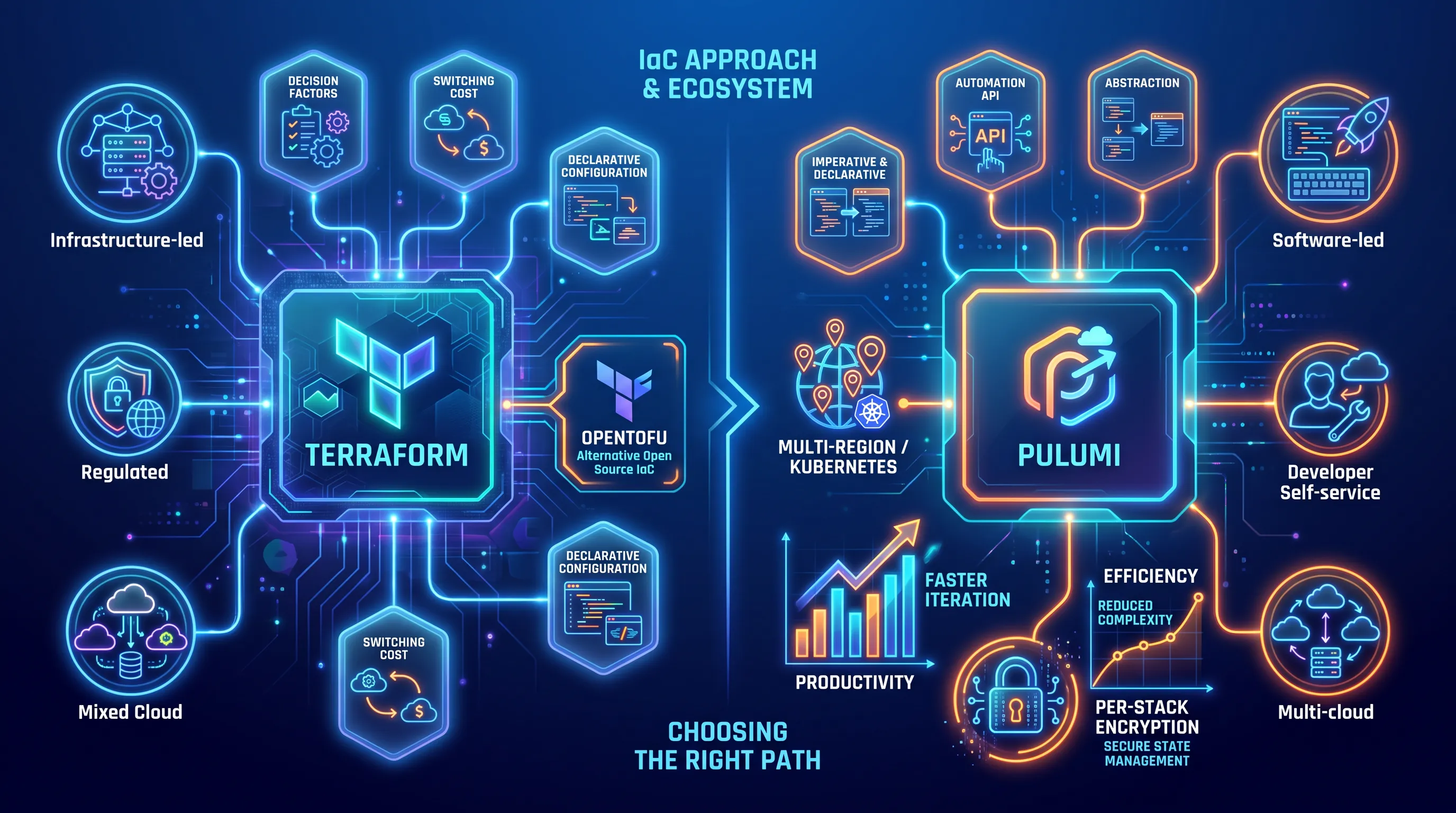
A neon hi-tech infographic with split panels for Terraform and Pulumi, featuring team personas, decision factors, and dynamic charts.

Tool fit is mostly team fit. Here's how these choices tend to land:

  • Teams standardized on HCL: Terraform or OpenTofu is the lower-friction path because it has existing modules, existing operational knowledge, and (if the license is your only objection) OpenTofu resolves it without retraining anyone.

  • Application engineering teams: Pulumi fits naturally when engineers already work in TypeScript, Python, Go, or similar, publish internal libraries, and write tests as a matter of course.

  • Platform teams: the deciding factor is less "which tool" and more which one sits more cleanly behind your golden paths, components/modules, policy layer, and self-service model. Both HCP Terraform (Stacks, no-code modules) and Pulumi (Automation API, Deployments) can serve this role.

  • MSP teams: standardization across clients is the priority, so are reusable modules or components, clear account/subscription/project boundaries, consistent policy baselines, credential isolation per client, audit evidence, a defined exception process, delegated ownership, and tested disaster recovery. Either tool can support this; what matters is whether the operating model above is actually built out, not just which tool is licensed.

Mixed cloud teams should verify provider coverage for the less common cloud first, regardless of which tool they lean toward.

Pulumi vs Terraform matrix

DimensionTerraformPulumi
Configuration modelHCLGeneral-purpose languages (TypeScript, Python, Go, .NET, Java, YAML, HCL)
EcosystemMature provider/module ecosystem, broad adoptionNative SDKs plus access to the Terraform/OpenTofu provider ecosystem via bridge
StateBackend-dependent (local, S3, HCP Terraform, etc.)Pulumi backend/secrets-provider model (Pulumi Cloud or self-managed)
Secret handlingSensitive state, with ephemeral/write-only options for supported valuesPer-value encrypted secrets, propagated through derived values
CredentialsOIDC / dynamic credentials supportedOIDC / dynamic credential workflows supported
TestingTerraform-native testing (.tftest.hcl)Host-language testing ecosystem (pytest, Jest, Go testing)
PolicySentinel / OPA / policy sets in HCP TerraformCrossGuard (TypeScript, Python, or Rego)
Reuse unitRegistry modulesLanguage packages/components (npm, PyPI, NuGet)
Self-serviceHCP Terraform, Stacks, APIsAutomation API, Pulumi Deployments
Open-source alternativeOpenTofuN/A
Learning curveLower for existing Terraform/HCL teamsLower for teams already fluent in a supported language
MSP fitStrong for standardized, large existing Terraform estatesStrong where code-based abstractions and developer self-service are priorities

No dimension here has a universal winner. Treat this as a checklist to weigh against your own constraints, not a scorecard to total up.

Terraform offers a mature ecosystem and a large existing practitioner base. Pulumi offers general-purpose programming languages, component abstractions, and encrypted secret values with propagation through derived state. The significance of those differences depends on the organization's existing skills, platform model, security requirements, and operational constraints.

Migration effort

Greenfield adoption is cheap on either side. A new team and a new account. Pick the one that fits your staffing and move on.

Switching an existing estate is a different project entirely, and it's routinely underestimated. Pulumi provides real tooling here. pulumi convert --from terraform translates HCL into your target language, and pulumi import --from terraform reads a .tfstate file and adopts those resources into a Pulumi stack. Those resources are marked protected so follow-up edits are safe. There's also an experimental state migration plugin that translates a full Terraform state into Pulumi state and recommends matching provider versions.

The tooling handles the mechanical part. What it doesn't handle:

  1. Module replacement. Every registry module you depend on has to be replaced with a Pulumi component or reimplemented. A mature estate with a dozen shared modules is weeks of work.

  2. Coexistence. You'll run both tools during the transition. Pulumi can read Terraform remote state, so the boundary is manageable, but you now have two state stores and two sets of credentials to keep straight.

  3. Pipeline changes. Every CI job and every approval gate gets rewritten.

  4. Validation. Before the first Pulumi-managed production change, every proposed difference should be reviewed and understood. For a pure adoption/import scenario, a no-change preview is the preferred target, but provider defaults, representation differences, and legitimate configuration changes still need to be evaluated individually rather than assumed to mean the import went wrong.

  5. Retraining. Your infrastructure engineers need to learn a language and its package ecosystem. Budget for that honestly.

  6. Security validation. Successfully importing a resource isn't the same as a successfully migrated environment. Explicitly re-test credentials, state access controls, encryption, secrets handling, provider versions, the imported resources themselves, dependency pinning, policy enforcement, rollback, state recovery, and drift detection under the new toolchain before calling the migration done.

Plan the rollback before you start. Keep the Terraform configuration in version control (as it already should be), and keep the remote Terraform state exactly where it's always been: encrypted, versioned, and access-restricted in its existing backend. Never place Terraform state itself into Git or any other version-control system; it's exactly the kind of sensitive, mutable artifact that VCS mishandles. Rely on the backend's own versioning and backups for recovery, restrict access to the legacy state as the cutover progresses, and confirm you can actually restore from a backup before you need to. The hidden maintenance cost is the period where both toolchains are half-alive, and nobody's sure which one owns a given resource. Shorten it deliberately.

Proof-of-concept checklist

Run a pilot that touches everything that will hurt later, and pick a real workload.

  1. Provision with your actual providers, including the obscure one you're worried about, against a production-like resource.

  2. Build one reusable pattern (a networking layer or service template) and consume it from a second project.

  3. Configure remote state in the backend you'd use in production, with locking enabled, and test recovery from a backup.

  4. Store a real secret and inspect the resulting state file yourself.

  5. Set up OIDC or another dynamic-credential workflow and confirm no long-lived key is required for the pipeline.

  6. Write a policy check that blocks something, then confirm it actually blocks the apply.

  7. Write two tests: one that passes, one that catches a deliberate misconfiguration.

  8. Upgrade a provider or module version mid-pilot and confirm nothing silently breaks.

  9. Change a resource in the console and run drift detection.

  10. Break an apply halfway through and recover from it.

  11. If you use cross-stack or cross-state dependencies, test what happens when one dependency is unavailable.

  12. Open a pull request and confirm the preview renders where reviewers will actually see it, gated behind an approval.

  13. Confirm your dependency-lock and approved-registry controls actually stop an unpinned or unapproved provider/module.

  14. If developer self-service is a goal, have someone outside the platform team trigger a deployment through it.

  15. Pull the audit trail afterward and confirm it would actually satisfy your compliance function.

Then ask the engineers who ran it what they thought, and write the answers down. Three people saying "the preview output was hard to read" is a finding. The point of a pilot is to surface the friction that documentation never mentions, and to test the platform against your messiest realistic workload, not a clean demo.

Provisioning is only the beginning

Most evaluations focus on getting infrastructure up. The maturity of an IaC practice shows up afterward, in how it handles: provider and module upgrades, credential and certificate rotation, dependency updates, resource replacement, ongoing drift, routine operational actions (scaling, restarts, config changes), recovery from a failed or partial apply, and eventual decommissioning. A platform that looks equivalent during a POC can diverge sharply here, because day-two operations are where the volume of change is the highest. Evaluate both tools against this full lifecycle, not just initial provisioning.

AI-assisted IaC

Both ecosystems support AI-assisted workflows. That's useful, but it doesn't change the operating model underneath it. AI-generated infrastructure should be treated like any other generated code: subject to the same policy checks, tests, review, least-privilege credentials, and controlled deployment path as anything a person writes. It speeds up authoring; it doesn't substitute for governance.

Make the decision

There's no universal IaC winner. Terraform, OpenTofu, and Pulumi represent different trade-offs around language, ecosystem, state, governance, platform engineering, and operational workflow. The right choice depends on existing engineering skills, existing IaC investment, state and security requirements, credential architecture, platform-engineering strategy, provider and module requirements, governance and policy needs, licensing, MSP standardization requirements, and migration cost. If your governance obligations demand encrypted secrets at rest with customer-managed keys, that narrows things before anyone argues about syntax. If you have 40,000 resources under Terraform and a team that's fluent in HCL, the migration math rarely works. And if licensing is your only objection to Terraform, OpenTofu is the shorter path.

Before you standardize, review your constraints and proof-of-concept criteria with ABS Technologies. We handle cloud architecture and DevOps pipelines, so your engineers stay on product delivery instead of relearning a toolchain mid-quarter. Book a free consultation to pressure-test your decision before you commit to it.

Need IT Support?

Book a free consultation with ABS Technologies experts we'll help you find the right managed IT, cloud, or security solution for your business.

Book a Free Consultation

Measure outcomes that affect daily operations, not feature counts. For the pulumi vs terraform decision, record preview review time, failed-apply recovery, provider coverage, state inspection results, policy failures, test effort, and the steps required for approval. Set pass or fail thresholds before engineers begin the pilot.

Yes, but each resource needs one clearly assigned owner. Separate stacks or workspaces by account, service, or lifecycle boundary, and avoid having both tools manage the same resource. Document state locations, credentials, dependencies, and handoff rules so a change in one tool doesn't create an unexpected plan in the other.

Choose OpenTofu when your main concern is Terraform's license and your team wants to retain HCL, existing modules, and provider workflows. Choose Pulumi when the team needs a general-purpose language, host-language testing, or reusable application-style packages. Compare migration effort against the specific problem before changing tools.

Start with a noncritical service and prove that the imported stack produces an empty preview before making changes. Keep the original configuration and state available, define a rollback owner, and migrate one ownership boundary at a time. Don't retire the Terraform pipeline until Pulumi has completed a production change cycle.

ABS Technologies can review provider coverage, state handling, security guardrails, pipeline approvals, and migration boundaries against your operating requirements. That review gives your team a written decision and pilot plan before standardization. If you'd rather hand off the assessment, book a free consultation with ABS Technologies →

Schedule a Meeting

Book a time that works best for you and let's discuss your project needs.

You Might Also Like

Discover more insights and articles

Title:
Containers and Orchestration: The Future of Scalable Apps

Meta description:
Read: How are containers redefining scalability? You learn to deploy code faster and cut server costs.

Article:
# C

Containers and Orchestration: The Future of Scalable Apps

Most teams adopt containers expecting speed and simplicity. What they get is Kubernetes in production. The DORA research is direct about what happens next: migrating workloads to flexible cloud infrastructure without changing how you operate them can be more harmful than staying in a traditional data center. This article is an operational guide to what happens after adoption.

Futuristic digital data infrastructure representing secure document management software and connected information systems

Cloud Security Posture Management: From Misconfiguration Alerts to Measurable Risk Reduction

Finding cloud misconfigurations is increasingly easy. Deciding which exposures matter, getting them to the right owner, and proving they were actually removed is the harder problem. Read about the ownership and prioritization work required to convert a raw posture backlog into exposure, and see the metrics that reveal whether that remediation effort is actually working.

Title:
Cloud Development Environments: Faster Onboarding Without Losing Control

Meta description:
Discover how cloud development environments help you speed up developer onboarding and keep control o

Cloud Development Environments: Faster Onboarding Without Losing Control

Moving developer workspaces to the cloud is easy to sell and even easier to get wrong. Teams might commit for the wrong reasons, or skip the governance decisions that make it stick. Here's when the move actually earns its keep, the operating models on offer, and the governance calls to settle before you commit.

Title:
Blue-Green Deployment Strategy: Safe Releases, Fast Rollback, and Hidden Tradeoffs

Meta description:
Evaluate a blue green deployment strategy to help your team cut rollback times and prevent

Blue-Green Deployment Strategy: Safe Releases, Fast Rollback, and Hidden Tradeoffs

A second production environment is sold as insurance. In practice, it's only insurance if the automation underneath it is solid; otherwise it's just more surface area to get wrong. Here's when the redundancy earns its cost, which controls your platform team needs to automate first, and the failure modes that turn a fast rollback into a long incident.