What You Will Learn
We will compare an in-house DevOps team (Build) against an outsourced, fully managed DevOps platform (Buy), breaking down the true fully loaded cost of hiring in the US and Canada, showing how 24/7 coverage, IT helpdesk integration, and remote monitoring shift the risk surface, and explaining where most companies systematically undercount hidden expenses such as tooling, on-call fatigue, and compliance audits. You will also see real-world numbers from firms that pivoted to managed IT services and support, slashed burn rates, and maintained release velocity. By the end, you will be able to explain to any board why outsourcing DevOps is not a gamble, but a predictable operational play.
Total Cost of Ownership
In the US and Canada, even conservative salary benchmarks show that a senior DevOps engineer now costs between $200,000 and $250,000+ per year. Once healthcare, payroll tax, equity refreshers, and on-call bonuses are included, the fully loaded annual figure routinely exceeds $250,000. Multiply by the minimum three to five specialists needed for round-the-clock coverage, and mid-market firms face a $1.2 million payroll line before writing a single line of pipeline code.
This is where the Build vs. Buy equation becomes impossible to ignore. A managed DevOps provider spreads those same costs across dozens of clients:
-
Subscription fees are typically billed monthly or quarterly, instantly moving spend from CapEx to OpEx
-
Tool licensing, security scanning platforms, and observability tiers are bundled and negotiated at scale
-
Night, weekend, and holiday coverage already sits in the contract, removing overtime volatility
Most providers quote all-in pricing between $25,000 and $40,000 per month, or roughly $360,000 annually for 24/7 coverage. That is often less than the fully loaded cost of a single senior local DevOps hire - yet it delivers an entire bench: a full stack of experts across Security, Cloud, and FinOps - plus a built-in IT helpdesk queue for lower-severity tickets.
Hiring freezes also matter. The minute a managed contract starts, you avoid recruiter fees and months of unfilled roles, keeping product roadmaps alive.
Paying a single invoice beats juggling five salaries, especially when venture markets demand burn reduction. For a tactical breakdown of how managed DevOps models can cut costs and multiply productivity, see The Managed DevOps Cheat Sheet: how to cut App Development Time and Costs by 80% about devops technology.
How Managed DevOps Extended Runway by 14 Months
A Vancouver SaaS firm was provisioned for rapid growth but hit a funding lull. Their five-person DevOps squad cost $1.3 million annually. Switching to a managed DevOps subscription at $32,000 per month freed $916,000 in yearly cash flow, extending runway by 14 months without delaying releases.
Depth of Talent and 24/7 Coverage
DevOps today is a composite discipline: CI/CD, infrastructure as code, container orchestration, observability, security hardening, cost optimization, and governance. No single engineer can master every layer, and schedules are finite.
This is another point where the Build vs. Buy logic breaks down. Managed providers solve the depth problem via a team-of-teams staffing model:
-
Rotating follow-the-sun shifts provide eyes on dashboards every minute
-
Specialists jump in as needed: Kubernetes, database tuning, or SOC analysts for alerts
-
Continuous remote monitoring feeds anomalies straight to the provider’s Network Operations Center, not a sleeping engineer’s phone
In-house teams rely on fragile on-call rotations that attempt to simulate 24/7 coverage - often draining morale, increasing error rates, and accelerating turnover. When an outage strikes at 3 a.m. on a long weekend, the risk of human error spikes.
Managed services also shorten mean time to resolution (MTTR). Gartner puts the average $5,600 per minute price tag on enterprise downtime. Faster incident response is not a perk. It is insurance.
Once the internal pager racket disappears, in-house staff can finally focus on core product features, enhancing revenue rather than firefighting. For an in-depth look at how managed DevOps keeps organizations online and addresses fatigue from on-call rotations, read Cloud Support: How Managed DevOps Keeps Your Business Online 24/7.
How 24/7 Managed DevOps Prevented a $350,000 Outage
A Chicago fintech ran a lean two-person DevOps pair. A Sunday database failover error caused four hours of downtime, costing $350,000 in chargeback penalties. After migrating to a managed platform with 24/7 observability and an on-call pool, the same issue was detected and rolled back within eight minutes, avoiding penalties entirely.
Security and Compliance Risk

Regulators and customers view DevOps pipelines as part of the attack surface. The cybersecurity talent crunch is widening: the global workforce faces a 3.4 million professional gap, leaving many mid-market companies under-protected.
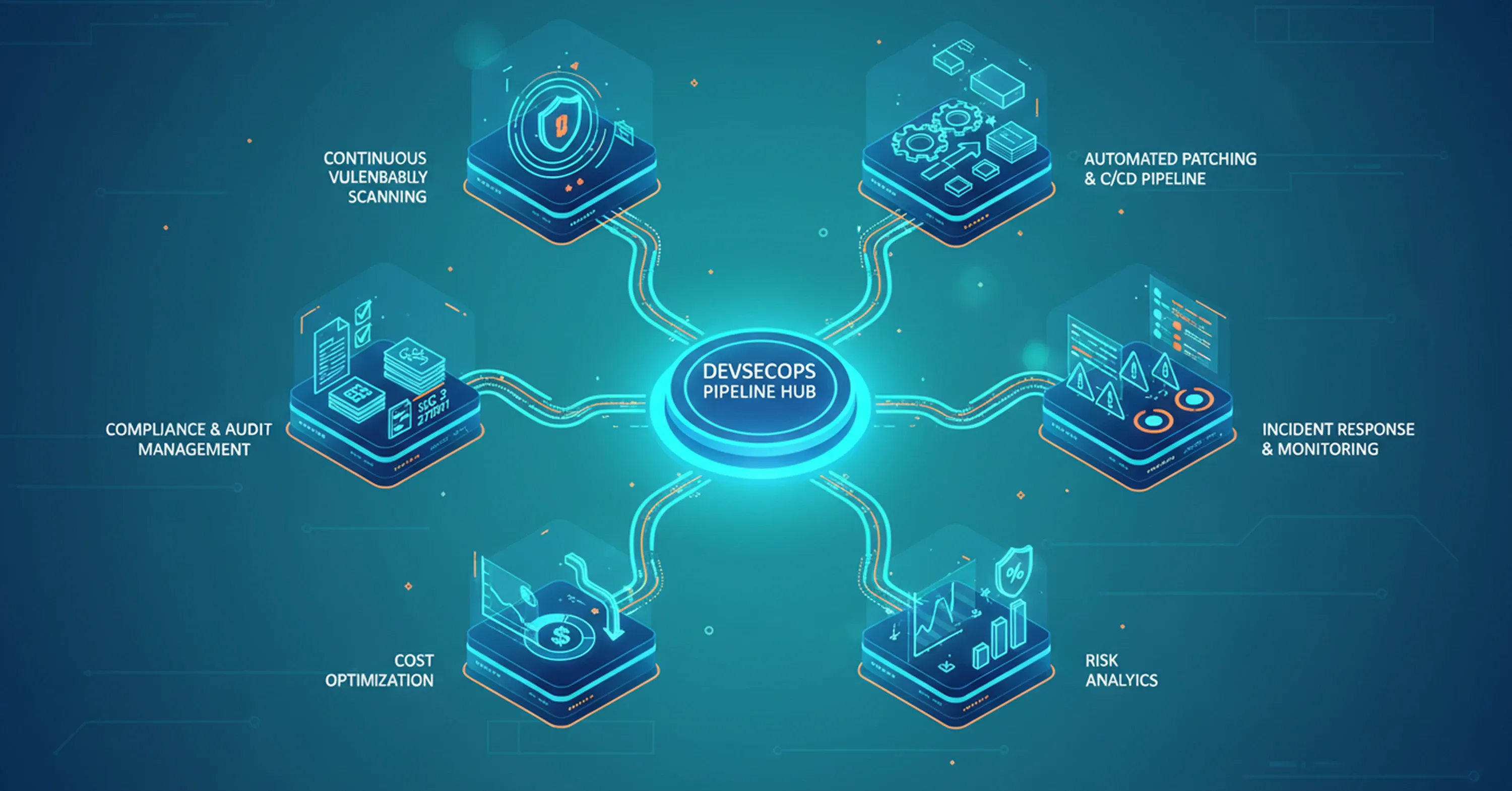
Managed DevOps vendors hard-bake security into every sprint:
-
Continuous vulnerability scanning inside the CI process
-
Automated patch pipelines for dependencies
-
SOC 2 Type II or ISO 27001 audited controls the client inherits by contract
That shifts liability outward. Breach forensics, incident response playbooks, and audit support come as part of the subscription.
Compliance costs also drop. External auditors accept evidence packs produced by mature providers, shortening audits by weeks and saving legal fees.
When regulators question data handling, pointing to a certified third-party partner carries more weight than ad-hoc internal policy documents.
For practical steps on integrating DevSecOps into your pipeline and reducing compliance overhead, see Tech-Driven DevOps: How Automation is Changing Deployment.
How Managed DevOps Eliminated $80,000 in HIPAA Compliance Costs
A healthcare analytics startup in Boston faced its first HIPAA audit. Internal DevOps overhead for encryption and log retention was estimated at $80,000 for contractor hours. Partnering with a managed provider already HIPAA-ready delivered the required artifacts in days and cost $0 beyond the normal monthly fee.
Speed to Value and Time-to-Market
Building an in-house DevOps culture from scratch is slow:
-
Recruit
-
Onboard
-
Set up toolchains
-
Document everything
-
Iterate
Six to twelve months often pass before pipelines stabilize.
Managed DevOps platforms arrive production-ready:
-
Pre-configured templates for Terraform, Git-Ops, and Kubernetes clusters
-
Integrated dashboards with SLAs baked in
-
Playbooks tested across dozens of environments
Clients can push code safely within the first week. That agility means features reach customers sooner, reducing churn and boosting revenue.
Parallel efficiency emerges. Developers open a ticket with the shared it helpdesk, and within hours new staging clusters appear without internal back-and-forth. Release velocity increases while ticket queues shrink.
For further strategies and real-world outcomes on accelerating innovation with cloud DevOps, explore From Code to Customer: Accelerating Innovation with Cloud DevOps.
Scalability and Future Proofing
Growth is unpredictable. Flash-sale events, holiday traffic, or viral marketing can triple load overnight. Resizing an in-house team on demand is impossible, and over-hiring wastes capital during quiet periods.
Managed platforms scale elastically:
-
Cloud autoscaling policies are tuned by provider FinOps teams
-
Extra monitoring and security capacity spin up automatically
-
Contract tiers adjust usage, smoothing costs rather than spiking them
Market reports show the managed services sector itself ballooning to $557.1 billion by 2028, proof that scalability via partners has become mainstream.
Your firm avoids obsolescence. When new tech - whether serverless, WebAssembly, or AI operations - arrives, the provider integrates it across the fleet. You ride that R&D at a fraction of the price.
For a full framework on scalable support and managing growth with modern cloud services, see How to Build a Cloud Services Support Model That Scales.
How Managed DevOps Turned a Viral Spike Into a 320% Sales Weekend
A Canadian retail chain ran a viral TikTok campaign that pushed site traffic from 2,000 to 50,000 concurrent users in 24 hours. The managed DevOps partner autoscaled Kubernetes nodes and database read replicas instantly. Sales climbed 320% over the weekend, and no outage occurred. The in-house team later estimated they would have needed eight weeks’ prep to survive that spike.
What Is Managed DevOps? A Simple Definition for 2026
Managed DevOps is a subscription model where a specialized third-party team replaces the need for an in-house DevOps department by delivering 24/7 coverage and a full stack of experts across Security, Cloud, and FinOps - for a predictable operational fee that is often lower than the cost of a single fully loaded senior hire, providing 24/7 monitoring, security, and cost optimization for a flat operational fee that is typically lower than hiring a single senior engineer.
Conclusion
The Build-vs-Buy puzzle is not philosophical, it is arithmetic. Hiring and retaining DevOps talent in North America costs six figures per person, yet coverage gaps still appear. An outsourced managed model replaces unpredictable six-figure local hires with a predictable operating expense, delivers true 24/7 coverage, and gives you instant access to a full stack of experts across Security, Cloud, and FinOps - often for less than the cost of a single senior DevOps engineer.
For CFOs under pressure to thin burn rates while defending product velocity, moving to managed it services and support is no longer a fringe idea. It is the clearest, fastest path to stability, security, and scalable growth. A leading provider of managed IT services can shoulder the infrastructure load, leaving your engineers free to build the features customers actually pay for.