Cloud Workload Protection Platforms: What to Evaluate Before Choosing a CWPP

Content authorBy Irina BaghdyanPublished onReading time15 min read
Abstract 3D visualization of interconnected digital infrastructure with glowing data nodes and network connections

Protecting workloads that run across both virtual machines and Kubernetes is hard to judge from vendor demos alone. A vendor-neutral comparison starts with requirements mapping, moves to capability testing, and ends in a proof of concept you control rather than one the vendor runs for you.

Why this decision keeps going wrong

A cloud workload protection platform (CWPP) is simple to shortlist and difficult to choose well, because every vendor demo looks convincing until it meets your actual architecture. The demos run on clean clusters. Your production runs on four years of accumulated decisions.

The gap shows up in the numbers. Red Hat surveyed 600 DevOps and security professionals in 2024 and found that 67% had delayed or slowed application deployment because of container and Kubernetes security concerns. That's a sign that cloud workload security controls were bought before anyone mapped them to how software actually ships.

So this is a buying guide written backward. Start from your workloads, then work toward the product.

Cloud workload protection platform basics

A CWPP provides workload-centric security for server workloads across hybrid and multicloud infrastructure, as Gartner defines the category. The scope is whatever runs your code: virtual machines, containers, Kubernetes, serverless functions, and hybrid environments. Supported workload types and security capabilities vary by vendor, so confirm coverage for your own estate. Five functions sit at the core:

  • Visibility: continuous discovery of what is running and where.

  • Workload identity protection: detecting excessive permissions, exposed secrets, and the identities workloads use.

  • Vulnerability management: scanning images, hosts, and packages, with context on what is actually reachable.

  • Runtime threat detection: behavioural monitoring of processes, files, and network activity as they happen.

  • Response: containing a compromised workload without taking the service down with it.

Why can't existing endpoint tooling cover this? Because the asset stopped behaving like an asset. Sysdig's 2025 usage data found that for the first time, 60% of containers live for 60 seconds or less. "Given the short lifespan paired with how quickly attackers can move across cloud environments, I am encouraged to see defenders actively detecting and responding to threats in less than 10 minutes," said Loris Degioanni, Sysdig's founder and chief technology officer.

An agent that inventories a host once a day sees none of that. Neither does a scanner that reads a disk snapshot every six hours. CWPP security exists because the protected thing now appears and disappears faster than traditional controls can register it.

CWPP versus adjacent platforms

CWPP overlaps with several neighbouring categories, and vendors rarely draw the boundaries cleanly. It is easier to separate them by the question each one answers:

  • CWPP protects the workload itself: vulnerabilities, runtime behaviour, workload identity, and response across virtual machines, containers, and, depending on the vendor, serverless functions.

  • CSPM (Cloud Security Posture Management) checks the workload's configuration, such as public buckets, permissive security groups, and policy drift. It is blind to a cryptominer running inside a correctly configured pod.

  • CNAPP (Cloud-Native Application Protection Platform) combines posture management, workload protection, and usually identity-entitlement and code-to-cloud context in a single product.

  • EDR/XDR detects and responds to endpoint threats, with XDR correlating additional telemetry sources. Many EDR products now cover Linux servers, but support for container runtimes, Kubernetes context, and short-lived workloads varies widely.

A broader cloud security strategy addresses these controls together. In practice, the categories overlap. An EDR agent on a Linux host may already provide some runtime detection, and a CNAPP may already include CWPP functions. Before you shortlist anything, map what your existing endpoint and cloud security tools already cover so you pay only for the gap.

Consolidation into CNAPP is the direction of the market, but that does not make it the right move this year.

A standalone CWPP is usually the better fit when runtime depth is the binding constraint, your posture tooling already works, and your team needs detection and response that go deeper than a bundled module.

A consolidated CNAPP is usually the better fit when you are buying posture and workload protection together and value correlation and a single operating model over best-of-breed depth. If EDR already covers your Linux hosts and you only need container and Kubernetes coverage, a full platform to fill one gap may be the more expensive path. Name the gap you are closing first, then compare products against it.

Map workload requirements

Before a single vendor call, write down what you actually run. List on-premises infrastructure, private cloud, hybrid environments, and legacy workloads alongside public cloud. Record operating system and kernel versions, container runtimes, and Kubernetes distributions, both managed and self-managed, across the cloud accounts and regions that host workloads owned by teams that will never install anything. Confirm compatibility for each.

Then add what is coming in the next 18 months, including growth in workload count and scale. Serverless adoption is uneven in a way that matters here. Datadog’s telemetry shows Lambda used by 65% of AWS customers and Cloud Run by 70% of Google Cloud customers, while App Service leads on Azure at 56%. A CWPP that is strong on Linux hosts and thin on functions becomes a coverage problem the moment an event-driven service goes live.

The requirement to put in writing is this: demonstrate depth per environment. Not "we support Kubernetes." Show detection on our managed node pool and our kernel version. 82% of container users now run Kubernetes in production according to CNCF's latest annual survey, so generic cluster support is table stakes rather than a differentiator. Strong Kubernetes operations should be part of the evaluation.

Need IT Support?

Book a free consultation with ABS Technologies experts we'll help you find the right managed IT, cloud, or security solution for your business.

Book a Free Consultation →

Evaluate protection capabilities

Capability evaluation fails when it becomes a feature checklist. Every vendor checks every box. What separates them is whether detection and response hold up inside your architecture and under your alert volume.

Treat the four subsections below as the spine of your CWPP security assessment. Each one should produce evidence you can score.

Cloud workload security visibility

Start with discovery. Can the product find workloads nobody registered: the EC2 instance a contractor launched and the cluster spun up for a migration that never got decommissioned? Unmanaged assets are where incidents start.

Then look at telemetry depth. Process lineage and outbound network connections per workload are what let an analyst reconstruct what happened. Dependency mapping matters too, because knowing a compromised pod can reach your payments database changes the severity of everything.

The hard test is short-lived resources. Ask the vendor to show you full forensic detail for a container that ran for 40 seconds and exited three days ago. Many cloud workload security products cannot, and that limitation rarely appears in a datasheet.

Extend visibility to identity. Ask the product to surface workloads with excessive permissions, secrets exposed in images or environment variables, and the paths an attacker could use to move laterally from one compromised workload to another. Also check how long telemetry is retained and whether it is searchable during an investigation.

Vulnerability management

Scanning depth and accuracy differ significantly between vendors. Compare coverage of OS packages versus application dependencies, handling of base images, false-positive rates, and whether findings reflect what is actually loaded at runtime. Test each of these against your own images rather than assuming parity.

Volume makes prioritisation the harder problem. Sysdig’s own telemetry, which is vendor-reported rather than independent research, found 87% of container images carry high-risk vulnerabilities, with roughly 15% of those reaching runtime environments. A short container lifespan gives teams false comfort, because an identical container with identical flaws starts right behind it.

Rank findings with several signals instead of one:

  • CVSS describes severity, not likelihood of exploitation.

  • CISA KEV (Known Exploited Vulnerabilities) lists vulnerabilities with confirmed exploitation in the wild.

  • EPSS (Exploit Prediction Scoring System) estimates the probability that a vulnerability will be exploited in the next 30 days.

  • Asset criticality and runtime exposure show whether the vulnerable package is loaded, whether the workload is internet-facing, and what it can reach.

A CWPP that ranks by CVSS alone hands engineers a backlog they will stop reading.

Then confirm that the finding reaches someone who can act on it. Check how the product integrates with ticketing, patch management, and DevSecOps workflows, including build-time gating, registry scanning, and base-image updates. A vulnerability tied to a namespace and a deploy pipeline becomes a ticket. One tied to an IP address becomes a spreadsheet row. Measure quality by how many findings remain once exploitability and exposure filters are applied.

Behavioral detection

Baselining sounds good in a demo and gets tested in week six. Ask how long the learning period is and whether a batch job pollutes the profile of a request-driven service running on the same node.

Noise is the real failure mode. A survey reported SOC teams receiving an average of 3,832 alerts per day, with 62% of them ignored, and the SANS 2024 SOC Survey found 66% of SOC teams unable to keep pace with alert volume. Detection you can't triage is detection you don't have.

Weigh forensic context as heavily as detection logic. CrowdStrike recorded 82% of detections in 2025 as malware-free, which means your analysts are judging whether legitimate binaries were used illegitimately. That judgment requires the surrounding story. Good cloud workload security tooling hands over the story.

Validate detection against representative attack techniques, preferably mapped to MITRE ATT&CK, rather than relying on vendor claims. Measure false-positive rate, detection latency, and alert quality, and confirm that alerts flow into your existing SOC monitoring and investigation processes.

CWPP security response

Response actions range from alerting to full workload isolation, and the distinctions matter: process termination, workload isolation, automated containment, and recovery are different capabilities with different risks.

Define approval controls before you enable anything automatic. Decide which namespaces allow automated actions and which require a human, with extra safeguards for business-critical workloads. CrowdStrike, a vendor, measured average eCrime breakout time at 48 minutes in 2024, with the fastest at 51 seconds, so manual-only response has a real cost. Automated response that takes down production has a cost too.

Test the rollback path, and set recovery requirements from business impact: how long each workload can be unavailable and what its disruption costs, rather than one arbitrary time limit for everything.

Need IT Support?

Book a free consultation with ABS Technologies experts we'll help you find the right managed IT, cloud, or security solution for your business.

Book a Free Consultation →

Assess deployment tradeoffs
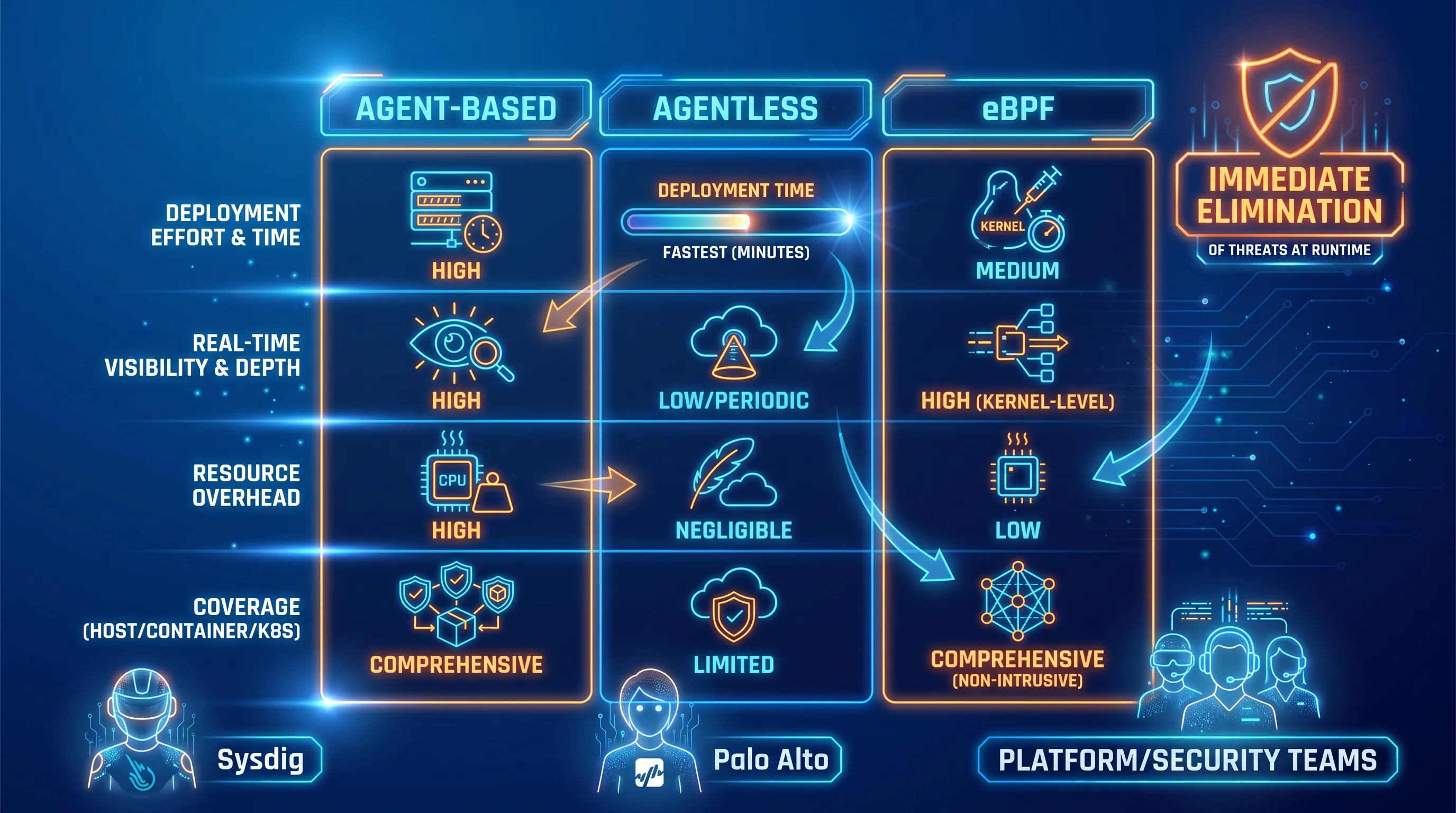
Neon hi-tech infographic on a deep blue background featuring a glowing comparison chart for cloud workload protection models.

Three deployment architectures dominate, and each buys something at a price.

  • Agent-based sensors give deep runtime telemetry and, in many products, inline enforcement. The cost is installation and upgrade work across every host, plus the privileges the agent needs.

  • Agentless scanning deploys in hours through cloud provider APIs and snapshots and gives broad coverage. As Sysdig’s own engineering team acknowledges, it lacks real-time visibility and cannot tell you whether a vulnerable package is loaded in memory.

  • Hybrid models combine agentless breadth with sensors on critical workloads. Palo Alto Networks’ engineering blog describes this as a common pattern, though that is a vendor perspective.

eBPF is not a fourth model. It is a kernel instrumentation technology that many agent-based and hybrid sensors use to capture events at low overhead, typically deployed as a DaemonSet. Its constraint is kernel compatibility, which is why your node inventory matters.

Score each architecture against four factors:

  • Resource consumption: CPU and memory overhead at peak load.

  • Required privileges: whether the sensor needs privileged access.

  • Kernel and runtime compatibility: the kernel versions and container runtimes you actually run.

  • Operational maintenance: who owns upgrades, and how often.

If your platform team has a hard rule against privileged DaemonSets, that rule eliminates products before any CWPP comparison begins. Find that out in week one.

Test operational fit

A CWPP that does not fit your workflows becomes another console nobody opens. Check integrations in three groups:

  • Detection and response: your SIEM, SOAR, and SOC or MDR provider.

  • Workflow: ITSM and ticketing systems, so findings land with the team that owns them.

  • Delivery pipeline: CI/CD, registry scanning, and Kubernetes admission control. A secure CI/CD pipeline should make those checks repeatable.

Then assign ownership in writing, per function. Who monitors alerts and who responds at 2 a.m.? Who tunes detection rules? Who owns agent maintenance across clusters, and who fixes the vulnerabilities routed to application teams? Red Hat found 42% of respondents said their organisation lacks sufficient capability to address container security threats, and unclear ownership is a likely contributor.

Be explicit about coverage. If you need 24/7 monitoring, confirm whether it comes from your own SOC, the vendor’s managed service, or an MDR or MSP partner. Document escalation procedures and the service-level agreements behind them.

Finally, scrutinise overlap. If existing endpoint detection already covers your Linux fleet, running two kernel-level sensors can create conflicts and duplicate alerts. The value of a CWPP comes from closing gaps, not stacking tools.

Build the evaluation scorecard

Build the scorecard in two layers, and agree both before the first demo.

Layer 1: Mandatory pass/fail requirements. A product that fails any of these is out, regardless of its weighted score.

  • Coverage of every workload type in your documented inventory, including serverless if you run it

  • Data residency and sovereignty requirements

  • Role-based access control (RBAC) and audit logging

  • Telemetry retention that meets your investigation and compliance needs

  • Support for the compliance frameworks you report against

Layer 2: Weighted criteria. Weight these by your risk profile.

  1. Workload coverage, scored per environment rather than overall

  2. Runtime detection depth, with forensic retention for terminated workloads

  3. Vulnerability prioritisation quality, measured by how many findings survive exploitability and exposure filtering

  4. Response safety, including approval controls and rollback

  5. Deployment overhead, in engineering days for rollout and ongoing maintenance

  6. Integration fit with SIEM, SOAR, ITSM, and CI/CD

  7. Usability, judged by the people who will live in the console

  8. Scalability and reporting, covering behaviour at peak node count and audit evidence quality

  9. Support responsiveness and service levels

Cost. Model the three-year Total Cost of Ownership (TCO) rather than the licence price alone. Include the licensing model (per node, per vCPU, per workload, or consumption-based), the infrastructure the sensors consume, implementation and integration effort, and ongoing tuning and maintenance. Pricing models scale differently, so run each against your growth forecast.

Run a realistic proof

A proof of concept you design is worth more than one the vendor scripts. Use customer-defined test scenarios, and bring in the vendor’s technical support where you need it. Run yours on representative workloads: one production-like cluster and whatever your architecture treats as awkward. Define success thresholds before you start.

Measure these, with numbers:

  • Percentage of inventoried workloads actually discovered and protected.

  • True positive rate and alert volume per day per analyst.

  • Response action latency, plus any production impact during a controlled containment test.

  • CPU and memory overhead at peak load, compared against your service level objectives.

  • Engineering hours consumed by deployment.

  • Measure detection latency, false positives, resource overhead, workload coverage, and response effectiveness.

Attack simulation matters more than passive monitoring. Run simulations that cover credential compromise, privilege escalation, container escape, and lateral movement, wherever they apply to your environment. Cloud workload protection platform claims survive or collapse at that point. CrowdStrike reported cloud-conscious intrusions rising 37% in 2025, so these scenarios aren't hypothetical for anyone running production in the cloud. Validate the surrounding cloud architecture as part of the test.

Finally, judge operational integration. A CWPP that detects well but does not connect to your triage, ticketing, and response workflows will not hold up in production, however often anyone logs in.

Where a managed service provider fits

A CWPP is a product, and the outcomes come from how it is assessed, deployed, and run. A managed service provider (MSP) can take on several parts of that work:

  • Assessment and architecture design: mapping workloads, running the scorecard, and designing the deployment model.

  • Deployment and integration: rolling out sensors and connecting the platform to your SIEM, ticketing, and CI/CD pipeline.

  • Continuous optimisation: ongoing detection tuning, coordination of vulnerability remediation with application teams, and incident response support.

Responsibilities in a CWPP programme are shared, and they should be agreed in writing:

PartyTypically responsible for
Cloud providerSecurity of the underlying infrastructure
CWPP vendorProduct capability, updates, and vendor support
MSPDesign, deployment, integration, tuning, and agreed monitoring or response duties
CustomerWorkload configuration, remediation decisions, risk acceptance, and business-critical approvals

Judge the investment by outcomes, not features: reduced security risk, faster incident response, lower operational effort, and readiness for compliance audits.

Choose with confidence

The right choice is the one your architecture supports and your evidence backs. CWPP decisions go wrong when coverage gaps surface after the contract is signed, so let the proof of concept carry the weight the demo wanted to carry.

ABS Technologies works with engineering organisations on cloud architecture, Kubernetes, and managed DevOps, the foundation any workload protection rollout has to stand on. Talk to our team about your scorecard and proof criteria before you commit to a CWPP.


Need IT Support?

Book a free consultation with ABS Technologies experts we'll help you find the right managed IT, cloud, or security solution for your business.

Book a Free Consultation →

Include a production-like Kubernetes cluster, a short-lived container, a serverless workload, and an awkward legacy workload. Set pass or fail thresholds for coverage, alert volume, response time, resource use, and deployment effort before testing. Add controlled credential theft and lateral movement scenarios to assess detection and containment.

Compare the full operating cost, not only the initial rollout. Count engineering hours for installation, upgrades, permissions, troubleshooting, and workload disruption. Include the cost of missing live telemetry, such as delayed investigation or manual data collection. Record these figures during the proof of concept so vendors face the same test.

Forensic retention preserves evidence after a container exits, including its processes, network connections, identity, and deployment source. Without that history, analysts must investigate from incomplete logs or repeat the incident in a lab. Set a retention period based on your investigation process, then verify that terminated workloads remain searchable.

No. CSPM checks cloud configuration, while endpoint detection protects supported hosts and user activity. A cloud workload protection platform focuses on workload behavior, exposure, and containment. Compare existing coverage before purchasing, because duplicate sensors and alerts can increase operating effort without closing a security gap.

Contact ABS before vendor selection if your team needs help mapping cloud architecture, Kubernetes environments, deployment limits, or proof criteria. ABS can help turn those requirements into a comparable scorecard and test plan. You can reach the team at https://abs.am/contacts before committing to a platform.

Schedule a Meeting

Book a time that works best for you and let's discuss your project needs.

You Might Also Like

Discover more insights and articles

Close-up of modern data center infrastructure with illuminated servers, cables, and high-speed data connections

Platform Product Management: Turning Internal Infrastructure into a Product Teams Adopt

Want engineers to adopt your internal developer platform rather than work around it? Run it like a product. Start with discovery to learn what teams need, then track the measures that show whether the platform is earning its keep.

T professionals working with digital systems and technology interfaces in a modern office

Terraform Drift Detection: Finding and Fixing Infrastructure Changes Safely

This article explains how to standardize terraform drift detection across multiple teams and Terraform workspaces. It covers layered detection and a remediation sequence that keeps risky fixes behind review and approval.

Abstract visualization of cloud computing infrastructure with interconnected digital networks and data systems

Cloud Governance Framework: Guardrails That Enable Growth Instead of Slowing It

This article explains how to build a cloud governance framework that holds up after hybrid and multi-cloud growth outpaces your informal controls. It covers the operating model and a phased roadmap you can measure for a cloud governance model.

Automated manufacturing production line with industrial machinery, conveyor systems, and digital monitoring equipment

GitHub Actions Reusable Workflows: Standardize Delivery Without Blocking Teams

Copy-pasted pipelines drift. Across a large GitHub organization, every duplicated workflow becomes a separate place to patch, audit, and get wrong. Replace them with a centrally maintained set of GitHub Actions reusable workflows, structured so teams can adopt them without friction. Pair that structure with a governance model that keeps shadow pipelines from creeping back in.