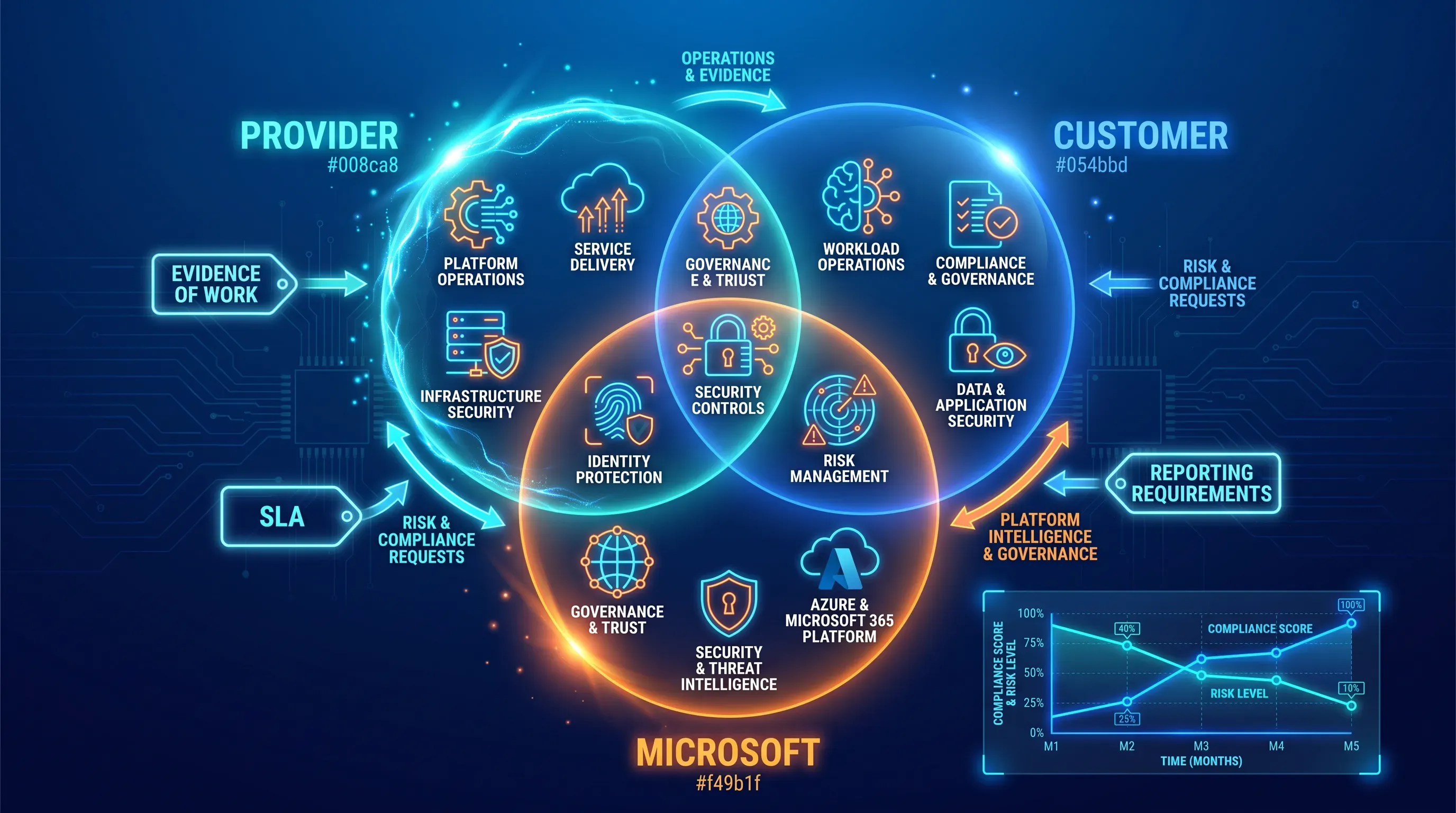
Where does responsibility stay with the customer
Microsoft secures the platform, and the provider operates it. You remain responsible for the business decisions that govern your data and access. Nobody hands away business risk in a managed services contract. The provider executes against the decisions you make, but the decisions stay yours.
This is where companies believe they are covered when they are not. CrowdStrike's summary of the model is direct: the cloud provider protects the cloud and its underlying infrastructure, while customers protect the data and assets they store in it. Microsoft will not classify your sensitive data for you. Your provider will not decide which workload can tolerate an hour of downtime.
The inference to carry into your negotiation is this. Any responsibility that requires knowing your business cannot be fully delegated, because a provider that has never met your customers cannot weigh the cost of losing them. You set data classification and retention rules. You also set severity definitions and access approvals. The provider enforces what you decide, and that division is the difference between an operator and a scapegoat.
Splitting cost, capacity, and AKS work
The provider owns FinOps monitoring and capacity forecasting. It also provides right-sizing recommendations and operates Azure Kubernetes Service (AKS) cluster automation, while you approve spend and architecture direction. The provider surfaces the waste and proposes the fix. You authorize the change, because rightsizing a production cluster affects performance you are accountable for.
The conclusion is bigger than monthly cost savings. According to the FinOps Foundation, roughly 21% of enterprise cloud spending is wasted. In 2026, that is not simply wasted infrastructure budget—it is lost AI capital. If your provider isn't aggressively right-sizing your Azure infrastructure, they are starving your future AI and Copilot initiatives of the compute budget they require. Every optimization report should therefore track both realized savings and the capacity those savings free for strategic innovation.
Recommendations alone do not reduce a bill. Insist that every optimization report tracks the savings actually realized from last month's recommendations, so the FinOps function proves its own value.
What changes in a hybrid cloud setup
In a hybrid setup, the provider must own connectivity and identity synchronization across both environments. It must provide consistent monitoring, with explicitly defined handoff points where on-premises responsibility begins. If you kept local infrastructure instead of a full lift and shift, the seam between Azure and on-premises is where accountability quietly disappears.
This is a common arrangement. Research from Dataintelo reports that more than 72% of large enterprises ran hybrid cloud as their primary IT strategy in 2025, up from about 58% in 2022. Azure Arc extends governance and monitoring across on-premises and edge, but the tool only works if someone is contractually named to operate it on both sides of the line.
What this means for your scope is specific. Ask exactly where the provider's responsibility for a workload stops when a request crosses from Azure into your data center. An undefined handoff leaves responsibility unowned, and unowned seams are precisely where hybrid incidents live longest before anyone claims them.
How should you run the governance meeting
Run a recurring governance meeting to keep the provider accountable against everything above, on a monthly cadence with a quarterly strategic review. This is the mechanism that turns a written scope into sustained performance, because a contract nobody reviews decays into a contract nobody follows.
Use this standing agenda:
-
SLA performance against target for the period
-
Security posture and Defender for Cloud findings
-
Cost trend, anomalies, and realized optimization savings
-
Open incidents and their current status
-
Recovery test results with measured RPO and RTO
-
Upcoming changes and policy approvals needing your sign-off
On attendance, the FinOps Foundation notes that mature cost practices depend on shared accountability across the organization. Send your operations lead and someone who can approve spend. The provider should bring the engineer who does the work alongside an account manager.
The point most engagements miss is that this meeting is where decision rights get exercised. If you attend without anyone empowered to approve changes, the provider's recommendations stall and the backlog grows between sessions, which defeats the reason you booked the meeting at all.
Turn your Azure operations into BenefIT
If you now know what to demand but need a partner who can deliver against it, that is the gap ABS Technologies fills. ABS Technologies is an Armenia-based Managed IT Services Provider whose offerings map directly to the day-two responsibilities in this checklist, from governance enforcement through tested recovery and security monitoring.
What sets the engagement apart is a vendor-independent stance, which means procurement advice you can trust because it is not steering you toward a product ABS needs to sell. The work follows a structured model that begins with assessment and agreement. Benchmarking guides ongoing support, so the scope you sign is measured against a baseline and reviewed over time.
Bring this checklist to a first conversation and use it as the frame. Define a clear post-migration operations scope with ABS Technologies, with named evidence and SLAs against each area, so you hold your platform accountable to a written contract instead of a hopeful assumption.