Image representing the content card

Breaking the Infrastructure Bottleneck: The Cloud Solution Behind a Unified Approach

Every growth spurt tests your infrastructure. Servers max out, tools proliferate, and costs spike faster than revenue. The question is not whether the next bottleneck will arrive, but whether you have the agility to clear it instantly. Today’s answer is the cloud, not as a remote storage locker, but as a living ecosystem that scales, heals, and optimizes itself while you focus on customers.

Content authorBy Irina BaghdyanPublished onReading time6 min read

What you will learn

This article reveals how the cloud breaks every old infrastructure limit - and why the fastest-growing companies treat it as their engine, not just their storage.

You’ll learn:

  • Elasticity: scaling in seconds, automatically
  • Consolidation: one control plane instead of tool chaos
  • The Three Scalability Pillars: vertical, horizontal, and global growth
  • Security at scale: why more cloud can mean less risk
  • Real-world wins backed by fresh 2025 data

By the end, you’ll know what great cloud architecture looks like - and how to choose the platform that will actually help your business grow.

Elasticity: infrastructure that breathes with demand

Sudden traffic spikes used to mean panic, delays, and paying for extra servers you barely used. With cloud elasticity, the system simply expands in real time - no guessing, no waiting, no stress.

  • Vertical scaling: boosting CPU, memory, or GPU on the same virtual machine
  • Horizontal scaling: cloning instances to handle parallel requests
  • Scheduled scaling: adding capacity during predictable busy hours, then shedding it overnight
  • Event-driven bursts: serverless functions spin up only for the milliseconds they are needed

Retailer snapshot: A midsize online retailer switched its seasonal-sale infrastructure to AWS Auto Scaling. During a major sale event, Auto Scaling automatically added more servers to handle the traffic spike - then turned them off when demand dropped. This ensured the site stayed responsive under load without paying for idle capacity.

Elasticity keeps performance steady and budgets lean, letting executives focus on strategy instead of capacity planning. For more depth on building elastic, scalable infrastructure, see Be Cloud: The Next-Gen Platform for Scalable Business.

Consolidating fragmented tools into one control plane

Cloud platforms replace a maze of on-prem consoles with unified dashboards, APIs, and policy engines.

  • Identity and access: single sign-on spans databases, applications, and analytics
  • Monitoring: one metrics pipeline tracks logs, traces, and user experience
  • Automation: infrastructure as code spins up entire environments from a Git commit
  • Cost governance: built-in FinOps tools surface spending anomalies in real time

Why it matters: According to the Flexera 2025 State of the Cloud Report, organisations now use on average 2.4 public clouds simultaneously. Consolidation doesn’t mean vendor lock-in - a well-designed control plane gives a single pane of glass across all environments, enabling a purposeful multi-cloud strategy and eliminating tool overload.

Mini case: A company used Terraform to manage multi-cloud infrastructure (Azure + Google Cloud) from a single repository. By leveraging Terraform’s built-in policy-as-code / continuous-validation features, infrastructure compliance and configuration checks - formerly manual - are now executed automatically whenever code changes are committed.

For guidance on consolidating cloud tooling and optimizing multi-cloud landscapes, explore how Managed IT Services help unify complex environments.

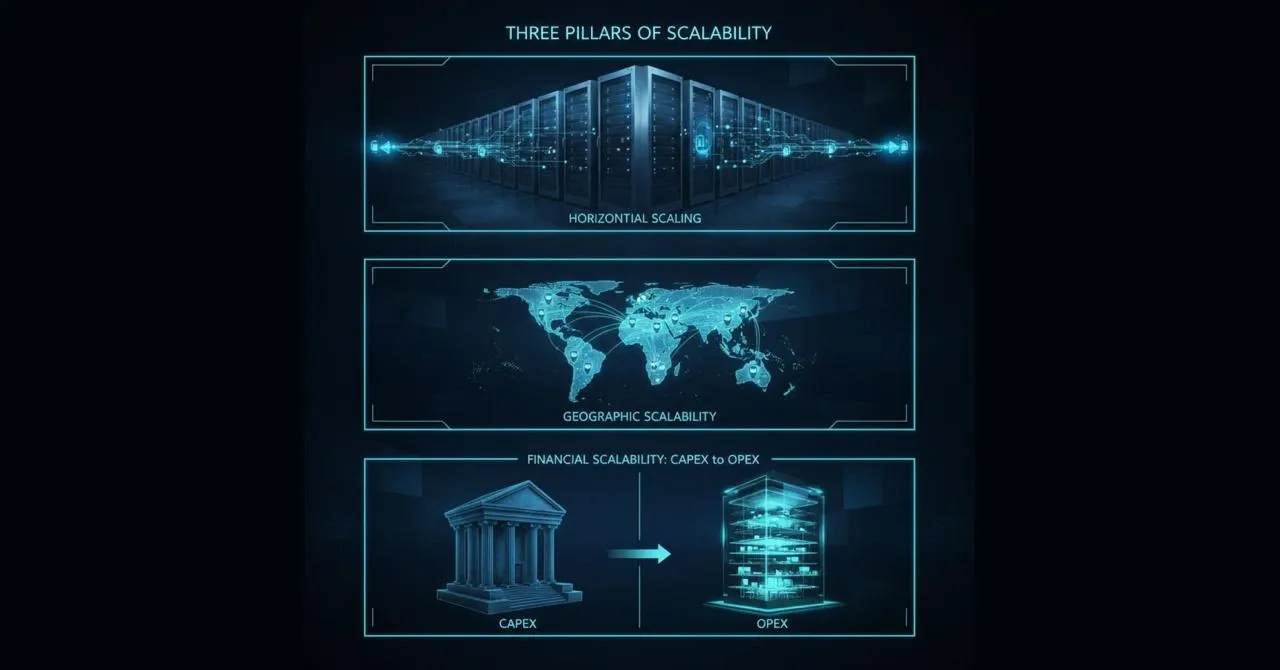
The Three Pillars of Scalability

Diagram showing the three pillars of scalability: horizontal scaling, geographic scalability, and financial scaling from CapEx to OpEx.Scalability is often treated as a single dimension. In practice it has three distinct pillars, each requiring different design choices.

1. Vertical vs. Horizontal scaling

Vertical scaling suits monolithic databases that depend on huge memory pools, while horizontal scaling shines for stateless web front ends.

Key takeaway: Choose managed database services that allow live resizing, and design application tiers for horizontal growth behind a load balancer. Hybrid and multi-cloud designs further this flexibility - discover more in What Makes ‘Cloud Technologies’ Different in 2025?

2. Geographic scalability

Latency kills conversions. Spreading workloads across regions puts content closer to users and helps satisfy data-sovereignty rules.

  • Use content delivery networks (CDNs) for static assets
  • Deploy active-active instances in multiple regions for high availability
  • Leverage managed Kubernetes clusters to orchestrate services globally

3. Financial scalability: CapEx to OpEx

Moving from hardware purchases to pay-as-you-go spending frees capital for innovation.

  • Reserved instances: lock in lower rates for steady workloads
  • Spot instances: slash compute costs for fault-tolerant jobs
  • Serverless: pay only for actual execution time, not idle servers

An IDC study found organizations migrating to Google Cloud IaaS gained a 318% five-year ROI and cut operational costs by 51%. Shifting financial models is not a bookkeeping trick, it funds faster releases and larger R&D bets. For actionable strategies on controlling cloud spend, see Cloud Support: How Managed DevOps Keeps Your Business Online 24/7.

IaaS in context: growth, concentration, and choice

Infrastructure-as-a-Service remains the foundation layer. According to a 2025 Gartner press release the global IaaS market hit $171.8 billion in 2024, up 22.5 % year-over-year. The top five providers now command 82.1 % of that market, led by AWS at $64.8 billion.

Despite this concentration, choice is widening through a multi-cloud approach:

  • 61% of large enterprises already use multi-cloud security tools
  • 57% rely on multi-cloud FinOps platforms

The data signals maturity: organizations can standardize controls across vendors without giving up the unique strengths of each cloud.

Security: why growth does not equal greater risk

More servers used to mean a larger attack surface. Modern cloud architectures invert that formula.

  • Zero trust networking: every request is authenticated, even inside the perimeter
  • Managed encryption: keys stored in hardware security modules, rotated automatically
  • Real-time threat intel: large providers ingest global signals and patch flaws faster than isolated data centers
  • Immutable infrastructure: instead of patching running servers, you redeploy golden images and terminate the old nodes

Case in point: A leading provider of managed IT services recently migrated a regional bank onto Azure confidential computing. The project doubled transaction throughput while meeting stringent encryption-in-use requirements, with no security incidents reported in the first 12 months.

For comprehensive insight into building a resilient, end-to-end security posture across hybrid and public clouds, read Cloud Managed Security: Unified Security Strategy for Cloud and Hybrid Enviroinments.

Bottom line: Cloud security is a design choice, not a roll of the dice. Done right, scaling up multiplies resilience.

What Is a Cloud Solution?

A cloud solution is basically a ready-made set of tools - servers, storage, networks, and apps - that you use over the internet instead of buying and maintaining hardware yourself. It grows when you need more power, shrinks when you don’t, keeps everything secure, and helps you pay only for what you actually use. All of it is managed from one place, so your team works faster and launches things quicker.

Conclusion

The cloud is no longer a storage strategy - it’s your growth engine. With built-in elasticity, unified control, and security that strengthens as you scale, it removes every constraint that used to slow companies down. When guided by the right managed service partners, the cloud doesn’t just support your growth - it accelerates it.

Your next breakthrough won’t come from buying more servers. It will come from the cloud architecture you design today.

Traditional hosting rents fixed hardware for fixed terms. IaaS provides virtual resources on demand, billed by actual usage, with self-service APIs for instant scaling.

It adds coordination challenges, but unified DevOps and FinOps tooling reduces friction. The payoff is vendor flexibility, optimized pricing, and regional compliance options.

Yes, when elasticity and operational savings are factored in. Studies show five-year ROI above 300 % and operational cost cuts of about 50 % for many workloads.

Absolutely. SMEs avoid large upfront hardware costs and gain enterprise-grade security, letting them compete on equal footing.

If your systems are slow, costly to maintain, or can’t handle traffic spikes, it’s time. Cloud platforms solve these issues with faster scaling, lower overhead, and built-in reliability.

Schedule a Meeting

Book a time that works best for you and let's discuss your project needs.

You Might Also Like

Discover more insights and articles

The image depicts an advanced enterprise AI chip embedded in a digital circuit board, visualizing neural network processing and high-performance computing architecture

Cyber-Resilience: Why 2026 Boards are Trading Protection for Immunity

Modern boards are staring at a blunt truth: threat actors now move faster than any human response plan. A single ransomware strike can wipe decades of data, paralyze revenue, and sink market value overnight. Buying more perimeter tools will not calm the boardroom. Ensuring the business never stops will.

Below is a practical roadmap for CISOs, IT Directors, and Business Continuity Managers who need to move their IT and business services from brittle protection to digital immunity before the next quarterly review.

The image shows a high-performance AI processor chip on a circuit board with flowing data streams, representing neural computing and modern enterprise IT architecture

The Sovereignty Shift: Navigating Data Residency and Corp IT Solutions in a Borderless Cloud

In 2026, the question is no longer just whether your data is in the cloud, but exactly which legal jurisdiction that cloud inhabits. For Chief Information Officers and Risk Officers, particularly in regions like the Gulf Cooperation Council (GCC) and Canada, the physical location of a server now carries as much weight as its uptime or security.

This article examines the critical transition from general public cloud strategies to the era of the Sovereign Cloud. We will explore how mid-market firms and large enterprises can navigate strict data laws in Saudi Arabia, the UAE, and beyond. You will learn how to design hybrid architectures that keep sensitive information within national borders while still leveraging global innovation, ensuring yourdigital enterpriseremains compliant and competitive.

Futuristic digital network illustration showing cloud infrastructure with glowing data flows, interconnected circuits, and real-time processing across a modern IT system

How to Build a Cloud Services Support Model That Scales

Cloud leaders love the flexibility of the public cloud, yet many still struggle to support thousands of fast-changing workloads without hiring armies of engineers. By 2026, operational excellence will be judged by a single metric: the Engineer-to-Instance ratio. The lower the ratio, the more resilient the platform—and the more strategic the IT budget.

Below is a practical, end-to-end playbook for CTOs, CIOs, and FinOps leaders who want a cloud services support operation that grows automatically with the business instead of linearly with headcount.

Futuristic cloud security and compliance dashboard visualizing FinOps and GreenOps metrics, cost optimization, and energy-efficient cloud infrastructure

The Green Cloud: Why Carbon-Aware DevOps is the Secret to 2026 Compliance

New EU and US climate rules are about to turn every container image, lambda call, and SQL query into an auditable emission line item. Platform teams must now prove that the way they build and run software is affordable and planet-friendly, or risk fines and reputational damage.

This article explains how carbon-aware DevOps connects cloud cost management (FinOps) with environmental accountability (GreenOps), why the two goals are inseparable, and what engineers need to change before the 2026 reporting deadlines arrive.