Overview
This article unpacks why cloud technologies feel brand-new again in 2025 and what you, the busy CTO or VP of Engineering, can do about it.
We will explore the market forces reshaping cloud platforms, from multi-cloud adoption and AI-driven FinOps to a surge of regional privacy laws.
You will learn:
- How cloud spending patterns have shifted and why over 92% of firms now run hybrid or multi-cloud architectures
- Emerging tactics that rein in runaway AI workloads without slowing down innovation
- The latest developer-centric services accelerating release cycles
- Practical steps to stay compliant when rules change faster than code
By the end, you will have a clear roadmap to keep costs predictable, teams productive, and auditors satisfied.
What Are Cloud Technologies?
Cloud technologies refer to the evolving mix of public, private, and edge computing services that let organizations consume infrastructure, platforms, and software on demand, integrate AI and machine learning natively, and combine resources across multiple providers for cost control, agility, and regulatory alignment.
The 2025 Cloud Landscape at a Glance
The cloud market blew past predictions, hitting $912 billion in global infrastructure spend this year, up from $679 billion in 2024 according to a recent industry analysis. This growth hides three pivotal shifts that matter to you.
Taken together, these data points explain why yesterday’s “move everything to one hyperscaler” approach no longer fits. Leaders need a balanced, provider-agnostic plan that tames AI bills, hardens security, and stays flexible.
Focusing on these new realities sets the context for deeper cloud transformation.
Cloud Transformation Is More Than Lift-and-Shift

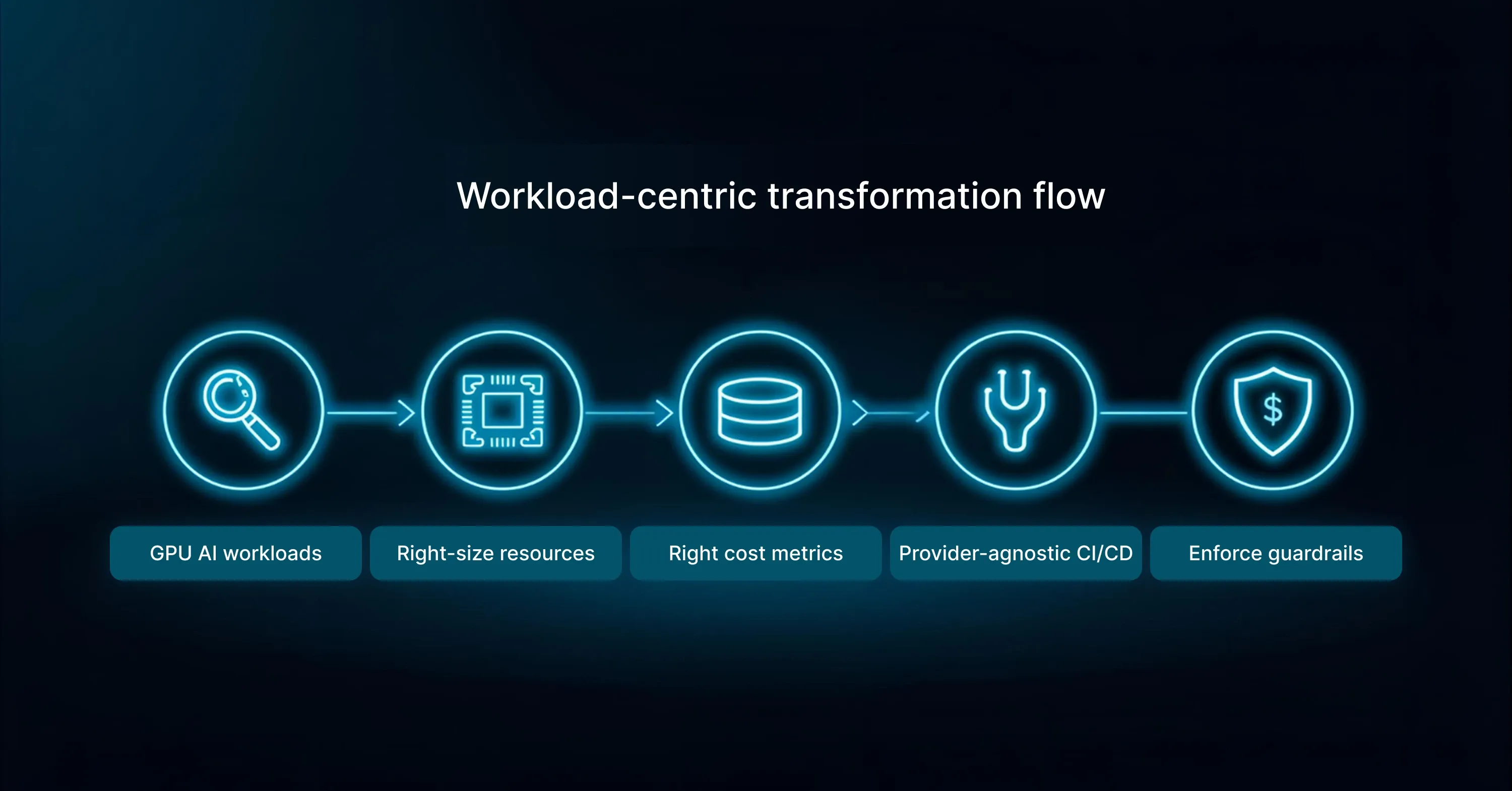
For many years, cloud transformation meant forklift moves of VMs into AWS or Azure. That playbook hit a wall when GenAI workloads entered the picture. You now need transformation strategies that optimize at the workload, not the VM, level.
- Identify “GPU magnets” early: train, fine-tune, or AI inference tasks with peak activity periods
- Right-size data pipelines before model training to avoid paying for unused storage IO
- Embed AI cost metrics into every sprint review so engineers see financial impact instantly
- Use provider-agnostic CI/CD templates to keep exit doors open if pricing shifts
A leading provider of Cloud Services and DevOps can lend capacity planning expertise here, building automated guardrails that free your architects to focus on features.
Cloud transformation in 2025 is iterative, telemetry-driven, and laser-focused on unit economics. Once that mindset is in place, hybrid architectures become easier to design.
Hybrid Cloud Becomes the Default Architecture
Hybrid cloud was once a compromise. In 2025, it is simply how modern systems are built. You can keep sensitive data on-prem for residency, place latency-sensitive AI inference at the edge, and burst to the public cloud during seasonal peaks.
Hybrid cloud success hinges on three pillars:
- Consistent identity: adopt a unified directory and enforce multi-factor authentication, closing the gap that caused 34% of recent identity breaches
- Portable workloads: package services in Kubernetes or WebAssembly so they move across clusters without drama
- Unified observability: use a single telemetry plane to track performance, compliance, and spend across environments
When executed well, hybrid cloud delivers the flexibility and resilience that 92% of businesses say they need, while letting you shop around for the best AI hardware price.
AI-Driven FinOps: How to Prevent Amazon Bedrock from Eating Your Entire Budget
Even tech giants confess that GenAI costs can spiral. The cure is real-time FinOps augmented by machine learning.
First, embed budget policies into your infrastructure-as-code. Then layer AI algorithms that forecast GPU usage based on historical traffic, release schedules, and even marketing campaigns.
- Tag every AI workload by project, model type, and business owner
- Set dynamic guardrails that throttle non-production inference when spend hits a weekly limit
- Auto-negotiate spot instances or shift inference to cheaper regions when SLA impact is low
- Alert finance leaders proactively, no surprise invoices
Companies applying AI-driven FinOps report 30–40% lower cloud bills while maintaining delivery speed. If that sounds daunting, a managed IT services partner can implement the telemetry stack and keep the algorithms honest. You can learn more about how managed IT services can consolidate infrastructure management and cloud operations in Managed IT Services.
With costs under control, you can turn to the next pressing issue: developer velocity.
Boosting Developer Velocity with Modern Cloud Tooling
Slow pipelines negate the cloud’s promise. New services fix that, provided you restructure workflows.
Short cycle times rely on:
- Serverless backend frameworks that auto-scale to zero, slashing cold-start penalties
- Internal developer platforms (IDPs) that offer golden paths: one line of code, get a sandbox
- Policy-as-code baked into pull requests so compliance checks never block releases late
- AI coding assistants running inside secure VPCs, giving productivity without data leakage risks
Firms using cloud-native dev platforms ship features 78% faster, according to a 2025 survey. Combine that speed with disciplined FinOps and you have a sustainable innovation engine.
Staying Compliant in a Maze of New Regulations
Regulators worldwide have noticed the explosion of AI and cross-border data flows. 2025 brings region-specific rules on model transparency, data residency, and software bill of materials (SBOM) disclosures.
Prepare your cloud stack by:
- Mapping every microservice to the jurisdiction that covers its data
- Encrypting data at rest and in transit, noting that only 21% currently encrypt more than 60 % of cloud data
- Automating compliance evidence: logs, policy states, vulnerability scans stored immutably and accessible for audits
- Selecting providers with built-in attestation for AI models, crucial for forthcoming “model cards” laws
Treat compliance as code, just like security or performance, and you will avoid last-minute scrambles when the next rule arrives. For step-by-step assistance with implementing and monitoring these controls, consider leveraging Information Security specialists.
With the pillars of cost, velocity, and regulation covered, you can harness cloud technologies with confidence.
Conclusion
Cloud technologies in 2025 are defined by multi-cloud flexibility, AI-powered cost controls, developer-first tooling, and a hard focus on compliance. Organizations that approach cloud transformation as an ongoing, metrics-driven journey, embrace hybrid cloud design, and adopt AI-driven FinOps will keep budgets healthy and teams productive. Those that ignore the shifts risk runaway bills and regulatory fines. The choice, luckily, is still yours.