Overview
DevOps-as-a-Service has emerged because most organizations need cloud-native delivery speed but lack the internal depth to build and sustain it. Maintaining reliable CI/CD pipelines, secure cloud environments, and scalable workflows has become a full-time challenge that few mid-sized teams can absorb alone.
This article covers how DaaS accelerates delivery maturity, where it falls short, and what separates a productive operational partnership from generic outsourcing.
Who This Is For
DaaS is not a fit for every organization.
It delivers the most value for:
-
Startups outgrowing ad hoc DevOps that need production-grade pipelines without building a platform team from scratch
-
Mid-market companies lacking platform engineering depth that are scaling headcount but not infrastructure maturity
-
Enterprises standardizing across multiple teams where inconsistent deployment practices create reliability and security risk
-
Regulated organizations that need governance-heavy pipelines with audit trails, policy enforcement, and compliance-aligned workflows
If your internal platform team is already mature, your deployment topology is highly specialized, or your organization is unwilling to share operational ownership with an external provider, DaaS is likely the wrong model.
Why Traditional DevOps Adoption Stalls
Building a mature DevOps practice internally is difficult because organizations must simultaneously manage tooling complexity, operational maturity, and talent shortages. For many mid-sized and scaling companies, the challenge is not understanding the value of DevOps, but sustaining the infrastructure and workflows required to make it effective at scale.
Common reasons DevOps adoption stalls include:
-
The need to integrate and maintain a growing ecosystem of CI/CD tools, infrastructure-as-code frameworks, monitoring platforms, and security scanners
-
A shortage of experienced platform engineering and DevOps talent capable of connecting workflows across multiple systems
-
Internal engineering teams spending more time maintaining tooling and infrastructure than delivering product features
-
Fragmented deployment processes that create inconsistent environments and unreliable releases
-
Limited operational visibility caused by disconnected monitoring and observability systems
-
Slow release cycles and infrastructure instability caused by excessive manual intervention
This is the environment where DevOps-as-a-Service becomes attractive. Instead of building every capability internally, organizations gain access to mature automation frameworks, standardized deployment workflows, and operational expertise through a managed delivery model.
However, tooling alone does not solve the problem. Teams often underestimate the organizational changes required for DaaS to succeed. Internal stakeholders still need to define release governance, set deployment reliability targets, and resolve workflow conflicts between existing engineering practices and provider-recommended operating models. Without clear ownership and accountability, even technically strong DaaS engagements can stall within months.
Faster Delivery Requires Process Change, Not Just Better Tooling
A large European bank saw efficiency improvements of up to 25% in developing updates for its online banking application after implementing DevOps. For organizations without deep internal DevOps teams, achieving that kind of improvement through a service model can be significantly faster than building from scratch. The bank's experience also highlights a common friction point: even with external support, internal teams had to restructure their release approval processes to keep pace with the new deployment cadence.
Accelerating Delivery Through Managed CI/CD and Automation

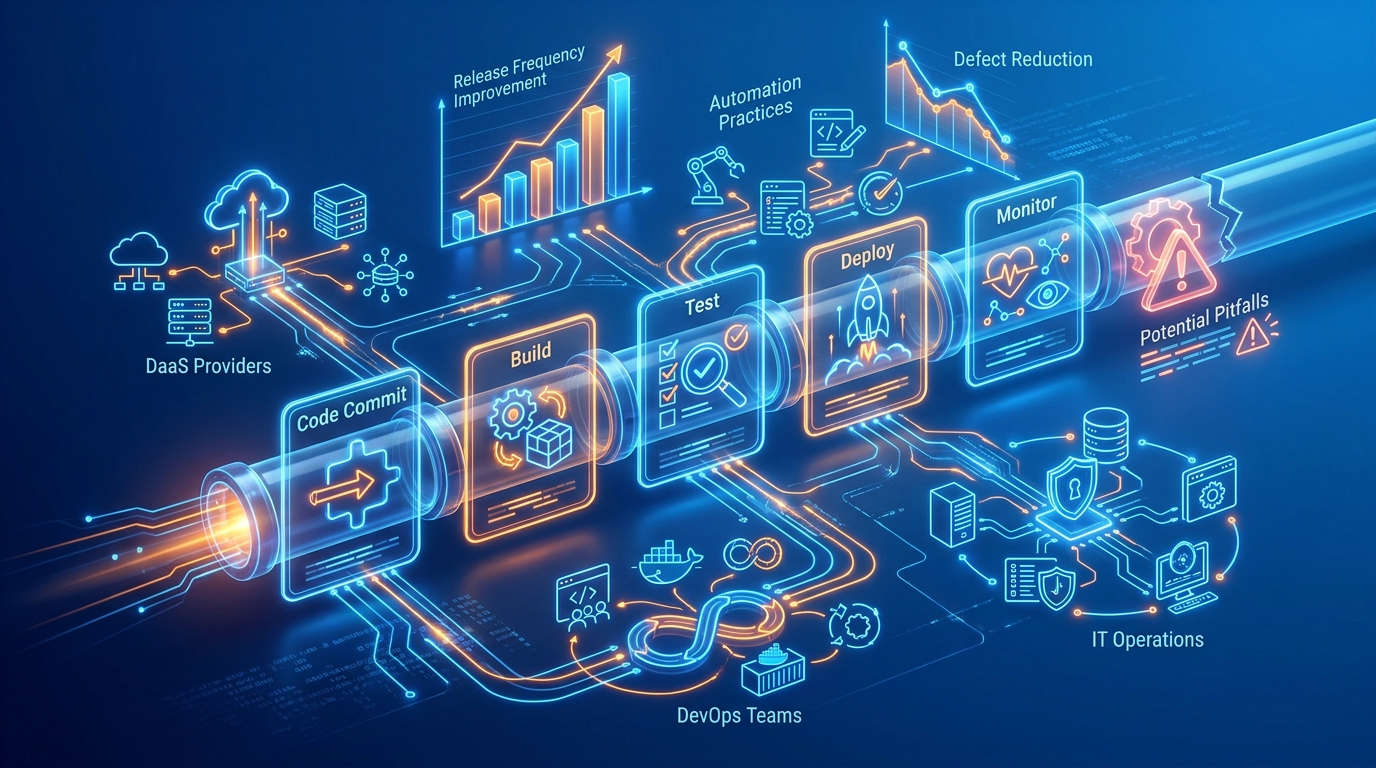
One of the clearest ways DaaS improves IT operations is by fast-tracking CI/CD pipeline maturity. Rather than spending months designing build, test, and deployment workflows, teams gain immediate access to pre-configured pipelines that follow repeatable, well-tested patterns.
Speed alone is not the goal. Consistency is. DaaS providers bring standardized deployment workflows that reduce manual steps, minimize configuration drift, and make releases predictable.
Key areas where this model delivers measurable impact include:
-
Automated build and test cycles that catch defects earlier in the pipeline
-
Infrastructure provisioning through code, reducing environment inconsistencies
-
Continuous monitoring and feedback loops that surface issues before they reach production
-
Standardized rollback triggers and recovery processes that lower deployment risk, including automated drift detection and policy-as-code enforcement to prevent configuration divergence between environments
For an in-depth look at how CI/CD automation powers delivery, see CI/CD Automation: How CI/CD Pipeline Automation Powers Modern Software Delivery.
When these capabilities are delivered as a service, organizations can release new code 100 to 200 times more frequently while reducing software defects by up to 70%. Measured against DORA benchmarks, mature teams target several deploys per day with a change failure rate below 15%. That combination of velocity and reliability is what separates functional DevOps from performative DevOps.
The trade-off worth acknowledging: you gain speed and standardization, but you give up some pipeline customization. DaaS providers optimize for repeatable patterns. If your deployment topology is unusual (multi-region active-active, heavy edge computing, or tightly regulated environments requiring per-commit audit trails), the provider's golden paths may need significant adaptation. Teams that don't surface these constraints early end up with pipelines that work in staging but break under production conditions.
What Commonly Goes Wrong
The most frequent failure mode with managed CI/CD is the "handoff gap." The DaaS provider builds and operates the pipeline, but nobody on the internal team fully understands its structure. When an incident hits at 2 a.m. and the provider's on-call response takes 20 minutes, that knowledge gap turns into extended downtime. Mature DaaS engagements address this with shared runbooks and joint incident response, not just SLA documents.
Standardized Automation Can Deliver Enterprise-Level Reliability Gains
Nationwide, the financial services company, achieved a 70% reduction in system downtime and a 50% improvement in code quality by implementing DevOps practices. For companies without Nationwide's resources, a DaaS model offers a practical path to similar outcomes, measured in MTTR reduction and deployment frequency, without the same level of internal investment.
For a blueprint on automating infrastructure, drift remediation, and robust governance alongside managed CI/CD, check out Infrastructure as Code (IaC): How Infrastructure as Code Automates Cloud Deployments.
The delivery acceleration that DaaS enables naturally raises the next question: what does this mean for operational costs and team structure?
Reducing Overhead Without Sacrificing Control
A common concern with any "as-a-service" model is loss of control. With DaaS, the opposite can be true when the model is well-designed. Organizations retain ownership of their priorities, architecture decisions, and release schedules. The service layer handles execution, tooling management, and operational support.
This is especially valuable for companies facing talent gaps or scaling pressure. Rather than expanding headcount to cover every DevOps function, teams can direct internal engineers toward product delivery while the DaaS provider manages pipeline health, environment stability, and infrastructure automation.
To learn more about managing operational overhead, governance, and cost optimization through managed services, see Cloud Cost Optimization: How to Cut Costs and Improve Cloud Performance.
The financial case is measurable. Companies that have combined DevOps with standardized, fully virtualized infrastructure have seen IT costs drop by as much as 25%. Meanwhile, cloud adoption itself can reduce IT overhead costs by 30 to 40% When DaaS is layered on top of a cloud-native strategy, these savings compound. Teams tracking FinOps unit metrics (cost per deployment, cost per active workload) can validate this directly rather than relying on aggregate estimates.
-
Fewer full-time hires needed to maintain toolchain infrastructure
-
Reduced context-switching for developers who currently handle operational tasks
-
Lower licensing and integration costs through shared, managed tooling
-
Faster onboarding of new services without redesigning internal workflows
How roles shift: the internal DevOps engineer's job changes from "build and maintain the pipeline" to "define standards, review provider output, and own the internal developer platform strategy." This is a meaningful career shift. Some engineers welcome it; others feel sidelined. Organizations that don't address this proactively lose their best people to companies where they can still build.
Providers like ABS, which delivers managed IT services across infrastructure, cloud, and cybersecurity, illustrate how structured DevOps support can reduce operational burden while keeping governance and visibility intact. For further details, explore Managed IT Services.
Faster Incident Response Becomes Critical in AI-Driven Development Environments
DevOps-enabled organizations have been able to tackle security issues in half the time traditionally required, freeing internal security and operations teams to focus on strategic work rather than reactive patching. In environments where release velocity is increasing, that reduction in response time directly lowers exposure windows.
To understand these security requirements in the context of modern pipelines, see DevSecOps Explained: How to Build Security into Every Stage of Development.
What Separates Effective DaaS from Generic Outsourcing
Not all DaaS engagements deliver equal value. The difference comes down to three factors: how deeply the provider integrates with your delivery workflow, how clearly ownership boundaries are defined, and how well the model scales with your release cadence.
Key qualities to evaluate in a DaaS model:
-
Transparent reporting and shared dashboards for system health and deployment metrics, including deployment frequency, change failure rate, and MTTR
-
Defined escalation paths and incident response aligned with internal SLAs
-
Collaborative planning cycles where the service team and internal engineers co-own priorities
-
Flexibility to scale support up or down based on project demand
-
Automation guardrails: policy-as-code enforcement, automated rollback triggers based on error rate thresholds, and drift detection that alerts before manual intervention is needed
DevOps-as-a-Service is a delivery model where an external provider manages CI/CD pipelines, infrastructure automation, monitoring, and operational workflows on behalf of an organization. It is integrated with internal teams and aligned to business goals, rather than replacing in-house engineering.
A signal from current reality: platform engineering teams are increasingly becoming the internal counterpart to DaaS providers. The most effective model in 2026 is one where the DaaS provider maintains the infrastructure layer and golden paths, while an internal platform team curates the developer experience, manages telemetry governance (deciding which signals are worth paying to store). Organizations that treat DaaS as a replacement for internal platform thinking, rather than a complement to it, consistently underperform.
To better understand this relationship and the impact of platform engineering on DevOps maturity and DORA metrics, see The Next Frontier: DevOps for Cloud-First Enterprises.
When these elements are present, DaaS stops being a vendor relationship and starts functioning as an operational partnership.
Managing Modern Risk: AI-Generated Code and Pipeline Security
As AI-generated code becomes standard in development workflows, pipeline security requirements are changing. Traditional static analysis tools were not built to catch the dependency risks, licensing ambiguities, and supply chain vulnerabilities that AI-authored code can introduce.
Organizations using DaaS should verify that their provider's pipeline includes:
-
LLM-aware code scanning integrated at the build stage
-
SBOM (Software Bill of Materials) generation for every build artifact
-
Automated dependency auditing that covers both human- and AI-authored code
Teams that treat this as optional will find their attack surface expanding faster than their security posture can keep pace.
Conclusion
DaaS works when it is treated as an operational partnership, not a handoff. The organizations that get results from it are the ones that maintain clear ownership boundaries, define measurable delivery targets, and keep internal teams engaged rather than sidelined. The pressure on delivery pipelines will only increase as cloud environments grow more distributed and AI-generated code raises the complexity ceiling. In that context, mature automation and reliable governance are not optional upgrades. They are the foundation that keeps speed and stability from working against each other.