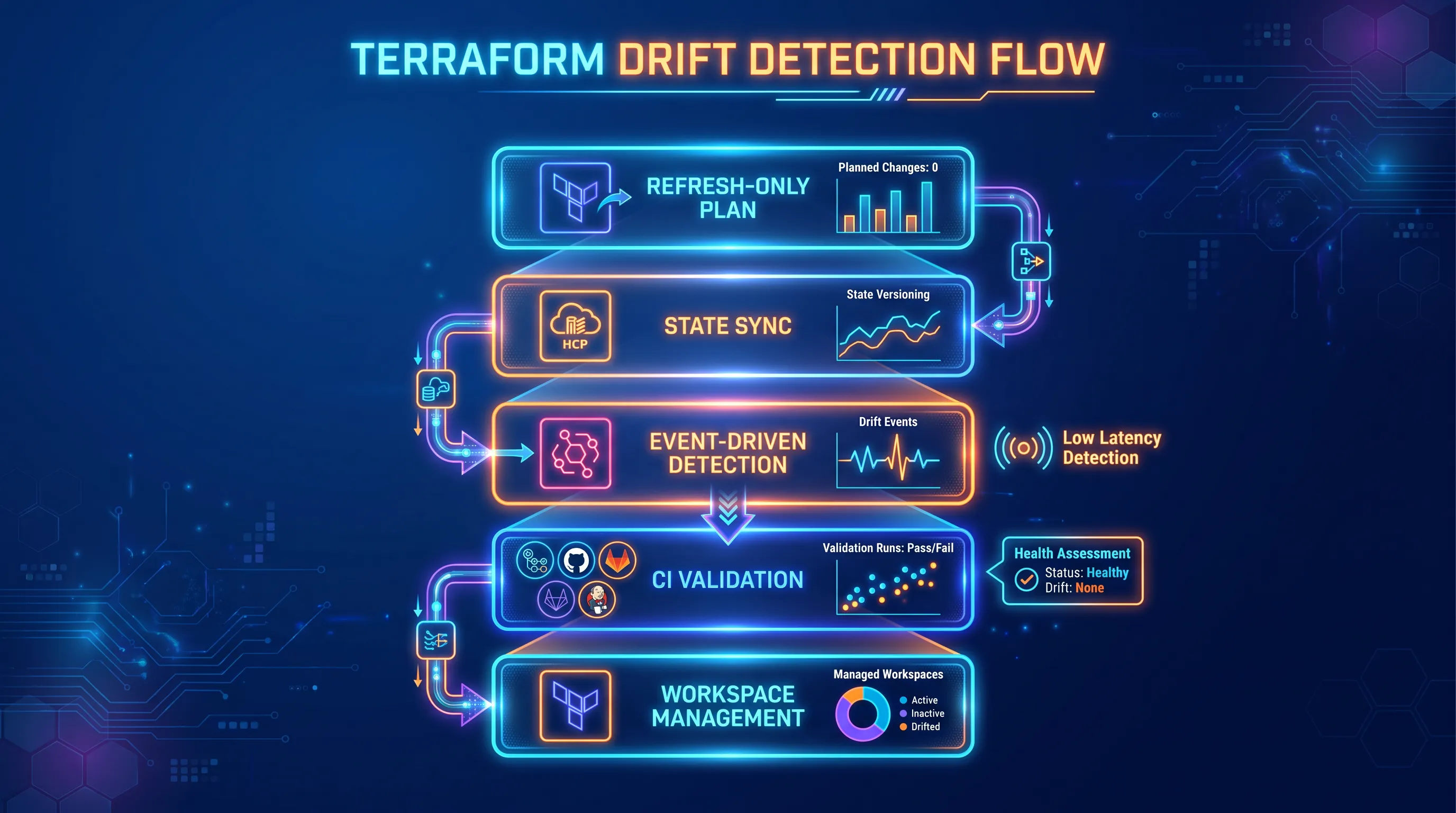
Assign findings clearly
Terraform drift detection generates work. Someone has to own that work before the first alert fires, or the platform team inherits all of it by default and becomes the operations queue for every account in the company.
Map each workspace, and where ownership is mixed, each resource, to an accountable team. Route findings to that team's channel rather than a central firehose. Severity should follow blast radius and data sensitivity, not resource count: a single modified network ACL in a payments environment outranks forty tag changes in a sandbox. Attach a response target to each severity so "we'll look at it" has a deadline.
A finding that arrives without context gets deferred. Give the receiving engineer enough to act:
-
The resource address and the physical ID of the live object.
-
The attribute-level diff, showing the value Terraform expected and the value it found.
-
The originating identity and timestamp from the provider audit log, which is what turns "something changed" into "who changed it and when."
-
The classification and any exception that already covers part of the finding.
Deduplicate across layers so an event-driven alert and the nightly plan don't open two tickets for one change. Escalate on age rather than on repetition, because a finding that has sat untouched for a week is a different problem from one that fired twice in an hour.
Drift response decision tree
Once a finding is owned, the sequence matters more than the speed. Terraform drift detection tells you something moved without telling you who was right.
Validate the finding first. Re-run the refresh-only plan to confirm the change is real and not an artifact of a provider upgrade or a stale lock file. Then identify ownership and root cause, because a change made by a known automation tool leads somewhere different from a change made by a named engineer at 3 a.m.
Assess security impact and blast radius next. Widened ingress or modified identity policy changes the urgency immediately. The IBM 2025 Cost of a Data Breach Report put the global average breach cost at USD 4.44 million with a mean identification and containment time of 241 days, and misconfigured cloud services sit near the top of the cause list. Finally, determine intended authority: should Terraform own this attribute, or does something else legitimately own it? That answer selects one of three paths. Terraform state drift, where the record itself is wrong, is handled inside whichever path applies.
Revert the live change
Use this when Terraform remains authoritative and the change was unauthorized or was always meant to be temporary. Run a normal plan and read it line by line to confirm the dependency graph before approving. A revert that looks like an in-place update can cascade into a replacement when a provider treats the attribute as immutable.
Destructive or production-impacting reverts need a second approver and a rollback plan. Elite delivery teams in the 2024 DORA State of DevOps report hold a change failure rate near 5%, and they get there by gating risky changes rather than by moving slower overall. The same logic applies to remediation.
Adopt the live change
Sometimes reality is right. The engineer who widened that security group was responding to a genuine capacity problem, and the new value should stand. In that case, update the configuration through version control so the change gets the same review any other change would get, then confirm the next plan comes back clean.
Where terraform state drift is the problem rather than the configuration, reconcile it with terraform apply -refresh-only, which shows you the diff and requires explicit approval before writing anything. If the binding is broken or the resource was never tracked, repair it with an import rather than editing state by hand. Then run the plan again. A stable, empty plan is the only acceptable end state.
Record an exception
Use this path when another system legitimately owns the attribute and will keep writing to it. Document the exception and set the review date, with the ignore rule scoped to the named attribute. The goal is to silence one known conversation between two systems while you continue to watch the resource.
Narrow scoping is what makes this safe. If you ignore the full tags map to accommodate a policy engine, you also stop seeing someone strip the environment tag off a production database. Ignore the specific key instead.
Measure recurring drift
Terraform drift detection becomes a management tool once you count it. Four measures carry most of the signal: how many open findings exist and how old the oldest ones are, along with how often the same resource drifts again after remediation and how long remediation takes from detection to clean plan.
Segment those by team and resource type. The segmentation is where the insight lives. Recurring infrastructure drift on the same resource type across several teams points at a module that's missing an attribute or at a provider default nobody declared. Repeated drift from one team points at a workflow problem, which is a gap between what their on-call engineers can do in the console and what the pipeline lets them do in code.
Age is the metric that exposes ownership failures. Findings that sit for weeks are routing problems, and no amount of faster terraform drift detection will fix them. Use the trend lines to decide what to change next: tighten console permissions or move a workspace to a different owner.
Build the implementation roadmap
Start with an honest assessment of state health and locking, along with workspace coverage versus actual cloud inventory. Phase the work so terraform drift detection stabilizes before automation touches anything.
ABS Technologies builds and operates cloud and DevOps pipelines for software-led companies, and those pipelines cover infrastructure automation and secure CI/CD architecture. Contact our team for an assessment and a prioritized terraform drift detection roadmap built around your existing workspaces.