Disaster Recovery Testing Services: Proving Recovery Before an Incident Does

Content authorBy Irina BaghdyanPublished onReading time10 min read
Abstract digital data processing concept with a futuristic computer chip, glowing blue circuitry, and orange energy particles on a dark background

A disaster recovery test that only produces a green checkmark proves very little. Credible testing shows that systems recover within the targets the business depends on. Knowing what a test should prove, how a serious engagement is scoped, which questions to put to a provider before signing, and what drives the price makes the difference between assurance and theatre.

Why disaster recovery testing services

Your plan says four hours. Disaster recovery testing services exist to find out whether that number survives contact with a real failure, or whether it only survives a steering committee review.

Three things get confused with each other all the time. A documented intention, which is a plan nobody has executed. A successful backup job, which proves data was written somewhere. And demonstrated recoverability, which is the only one that tells you the service comes back. Veeam's 2025 survey of attacked organizations found that only 10% recovered more than 90% of their data, while 57% recovered less than half.

The gap between the plan and the outcome is where the cost sits. More than half of operators in the 2024 Uptime Institute survey put their most recent significant outage above $100,000.

What testing must prove

Proof is not a completed test. Plenty of exercises finish on schedule and prove nothing, because nobody wrote down what success would look like before starting. A meaningful engagement for disaster recovery testing services defines measurable criteria first, then runs against them.

Those criteria have to cover more than servers. Systems and data are the obvious part. Procedures and vendor response matter just as much, and they're the parts most programs skip. Werner Vogels, Amazon's chief technology officer, built an entire engineering philosophy on the line that "everything fails all the time", and the practical consequence is that you design and verify for failure. A cloud resilience approach applies the same principle across the wider operating environment.

So the work splits into three questions, each with its own evidence. Did recovery meet the approved objectives, which is where RTO RPO validation lives? Did the full service come back? And could the people involved execute under pressure?

RTO RPO validation

A Recovery Time Objective (RTO) is the longest a service can be unavailable before the damage becomes unacceptable. A Recovery Point Objective (RPO) is how much data you can afford to lose, measured in time. RTO RPO validation compares what was observed during the test against what the business signed off on.

Observed recovery time starts at the declared failure and ends when the service is usable. Recovered data points get checked against the last known good transaction, which is how you find out your four-hour RPO is really nine. In Eon's 2026 infrastructure research, 75% of executives said their teams estimate recovery time from assumptions.

When a target isn't met, the finding gets documented with the measured number and the reason. When a target was never realistic given the architecture, that gets documented too, because an unachievable objective on an approved plan is a governance problem. Good disaster recovery testing services report both without softening either. That is why recovery objectives need to be tied to architecture, not just policy.

End-to-end service recovery

Infrastructure starting is a milestone. The service is recovered when a user can authenticate, and the application responds.

That means network paths and identity providers belong in scope from the start. It also means capacity gets checked, since a recovery environment sized for a demo will collapse under Monday morning load. The AWS us-east-1 incident of October 2025 made the point at scale: DynamoDB's DNS failure lasted around three hours, but EC2 launch failures and load balancer errors ran for roughly 15 hours as dependent systems rebuilt state.

Failback is the half nobody tests. Returning to the primary site carries its own data reconciliation risk, and a team that has never practiced it will improvise during the most sensitive window of the whole event. A managed DevOps operating model can help make that recovery discipline repeatable.

Need IT Support?

Book a free consultation with ABS Technologies experts we'll help you find the right managed IT, cloud, or security solution for your business.

Book a Free Consultation →

Team execution

Technology rarely fails alone. Four in five respondents to the 2023 Uptime Institute survey said their most recent serious outage could have been prevented with better management or processes.

So testing verifies who can declare a disaster at 3 a.m. and who approves a failover that will cost money if it's wrong. It checks whether escalation paths reach a human and whether privileged credentials are reachable when the identity system is the thing that's down. Anticipation is the point here. You want to find the broken phone number before the incident does.

Runbooks get tested two ways: can the team follow them, and can the team adapt when the scenario doesn't match the script? Delta Air Lines canceled about 7,000 flights after the CrowdStrike update of July 2024 and reported roughly $500 million in losses. It recovered more slowly than peers hit by the same defect.

Match tests to risk

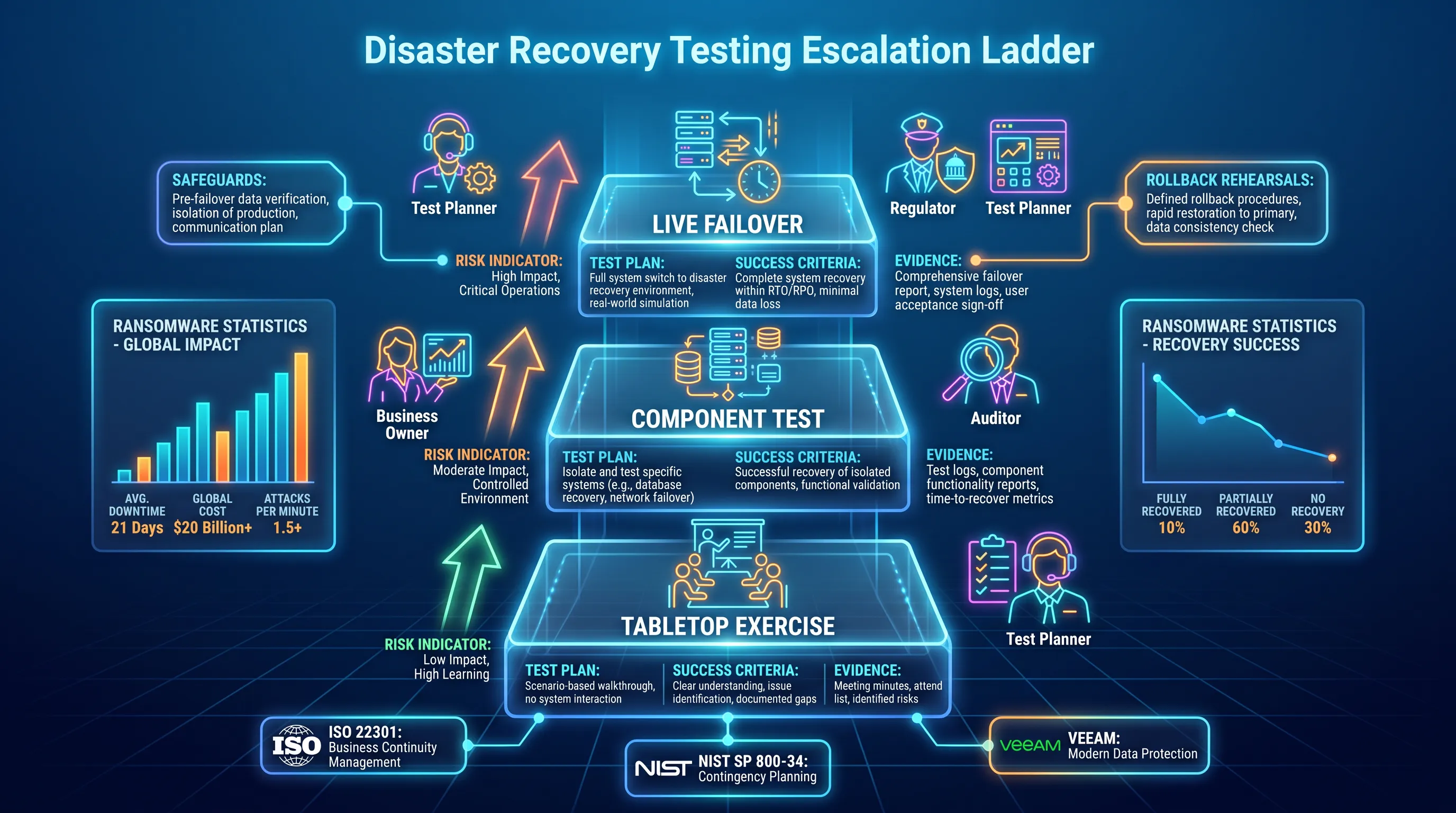
Neon hi-tech infographic of a 'Disaster Recovery Testing Escalation Ladder' with glowing steps, risk indicators, and compliance badges.

Not every question needs a live failover to answer, and running one before the basics are verified creates risk without producing evidence. Testing should climb a ladder, with each rung answering a question the one below it couldn't. NIST SP 800-34 Rev. 1 sets the same expectation by tying exercise depth to system impact level, with full-scale functional exercises reserved for high-impact systems.

Each level also needs different safeguards. A tabletop needs a scenario pack and a facilitator. A live failover needs isolation and written executive approval. The disaster recovery test plan is what holds those decisions together, and strong disaster recovery testing services build that document before touching a single system.

Disaster recovery test plan

The disaster recovery test plan is the contract for the exercise. It records what's being tested and what counts as success. Without it, findings become opinions.

A workable plan covers:

  • The initial assessment of current architecture, dependencies, and existing recovery evidence

  • Objectives and the specific scenarios chosen, with the systems and locations in and out of scope

  • Measurable success criteria, including the RTO and RPO targets each test is measured against

  • Named responsibilities on both sides, the schedule, and the agreed maintenance window

  • Evidence requirements, so screenshots, logs, and timestamps are captured as the test runs

  • Rollback steps, stop conditions, and the approvals needed before execution begins

Approval matters more than it looks. A disaster recovery test plan signed by the business owners is also the artifact your auditors and regulators will ask to see.

Need IT Support?

Book a free consultation with ABS Technologies experts we'll help you find the right managed IT, cloud, or security solution for your business.

Book a Free Consultation →

Tabletop and component tests

A tabletop costs you a room and a few hours, and it exposes the gaps that technical work never reaches: unclear decision authority or a dependency nobody documented. ISO 22301 Clause 8.5 requires exercises that produce formalized post-exercise reports with recommendations and actions, which is a useful bar even if you're not certified.

Component tests move to the technical layer without attempting full service recovery. You restore a selected backup into an isolated environment and verify the data. You fail over one database and watch replication behavior. You test a single integration's reconnection logic. Veeam found that 96% of ransomware attacks target backup repositories, with 76% of those attempts succeeding, which is why restore verification deserves its own test. Broader backup recovery practices can help connect that verification to business continuity.

Failover and full recovery

Live failover proves what the lower rungs can't: that the secondary environment carries real traffic, at real volume, with real users. End-to-end recovery goes further and proves the business can operate from it. These are the tests that convince a board, and they're also the ones that can cause an outage.

Appropriate conditions are specific. Component tests passed. Rollback has been rehearsed and timed. The environment is isolated or the blast radius is understood and accepted. Leadership has approved in writing, and the window is agreed with the business. Mature disaster recovery testing services will decline to run a live failover when those conditions aren't met, because an exercise that becomes an incident destroys the credibility of the whole program.

Scope disaster recovery testing services

Scoping starts with a dependency map. The map covers applications and their data stores. Business dependencies belong on the same map, because a recovered order system without a recovered payment provider doesn't let you trade.

Responsibilities then get split in writing. The provider designs the scenarios and runs the exercise. Your team supplies access and the people who have to execute. Prerequisites get listed, which means current architecture documentation and confirmed backup availability.

Exclusions deserve the same precision as inclusions. Systems outside scope and third-party environments the provider has no authority to touch should all be named in the disaster recovery test plan. Change control and the stop conditions that halt the test close out the scoping conversation. Clarity here is what separates disaster recovery testing services from an expensive guess.

Evidence you receive

The deliverable is proof, and proof has a shape. You get a test report with a timestamped timeline of what happened and the measured results against each success criterion. RTO RPO validation appears as observed numbers next to approved targets, with variance explained.

Expect dependency findings as a separate section, because the undocumented relationships a test exposes are frequently the most valuable output. Remediation actions come prioritized by business impact.

Findings only become capability when they're owned. That means:

  • A named owner and target date for each remediation item

  • Specific updates to recovery documentation and runbooks

  • Acceptance criteria that define what "fixed" means for each finding

  • A retest scope and date for the items that failed

Saudi Arabia's central bank formalizes exactly this loop: test results go to SAMA within four weeks, and a failed test must be retested within three months.

Evaluate fit and cost

Ask a provider how they decide which test level fits a given system, and listen for whether the answer is tied to risk or to their standard package. Then ask what evidence you'll receive and how it maps to your obligations. Under DORA Article 26, designated financial entities must run threat-led penetration testing on live production systems at least every three years, so a provider's comfort with production work is a fair question. A broader security posture review can also show whether recovery controls align with wider resilience requirements.

Worth confirming before you commit:

  • The methodology, and how scenarios get selected for your environment

  • Who holds the stop authority during execution, and how rollback is rehearsed

  • The split of responsibilities, and what's explicitly excluded

  • Which skills sit on the delivery team, by platform

  • Whether retesting of failed items is included or priced separately

  • How RTO RPO validation results are documented when a target isn't met

Pricing follows scope and depth more than anything else. The number of services in scope and the test level you choose set the base. Multiple sites and third-party dependencies that need coordination add to it. Out-of-hours windows and the depth of the evidence package move the figure again.

Scope your recovery workshop

Start with what you already have. A scoping workshop reviews your current evidence and settles on test levels your environment can carry safely.

ABS Technologies runs cloud and DevOps engagements on AWS and Azure under an ISO 27001-certified management system, which is the ground our recovery work stands on. If you need operational proof, talk to us about scoping disaster recovery testing services for your critical systems.

Need IT Support?

Book a free consultation with ABS Technologies experts we'll help you find the right managed IT, cloud, or security solution for your business.

Book a Free Consultation →

Test critical recovery procedures on a risk-based schedule, then repeat them after major architecture changes, supplier changes, or serious incidents. A fixed annual exercise can miss new dependencies, while frequent component checks can verify backups and access between larger exercises. Record the reason for each interval in the recovery plan.

Retain the approved test plan, change records, access approvals, timestamps, system logs, screenshots, communications, and the final report. Keep the version of each runbook used during execution because later reviewers need to see what the team followed. Store failed criteria with owners, due dates, and retest evidence.

Yes, start with isolated restores, tabletop exercises, and component tests that use replicas or nonproduction environments. A production failover needs written approval, a defined maintenance window, tested rollback steps, and a stop authority. If those safeguards aren't ready, the exercise should remain at a lower test level.

A successful backup job shows that data was copied, not that the application can use it. Recovery can still fail because transactions are inconsistent, credentials are unavailable, network paths are missing, or a required supplier is down. Test application startup, authentication, integrations, and data integrity instead of checking backup status alone.

Compare proposals by scenario selection, systems in scope, provider responsibilities, stop conditions, evidence supplied, platform skills, and retest terms. Ask ABS to explain how its proposed work fits your critical systems and recovery objectives, then contact ABS about scoping disaster recovery testing services if you need a defined engagement.

Schedule a Meeting

Book a time that works best for you and let's discuss your project needs.

You Might Also Like

Discover more insights and articles

Futuristic high-speed data transfer tunnel with glowing blue and orange streams of light moving through a digital network

Canary Deployment Strategy: Progressive Delivery with Measurable Rollback Signals

A bad release is far cheaper to catch when only a small slice of traffic sees it. A canary deployment strategy makes that possible by promoting or rolling back on evidence rather than opinion. Routing controls decide who gets the change first, and health signals decide whether it goes any further.

Close-up of modern data center infrastructure with illuminated servers, cables, and high-speed data connections

Platform Product Management: Turning Internal Infrastructure into a Product Teams Adopt

Want engineers to adopt your internal developer platform rather than work around it? Run it like a product. Start with discovery to learn what teams need, then track the measures that show whether the platform is earning its keep.

Abstract 3D visualization of interconnected digital infrastructure with glowing data nodes and network connections

Cloud Workload Protection Platforms: What to Evaluate Before Choosing a CWPP

Protecting workloads that run across both virtual machines and Kubernetes is hard to judge from vendor demos alone. A vendor-neutral comparison starts with requirements mapping, moves to capability testing, and ends in a proof of concept you control rather than one the vendor runs for you.

T professionals working with digital systems and technology interfaces in a modern office

Terraform Drift Detection: Finding and Fixing Infrastructure Changes Safely

This article explains how to standardize terraform drift detection across multiple teams and Terraform workspaces. It covers layered detection and a remediation sequence that keeps risky fixes behind review and approval.