Two professionals walking through a futuristic digital data environment symbolizing human and AI collaboration in advanced data infrastructure and decision-making

Why You Need a Dedicated DevOps Team and the Right devops automation tools for Cloud Projects

Modern software teams must ship faster, stay secure, and control cloud costs at the same time. Shortcuts in tooling or team structure often lead to outages, overspending, and burnout. This article explains why combining a strong DevOps culture with the right devops automation tools is essential for sustainable speed across AWS, Azure, and Google Cloud. You’ll learn how people and automation work together, why dedicated DevOps roles protect both delivery velocity and budgets, and how to choose a toolchain that scales with your business.

Content authorBy Irina BaghdyanPublished onReading time9 min read

Overview

Cloud infrastructure keeps multiplying: microservices, containers, serverless functions, and data pipelines all introduce moving parts that a simple script or weekend hack cannot cover. Companies that thrive in this landscape combine:

  • A dedicated DevOps mindset that blurs the line between development and operations, embedding reliability and feedback loops into daily work

  • A curated suite of devops automation tools that codify those processes, replacing fragile manual steps with predictable pipelines

We will examine why that cultural shift is pivotal, how the right specialists keep your cloud spend and security posture in check, and what criteria to apply when choosing automation platforms. Sprinkled throughout are real-world examples from scaling startups and large enterprises.

DevOps Is a Culture, Not Just a Toolchain

DevOps first gained traction as a way to break the “walls of confusion” between developers who write code and operators who run it. Yet many teams still start by purchasing flashy CI/CD platforms before agreeing on shared goals. This section shows why that order is backward.

A mindset shift comes first:

Teams must treat delivery speed, uptime, and user satisfaction as a single equation, shared by everyone. Metrics such as deployment frequency, change failure rate, and mean time to recovery should be discussed in the same stand-up that reviews bug counts.

  • Deployment frequency ties directly to business agility: if fixes roll out weekly instead of quarterly, churn drops.

  • Change failure rate quantifies the cost of speed; reducing it prevents “cowboy” releases.

  • Mean time to recovery indicates how quickly the team can detect and resolve incidents, signaling strong observability habits.

When these measurements guide daily decisions, tools become allies instead of trophies.

Yet the temptation to treat DevOps as a shopping list persists. The market for DevOps tooling is exploding, set to add USD 13.9 billion in new revenue by 2029. That growth proves demand, but it also fuels vendor noise, making cultural alignment even more critical.

Teams that embrace DevOps values first can then pick tools that reinforce collaboration instead of fragmenting it. For a practical look at breaking down silos and streamlining cloud pipelines, see Tech-Driven DevOps: How Automation is Changing Deployment.

When Automation Failed: A Fintech Lesson in DevOps Culture

A fintech startup introduced Kubernetes and a GitLab pipeline in one quarter, hoping to shorten release cycles. Without shared SLOs or incident reviews, developers still handed features to operations on Friday evenings. Downtime grew. Management paused feature work to run joint retrospectives, define recovery targets, and rotate on-call duties across both groups. Only after agreeing on goals did they revisit automation, integrating alerts into Slack and dashboards into daily scrums. Release speed tripled while incidents fell by 40 %.

The takeaway: culture guided tool investment, not the reverse.

Why Cloud Complexity Demands a Dedicated DevOps Team

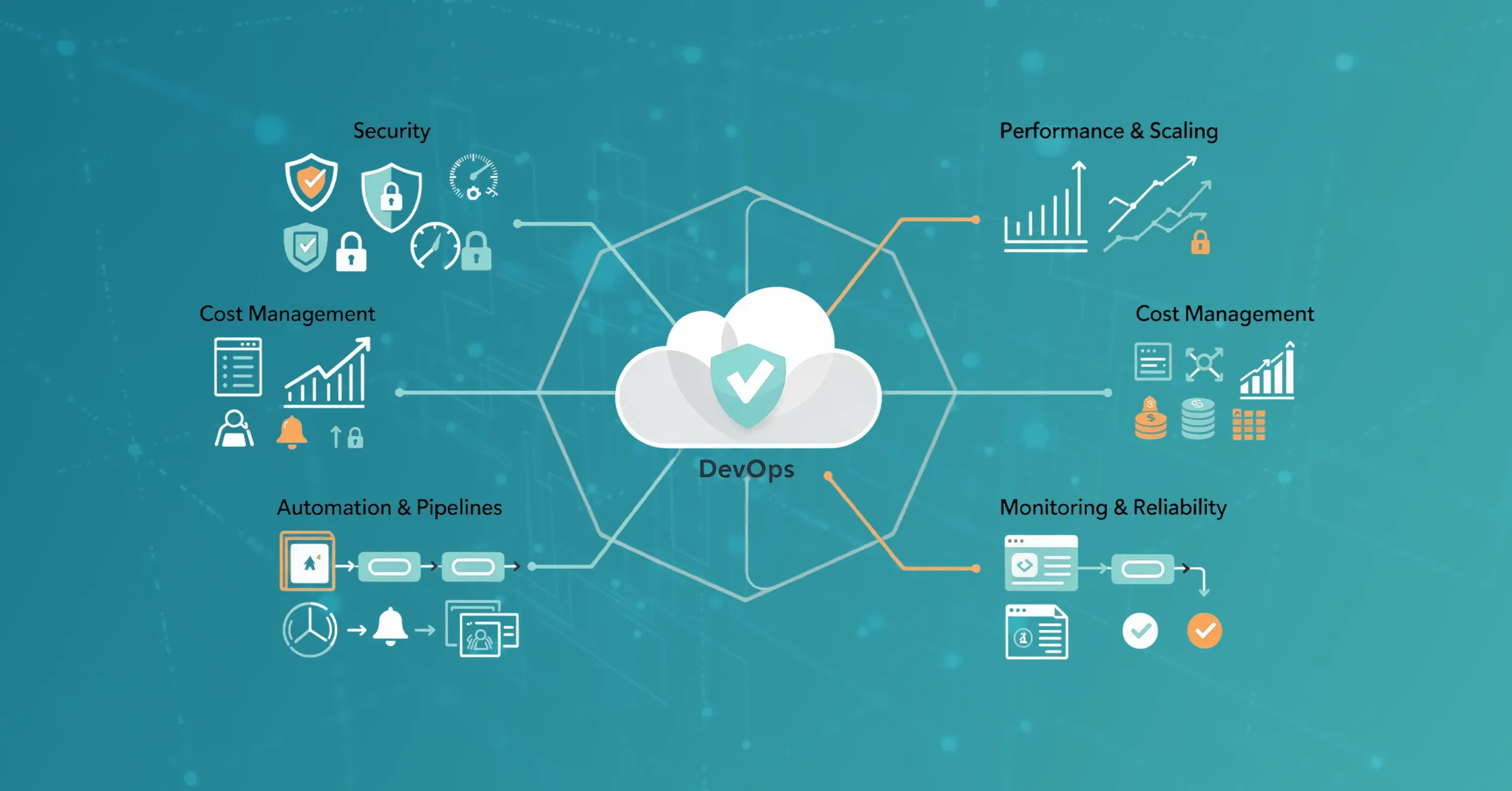
Illustration of a DevOps cloud architecture highlighting security, automation pipelines, performance scaling, cost management, and monitoring for reliable cloud operations

Handing DevOps tasks to whichever engineer has spare time rarely ends well. Cloud platforms now span hundreds of services, each with quirks in permissions, networking, and cost models. Specialized, dedicated DevOps engineers keep those moving parts aligned.

Unshared duties lead to blind spots:

  • Security gaps: Without a clear owner, IAM roles, firewall rules, and patching lag behind.

  • Performance surprises: Autoscaling works only if someone monitors metrics and load-tests capacity limits.

  • Cost spikes: Orphaned resources, chatty logs, and oversized instances silently drain budgets.

A dedicated DevOps squad counters these risks by owning the pipeline end-to-end, from commit to production telemetry. They institutionalize repeatable patterns - Infrastructure as Code, automated compliance checks, and standard observability stacks - so developers can focus on features.

Businesses also find that DevOps bandwidth maps directly to morale. The 83% of developers already involved in DevOps activities often juggle release duties with feature work. When those responsibilities lack formal support, weekend pages and context-switching breed stress. Assigning a clear DevOps role reduces the cognitive load for the wider team.

Some companies partner with external experts. A leading provider of managed IT services helps clients design cloud architectures, enforce security controls, and run 24/7 monitoring, allowing internal engineers to innovate instead of firefighting. For an overview of how these strategies are implemented in practice, see Why Outsourcing Your DevOps Platform is 2026’s Smartest OpEx Move: managed it services and support.

When Manual Scripts Met Holiday Traffic: Why Dedicated DevOps Matters

An e-commerce platform running on AWS hosted two engineers who manually pushed updates and toggled feature flags. A holiday surge broke their database scaling script; checkout stalled for 30 minutes. Afterward they hired a dedicated DevOps lead who implemented Terraform modules, automated load tests, and a blue-green deployment model. The next sale handled 5× traffic with zero incidents.

Choosing and Integrating DevOps Automation Tools

With culture and staffing in place, teams can evaluate the vast devops automation tools landscape. The market value hit USD 12.11 billion in 2024 and may reach USD 35.2 billion by 2029. Despite that flood of options, four selection principles endure.

Begin with your delivery workflow

Each stage - plan, code, build, test, release, monitor - has distinct automation needs. Mapping them prevents overlapping purchases.

  • Source control and code reviews: GitHub, GitLab, Bitbucket

  • CI pipeline: Jenkins, GitHub Actions, CircleCI

  • Artifact storage: JFrog Artifactory, AWS ECR

  • Infrastructure as Code: Terraform, Pulumi

  • Observability: Prometheus, Grafana, Datadog

For a detailed guide on building robust automation layers and scaling hybrid environments, see Cloud Services and DevOps.

Assess integration friction

  • Native plugins shorten setup time

  • Open APIs avoid vendor lock-in

  • Policy and role mapping ease security reviews

When evaluating DevOps automation tools, it is critical to align them with your team’s current skill set and long-term growth. Platforms that look impressive but demand rare or specialized expertise often see low adoption and quickly become shelfware. Instead, teams should prioritize tools that integrate naturally into their existing workflows and provide a clear path to scale in complexity over time. Just as important is choosing an ecosystem rather than isolated features: strong DevOps platforms create tight feedback loops by surfacing metrics in alerting systems, embedding test results directly into pull requests, and making cost data visible through shared dashboards. The evaluation process should conclude with a proof of concept that deploys a real service, measures pipeline performance, and incorporates developer feedback - because purchasing decisions grounded in real data consistently outperform those based on polished demos alone.

Adoption Follows Foundations: Why CI Comes Before New Tools

A media company loved a new testing SaaS but found that only 29 % of their developers used CI tools last quarter, per InfoWorld’s Q1 2024 survey. They first streamlined their Jenkinsfiles, slashing build times, then introduced the SaaS as an opt-in step. Adoption climbed to 70 % because the foundation was solid.

Balancing Security, Cost, and Speed: DevSecOps and FinOps

Pushing code faster can backfire if it unlocks data breaches or ballooning invoices. Two emerging disciplines, DevSecOps and FinOps, embed those guardrails directly in pipelines.

DevSecOps injects security scanning throughout the life cycle

  • Static code analysis flags insecure functions early

  • Dependency checkers prevent known-vulnerable libraries

  • Runtime monitors detect anomalous calls after deployment

FinOps treats cloud spending as a variable to optimize, not a fixed bill

  • Tagging policies expose which feature or team drives cost

  • Automated rightsizing turns off idle resources

  • Forecasting tools alert when budget thresholds near

The dedicated DevOps team becomes the connective tissue, tuning security gates and cost checks so they do not slow velocity. Containers help here; 92% of IT teams used them by 2025, letting identical images pass through dev, test, and prod with consistent scanning and resource footprints.

For practical strategies on embedding DevSecOps into your pipelines and establishing FinOps, read Tech-Driven DevOps: How Automation is Changing Deployment.

Preventing Developer Burnout and Accelerating Delivery

Human factors close our narrative loop. Even the best automation fails if people feel overworked or disconnected from outcomes.

Shared ownership plus automation reduces toil

  • On-call rotations across Dev and Ops spread knowledge and limit fatigue

  • Chat-ops bots surface alerts in real time, avoiding screen overload

  • Infrastructure as Code enables safe experimentation through reviewable pull requests

Developers reclaim focus time, an outcome echoed by the shift to remote IDEs: 36% of engineers worked primarily in cloud environments in 2024, freeing laptops from resource-heavy builds. With toxic toil reduced, AI coding assistants enter the mix; 64% of respondents already leverage them, accelerating unit tests and documentation.

For more on maintaining optimal cloud uptime and supporting your team around the clock, explore Cloud Support: How Managed DevOps Keeps Your Business Online 24/7.

The result is virtuous: faster pipelines mean fewer context switches, which fuels focus, which produces better code that flows smoothly through the pipeline.

Eliminating Schema Drift: How Automation Restored Release Confidence

A SaaS vendor replaced manual database migrations with Flyway in its GitHub Actions workflow. Engineers no longer spent late nights debugging schema drift, morale improved, and release cadence moved from monthly to twice weekly.

What Are DevOps Automation Tools?

DevOps automation tools are software platforms - such as CI servers, Infrastructure-as-Code frameworks, and monitoring suites - that replace manual deployment, testing, and infrastructure tasks with repeatable code-driven workflows, enabling teams to ship changes faster, reduce errors, and maintain consistent cloud environments.

Conclusion

DevOps success is not a matter of purchasing a magic platform. It is the result of nurturing a culture of shared responsibility, empowering a dedicated team to guard reliability and budgets, and selecting devops automation tools that reinforce those goals. In fast-moving cloud projects, this trio delivers the resilience, speed, and morale that modern businesses need to stay competitive.

A dedicated DevOps team provides clear ownership of deployment pipelines, security hardening, and cost optimization. That focus reduces outages, speeds releases, and frees developers to concentrate on feature work rather than firefighting.

Traditional scripts are often ad-hoc, tied to one engineer, and hard to version-control. DevOps automation tools integrate with source control, apply infrastructure as code principles, expose APIs for auditing, and support collaborative workflows that scale across teams.

Yes. Many leading tools offer generous free tiers or pay-as-you-go pricing. Startups should begin with core needs - version control, a simple CI pipeline, and basic monitoring - then add specialized platforms when usage and revenue justify the cost.

DevSecOps weaves automated security checks into every pipeline stage: code scans in pull requests, image scans during builds, and runtime anomaly detection in production. This approach catches vulnerabilities early without slowing release frequency.

FinOps applies financial accountability to cloud usage. By tagging resources, forecasting bills, and automating rightsizing, teams align cloud spending with business value, preventing runaway costs while maintaining performance.

Schedule a Meeting

Book a time that works best for you and let's discuss your project needs.

You Might Also Like

Discover more insights and articles

A futuristic illustration of an infinity loop symbolizing AI-driven DevOps, continuous integration, and continuous deployment through interconnected digital systems

CI/CD Automation: How CI/CD Pipeline Automation Powers Modern Software Delivery

Software delivery has become a race against the clock, yet moving too fast often breaks things. Teams face constant pressure to release features instantly, but manual processes create bottlenecks that slow down progress and introduce errors. This tension between speed and stability is the core challenge for modern IT leaders.

This article explores howci cd automationserves as the critical engine for solving this dilemma. You will learn how automating your pipeline transforms software delivery from a risky, manual chore into a reliable, high-speed process. We will examine the financial impact of poor quality, the mechanics of automated testing, and the strategic value of streamlining your release process to drive better business outcomes.

Futuristic secure data center corridor visualizing cloud infrastructure, cybersecurity architecture, and high-performance digital systems with blue and orange circuit patterns

Institutional-Grade Ops: Getting 24/7 SRE Resilience Without the Silicon Valley Price Tag

Mid-sized fintech, healthcare, and e-commerce firms in the GCC and Canada have a quiet, dangerous habit: they rely on a single in-house guru who “knows the cloud.” When that person is on holiday or leaves, revenue stalls. A managed IT support company can remove that single-point-of-failure and give you the same always-on reliability the big Valley brands enjoy, but without the premium price tag.

A quick look at the numbers explains why this matters. Nearly76 % of SMBs already lean on an MSP for at least some IT functionsand67 % plan to increase spending in the next 12 months(JumpCloud). They do it because downtime bleeds cash and damages trust.

Abstract visualization of interconnected data streams representing digital marketing automation, data integration, and performance-driven decision systems

Why Outsourcing Your DevOps Platform is 2026’s Smartest OpEx Move: managed it services and support

Leading CFOs have a new line item keeping them up at night: the spiraling cost of in-house DevOps. Salaries keep climbing, outages remain unforgiving, and security demands never sleep. The question is no longer “do we need DevOps?” but “do we still need to build it ourselves?”

This article walks through the facts, the math, and the risk calculus behind the Build-vs-Buy decision, showing why a managed DevOps model delivers nonstop expertise, lower exposure, and smoother cash flow for less than one senior engineer’s payroll.

The image depicts an advanced enterprise AI chip embedded in a digital circuit board, visualizing neural network processing and high-performance computing architecture

Cyber-Resilience: Why 2026 Boards are Trading Protection for Immunity

Modern boards are staring at a blunt truth: threat actors now move faster than any human response plan. A single ransomware strike can wipe decades of data, paralyze revenue, and sink market value overnight. Buying more perimeter tools will not calm the boardroom. Ensuring the business never stops will.

Below is a practical roadmap for CISOs, IT Directors, and Business Continuity Managers who need to move their IT and business services from brittle protection to digital immunity before the next quarterly review.