Why evaluation fails before it starts
Most selection processes for a cloud managed service provider go wrong at the beginning. Requirements get written after the first vendor demo, and the demo sets the vocabulary. From that point, you're comparing marketing decks against each other instead of comparing proposals against what your workloads actually need at 3 a.m. on a Sunday.
The stakes are not abstract. Uptime Institute's 2024 analysis found that among 412 operators asked about the most common cause of outages, IT and networking issues made up 53%, which the report attributes to change management problems and misconfigurations in increasingly complex environments. That's operational discipline. Discipline is exactly what you're buying, and it's the hardest thing to verify from a slide.
Set the evaluation baseline
Write down what you need before you talk to anyone. That document should state the business outcomes you're accountable for and which workloads carry revenue or regulatory weight. This takes a week and saves you a quarter.
Workload criticality is the spine of the whole document. A batch reporting job that can fail overnight and be rerun at 8 a.m. does not belong in the same tier as a payment API. Once you tier your workloads, everything downstream gets easier, from response times to how much you're willing to pay for coverage you'll rarely use.
Skill gaps deserve honesty rather than diplomacy. ManpowerGroup's 2025 IT outlook found that 76% of IT sector employers struggle to find the tech talent they need, with scarcity concentrated in exactly the roles you'd hire for here: data engineers and cloud architects. If you can't hire a Kubernetes specialist in your market at your budget, say so in the document. That's a mandatory requirement.
Then split the list in two:
-
Mandatory requirements: things that disqualify a provider outright, like 24/7 human coverage for tier-one workloads or a current SOC 2 Type II report covering the service you're buying.
-
Optional capabilities: things that break ties, like FinOps tooling you'd adopt in year two, or multi-cloud managed services you don't use yet but plan to.
Budget constraints belong in the baseline too, stated as a range rather than a number you hide. A cloud managed service provider who knows your ceiling will tell you what fits inside it. A provider who doesn't will design something you can't afford and then discount it in ways that quietly remove coverage.
Compare sourcing models
Managed services is one option among four, and it isn't automatically the right one. Each sourcing model, including cloud operations outsourcing, solves a different problem, and the difference comes down to who holds operational accountability when something breaks.
Hyperscaler support covers the platform. AWS Enterprise Support gives you a designated Technical Account Manager and a response within 15 minutes for business-critical outages, which is fast. But nobody at AWS is going to log into your account at 2 a.m. and roll back your bad deployment. They answer questions about their platform. You still own the runbook and the fix.
Staff augmentation gives you hands under your management, which means you keep the accountability and the process design work. That's the right call when you have a strong operating model and a headcount problem. It's the wrong call when you have a process problem, because contractors inherit whatever process already exists. Project consulting is bounded by definition. Useful for a migration or a landing zone build, useless as a permanent answer to who watches the alerts when you need cloud operations outsourcing.
Cloud operations outsourcing is the model where a provider takes named accountability for running something continuously, against agreed targets, with defined escalation. Here's how the four compare on the dimensions that matter:
-
Ownership and accountability: managed services and cloud operations outsourcing put operational responsibility on the provider. Augmentation and consulting leave it with you.
-
Engagement duration and knowledge retention: consulting ends and takes the knowledge with it unless you contract for documentation. Managed services accumulate context over time, which is an advantage while the relationship lasts and a risk when it ends.
Scalability and pricing pull in opposite directions across the models. Augmentation scales linearly with cost because you're buying people. Managed services scale better because you're buying a shared operating capability, though the pricing model matters more than the headline rate. Multi-cloud managed services priced per resource behave differently from a flat retainer once your footprint grows, and that difference shows up in month fourteen.
Cloud managed service provider scope
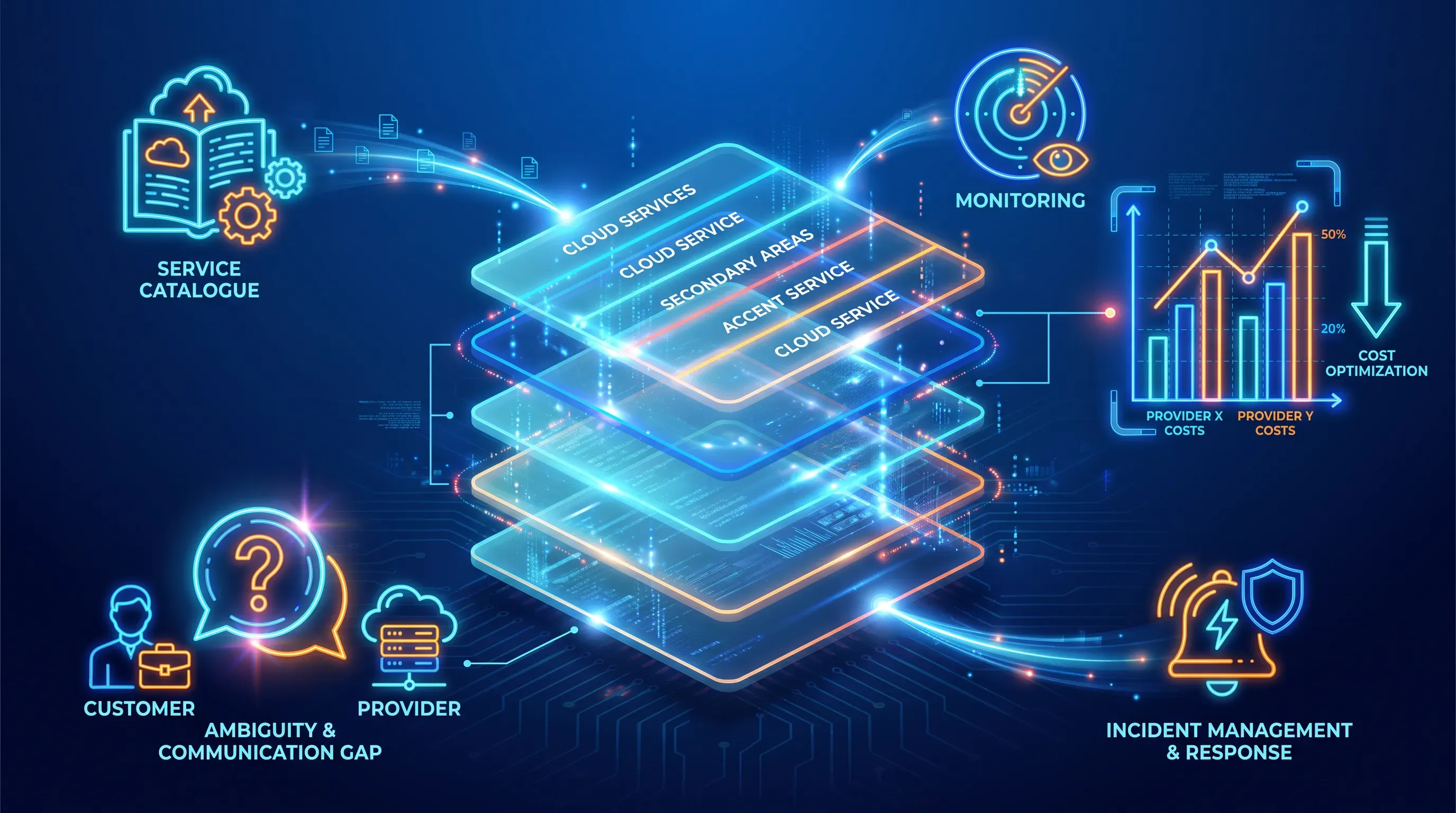
Every cloud managed service provider publishes similar service catalogues and means different things by them. "Monitoring" appears on nearly every one. Sometimes it means a dashboard you can log into. Sometimes it means an engineer who acknowledges the alert and applies the fix. Labels are identical, but the cost difference is several multiples.
Depth varies along two axes: how many layers of the stack the provider touches, and how far they go on each layer. A cloud managed service provider might handle infrastructure but stop at the container boundary. Another might manage your Kubernetes clusters but not the applications inside them. Ask where the line sits for each layer you care about, and get the answer in writing rather than in a conversation.
The sections that follow break the scope into five areas worth interrogating separately. None of them are optional to examine, because gaps between them are where incidents live.
Multi-cloud managed services
Single-cloud coverage is the simplest thing to buy and verify, unlike multi-cloud managed services. If everything you run sits in one platform, a provider with deep expertise there beats a generalist who claims all three. Depth in one platform shows up in the details: knowing which service quotas bite at scale and which failure modes are silent.
Multi-cloud is a different purchase. Flexera's 2025 survey of more than 750 cloud decision-makers found that 87% of enterprises use multiple providers, yet only 39% have unified cost visibility across them. That gap is what multi-cloud managed services are supposed to close, and it's also where the claims get loose. A provider running one dashboard across multiple clouds has solved visibility. Whether they can debug an Azure networking problem at the same depth as an AWS one is a separate question, and you should ask it about each platform by name.
Hybrid adds on-premises dependencies that standardized tooling handles poorly. If your identity provider or your database lives in a data centre, the provider's cross-cloud governance model for multi-cloud managed services has to reach it, or their coverage has a hole in the middle of your architecture. Ask which parts of their tooling stop at the cloud boundary. Every honest answer includes at least one.