FinOps Consulting Services: Turning Cloud Cost Data Into Engineering Action

Content authorBy Irina BaghdyanPublished onReading time16 min read
Title:
FinOps Consulting Services: Turning Cloud Cost Data Into Engineering Action

Meta description:
Learn how finops consulting services help you convert cloud cost data into developer action and re

Learn why cloud cost dashboards rarely change engineering behavior on their own, and what it takes to close the gap between reporting and action. See the operating model and the workflows that make cost accountability stick, plus what outside help realistically delivers.

Why dashboards stall

If your cost dashboards are accurate and nothing has changed in six months, the problem isn't visibility. If your cost dashboards are accurate and nothing has changed in six months, the problem isn't visibility. This is the pattern behind most organizations that come looking for FinOps consulting services:

  • AWS or Azure bills are growing faster than workload growth

  • DevOps gets a list of optimization recommendations and never gets around to prioritizing them

  • Nobody owns the cost of shared Kubernetes or platform infrastructure

  • Finance can't explain the variance between forecast and actual cloud spend

  • Reserved capacity or committed spend sits underutilized

  • Non-production resources keep running long after anyone needed them

  • The team has a dashboard, but no workflow for turning a finding into an engineering ticket

None of that is a data problem. What's missing is a mechanism that converts a number on a screen into a ticket someone owns.

Reporting tells you what happened. Cloud financial operations decides what happens next. One-time cost-cutting sprints produce a visible dip and then a return to trend, because nothing in the way engineering plans or deploys actually changed, and FinOps consulting services address that gap by changing how teams plan and deploy.

Four failures explain most of the stall. Ownership is unclear, so a $40,000 anomaly belongs to everyone and therefore no one. Allocation is unreliable, which means any team pushed to explain their spend can credibly argue the data is wrong. Planning happens separately from engineering roadmaps, so the forecast is a finance artifact rather than a shared commitment. And recommendations arrive unprioritized, hundreds at a time, with no sizing and no deadline.

The scale of the waste is stable enough to be structural. Flexera's 2025 survey of more than 750 cloud decision-makers found 84% of respondents name managing cloud spend as their top cloud challenge, and self-estimated waste has hovered between 27% and 32% every year since 2019. That number doesn't move because dashboards don't move it.

The FinOps operating model

Cloud financial operations works when decision rights are written down. Finance owns the budget envelope and the general ledger mapping. Engineering owns the architecture and provisioning choices that create cost. Product owns whether a feature is worth what it consumes, and procurement owns contract negotiation and enterprise agreement renewals. Executives own the tie-break when efficiency and delivery speed collide.

That last one gets skipped, and it's the reason most practices plateau. Without a named executive who will say "we accept a two-week delay to fix this cost profile," every escalation dies in a meeting. The FinOps Foundation's 2026 survey of organizations responsible for over $83 billion in cloud spend shows organizational alignment climbing the priority list precisely because optimization alone has stopped producing easy wins.

Cadence matters as much as roles. A weekly anomaly triage that lasts twenty minutes beats a monthly two-hour cost review, because the anomaly is still fixable in week one. Quarterly, the conversation shifts to commitment posture and forecast reset, and that's the meeting where executives belong.

Cloud financial operations roles

Ownership needs to be specific enough that a name goes next to each item. Vague shared responsibility is how allocation disputes start.

  • Budget owner: a named engineering or product leader per cost center, accountable for variance explanations, not just visibility into them.

  • Forecast owner: finance builds the model, engineering supplies the drivers such as expected traffic growth and planned migrations.

  • Allocation ruleset owner: the central FinOps team, because tag taxonomies and shared-cost rules break when everyone edits them.

  • Commitment owner: procurement executes, but engineering signs off on the usage floor that makes a three-year commitment safe.

  • Optimization execution: the team that owns the workload, always. A central team that rightsizes other people's services will be blamed for the next outage.

The central FinOps team enables. It builds the data pipeline and reports the truth to leadership. Provisioning and architecture approval stay with the owning teams. Distributed ownership scales because the people making the spending decisions are the people who can change them.

Cloud cost governance

Good cloud cost governance is mostly automated and mostly invisible. Policy that requires human approval for every new instance will be routed around within a month. Policy that blocks untagged resource creation at deploy time costs an engineer thirty seconds and holds forever.

Set approval thresholds by materiality rather than by resource type. A GPU node group that changes the monthly run rate by six figures deserves review. A t3.medium doesn't. Exception handling needs a documented path with an expiry date, because permanent exceptions are how cloud cost governance decays into a spreadsheet nobody reads.

Automated controls that preserve delivery speed include tag policies enforced in Terraform modules and service control policies that restrict expensive instance families to approved accounts. Leadership sponsorship is what makes any of it enforceable. The FinOps Foundation's 2026 data shows 78% of FinOps practices now report into the CTO or CIO, which puts the mandate where the engineering budget already sits.

Need IT Support?

Book a free consultation with ABS Technologies experts we'll help you find the right managed IT, cloud, or security solution for your business.

Book a Free Consultation

Build reliable accountability

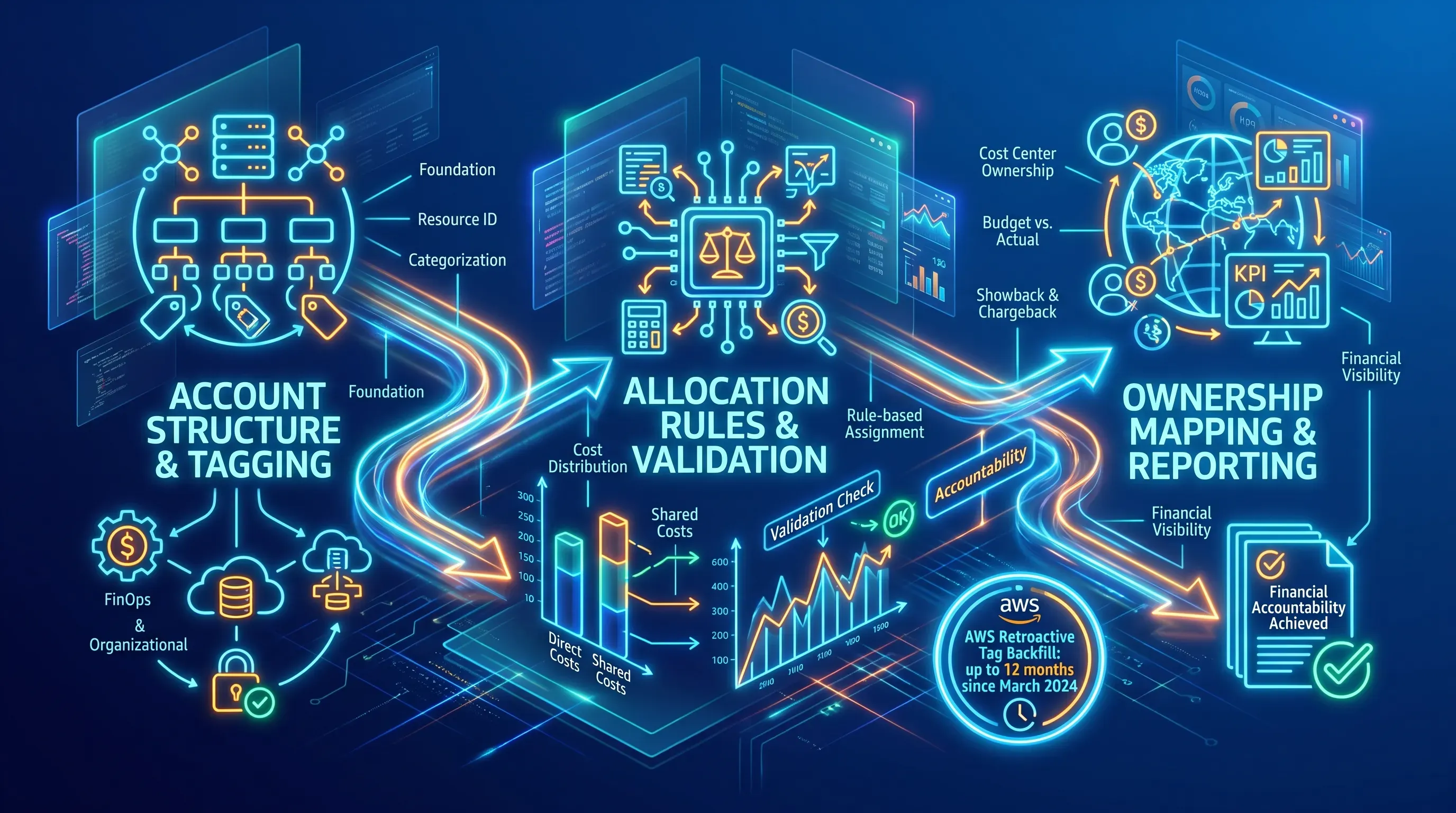
A vibrant neon infographic illustrating financial accountability in a SaaS organization with glowing icons and dynamic charts on a blue gradient background.

Every accountability conversation eventually turns into an argument about the data, and the team with the weaker data loses. So the allocation layer has to be defensible before anyone is asked to own a number.

Account and subscription structure does more work than tagging. Costs that are separated by account boundary are unambiguous by construction, which is why a per-team or per-product account model is worth the setup pain. Tags then handle the granularity inside those boundaries, applied at creation through infrastructure as code rather than swept up later. AWS made retroactive backfill for up to 12 months available in March 2024, which helps, but only for resources that carried the tag at the time. Untagged spend stays untagged forever.

Shared costs are where credibility is won or lost. Shared clusters and platform services need an allocation rule that teams agreed to in advance, whether that's even split or proportional to consumption. Publish the rule. Argue about it once, then stop.

Validation closes the loop. Reconcile allocated spend against the invoice monthly and map every cost center to a current human owner, because org changes silently orphan cost centers. On showback versus chargeback, the FinOps Foundation is direct: showback is always required in any FinOps practice, while chargeback depends on organizational accounting policy, and neither is more mature than the other. Chargeback is credible only when allocation coverage is high, and the shared-cost rule is settled. Push charges into P&Ls before then, and you'll spend the next two quarters relitigating the data instead of fixing the spend.

Turn data into action

The conversion step routes every budget breach and rightsizing candidate to an owner with a dollar figure and a date. Anything without all three stays a dashboard entry.

Organizations typically take up to a month to identify and eliminate cloud waste, while only a third of developers have fully automated cost-enforcement practices. A month is long enough for an anomaly to become the new baseline. Cut that by wiring alerts into the channel the owning team already watches, with the service name and the estimated monthly impact in the alert itself.

The optimization backlog is the mechanism that makes this repeatable. Treat it exactly like a product backlog:

  1. Size every item in monthly dollars and engineering hours, then drop anything below your materiality floor.

  2. Assign it to the team that owns the workload, in their tracker.

  3. Commit a percentage of sprint capacity to it, negotiated with engineering leadership rather than imposed.

  4. Verify the saving in the billing data after the change ships, and close the item only when the number moves.

Policy automation in cloud cost governance handles the recurring work so the backlog stays reserved for judgment calls. Idle resource detection with a warning window and automatic termination runs without a ticket, as does scheduled shutdown of non-production environments. Mike Fuller, CTO of the FinOps Foundation, describes the goal as building policies that let optimization recommendations be routed to engineering teams so they can identify efficiency opportunities themselves.

Measure cloud business value

Savings alone is a weak metric because it rewards cutting and punishes growth. Unit economics fixes that by expressing spend as a rate: cost per customer or per transaction. When usage doubles, and cost per transaction falls, the cloud bill going up is good news, and the finance conversation changes completely.

J.R. Storment, executive director of the FinOps Foundation, put the point sharply when he told Business Insider that FinOps is not about saving money: "The nirvana stage of this practice is not optimizing costs, it is about aligning revenue against the cost to make sure that for every dollar you put in, you get X dollars back."

The operational scorecard sits underneath the unit metrics and tells you whether the machine is running. Track allocation coverage, since mature practices target above 90 percent and anything under 80 makes chargeback indefensible. Track forecast accuracy against actuals and anomaly response time from alert to owner acknowledgment. Commitment utilization and coverage pair with realized savings verified in billing data, and backlog completion rate against committed capacity belongs on the same scorecard. Six numbers, reviewed monthly, tell you more than a hundred charts.

Pick the unit denominator your business already uses in board reporting. If revenue is discussed per active account, cost per active account is the metric. Inventing a new denominator for cloud financial operations purposes guarantees nobody outside the practice will quote it.

FinOps for DevOps and Kubernetes teams

Kubernetes breaks the allocation model that works everywhere else, because the billing boundary is the node and the ownership boundary is the pod. A CNCF microsurvey found Kubernetes drove cloud spend up for 49% of respondents, with overprovisioning cited by 70% as the main cause of overspending. You can't fix what the invoice can't see.

Allocation inside clusters requires a layer the cloud provider doesn't give you. OpenCost, the CNCF incubating project that shipped an AI-ready MCP server for natural-language cost queries in 2025, reads pod consumption and prices it against node rates to produce namespace and workload costs. The hard part is idle. Datadog's analysis of AWS cost data found 83 percent of container costs are associated with idle resources, split between cluster idle from overprovisioned infrastructure and workload idle from oversized requests. Cluster idle belongs to the platform team. Workload idle belongs to the service team. Decide that split before you publish a single namespace report.

AI workloads compress the same problem into a shorter timeframe with a higher hourly rate. GPU instances rose to 14 percent of compute costs among organizations using them, a 40 percent increase in a year, and utilization on statically provisioned fleets is poor enough that a long weekend of idle capacity costs real money. Attribution needs to distinguish training runs, which are project-shaped and schedulable, from inference, which is traffic-shaped and continuous.

Token-based model API spend needs its own treatment because there's no instance to tag. Attribute by API key or project identifier at the gateway and convert to cost per thousand tokens per model. Storment framed the shift bluntly in November 2025: "Token costs and efficiency have become a CEO-level concern, not an engineering footnote." Cloud cost governance that ignores token spend will be governing a shrinking share of the bill.

Need IT Support?

Book a free consultation with ABS Technologies experts we'll help you find the right managed IT, cloud, or security solution for your business.

Book a Free Consultation

Where FinOps consulting services help

FinOps consulting services earn their fee when the blocker is structural rather than technical. The clearest trigger is stalled adoption: the tool is deployed, and engineering hasn't changed a single provisioning habit. A second is disputed ownership, where two leaders have spent a quarter arguing about who pays for the shared platform, and neither will concede to the other. Both are political problems, and a neutral third party resolves them faster than an internal team with a stake in the outcome.

Data quality is the other common trigger. Rebuilding an allocation model across accounts and clusters is a project with a defined end, which makes it well suited to an engagement rather than a permanent hire. The same applies to multi-cloud normalization, where FOCUS, the FinOps Open Cost and Usage Specification, now has adoption across AWS, Microsoft, Google Cloud, and Oracle Cloud. Implementing it once, correctly, is worth more than a year of ad hoc reconciliation.

Rapid growth and AI cost volatility create the same condition: spend outruns the practice's ability to explain it. Hiring solves this eventually, but a FinOps lead takes months to recruit and then arrives without an operating model to run. Buying software solves visibility and nothing else, which is how organizations end up with the dashboard problem described at the start. Consulting services are the right instrument when you need the model designed and adoption driven, then handed over.

Typical consulting deliverables

Judge a proposal by its artifacts. A credible FinOps consulting services engagement produces a responsibility matrix with named roles and at least one pilot. If a scope of work is missing the responsibility matrix and the pilot, it's an assessment wearing a bigger price tag.

Assess current maturity

The FinOps Framework assesses each capability independently as it moves from crawl to run, where crawl means manual and walk means partially automated with broader adoption. Run means fully automated and embedded in engineering culture. The point is not to reach run everywhere. Nobody needs run-level sustainability reporting while allocation coverage sits at 60 percent.

A useful assessment from FinOps consulting services scores capabilities against your actual cost drivers. If 70 percent of your spend runs in Kubernetes, container allocation maturity matters more than commitment management sophistication. The output names the three capabilities where a level shift produces measurable financial or operational change, and explicitly deprioritizes the rest.

Design the target model

The target model from FinOps services specifies what the practice looks like when it's working. Processes with triggers and outputs, and roles with decision rights.

Two design elements get underspecified and cause most of the later friction. The first is meeting cadence with named attendees, because a cloud cost governance forum without a decision-maker in the room is a status update. The second is engineering integration: where cost data appears in the developer workflow and how backlog items flow into existing sprint planning. A model that requires engineers to visit a separate portal will be used by the cloud financial operations team and nobody else.

Drive adoption

Adoption is the deliverable that determines whether any of the rest survives the consulting services engagement. Start with a pilot on one team with material spend and a cooperative lead, and publish the result internally with real numbers.

Training has to be role-specific. Finance needs the allocation model and the forecast method. Engineering needs to read their own cost data and size a rightsizing candidate. Incentives need care, because rewarding raw savings encourages teams to under-provision and then blame the practice for the incident. Reward unit cost improvement instead. Backlog coaching runs for a few sprints until the owning team is sizing and prioritizing items without help, and handover is complete when the internal team has run a full monthly cycle unassisted.

Compare FinOps consulting services

Buying FinOps services is easier when your evaluation questions force specifics. Ask about the practitioners who will actually be on the engagement. Ask for a client where the engagement failed and what they learned, because a vendor with no failures has no memory.

Use these to structure the comparison:

  • Practitioner experience: how many engagements has this named team run, at what spend scale, and in your industry?

  • Vendor neutrality: does the recommendation change if you already own a tool, and does the firm resell any platform it recommends?

  • Technical depth: can they explain your Kubernetes shared-cost split and your GPU attribution approach in the first meeting?

  • Deliverables and outcomes: which artifacts arrive on which date, and what measurable target do they commit to?

  • Implementation support: do they build the pipeline and policies, or hand over a document?

  • Security: what access do they need, for how long, and under what data handling terms?

  • Pricing and references: fixed scope or time and materials, and will they connect you with a reference at similar scale?

  • Knowledge transfer: what does your team need to demonstrate before the engagement closes?

Certification is a filter rather than an answer. The FinOps Foundation's Certified Service Provider program requires publicly referenceable statements of work with scope and deliverables aligned to Framework capabilities, which at minimum tells you the firm has documented its methodology. Weigh it against direct evidence that they've worked with your cloud mix and your container platform.

The strongest signal is how a firm providing FinOps consulting services answers a question about your worst data. Cloud financial operations gets built on partial tagging and shared clusters nobody wants to own. A firm that asks to see the untagged 30 percent before quoting is one that has done this before.

Ready to make cost data operational?

Dashboards report. Operating models act. The distance between them is ownership and a workflow that puts sized items in front of the teams who can fix them.

Do you need FinOps help?

You probably don't need another dashboard if:

  • Cloud spend increased more than 20 percent, and nobody can clearly explain why

  • Engineering receives optimization recommendations, but fewer than 30 percent get implemented

  • Kubernetes or shared infrastructure costs can't be attributed to a product or a team

  • Finance forecasts cloud spend separately from engineering's roadmap

  • Reserved capacity or savings plans get purchased without sign-off from the team that owns the workload

  • Cost anomalies surface during the monthly billing review instead of within days

  • More than 10 to 20 percent of spend is unallocated

  • Nobody can state cost per customer, per transaction, or per workload

  • Developers have to open a separate portal to see their own recommendations

  • Cost optimization happens through periodic cleanup projects rather than a standing process

If three or more of these apply, the problem is your operating model and engineering execution, not your reporting. Request a 30-minute FinOps assessment, and we'll tell you which capability to fix first.

FinOps Consulting is for organizations that need to establish the operating model: define ownership, build the allocation layer, design the cadence, and drive adoption until the practice runs without outside help.

Managed FinOps is for organizations that want the operating model run on an ongoing basis: cloud cost monitoring, anomaly investigation, optimization backlog management, monthly reporting, commitment review, Kubernetes optimization, architecture recommendations, and DevOps implementation.

ABS Technologies handles the infrastructure work underneath a working FinOps practice, from account structure and cloud architecture through DevOps pipelines and cost controls, so your engineers stay on product. If you'd rather hand this off than build it the hard way, book a free consultation to scope the engagement that fits.

Need IT Support?

Book a free consultation with ABS Technologies experts we'll help you find the right managed IT, cloud, or security solution for your business.

Book a Free Consultation

Set the floor above the monthly savings needed to justify the engineering time and operational risk. Use the same threshold across a team for a quarter, then revise it after comparing completed backlog items with verified billing changes.

A pilot should last until the team has completed a full cost-management cycle: allocation review, backlog delivery, and billing verification. It should also include at least one forecast or anomaly decision, so the handover tests real ownership rather than training attendance.

Forecast errors and savings answer different questions. Forecast accuracy tests whether finance and engineering understand demand drivers, while verified savings test whether a specific change reduced spend. Keep both measures separate, or a lower bill can hide missed demand assumptions.

Yes, when each application uses a distinct gateway API key or project identifier that maps to an accountable owner. Bill the usage at the model's recorded token rate, then review cost per thousand tokens alongside the product's business metric.

A handover for finops consulting services should leave internal staff able to run the monthly review, maintain allocation rules, and manage the backlog without outside support. ABS Technologies offers a free consultation → to define the required artifacts, access boundaries, and handover criteria before work starts.

Schedule a Meeting

Book a time that works best for you and let's discuss your project needs.

You Might Also Like

Discover more insights and articles

Title:
Cloud Development Environments: Faster Onboarding Without Losing Control

Meta description:
Discover how cloud development environments help you speed up developer onboarding and keep control o

Cloud Development Environments: Faster Onboarding Without Losing Control

Moving developer workspaces to the cloud is easy to sell and even easier to get wrong. Teams might commit for the wrong reasons, or skip the governance decisions that make it stick. Here's when the move actually earns its keep, the operating models on offer, and the governance calls to settle before you commit.

Title:
Blue-Green Deployment Strategy: Safe Releases, Fast Rollback, and Hidden Tradeoffs

Meta description:
Evaluate a blue green deployment strategy to help your team cut rollback times and prevent

Blue-Green Deployment Strategy: Safe Releases, Fast Rollback, and Hidden Tradeoffs

A second production environment is sold as insurance. In practice, it's only insurance if the automation underneath it is solid; otherwise it's just more surface area to get wrong. Here's when the redundancy earns its cost, which controls your platform team needs to automate first, and the failure modes that turn a fast rollback into a long incident.

Title:
Prometheus vs Grafana: Different Roles, Better Together

Meta description:
Learn how prometheus vs grafana work together so you can pick the right storage and alerting architecture for your tea

Prometheus vs Grafana: Different Roles, Better Together

Picking a metrics stack is easy to get wrong when the roles of Prometheus and Grafana aren't clearly separated. Learn what each tool actually does inside the pipeline, how to architect around your scale and retention needs, and how self-hosted stacks compare to managed options.

Title:
Cloud Inventory Management: A Practical Control Framework for Growing IT Estates

Meta description:
See how cloud inventory management gives you reliable asset records for cost decisions and fa

Cloud Inventory Management: A Practical Control Framework for Growing IT Estates

Cloud sprawl and hybrid footprints make asset visibility a moving target. Here's a control framework for getting a reliable answer: it walks from scope definition through cost mapping, and ends with a maturity checklist you can apply directly to your own estate.