Title:
Mastering Cloud Cost Optimization: From Waste to Efficiency

Meta description:
Ask: How do companies master cloud cost optimization? You will form daily routines to cut waste and link your plat

Mastering Cloud Cost Optimization: From Waste to Efficiency

Cloud cost optimization is an important practice for both technical teams managing cloud infrastructure and business leaders overseeing budgets. It's the continuous discipline of ensuring every dollar spent on cloud services delivers measurable business value through ongoing, collaborative efforts. It pairs financial accountability with engineering decisions so spending tracks real demand. The work is ongoing because your environment, workloads, and pricing options keep changing.

Content authorBy Irina BaghdyanPublished onReading time14 min read

What is cloud cost optimization really about?

Cloud cost optimization is about value and efficiency over raw cost reduction. The distinction matters because cutting the bill and improving the return on spend are different goals that sometimes pull in opposite directions. The practice asks a sharper question than "how do we spend less": it asks whether each unit of spend is tied to performance, delivery speed, or revenue.

It's a continuous process of managing cloud expenses by right-sizing resources and aligning them with business objectives. Notice the word continuous. A quarterly cleanup does not meet that definition.

What this framing implies, and the glossary does not spell out, is that a falling bill can still signal a failing program if it came from throttling production or deferring needed capacity. The real scoreboard is unit economics, the cost to serve one customer or run one workload, measured against the value that workload produces. That is the lens the rest of this guide uses.

Why does cloud waste keep coming back?

Cloud waste keeps coming back because organizations lack clear resource ownership, enforce incomplete tagging policies, and miss key financial controls such as budget alerts and regular review cadences. There is often no approval workflow for provisioning expensive resources, no accountability for unused or forgotten environments, and a disconnect between technical resource usage and financial reporting. You run a cleanup, savings appear, and within two or three quarters the spend has crept back to where it started. The model that produced the waste never changed, so the waste regenerated.

The scale of the problem is steady. The Flexera 2025 State of the Cloud Report estimates that 27% of cloud spend is wasted, a figure that has held between 27% and 32% every year since 2019. Stability at that level is the tell. A cyclical problem fluctuates, but a structural one sits flat year after year.

If waste resists a decade of tooling improvements and cleanup campaigns, the cause is an operating model that lets people spend without seeing or owning the cost. The next three sections break that down.

Idle and overprovisioned resources

Idle and overprovisioned resources are the two largest physical drivers of cloud waste. Theн accumulate silently because of default habits. Engineers provision generously to avoid being paged at 2 a.m., and a temporary test environment outlives the test that justified it. Neither shows up as a failure, so neither triggers an alert. That silence is the danger. A broken service screams, but an instance running at 8% utilization keeps billing quietly for months without anyone noticing it never earned its keep.

Poor visibility and unclear billing

Without granular tagging and a working grasp of how providers bill, optimization has no direction and discount options sit unused. You cannot fix consumption you cannot attribute to a team or a workload.

Tagging is the foundation here, but it has hard limits. Amazon Web Services (AWS) notes that some commitment-based discount fees, such as unused Reserved Instance and Savings Plan charges, cannot be tagged before they appear in billing reports. That gap matters more than it sounds. It means a tag-only strategy leaves part of your committed spend unattributable, so the teams driving commitment decisions never see the cost of getting those commitments wrong.

Cost treated as someone else's problem

When the engineers who provision resources never see the financial impact of those choices, waste is structurally guaranteed. This is the organizational root beneath the idle instances and the missing tags.

The FinOps Foundation builds its entire practice on the opposite principle, that everyone takes ownership of their cost and usage, supported by a central group. Read that as a diagnosis of the failure mode. If ownership has to be deliberately engineered, the default state of a cloud organization is one where consumption and accountability are split between different people. Closing that split is the work the rest of this article describes.

Why one-time cost cuts never hold

One-time cost cuts never hold because they treat symptoms while leaving the operating model that created the waste fully intact. You delete orphaned volumes and resize a few instances, the bill drops, and everyone moves on. But the provisioning habits, the missing ownership, and the absent feedback loops are all still in place, so spend rebuilds within quarters.

The pattern is well documented. The AWS Well-Architected Framework defines cost optimization as a continual process of refinement and improvement across the workload lifecycle, requiring regular review and optimization rather than one-time interventions. This creates a natural tendency for organizations to revisit the same cost issues as environments evolve, leading to a cycle of repeated optimization work rather than a permanent resolution.

Here is the implication worth sitting with. Each repeated cleanup costs real engineering hours, so a reactive model delivers temporary results and costs more in labor than a continuous one. You pay twice, in cloud spend that returns and in the cost of the people who keep chasing it. The alternative is to change the system that generates the waste, which is what continuous cloud financial management does.

How does FinOps make optimization continuous?

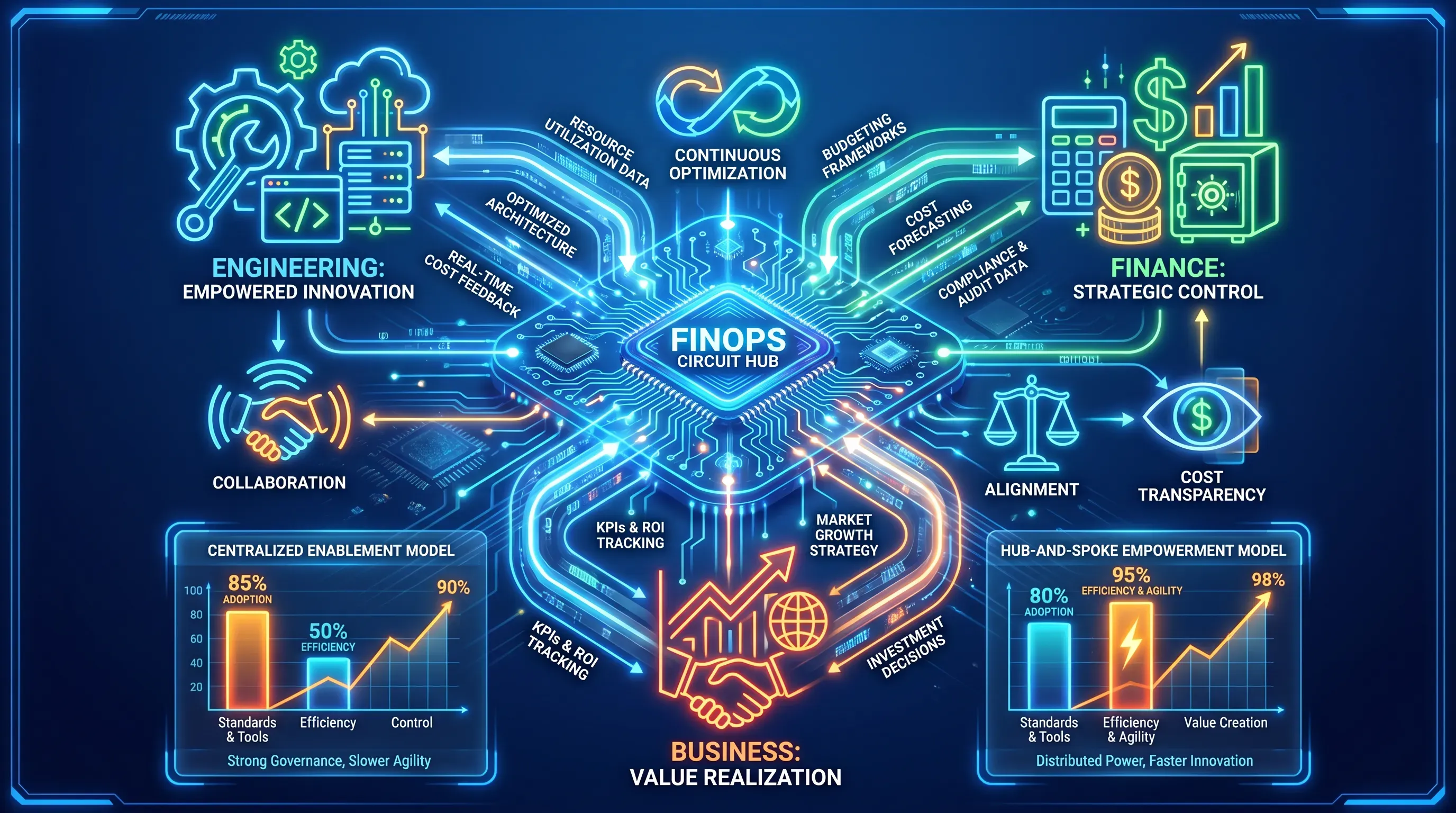
A vibrant neon hi-tech infographic featuring a central glowing FinOps hub with team icons for engineering, finance, and business.

FinOps makes optimization continuous by turning it into a shared cultural and operational habit across teams. It brings engineering, finance, and business into one accountability model so cost decisions happen in the flow of daily work instead of in an annual review.

The FinOps Foundation defines the practice as an operational framework and cultural practice that creates financial accountability through collaboration between engineering, finance, and business teams. The word cultural is doing heavy lifting there.

What that definition implies for anyone deciding whether to formalize a FinOps function is this. Continuity requires behavioral change because behavior erodes savings. A central platform can surface a thousand inefficiencies, but if the engineers who created them have no reason to act, the report goes unread. FinOps works because it changes who cares about the number, which is harder to install and far more durable than any dashboard. The next two sections cover how to structure it.

Aligning engineering, finance, and business

Durable optimization requires engineers seeing real-time cost data and finance understanding the technical constraints behind it. Decisions then balance performance against economics instead of one side overriding the other.

The practice often framed as the translator between finance teams that want predictable budgets and engineering teams that need flexibility to innovate. That translation role reveals the failure it prevents. When the two groups speak different languages, finance cuts budgets without knowing which workloads carry reliability requirements, and engineering over-provisions without knowing what it costs. Alignment is what keeps a savings target from quietly becoming an outage.

Central guidance with team-level ownership

The most effective structure is a small central function that sets standards and negotiates commitments while individual teams own their own consumption. This combines consistency with speed.

The data backs the model. The State of FinOps 2026 report found that centralized enablement (60%) is the most common team structure, with hub-and-spoke models at 21% in larger enterprises. The shape of that distribution carries a lesson. A central team that tried to control every spending decision would become a bottleneck, so the successful pattern keeps the center thin: it owns standards and rate negotiation while day-to-day accountability moves to the teams who actually provision.

How do you build proactive cost governance?

Proactive cost governance means defining cost ownership, setting consumption guardrails, and exposing spend through chargeback or showback so inefficiencies surface before they become budget overruns. The goal is to catch drift early, before the invoice arrives.

The need is acute. IDC's research found that only 4% of organizations said their cloud spend was under control, with over half wasting more than 15% of their budgets.

That number reframes the whole problem. When 96% of organizations lack control despite widely available and widely purchased cost tools, the cause is an operating-model mismatch: the absence of clear ownership and guardrails that make spending visible at the point of decision. Governance is the operating model behind the software. The next three sections detail its pieces.

Defining cost ownership and guardrails

Clear ownership combined with budget thresholds, provisioning policies, and approval workflows lets teams move fast inside safe boundaries. Guardrails define the limits within which engineers can act without asking permission.

The AWS tagging guidance recommends that untagged resources be automatically flagged and treated as a governance failure. Treat that standard as the line between policy and theater. A guardrail that depends on engineers remembering to tag will fail, because people forget under deadline pressure. A guardrail enforced at provisioning time, where untagged spend is caught automatically, is the only kind that holds when teams are moving fast.

Chargeback versus showback

Showback exposes a team's costs without billing them, while chargeback bills those costs directly to the team's budget. Showback builds shared understanding, and chargeback adds financial consequences. The difference determines how hard behavior shifts.

The FinOps Foundation is clear that neither method is more mature than the other, since the right choice depends on your accounting policy. That neutrality is useful guidance, but it understates the behavioral gap. Showback provides teams with visibility into their cloud costs and fosters awareness, while chargeback assigns those costs to the team’s own budget, creating stronger financial accountability. The best approach depends on organization’s maturity, accounting policies, and confidence in cost allocation accuracy. Often organizations start with showback to build trust and move to chargeback when it’s necessary to drive consumption changes.

Cost metrics in operational decisions

Cost becomes part of daily engineering work when cost data lives inside the dashboards, reviews, and architecture decisions engineers already use. The aim is to make efficiency a default consideration in daily engineering work.

Cost recommendations only influence behavior when they are embedded directly into engineering workflows. When cost data exists outside the systems, it is often ignored or deferred in favor of performance and delivery constraints. Integrating cost visibility into the same environments where engineers configure and deploy services increases the likelihood that cost becomes a factor in real-time decision-making.

How observability and automation sustain savings

Observability and automation sustain savings because observability surfaces inefficiency in near real time while automation schedules non-production environments and continuously rightsizes resources; anomaly flags appear before they reach the budget. Together they keep optimization running without constant manual effort, which is what makes savings durable across seasons.

The payoff on scheduling alone is large. AWS Instance Scheduler documentation cites up to 70% savings when instances only run during business hours, since non-production environments rarely need to run nights and weekends.

There is a sequencing lesson buried in how mature teams automate, and it is worth stating plainly. Automate visibility before you automate enforcement. Start with low-risk actions like flagging idle resources, routing missing tags to owners, and scheduling non-production shutdowns. Hold off on fully automated deletion or resizing until you have clear ownership and dependency visibility, because an automated action without those guardrails can take down a workload faster than any human ever would. The capabilities to prioritize are these:

  • Near real-time cost observability tied to teams and services, so inefficiency is visible the day it appears rather than at month end

  • Automated scheduling for non-production environments, the highest-confidence saving with the lowest risk

  • Continuous rightsizing and anomaly detection that alert owners before a spike compounds into an overrun

When does cutting costs harms business outcomes

Cutting costs hurts the business when aggressive optimization degrades performance, reliability, security, or developer productivity. The goal is to balance cost efficiency against operational requirements while protecting the workload. A bill that drops while your error budget burns is not a win.

Spot capacity is the clearest example of the trade-off. Spot instances offer discounts of 70 to 90% versus on-demand pricing, but the provider can reclaim them on short notice, which causes workload disruption and loss of progress for anything that cannot tolerate interruption.

For anyone defending service-level agreements, the effective cost of spot includes the engineering time spent making workloads interruption-tolerant after restart overhead and checkpoint storage are priced in. A saving that forces your team to re-architect for resilience costs more in labor than it returns in compute, which is exactly the calculation a discount percentage hides. The next two sections cover where this goes wrong and how to optimize without breaking the workload.

Performance and reliability risks

Aggressive rightsizing, low autoscaling minimums, fewer backups, and heavy spot reliance can cause latency, scale-up delays, and slower recovery. Each is a cost lever, and each has a reliability cost on the other side.

Every cut that removes headroom, whether it is a tighter instance, a lower autoscaling floor, or a thinner backup schedule, trades a known recurring cost for a probabilistic failure cost. That trade can be worth making, but only when you have priced the failure alongside the saving.

Making trade-offs incrementally

Changes should be incremental, reviewed with engineering, and measured over meaningful time windows so savings never quietly compromise the workload. A single large cut hides which change caused which problem.

The operating principle behind continuous rightsizing supports this. Treat incremental change as a safety mechanism first. Small changes measured over a real demand cycle let you catch a latency regression before it reaches a customer, while a sweeping one-time cut surfaces the damage only after it has already done harm.

What business outcomes does mature optimization deliver?

Mature optimization delivers budget predictability, higher infrastructure efficiency, stronger utilization, faster decisions, and the confidence to scale. These are business outcomes, not technical ones, which is the language that wins executive support for the investment.

The results are measurable. An analysis of FinOps implementations across 42 financial institutions found an average cost reduction of 26.4% against pre-implementation baselines while workload capacity increased, alongside improved cost predictability and the ability to scale efficiently.

The inference that matters for justifying the program is in the pairing of those two numbers. Costs fell while capacity rose, which means mature optimization enables growth. That reframes the budget conversation entirely. You are funding the capability that lets the business scale infrastructure with confidence because spending finally tracks value. The concrete gains worth naming to an executive are these:

  1. Predictable budgets and accurate forecasting, so cloud spend stops surprising finance

  2. Higher utilization and reduced waste, which lowers the cost to serve each customer

  3. Faster, better-informed decisions, because cost data sits beside engineering and product choices

Signs your cloud spending needs optimization

Identifying the need for cloud cost optimization early helps prevent budget overruns and operational risks. Watch for these red flags:

  • Monthly cloud invoices steadily increase without clear corresponding business growth

  • Teams cannot clearly explain which service or team owns specific costs

  • Many cloud resources remain untagged, making cost attribution difficult

  • Non-production environments run continuously, even outside business hours

  • Cost reports are delayed, arriving too late to guide timely action

  • Finance and engineering review cloud spending separately with minimal collaboration

  • Rightsizing and cleanup are performed only as occasional, one-off projects

If any of these symptoms appear, it’s time to shift from reactive cleanups to a continuous cost management practice

Turn cloud spend into measurable benefit

The natural next step, once you accept that cost optimization is an operating practice, is to build governance around observability and automation; that work benefits from a partner who has no stake in which cloud or tool you choose.

ABS Technologies is an Armenia-based, vendor-independent managed IT, Cloud, and DevOps provider. That independence is the point relevant to everything above. A vendor-independent partner can take an impartial procurement stance and recommend the commitment model and architecture that actually fit your workloads; the guardrails can then be designed around your business.

Their infrastructure optimization, proactive monitoring, and IT consulting map directly to the disciplines this guide describes, the continuous visibility and accountable governance that keep savings from eroding. If you are ready to move past repeating the same cleanup and want cloud spending tied to measurable value, start by mapping your current cost ownership and guardrails, then bring in a partner who can help you operationalize what is missing.

Start by mapping spend to owners and services using required tags and billing exports. Before deleting resources, confirm who owns each workload and what it supports. This gives teams the data needed to fix idle resources and oversized instances without hurting production.

Review anomalies daily and spend trends weekly once alerts are in place. Commitment purchases and rightsizing changes need a monthly review because usage patterns shift after releases. Quarterly reviews help with planning, but they're too slow to catch runaway resources before the invoice closes.

Yes, small teams can use FinOps by naming cost owners and setting basic tagging rules. One finance contact and one engineering lead can review weekly spend and approve larger changes. They should track unit cost as part of that review.

Buy commitments only for steady workloads with a predictable usage baseline. Use 30 to 90 days of on-demand usage data, then commit to the portion that runs consistently. Keep variable workloads on flexible pricing until their demand pattern is proven.

Measure success with unit cost and service health. Use a metric such as cost per customer or cost per transaction, then read it beside latency and error rates. A lower bill alone isn't enough because it can hide slower performance or weaker reliability.

Schedule a Meeting

Book a time that works best for you and let's discuss your project needs.

You Might Also Like

Discover more insights and articles

Title:
Deploying Faster with Infrastructure as Code

Meta description:
Want to know: How does Infrastructure as Code speed up deployment? You will learn to automate builds and ship faster.

Article:
#

Deploying Faster with Infrastructure as Code

Infrastructure as Code (IaC) speeds up deployment by replacing manual, ticket-driven provisioning with automated, version-controlled definitions that deploy in minutes instead of days. It removes repeated setup time and the rework caused by environments that drift apart, because the same code builds every environment the same way, every time.

Title:
The Building Blocks of Robust Cloud Infrastructure

Meta description:
Find out What’s the foundation of strong cloud infrastructure? You will learn how to keep your systems online when failures

The Building Blocks of Robust Cloud Infrastructure

Robust cloud infrastructure is built on deliberate architectural choices across interconnected layers: virtual networking, elastic compute, storage architecture, redundancy, and environment segmentation. Resilience comes from the way those layers work together under pressure. They must be designed and operated together so that failures stay contained and performance holds under pressure. For CTOs, cloud architects, infrastructure leaders, and IT decision-makers, the challenge comes from ensuring these layers work together as a resilient system.

Title:
Smarter Cloud Optimization: Performance Meets Savings

Meta description:
Discover How to optimize cloud performance while cutting costs? You will get a guide to build faster systems and lower b

Smarter Cloud Optimization: Performance Meets Savings

Cloud performance and cloud cost are not opposing forces. Treated as one discipline, rightsizing, automation, observability, and governance produce faster systems and lower bills at the same time. The organizations spending least per workload are also the ones with the lowest latency, because both outcomes share the same root cause: resources matched to actual demand.

Close-up of a futuristic high-performance processor chip with glowing data pathways and illuminated circuitry representing advanced computing, AI processing, and next-generation semiconductor technology

DevSecOps in Action: Building Security into Every Line of Code

DevSecOps is the operating model that builds security checks and policy enforcement into every stage of the software delivery pipeline, with monitoring handled as part of the same release process. It makes security a shared responsibility across development and operations, supported by automation inside CI/CD so teams ship faster with lower exposure and remediation cost.