AWS MSP Proposal Scorecard: Scope, SLAs, Security and Cost

Content authorBy Irina BaghdyanPublished onReading time17 min read
Title:
AWS MSP Proposal Scorecard: Scope, SLAs, Security and Cost

Meta description:
Use this AWS MSP Explainer to compare bids and spot hidden costs before you choose support suited to your risk need

Use pass-fail gates to screen shortlisted AWS managed service provider (MSP) proposals, then score the survivors against a normalized workload baseline and a weighted 100-point model before you look at price. This exposes the exclusions and customer-owned work hidden inside low monthly fees, as well as charges for third-party tools. Procurement can then work with engineering and security to rank bids on risk-adjusted value.

Normalize every proposal before scoring

You cannot score two proposals fairly until both bidders use one pricing template based on the same workload inventory. The template must also define service boundaries and operating assumptions. MSPs package offers differently on purpose, which means a headline fee from one bidder rarely covers the same commitments as another. Normalization converts unlike offers into comparable commitments before a single point is awarded.

The risk is real because scope creep drives budget overruns in 62% of cases, according to the State of FinOps 2025 report. An MSP proposal that leaves scope loosely defined transfers the definition risk onto your budget after signature.

Give your cross-functional team one shared intake pack and require every bidder to respond inside it. Where a bidder has priced against different assumptions, issue a written clarification rather than adjusting their number yourself. That keeps the comparison clean and forces each MSP to own its own math instead of leaving you to reconcile it.

What baseline must every bidder use?

Every bidder must respond to one fixed baseline so their prices describe the same work. That baseline lists AWS accounts and regions, as well as the workloads and environments in scope. It also defines compliance obligations and support coverage hours. Usage or transaction assumptions sit alongside the recovery objectives each workload has to meet.

The reason matters because customer responsibility shifts with the services chosen. AWS states in its Shared Responsibility Model that customer responsibility for an Amazon EC2 instance includes guest OS patching and application software. Security group configuration also remains with the customer. So a bidder assuming managed platform services carries a lighter operating load than one assuming raw EC2, and their fees will diverge for that reason alone. When a proposal prices against materially different assumptions, send a clarification and hold the number until they re-answer the baseline.

Which exclusions change the real scope?

Record every exclusion in a separate exceptions register rather than letting it sit inside narrative prose. Track excluded applications and operating systems, with databases recorded separately. Also document network services and patching commitments. Record after-hours work and migration tasks. Include remediation of pre-existing issues as well.

An exclusion buried in a paragraph reads as a footnote, yet it becomes your problem later. A requirements error costs 15 to 20 times more to fix after launch than during analysis, according to the CHAOS report. That multiplier is exactly why an undiscovered exclusion is dangerous. If patching or after-hours coverage falls outside the fee, you'll either staff it internally or buy it under an urgent change rate, both at the inflated post-signature cost the register exists to prevent.

Which customer dependencies create risk?

List every task the MSP expects you to perform, because each one is an unpriced obligation that lands on your team. These include approvals and application testing. They also cover data classification and access provisioning. Record any vendor coordination, along with the named customer resources the provider assumes will be available.

For each dependency, require an owner and an effort estimate. Document its prerequisite and schedule effect as well. Analyses by the Project Management Institute show organizations investing in proven management practices waste 28 times less money, and disciplined dependency tracking is one of those practices. A dependency without a named owner and an estimated effort is a delivery risk the MSP has quietly parked on your side of the line, and it surfaces as a delay the moment your team lacks capacity to meet it.

Which tool costs sit outside fees?

Require each bidder to itemize every tool cost that sits outside the recurring management fee. That list covers observability and Security Information and Event Management (SIEM). It must also identify backup and ticketing. Record FinOps tooling and security products separately. Add data ingestion charges and any licensing the MSP passes through.

Model these against growth and minimum commitments, with price changes reflected in the projections because usage-based tools scale with your environment. Egress alone can represent 10 to 15 percent of total cloud costs, as OpenMetal documents, with one team serving 75 TB per month paying over $6,700 monthly. A bid that looks cheapest today loses that position once ingestion and observability volumes climb, so normalize every tool line to your projected 12-month usage before comparing headline fees.

Use a weighted 100-point scorecard

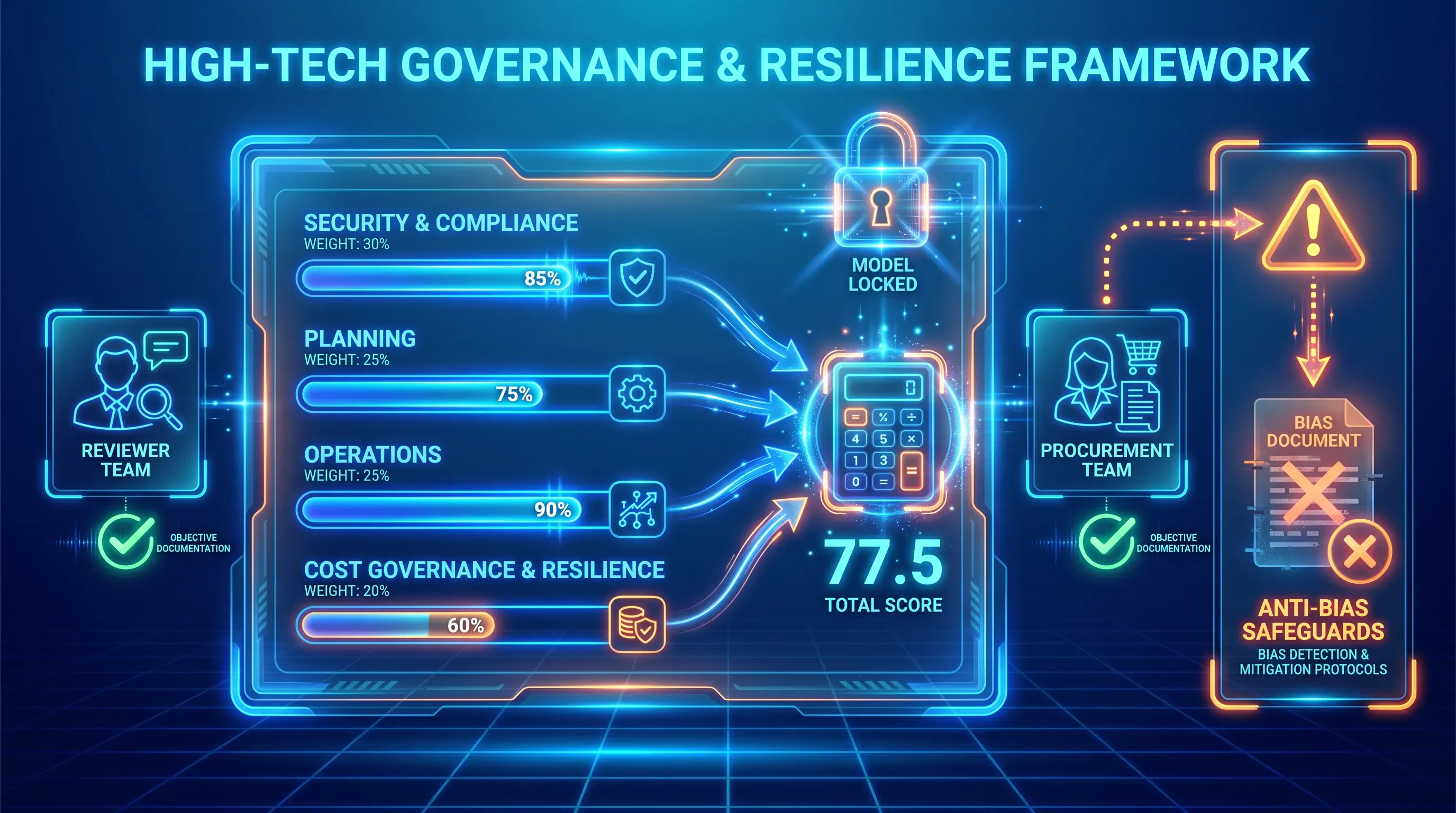
A neon high-tech infographic featuring a central glowing scorecard with progress bars for security, planning, operations, and cost governance.

Score each criterion from zero to five and multiply it by the assigned weight. For every rating, record the proposal citation and a reviewer comment. This produces a defensible number instead of a gut feeling, and the citations let you reconstruct why a bid won or lost months later.

Agree the weights before anyone sees a price. Weighted scoring replaces subjective evaluation with measurable comparison, and procurement guidance places security and compliance at 25 to 35 percent of total weight for IT selections. Set weights after seeing a preferred bidder's price and you'll unconsciously tune them to justify that bidder, which is the exact bias the scorecard exists to remove. Lock the model first, then open the fees.

The four weight bands below are a starting model your team can adjust:

  • Planning and transition: 20 points

  • Operations and support: 25 points

  • Security and resilience: 30 points

  • Cost governance and exit: 25 points

Need IT Support?

Book a free consultation with ABS Technologies experts we'll help you find the right managed IT, cloud, or security solution for your business.

Book a Free Consultation

Planning and transition deserve 20 points

Allocate these 20 points first between discovery and target architecture. Use another portion for migration planning and acceptance criteria. Score knowledge transfer separately. A proposal earning high marks here defines concrete deliverables and decision rights. It also sets the sequence and includes rollback planning. The proposal draws a clear boundary between one-time project work and steady-state service.

That boundary matters more than most bids admit. Only 31% of IT projects are fully successful, per the CHAOS report, and blurred transition scope is a common reason. When a proposal leaves acceptance criteria vague, you lose the objective test for whether transition is actually done, which lets the MSP declare completion while unfinished work quietly becomes a billable change request.

Operations and support deserve 25 points

Score the day-to-day mechanics of infrastructure as code and automation. Evaluate monitoring coverage and event handling. Review support hours and escalation paths. Score operational reporting and service documentation. Separate named deliverables and measurable response commitments from soft language about being proactive.

"Proactive support" with no metric behind it is unscoreable. Weak-performing teams need a week to a month to restore service after a failure, while the best restore in under an hour, according to DORA research. A proposal that commits to automation and defined event handling describes the operating discipline behind that faster recovery, so reward specific, testable commitments and mark down vague assurance no matter how confident it sounds.

Security and resilience deserve 30 points

Give security and resilience the highest combined weight. Allocate part of it to identity and privileged access. Use separate portions for logging and incident response. Assign vulnerability management and configuration management its own share. Divide the remainder between backup and disaster recovery, then score recovery testing separately. This is where a control gap does the most financial damage, so it earns the most points.

A mature MSP does not run your entire environment from a single AWS account, so score the bidder's approach to AWS Organizations and multi-account isolation as a separate line item within this weight. A strong proposal segregates production, development, and security-tooling workloads into distinct account boundaries rather than separating them with IAM policy alone inside a shared account. If a bidder cannot clearly explain how it isolates your cloud database environments, development workloads, and security tooling behind strict account boundaries, treat that as a structural gap: shared accounts widen the blast radius of any single compromised credential and make lateral movement between environments far easier to achieve and far harder to detect.

Remember that AWS security stays shared. The AWS Shared Responsibility Model keeps guest OS patching and application software with the customer even on AWS-managed infrastructure. Firewall configuration also remains with the customer. A strong proposal maps exactly what AWS operates and what the MSP operates. It also identifies what stays with you, control by control. If a bid claims broad security coverage without that split, it's describing an intention rather than an accountable division of duties, and an unmapped control is one nobody owns until an incident proves it.

Cost governance and exit deserve 25 points

Score pricing transparency and FinOps practices. Evaluate allocation and forecasting reports alongside optimization cadence. Separately assess contractual change controls and data portability. Score transition assistance and asset return at exit. Those assets include documentation and automation. These provisions leave the opening monthly fee unchanged, which is exactly why bidders underinvest in them.

They shape long-term value instead. Inefficient cloud resource management generated $225.9 billion in waste in 2024, reports the State of FinOps 2025 survey. An MSP with a real optimization cadence and clean allocation reporting recovers a share of that waste on your behalf every month, while a weak exit clause quietly locks you in by making departure expensive. Treat both as forward value in the score.

Some requirements should be pass-fail

Set non-negotiable gates before evaluation so a low price can never buy back an unacceptable control gap or an inability to run a critical workload. Weighted scoring blends strengths and weaknesses into one number, which means a cheap bid can mathematically outscore a safe one unless certain requirements sit outside the math entirely.

Procurement best practice supports this. A pass-fail first round eliminates 40 to 60 percent of candidates before formal scoring begins, a result documented by the Procurement Toolkit under typically eliminates 40 to 60 percent of candidates. This saves time and protects the shortlist from disqualified bids. Define your gates as hard yes-or-no tests. Use required coverage hours and mandatory regulatory controls as gates. Add privileged-access safeguards and committed RTO and RPO. Audit rights and viable exit assistance should also be mandatory. A bidder who fails any gate leaves the process regardless of price, because a control you must have isn't something you trade for a discount, and treating it as scoreable is how organizations rationalize a decision they later regret.

SLAs must measure business-relevant outcomes

Test whether the SLA measures the outcomes your business depends on rather than only ticket acknowledgement. A fast acknowledgement means the MSP saw your ticket, which tells you nothing about when service actually returns.

Compare bidders first across severity definitions and response and restoration targets. Then assess the monitoring start point and exclusions. Review service credits and reporting. Finally, compare breach escalation and obligations during a major incident. A response without a resolution is just an acknowledgement that your problem exists. So a contract quoting only response times has left its most important commitment undefined. Read every SLA looking for what it promises about restored service, and treat a missing restoration target as the gap it is, because that's the number your business will care about at 3 a.m.

Do severity levels match business impact?

Require each bidder to map severity to your workload criticality and user impact. The map must also account for security impact and loss of service. This prevents the MSP from classifying incidents on its own. Whoever defines severity controls the clock, and a provider left to self-classify has every incentive to downgrade.

Need IT Support?

Book a free consultation with ABS Technologies experts we'll help you find the right managed IT, cloud, or security solution for your business.

Book a Free Consultation

Are response and restoration separated?

Confirm the SLA sets distinct targets for response and for restoration, because a quick acknowledgement guarantees neither diagnosis nor recovery. A provider can respond in 10 minutes and still take three days to fix the problem, as Spector IT notes.

Score separate commitments for response and engagement. Evaluate update cadence and workaround commitments. Score restoration on its own. Add root-cause analysis where the severity warrants it. A contract that collapses all of this into one response number is measuring the easiest step and staying silent on the one that restores your revenue, so reward bids that commit to each stage independently.

When does the SLA clock stop?

Read the clock-stop rules as carefully as the targets, because pause conditions decide whether a reported number reflects your real experience. Examine the clock start and customer-pending status. Then review suspension rules for maintenance windows and force majeure. Address third-party dependencies separately.

SLA compliance is measured as tickets handled within SLA divided by total tickets, with most teams targeting 95 percent or higher. Broad pause conditions inflate that percentage without improving anything you feel. A provider can report 98 percent compliance while your business stays disrupted, simply because the outage sat in "customer-pending" or "third-party dependency" the whole time. Flag any exclusion wide enough to let the clock stop while the incident continues.

Demand evidence instead of assurances

Treat proposal language as a statement of intent and operating artifacts as proof of execution. Anyone can write that they run mature incident response. The sanitized runbook and the redacted post-incident review show whether they actually do it under pressure. A recovery test result provides further proof.

Score evidence on both relevance to the proposed service and recency, then use reference calls to verify how the process holds up when something breaks. Scenario-based evaluation improves vendor selection outcomes, because it reveals real performance behind polished presentations. A bidder who can't produce sanitized artifacts is telling you those artifacts either don't exist or don't survive inspection, and either answer moves your score.

What should sample reports prove?

Ask for representative service and incident reports with sensitive data removed. Request security and capacity reports as well. Obtain availability and FinOps reports. A strong sample exposes trends over time and the actions taken. It identifies named owners and cost allocation. It also shows unresolved risks, which makes it more useful than a dashboard screenshot with no decision attached to it.

Report quality predicts governance quality. Vendor scorecard programs commonly fail from tracking too many metrics or never acting on results. A report that lists actions and owners shows the MSP closes the loop, while a metrics dump with no decisions signals it collects data it never uses, which is the operating pattern you'll inherit.

What should runbooks prove?

Request sanitized monitoring and incident runbooks. Obtain escalation and backup runbooks as well. Recovery and handover runbooks should come with evidence that they are reviewed and exercised on a schedule. Also ask for anonymized escalation records or post-incident reviews that show timelines and communications. They should document ownership and corrective actions.

A runbook that exists but is never exercised is a document, not a capability. Best teams keep change failure rates below 15% and restore service in under an hour, and that performance comes from rehearsed procedures. A post-incident review with real timelines and named corrective actions is the closest proof you'll get that the MSP performs at that level rather than aspiring to.

What should recovery results prove?

Request recent backup-restore and disaster recovery test results that compare achieved recovery times and recovery points against the stated objectives. A recovery plan on paper is a hypothesis until a test converts it into a measured result.

AWS guidance is direct on this. AWS re:Post advises teams to "test regularly" by simulating failovers to validate RTO and RPO. So score the actual test outcome and the gaps it identified. Give remediation status and test frequency their own scores. Use the measured results as the basis for the score. A bidder who quotes an RTO but has never tested to it is quoting an assumption, and an untested recovery target is the one that will fail at the moment you depend on it.

What should security evidence prove?

Ask for certifications or audit reports relevant to the proposed service. Request privileged-access workflows and personnel screening practices where appropriate. Obtain sample security reporting and evidence of working vulnerability processes. Require evidence of working incident processes as well. Keep the focus on controls that apply to your environment, since a credential proves only that the MSP passed an audit. Evaluate workload fit directly.

The shared model makes fit specific. Application-layer controls and data classification remain customer tasks regardless of the AWS service in use. A certificate or AWS program status doesn't tell you which of those controls the MSP will actually operate for you. Only the privileged-access workflow and the sample security report answer that, so weight the artifacts over the badges.

The lowest fee may cost more

Compare bids on risk-adjusted total operating cost, not the headline monthly management charge, because the charge is one line in a much larger bill. Add recurring fees and transition and migration work. Include AWS consumption and third-party tools. Account for customer labor separately. Then layer in out-of-scope rates and minimums. Add overages and remediation costs. Include exit costs.

The headline fee misleads by design. Nearly 95% of IT leaders have hit unexpected cloud charges that disrupted budgets, according to a 2025 Backblaze survey. Beyond the itemized numbers, price in the financial exposure created by weaker security and support commitments. Account separately for weaker recovery commitments, because a bid that saves a few thousand a month on fees but carries a slower RTO can lose far more in a single outage. The cheapest proposal on paper is frequently the most expensive one to live with, and the scorecard is what makes that visible before signature rather than after.

A consensus review prevents hidden bias

Have procurement and engineering score independently against the shared rubric first. Security should do the same. Then reconcile the major variances together and document the evidence behind each final rating. Independent scoring surfaces disagreement that a group discussion would paper over, and a large gap between two reviewers points to a real ambiguity in the proposal worth resolving.

Build in two checks before you commit. Combat leniency bias by defining what a score of 1 and 2 look like before scoring begins, as the Procurement Toolkit advises, since evaluators drift toward 4s and 5s and compress the scale until every bidder looks similar. Run a sensitivity check on the weights to see whether small, defensible changes flip the winner. Reserve demonstrations and reference calls for the specific claims that will change the outcome. Seek written clarification on anything still unclear so the final decision rests on documented reasoning rather than the loudest voice in the room.

Need an independent proposal assessment?

Before any of this scoring works, someone has to get the baseline right. If your team needs help establishing that baseline before bidders respond, ABS Technologies can support that work. ABS Technologies is a provider of Managed IT Services and Information Security, Cloud Services, and DevOps.

That's the layer this scorecard depends on. Normalization and pass-fail gates only produce a fair comparison when every bidder is answering the same question, which means your account inventory, security responsibilities under the shared model, and support requirements need to be documented clearly first, not inferred from each proposal after the fact.

If you're preparing an AWS MSP RFP and want your requirements and boundaries mapped before bids come in, talk to ABS Technologies about a structured assessment of your environment.

Need IT Support?

Book a free consultation with ABS Technologies experts we'll help you find the right managed IT, cloud, or security solution for your business.

Book a Free Consultation

Score the commitment against the published rating definitions, not the bidder’s intent. A partial commitment earns credit only for the defined portion, with the missing scope recorded in the exceptions register. Ask for written clarification if the proposal doesn’t state who owns the remaining work.

Don’t move failed proposals into weighted scoring. Tell each bidder which mandatory requirement failed and allow a controlled written response only if your procurement rules permit it. If no bidder can meet the gates, revise the sourcing approach or retain the current operating model while you re-tender.

Use one evaluation structure, but tailor the baseline and pass-fail gates to workload criticality. A customer-facing production system needs tighter restoration objectives than a development account. Keep the same requirements for every bidder within that sourcing event, or the scores won’t be comparable.

Review weights before each procurement starts and before reviewers see commercial pricing. Update them when business priorities, regulatory duties, or workload risks have changed. Keep a dated record of the approved weights, because mid-process changes can distort the result and weaken the audit trail.

Yes, include Savings Plans, Reserved Instances, and any commitment-management service in the total operating cost model. State the assumed coverage, term, and payment option in the shared baseline. Separate AWS discount assumptions from the MSP fee so one bidder’s forecast doesn’t appear cheaper through unsupported savings.

Schedule a Meeting

Book a time that works best for you and let's discuss your project needs.

You Might Also Like

Discover more insights and articles

Title:
Cloud Managed Service Provider: A Practical Evaluation Framework

Meta description:
Evaluate a cloud managed service provider with this framework so you can set requirements and test contracts

Cloud Managed Service Provider: A Practical Evaluation Framework

Evaluating a cloud managed service provider gets harder once you're already running production workloads. Here's a working method for setting requirements and testing the contract before you sign it.

Title:
Cloud Migration Consulting Services: What Expert Support Should Deliver

Meta description:
Learn how cloud migration consulting services guide you to evaluate provider proposals as you manage d

Cloud Migration Consulting Services: What Expert Support Should Deliver

You need cloud migration consulting when the destination is clear, but the path isn't. A good migration consultant hands you named, checkable outputs at every stage: a dependency map, a landing zone design, tested rollback procedures, signed-off runbooks, plus a clear line showing where their job ends and yours begins. This guide sets out what to ask for, what a credible proposal looks like, and the mistakes that turn a migration into a budget overrun: vague scope, untested rollback plans, and no named owner for risk.

Enterprise storage server in a modern data center.

Cloud Disaster Recovery Services: How to Evaluate Recovery Readiness

Most technology leaders have a disaster recovery runbook. Far fewer have a recovery capability they can prove will work under pressure. According to the Veeam 2024 BC/DR survey, only 32% of organizations believe they can recover 50 workloads within a full business week. The problem is that manual runbooks, undocumented dependencies, and human-driven failover steps break down when the environment is compromised. In 2026, if your disaster recovery strategy still depends on people clicking through a sequence of recovery steps, you are planning around a point of failure. Modern cloud disaster recovery services should use automated DevOps pipelines to rebuild, validate, and recover the environment consistently.

Title:
Azure Day-Two Operations: A Provider Responsibility Checklist

Meta description:
Use this checklist to hold your Azure provider accountable and keep your post-migration cloud platform secure.

Azure Day-Two Operations: A Provider Responsibility Checklist

Most organizations pop the champagne when their Azure migration closes, completely unaware they just stepped off the 'Day-Two Cliff.' Migration is a finite project; Day-Two is an infinite operational liability.

Retrofitting governance into an existing Azure environment costs three to five times more than building it into the platform from day one, according to Errin O'Connor of EPC Group. That makes day-two operations a strategic concern for decision-makers, not just an operational one.