What You Will Learn
This article walks you through the core risks of tribal knowledge, the building blocks of Site Reliability Engineering (SRE) on a budget, and how to evaluate a managed IT provider that can guarantee a service level agreement strong enough for 2026-grade compliance. Along the way, you will see real-world examples from fintech portals that clear millions per hour, regional healthcare systems bound by PHIPA and HIPAA, and e-commerce brands that lose five figures for every minute their carts fail.
Before we dive deeper, pin this simple definition.
What Is a Managed IT Support Company?
A managed IT support company is a third-party organization that assumes day-to-day responsibility for a customer’s infrastructure, cloud environments, and cybersecurity, delivering documented, automated, and round-the-clock operations under a commercial service level agreement that guarantees specified uptime, response times, and security controls.
The Hidden Cost of Tribal Knowledge
The problem rarely begins with technology. It starts with human bottlenecks. One sysadmin tweaks Terraform files at 2 a.m., no one documents why, and the whole stack becomes opaque.
-
Failed handovers delay recovery during incidents
-
Vacation overlap means no one can deploy a hotfix
-
Compliance audits stall because evidence lives in personal laptops
In industries where every 15-minute outage erases six-figure revenue, that is unacceptable. CEOs often assume redundancy at the cloud layer covers them, but resilience is a process, not a zone-redundant checkbox.
Tribal knowledge also blocks innovation. New hires waste weeks reverse-engineering bash scripts rather than shipping features. The cost in developer morale is subtle yet real.
The obvious fix is process documentation, but writing docs is no one’s day job. That is why more firms shift to external partners that treat documentation as a deliverable, not a nice-to-have.
This brings us straight to how an external team can institutionalize what is currently stuck in one engineer’s head.
How Tribal Knowledge Caused a $420,000 Outage
A Bahrain-based payments gateway handled 14 million transactions per month. Only the original architect understood the Kubernetes ingress rules. During Ramadan peak traffic, he was in London. A mis-typed Helm update blocked the public API for 19 minutes, costing USD 420,000 in lost fees. After onboarding a managed IT support company with mandatory run-books stored in Git, any engineer can now roll back in under five minutes.
The stage is set to explore what you gain when you outsource this operational muscle.
How a Managed IT Provider Builds Institutional-Grade Ops

Partnering does not mean handing over the keys and hoping. It is a structured collaboration grounded in a legally binding service level agreement (SLA).
First, the provider conducts an architecture audit. They map every workload, data flow, and compliance obligation. Then, they codify “desired state” in tools like Terraform or AWS CloudFormation, which means infra can be rebuilt at the click of a pipeline.
Key ingredients the provider brings:
-
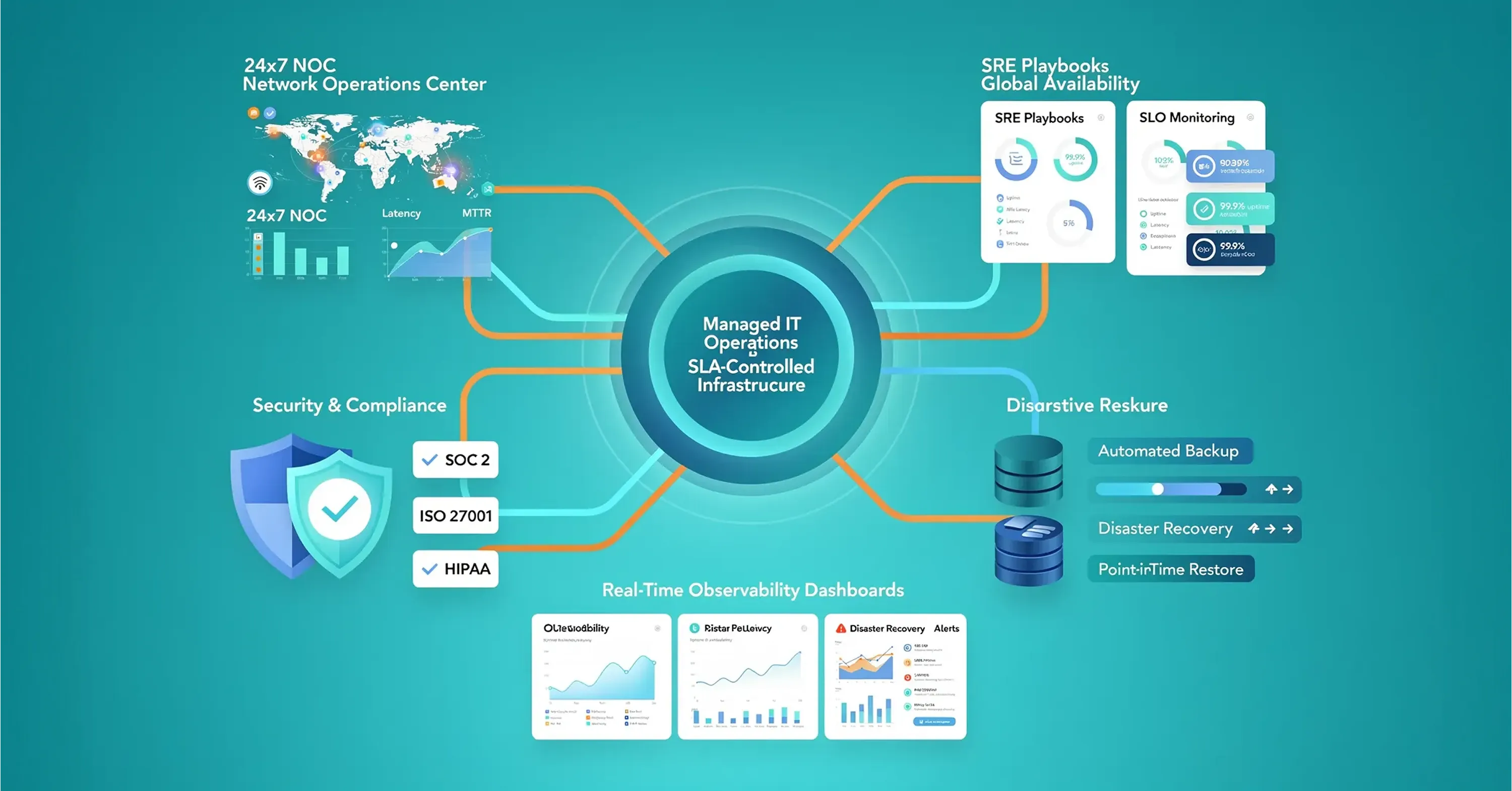
24×7 Network Operations Center staffed in multiple time zones
-
SRE playbooks aligned to SLOs (Service Level Objectives) such as 200 ms p95 latency
-
Continuous security patching that meets SOC 2, ISO 27001, and local GCC or Canadian PIPEDA norms
-
Automated backups with point-in-time restore verified weekly
-
Real-time dashboards exposing uptime, incident MTTR, and change failure rate
The SLA transforms vague promises into contractual certainties. Targets like 99.99% uptime, first-response in under five minutes, and hourly encrypted backups are measurable and enforceable. If the provider misses, credits apply.
When the SLA is clear, everyone sleeps better, including auditors.
Ending on that note, let’s see how SRE methods create genuine 24/7 resilience.
When Auditors Accept Your SLA as Proof
A Toronto telehealth startup faced HIPAA and PHIPA scrutiny. Their new managed IT provider wrote an SLA mandating on-call escalation within three minutes and encryption of patient data in transit and at rest. Auditors accepted the SLA as evidence of compliance, speeding certification by two months.
Key Elements of 24/7 SRE Resilience at Mid-Sized Scale
SRE borrows from software engineering, but focuses on reliability as a feature. You do not need dozens of Google-level engineers to reap its benefits.
The managed IT provider layers five pillars:
-
Observability
-
Metrics, logs, and traces feed a single pane of glass
-
Alerts route via Opsgenie or PagerDuty with severity filters
-
Immutable Infrastructure
- Servers are replaced, not patched in place, reducing config drift
-
Error Budgets
- A 0.01 % allowance quantifies acceptable risk and curtails reckless releases
-
Chaos Testing
- Controlled failures validate recovery scripts weekly
-
Continuous Compliance
- Automated evidence gathering for PCI-DSS, GDPR, or local data residency laws
With these pillars in place, incident frequency drops, and recovery becomes a rehearsed drill rather than an improvised scramble.
Once resilience is methodical, the CFO still asks, “Is the extra nine worth it?” Let’s answer that numerically.
How One Extra Nine Protected $1.5 Million a Year
An e-commerce fashion brand in Riyadh processes USD 35,000 per minute during Friday flash sales. Moving from 99.9% to 99.99% uptime eliminates 43.8 minutes of downtime annually. At their peak revenue rate, the switch protects USD 1.5 million a year, far outweighing the managed service fee.
Calculating the ROI: From 99.9% to 99.99% Uptime
Transitioning to an external SRE model is not a sunk cost; it is a hedge against outage-driven burn.
-
Downtime Cost Formula: revenue per minute × minutes of downtime
-
Personnel Savings: one senior DevOps engineer fully loaded costs USD 180,000 in Toronto; an MSP plan with 24×7 coverage can come in at roughly two-thirds
-
Market Growth: the infrastructure implementation and managed services segment reached USD 367.2 billion in 2024, reflecting rising demand and economies of scale
-
Security Exposure: breach fines under GDPR hit 4% of annual turnover; an SLA with continuous vulnerability scanning slashes that liability
When you pencil it out, the choice becomes clear: spend predictable operating expense to avoid unpredictable capital and reputational hits. For a tangible look at the ROI and payback scenarios achievable through smart outsourcing strategies, see How Managed IT Services Empower Business Growth.
Choosing the Right Managed IT Support Company
Not all vendors deliver institutional-grade outcomes. Only 7.5% of MSPs have a mature, highly effective customer success framework. Selecting the right partner is critical.
Look for these signals:
-
Proven expertise in your regulated sector (FINTRAC, PCI-DSS, HIPAA)
-
Transparent, itemized SLA with uptime, RTO/RPO, and financial penalties
-
Documented hand-over process: run-books, topology diagrams, and credential vaults
-
Automated CI/CD pipelines with staged approvals
-
Distributed NOC coverage across GCC, North America, and APAC for rolling holidays
Do not underestimate culture. Your provider should join your weekly stand-up and speak business impact, not only packet loss.
If you need a benchmark, a leading provider of managed IT services can showcase cross-industry case studies, on-demand penetration reports, and customer satisfaction scores updated in real time. See more about what to seek in a trusted technology ally in How Managed IT Services Empower Business Growth.
The Dashboard That Won the Board
A Kuwait-based BNPL startup shortlisted three vendors. The winning provider demonstrated a live dashboard of current SLA performance across 40 clients, with average critical incident resolution at 11 minutes. The board signed within a week.
Conclusion
Tribal knowledge is fragile and expensive. Institutional-grade operations require processes, automation, and 24/7 human oversight that most mid-sized firms cannot staff alone. A managed IT support company that signs a clear service level agreement, applies SRE discipline, and meets sector-specific compliance lets CEOs in the GCC and Canada buy resilience, not hope. The result is 99.99% uptime, auditable security, and the confidence to pursue growth without fearing the next pager alert.
For practical strategies to ensure around-the-clock operations and proven frameworks for SRE, see Cloud Support: How Managed DevOps Keeps Your Business Online 24/7.
Want to see how these approaches can be adapted to your industry or region? Visit the Industries overview for case studies and compliance frameworks tailored to finance, health, and commerce.