Cloud Migration Consulting Services: What Expert Support Should Deliver

Content authorBy Irina BaghdyanPublished onReading time14 min read
Title:
Cloud Migration Consulting Services: What Expert Support Should Deliver

Meta description:
Learn how cloud migration consulting services guide you to evaluate provider proposals as you manage d

You need cloud migration consulting when the destination is clear, but the path isn't. A good migration consultant hands you named, checkable outputs at every stage: a dependency map, a landing zone design, tested rollback procedures, signed-off runbooks, plus a clear line showing where their job ends and yours begins. This guide sets out what to ask for, what a credible proposal looks like, and the mistakes that turn a migration into a budget overrun: vague scope, untested rollback plans, and no named owner for risk.

Scope cloud migration consulting services

Before the scope debates and RACI charts, here's the short version:

  • An application inventory and dependency map

  • A named wave plan with entry/exit criteria and rollback triggers per wave

  • A landing zone built to your compliance and data residency requirements

  • Signed-off runbooks and application-owner acceptance for every wave

  • A documented handover, with your team able to run the environment without calling them back

If your migration goals are already agreed and the gap is expertise or delivery capacity, the hardest part of hiring a cloud migration partner is working out what you're actually contracting for. Three distinct things get sold under one label. Strategic advice produces decisions and evidence. Implementation moves workloads. Managed operations runs what lands.

Blur those three, and you get the outcome McKinsey documented across its client base: inefficiencies in orchestrating migrations cost the average company 14% more in migration spend than planned each year, and 38% saw programmes slip by more than a quarter. Those numbers are mostly about coordination.

Define scope by phase and by artefact. Discovery ends with dispositions and a business case. Mobilisation ends with a working landing zone and migration wave planning. Migration ends with workloads running in production under documented runbooks. Operational transition ends when your own teams hold support ownership, and the source systems can be retired.

A proposal from a migration advisory service that covers 'end-to-end migration' without naming those boundaries. Ask which phases the provider is committing to and which they assume you'll handle. The gaps and overlaps show up immediately once the question is asked in those terms.

Who is responsible for what during a cloud migration

Accountability doesn't transfer with a purchase order. Under the AWS shared responsibility model, the provider secures the infrastructure, and you secure what you run on it, which covers guest operating systems and the security group rules around each instance. Your migration consultants can design those controls. The consequences of getting them wrong stay with you.

That principle should shape how you divide work. Five roles appear on a migration of any size, and each needs a named owner before the first wave:

  • Advisory consultants own architecture recommendations and the evidence behind dispositions

  • Implementation engineers own build and cutover execution against agreed runbooks

  • Managed service providers own steady-state operations after handover, on defined service levels

  • Your internal platform team owns the landing zone and the identity model

  • Application owners own functional acceptance and the decision to go live

Microsoft's Cloud Adoption Framework goes as far as publishing a RACI matrix for aligning responsibilities across cloud functions, and the reason it exists is that verbal agreements collapse the first time a cutover goes badly at two in the morning. Document responsibility and accountability per activity, then attach decision rights to it.

Some decisions must never leave your organisation. Risk acceptance and go/no-go on production cutover belong to internal owners. Transparity, a UK Microsoft partner, described rebuilding a client's operating model with a new RACI matrix so internal support teams knew which engineer was responsible for each part of the environment, which is remedial work you'd rather not pay for twice.

Choose workload approaches

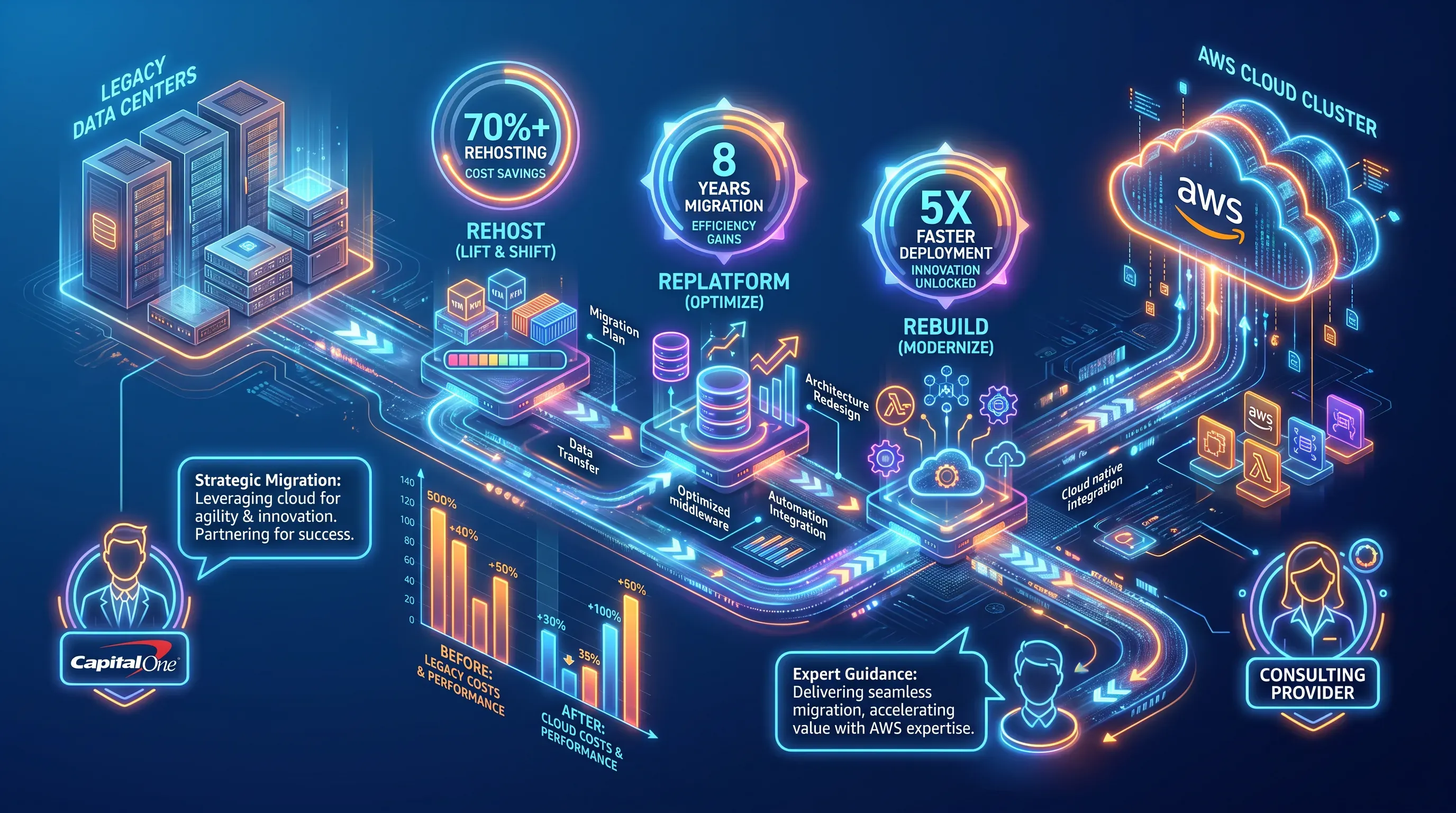
High-tech neon infographic depicting an AWS cloud migration journey from legacy data centers to a glowing AWS cluster, with vibrant icons and charts.

AWS Prescriptive Guidance names seven migration strategies, the 7 Rs. Rehost moves a server unchanged. Relocate shifts a whole virtualised estate. Replatform swaps components, a self-managed database for a managed one, without rewriting application logic. Refactor rebuilds around cloud-native services. Repurchase replaces the application with a SaaS product. Retain leaves it where it is, and retire switches it off.

Notice what AWS says about the most ambitious option. Modernising during the move is the most complex path and hard to manage across a large portfolio, so the guidance is to rehost or replatform first, then modernise once the platform is stable. AWS field experience puts rehosting at 70% or more of applications in large legacy migrations.

Disposition is a workload-level judgement. The inputs are business value and dependency depth. A cloud migration partner who proposes one universal strategy across your estate hasn't looked at your estate.

Capital One is the reference case for how this plays out at scale. The bank exited eight data centres by 2020 and rebuilt 80% of its nearly 2,000 applications from the ground up, which cut average development environment build time from three months to minutes. Chris Frank, who led parts of the programme, described the pragmatism it required: "It was like moving from one house to another and you're kind of cleaning out your attic. At some point, you say: 'Well, this I'm going to put it in this box, and I will deal with it kind of at the new house.'" That took eight years and a deliberate mix of strategies.

Need IT Support?

Book a free consultation with ABS Technologies experts we'll help you find the right managed IT, cloud, or security solution for your business.

Book a Free Consultation

Key cloud migration consulting deliverables

Deliverables are how you convert a statement of work into something you can accept or reject. Each phase should produce named artefacts specific enough to become contractual milestones, with a defined reviewer and a defined acceptance test. Vague deliverables are the mechanism by which schedule risk moves quietly onto your side of the table.

Assessment outputs

The assessment phase should hand you an application inventory and a dependency map. Google's Migration Center produces exactly this shape of output, with asset discovery feeding TCO reports and wave definitions in the plan phase.

The dependency map is the artefact that earns its cost. AWS Application Discovery Service builds it by analysing network connections over weeks, which captures process-level detail and application-to-application traffic that agentless scanning misses. That data is also what lets you right-size instances against measured utilisation instead of guessing from the source specification.

Insist on stated assumptions. A credible assessment names its data quality limits and the decisions still open. Gartner's estimate that 83% of data migration projects fail outright or exceed budget and timeline traces back in large part to complexity discovered after the estimate was signed. An assessment that reads as uniformly confident is hiding something.

Mobilisation and migration wave planning

Mobilisation builds the platform your workloads will land on. Expect a target architecture and a landing zone design. AWS defines a landing zone as a well-architected, multi-account environment holding the accounts and resources subject to compliance regulation, with preventive and detective controls applied across it.

Data residency belongs in this phase. Replicating EU personal data into a US region for disaster recovery breaches GDPR Article 44's restrictions on international transfers, and the exposure runs to 4% of global annual revenue. Region selection and key management are architectural decisions with legal consequences.

Then comes migration wave planning, which is where discovery data earns its keep. Sequence waves on dependencies and business criticality. Without dependency data, waves get sequenced on assumptions rather than actual communication patterns, and teams find out Server A talks to Server B only when Server A has already moved and the connection breaks.

Good migration wave planning includes entry and exit criteria per wave and rollback triggers. Early waves should carry lower-risk applications that are still representative enough to validate support and operational readiness. Seeding a few genuinely complex workloads early is also defensible, because it surfaces the awkward patterns before the critical cutovers arrive.

One constraint on migration wave planning that gets overlooked: team capacity. Networking and security specialists become bottlenecks when three waves need them simultaneously, so the plan has to balance load across the people who can actually do the work.

Migration outputs

Each wave should produce evidence. Pilot results first, because the pilot is what proves the runbooks are real. Then repeatable runbooks and a signed acceptance from each application owner.

Rollback deserves specific attention, because 24% of organisations in one compilation of migration failure data lacked a rollback plan, which raised failure severity when things went wrong. Microsoft's guidance is to define what counts as a failed deployment collaboratively with business stakeholders and workload owners so that specific trigger conditions such as CPU limits or error rates can trigger an automated reversion in the pipeline. Rollback procedures that have never been tested in pre-production are documented.

Application-owner sign-off per wave is the control that keeps functional acceptance where it belongs. Your provider can demonstrate that a database replicated cleanly. Only the business owner can confirm that the month-end report still reconciles.

Need IT Support?

Book a free consultation with ABS Technologies experts we'll help you find the right managed IT, cloud, or security solution for your business.

Book a Free Consultation

Transition outputs

Transition is the phase where migrations quietly fail, because the workloads are running and everyone assumes the programme is finished. What you need out of this phase is named support ownership and explicit criteria for retiring the source systems.

Security validation means testing the implemented controls. NIST SP 800-53 Rev. 5 control CA-7 requires continuous monitoring, which in cloud environments means configuration and identity controls evaluated continuously through native tooling with API-backed evidence. Temporary administrative credentials used during data transfer need to be scoped and revoked on completion, followed by an entitlement review against a least-privilege baseline. Where the migration involves regulated data, this is also where you confirm the region and encryption decisions made during mobilisation actually held.

Cost control belongs here for a reason. Flexera's 2025 survey of more than 750 cloud decision-makers found that 84% of respondents rate managing cloud spend as their top challenge, with spend expected to rise 28% in the coming year. The same report puts wasted spend at 27% of the total, a figure that has barely moved since 2019. Waste is structural, and it starts on day one of production.

Retiring source systems needs written criteria, because that's where the business case is realised. Define the acceptance evidence and the compliance sign-off required before hardware gets decommissioned. Until the source is off, you're paying for both.

Control delivery risk

Governance on a migration exists to make decisions fast. You need a delivery forum that meets weekly on progress and blockers and a design authority that reviews architecture changes against the agreed target. Anything requiring more than two approvals to unblock a wave will slip.

Change control should distinguish between changes inside the agreed pattern and changes to the pattern itself. The first belongs with the delivery team. The second goes to architecture assurance, because pattern drift across waves is what turns a repeatable migration into a collection of one-offs that nobody can operate afterwards.

Security gates work best when tied to wave exit criteria. The gate needs teeth: no wave exits without evidence that identity and encryption controls were validated against the baseline.

Risk ownership must sit with named individuals on your side. A cloud migration consulting services provider can raise and manage risks. Accepting one is a decision about your business, and the NAO's contract management guidance makes the same point about the commercial lifecycle. Reporting should tie to the measurable milestones you defined as deliverables, so that "wave three complete" means the sign-offs exist.

A few patterns are visible before the contract is signed and reliably predict trouble later:

  • The proposal talks about "the team" or "our experts" without explaining who they are.

  • One migration strategy proposed for the whole estate, ignoring the workload type

  • Rollback described as "best effort" rather than a tested, triggered process

  • Deliverables stated as outcomes only ("reduced risk," "improved efficiency") with no artefact attached to sign off against

  • Vendor funding or incentive arrangements not disclosed upfront

  • Reluctance to discuss what happens commercially when the estimate turns out to be wrong

Assess provider proposals

Headline cost is the least informative number in a proposal. What separates a deliverable proposal from an optimistic one is what it says about method and what happens when the estimate turns out to be wrong. Work through these before you compare prices:

  1. What discovery method produces the inventory and dependency map, agent-based or agentless, and over what observation window?

  2. Which named individuals are assigned, at what allocation, and who backfills them if they roll off?

  3. Which parts of delivery go to subcontractors, and who holds accountability for their work?

  4. What tooling is used and what happens to the automation when the engagement ends?

  5. What assumptions underpin the estimate, and what is explicitly excluded from scope?

  6. What cloud provider incentives are involved and do they reduce your cost or the provider's?

  7. Who owns the infrastructure-as-code and runbooks created during delivery?

  8. What does handover include, and what proves knowledge transfer actually happened?

  9. What is the commercial consequence when discovered dependencies exceed the estimate?

The incentives question matters more than it looks. AWS restructured its Migration Acceleration Program in July 2024, which raised maximum partner funding to $2 million from $460k and added strategic partner incentives for greenfield and modernisation cases. That funding flows through the partner and is milestone-validated against projected consumption, so ask how it's being passed through and what usage commitments it implies for you.

Intellectual property is the second question that gets skipped. Terraform modules and runbooks are the operating manual for your platform. Standard DevOps consulting agreements treat work product as belonging to the client while protecting the provider's pre-existing frameworks through licence grants, which is a reasonable position for most migration engagements. What isn't reasonable is discovering after handover that you can't modify your own landing zone without the original author.

On accountability for bad estimates, push for specifics. Whether the answer is a fixed-price wave or a re-baselining process with defined triggers matters less than the answer existing at all. Providers who won't discuss it before signing won't discuss it afterwards either.

How to measure cloud migration success

Completion has to be defined per deliverable and per workload, or it defaults to "the invoice was paid." For deliverables, acceptance means a named reviewer confirmed the artefact against stated criteria within an agreed window. For workloads, acceptance means measured evidence against a baseline you captured before the move.

Schedule and budget are the easy measures and the least revealing. The harder set covers availability against target and performance against pre-migration benchmarks. Microsoft's migration planning guidance recommends setting measurable success criteria such as performance benchmarks and user acceptance before cutover, with scheduled go/no-go checkpoints.

Operational readiness is worth measuring directly, because it's the one criterion that can't be inferred from a dashboard. Can your on-call engineer diagnose an incident in the new environment without calling migration consultants back? If not, knowledge transfer didn't complete regardless of what the handover document says. Uptime Institute's 2024 survey found 54% of operators saying their most recent significant outage cost more than $100,000, with one in five above $1 million, and the most common cause across all severities was IT and networking issues linked to change management and misconfiguration.

Benefit tracking runs past the engagement. Set a review at 90 days and again at six months against the business case, which should cover realised cost and incident volume. Workload optimisation and waste reduction were the top priority for 50% of FinOps practitioners in the FinOps Foundation's 2025 survey, whose respondents collectively manage over $69 billion in cloud spend, and optimisation opportunity is highest immediately after migration when everything is still sized for the source environment.

Conclusion

Migration outcomes turn on the unglamorous parts: documented dispositions and tested rollback procedures. Get those right, and the technology follows.

ABS Technologies handles cloud architecture and security guardrails as hands-on delivery work, so your engineers stay on product. If you'd rather hand off the foundation work than learn it the hard way, book a free consultation to scope your cloud migration, and we'll review your current plan with you.

Need IT Support?

Book a free consultation with ABS Technologies experts we'll help you find the right managed IT, cloud, or security solution for your business.

Book a Free Consultation

You should approve a workload only after its dependencies, acceptance criteria, and rollback trigger are documented. Cloud migration consulting services should provide this evidence before scheduling a wave. The application owner should confirm that functional and performance checks meet the agreed baseline.

You should test rollback in a pre-production environment before every production cutover. Use the same reversal steps and access permissions that the team would use during an incident. Record the time required and confirm that the application returns to its agreed state before approving the wave.

You should pause the affected wave and assess the dependency before changing the schedule. Confirm whether the connected system must move with it or can remain reachable across environments. Then use the contract's re-baselining process or agreed change control to revise the effort and cost.

No. A workload shouldn't enter production until the landing zone has the agreed identity controls and network connectivity. Moving first shifts platform decisions into a live cutover, where fixes carry greater operational risk. The internal platform team should accept the landing zone before migration waves begin.

Handover is complete when your on-call engineer can resolve a representative incident without provider help. Test this through a scheduled support exercise that uses the runbooks and access model. Book a free consultation with ABS Technologies → to review handover evidence and identify unresolved operational ownership.

Schedule a Meeting

Book a time that works best for you and let's discuss your project needs.

You Might Also Like

Discover more insights and articles

Title:
Cloud Managed Service Provider: A Practical Evaluation Framework

Meta description:
Evaluate a cloud managed service provider with this framework so you can set requirements and test contracts

Cloud Managed Service Provider: A Practical Evaluation Framework

Evaluating a cloud managed service provider gets harder once you're already running production workloads. Here's a working method for setting requirements and testing the contract before you sign it.

Enterprise storage server in a modern data center.

Cloud Disaster Recovery Services: How to Evaluate Recovery Readiness

Most technology leaders have a disaster recovery runbook. Far fewer have a recovery capability they can prove will work under pressure. According to the Veeam 2024 BC/DR survey, only 32% of organizations believe they can recover 50 workloads within a full business week. The problem is that manual runbooks, undocumented dependencies, and human-driven failover steps break down when the environment is compromised. In 2026, if your disaster recovery strategy still depends on people clicking through a sequence of recovery steps, you are planning around a point of failure. Modern cloud disaster recovery services should use automated DevOps pipelines to rebuild, validate, and recover the environment consistently.

Title:
AWS MSP Proposal Scorecard: Scope, SLAs, Security and Cost

Meta description:
Use this AWS MSP Explainer to compare bids and spot hidden costs before you choose support suited to your risk need

AWS MSP Proposal Scorecard: Scope, SLAs, Security and Cost

Use pass-fail gates to screen shortlisted AWS managed service provider (MSP) proposals, then score the survivors against a normalized workload baseline and a weighted 100-point model before you look at price. This exposes the exclusions and customer-owned work hidden inside low monthly fees, as well as charges for third-party tools. Procurement can then work with engineering and security to rank bids on risk-adjusted value.

Title:
Azure Day-Two Operations: A Provider Responsibility Checklist

Meta description:
Use this checklist to hold your Azure provider accountable and keep your post-migration cloud platform secure.

Azure Day-Two Operations: A Provider Responsibility Checklist

Most organizations pop the champagne when their Azure migration closes, completely unaware they just stepped off the 'Day-Two Cliff.' Migration is a finite project; Day-Two is an infinite operational liability.

Retrofitting governance into an existing Azure environment costs three to five times more than building it into the platform from day one, according to Errin O'Connor of EPC Group. That makes day-two operations a strategic concern for decision-makers, not just an operational one.