Canary Deployment Strategy: Progressive Delivery with Measurable Rollback Signals

Content authorBy Irina BaghdyanPublished onReading time13 min read
Futuristic high-speed data transfer tunnel with glowing blue and orange streams of light moving through a digital network

A bad release is far cheaper to catch when only a small slice of traffic sees it. A canary deployment strategy makes that possible by promoting or rolling back on evidence rather than opinion. Routing controls decide who gets the change first, and health signals decide whether it goes any further.

Subjective release checks don't survive contact with production

A canary deployment strategy only pays off when the decision to promote is tied to numbers someone agreed on in advance. Most teams don't get there. They ship to 10% of traffic and stare at a dashboard for twenty minutes before calling it healthy because nothing looked wrong.

That gap between watching and measuring is where money leaks. Knight Capital's deployment went to eight servers, one of them with stale code, and the firm lost more than $460 million in 45 minutes before anyone shut it down.

So the question is whether your rollout can prove, from telemetry, that the new version is at least as good as the old one. Everything below is built around that proof.

Canary deployment strategy prerequisites

Before you split traffic, you need the capabilities that make the split meaningful. Google's SRE team defines canarying as a partial and time-limited deployment of a change, evaluated against the version it's replacing. Both halves of that definition assume infrastructure you don't have yet.

Here's the baseline a canary deployment strategy depends on:

  • Repeatable deployments from a versioned artifact, so the canary and the stable version differ by exactly one change

  • A stable control version that stays untouched for the whole observation window and acts as your comparison

  • Traffic management that can route by weight or by request attribute, independent of instance counts

  • Telemetry tagged by version, with enough request volume in the canary slice to detect a regression

  • A named owner who can abort the rollout without convening a meeting

  • A rollback path that's been executed in production within the last quarter, not just documented

The last one gets skipped. A rollback you've never run is a plan.

DORA's 2024 research puts the elite cluster at a change failure rate near 5% with recovery under an hour, and the recovery number is the one a canary deployment strategy moves first. You're shrinking who sees failures and how long they last.

Choose rollout controls

Two mechanisms control exposure, and they answer different questions. Infrastructure routing decides which version handles a request. Feature flags decide what the code does once it has the request. Picking the wrong one for a given change is how teams end up with a canary deployment strategy that can't be rolled back.

Judge each control on what kind of change it can isolate and how fast it reverses. Then add the question auditors ask: who changed the exposure, when, and on what evidence? In regulated payment environments, a flag flipped from a web console with no approval trail is a finding waiting to happen.

Infrastructure-level canary release

A load balancer or service mesh shifts a percentage of requests between two running versions of the same service. This is the control that covers runtime changes and anything the application can't toggle from inside itself.

Pod ratios are where precision breaks down. If you split traffic by scaling replicas for a canary deployment strategy, a 1% canary release needs 100 instances, and autoscaling quietly rewrites your traffic weights every time load changes. Istio's own guidance makes the point directly: weighted routing lets you send 1% of traffic without requiring 100 pods, and the two versions can scale up and down independently without touching the distribution. If your platform can't express weight separately from replica count, your canary percentages are approximations.

Feature flags for progressive delivery

Flags separate the act of deploying code from the act of exposing behavior. The new version ships dark to everyone, then you enable the path for a specific cohort: internal staff or one merchant account. On Martin Fowler's site, Pete Hodgson separates flags into four toggle categories by how long they live, and release toggles are the short-lived ones that belong in progressive delivery. Treat them as inventory with a removal date.

What flags can't do is isolate the things underneath the code. A new database driver or a schema migration affects every request the process handles, whether the flag is on or off. Reaching for a flag there gives you the feeling of control and none of the containment.

Need IT Support?

Book a free consultation with ABS Technologies experts we'll help you find the right managed IT, cloud, or security solution for your business.

Book a Free Consultation →

Combine both controls

Layering is the answer for high-risk releases. Run the new application version behind weighted routing at 5%, and inside that version keep the riskiest feature off for everyone except an internal cohort. You get two independent kill switches with different blast radii and different recovery times.

A payments team rewriting its fraud-scoring call does exactly this: route a small share of live authorization traffic to the new build, then enable the rewritten scoring path only for employee test accounts. If latency climbs, you cut traffic weight. If the scoring logic returns nonsense, you kill the flag and leave the deployment in place. Progressive delivery works best when the control you pull matches the thing that broke.

Design a canary deployment strategy
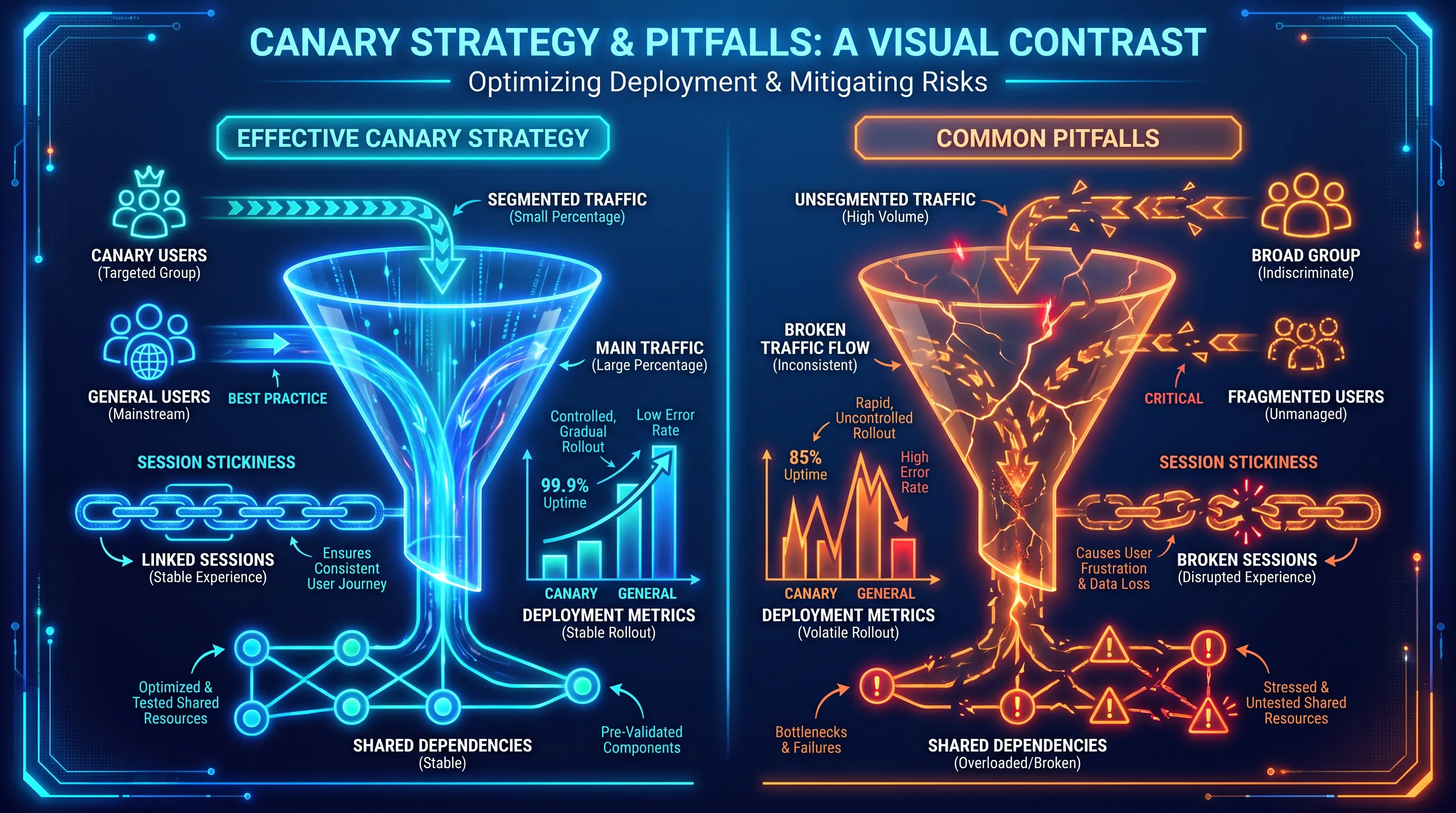
A neon-infused split-panel infographic contrasting 'Effective Canary Strategy' with 'Common Pitfalls', featuring glowing icons and metrics.

Percentage is the crudest segmentation and the right place to start. Beyond that, you can slice by geography or by internal users. The constraint is representativeness. A canary fed only by internal traffic will miss the request shapes that real customers generate, and a canary fed only by one region will miss the failure that depends on a different currency or a different regulatory path.

Session stickiness matters more than teams expect. If a user bounces between the canary and the stable version mid-session, you get inconsistent behavior that's hard to attribute and harder to debug. Pin the session once assigned, and make sure the pin covers every service in the request path rather than only the edge.

Then there's sample size. At 1% of 200 requests per minute, you'll see two requests a minute, and a 5% error-rate regression is statistically invisible for hours. Lengthen the window or raise the share, because otherwise this stage proves nothing beyond "the process started." Shared dependencies deserve the same scrutiny, because a canary deployment strategy that writes to the same cache or the same queue as the stable version can poison both.

Define measurable health signals

A scorecard is better than a threshold list. Fixed thresholds fire on Monday traffic patterns and stay silent during a Saturday incident. Comparison between the canary and the stable version controls for all of that, because both are serving the same conditions at the same moment.

Netflix learned this the hard way and runs a dedicated baseline cluster alongside production and canary, so the comparison isn't polluted by long-running instances with warm caches and aged heaps. Keep your scorecard short. Ten signals you trust beat forty you ignore.

User-impact signals

Error rate comes first, split by status class and by endpoint. A 1% rise in 5xx responses on a checkout endpoint means something different from the same rise on a health probe. Crashes and request timeouts follow, because both represent a customer who got nothing at all.

Latency belongs in percentiles. Watch p95 and p99 against the stable version, since the mean will stay flat while the tail doubles. These signals earn their place at the top of the scorecard for one reason: each maps to a person who couldn't complete something.

System and dependency signals

Underneath user impact sits saturation. CPU and memory trends tell you whether the canary is healthy now but heading somewhere bad. Database signals deserve their own line, especially query latency and lock contention, because a new version with one unindexed query will look fine at 5% traffic and take the cluster down at 50%.

Resist letting this layer drive the decision. Infrastructure metrics are noisy, and a canary deployment strategy that aborts every time a node reschedules trains your team to override the automation. Weight these signals lower than user impact, and use them to explain a regression rather than to detect one.

Business and security signals

A release can be technically clean and still cost you money. Transaction completion rate and settlement success are the signals that catch a change which returns HTTP 200 with the wrong body. For anyone running payments or lending, those numbers are the release criteria.

Security signals round it out. Watch authentication failure rates and authorization denials, since a new version that quietly broadens an access check won't register anywhere else on the scorecard. Anomalous access patterns against the canary slice deserve a page.


Need IT Support?

Book a free consultation with ABS Technologies experts we'll help you find the right managed IT, cloud, or security solution for your business.

Book a Free Consultation →

Automate promotion and rollback

Three outcomes exist, and most pipelines only encode two. Success promotes. Failure aborts. Inconclusive is the one that matters, and it means the data didn't support a decision, which is not the same as the data looking good.

Argo Rollouts expresses this concretely: an analysis that measures HTTP success below 95% across three such measurements marks the run failed and returns canary weight to zero. The consecutive-breach rule is what keeps a single scrape blip from aborting a healthy release. Flagger applies the same idea with a failed-check threshold before it reverts, and both tools support automated promotion or rollback driven by a metrics provider rather than a human opinion. Kayenta, built by Google and Netflix, scores each metric and returns an aggregate score from 0 to 100, where a marginal result routes to human approval instead of a binary verdict.

Greg Burrell, senior reliability engineer at Netflix, framed the motivation plainly when Kayenta was released: "Automated canary analysis is an essential part of the production deployment process at Netflix and we are excited to release Kayenta." His team expected it to make thousands of canary judgments per day, a volume no human review process reaches.

Bake time deserves a decision. Set it long enough to cover one full traffic cycle for the service, and require a manual approval gate at the step where exposure crosses into material revenue. When telemetry goes missing or two signals contradict each other, the rule is abort and investigate, because an unverifiable release is a failed release. Then drill the rollback on a schedule. Teams that practice recovery quarterly are the ones whose progressive delivery automation gets trusted when it matters.

Handle database changes

Code rolls back cleanly. Data doesn't. The moment a canary writes a row the stable version can't read, your rollback path is a data repair project with a deadline.

Martin Fowler's parallel change pattern at Expand, Migrate, Contract treats every phase of that sequence as independently deployable and reversible. Stripe applied the same shape to a live subscriptions table through four migration phases with dual writes to both the old and new stores. The old data was removed only after reads and writes had moved. The discipline is that the contract step is a separate deploy, run days or weeks after the canary is fully promoted.

Practical rules for a canary deployment strategy that touches schema:

  1. Ship additive changes only during the rollout, so both versions read and write successfully against the same schema

  2. Hold destructive changes such as column drops and type narrowing for a deploy that happens after 100% promotion has been stable for a defined period

  3. Write a data repair plan before the rollout so that you know what you'll do with rows the canary created in the new shape

  4. Validate dual-read consistency with a sampled comparison rather than assuming the backfill was complete

Some changes don't belong in a canary at all. Anything that can't tolerate two versions writing concurrently needs a different approach with an explicit cutover and a tested restore. Saying so early is cheaper than discovering it at 40% traffic.

Use a staged rollout template

Stages exist to buy information, and each one costs more confidence to enter than the last. Adapt the sequence to your traffic volume, because the right first stage for a service handling 50 requests per second isn't the right one for a service handling 50,000.

StageEntry criteriaObservation windowPromotion gate
Internal cohortBuild passes pipeline, flag defaults off2 to 24 hoursNo errors attributable to the new version
1%Internal cohort clean, owner on call30 to 60 minutesError rate and p99 within parity band
10%Automated analysis passed at 1%1 to 2 hoursScorecard green, no dependency saturation
25%Business signals flat or improving2 to 4 hoursConversion and completion within parity
50%Manual approval recorded4 hours to overnightFull scorecard green across a traffic cycle
100%All prior gates passedOngoingContract-phase migrations scheduled separately

Every stage needs a named owner and a rollback trigger written as a number. Capture the evidence as you go, because the dashboard screenshot you take at 10% is what an auditor or a postmortem will ask for. This is where progressive delivery stops being a deployment technique and starts being a governance record.

Minimum observability checklist

The template above is unusable without data that distinguishes the two versions. OpenTelemetry's service.version resource attribute exists for exactly this, and it needs to be present on traces and logs rather than metrics alone.

  • Version-tagged metrics emitted by every service in the request path

  • A side-by-side dashboard comparing canary and stable on the same axes

  • Distributed traces that let you follow one failed request across service boundaries

  • Structured logs carrying version and cohort labels

  • Dependency-level visibility into database and third-party call performance

  • Business key performance indicators refreshed at the same cadence as technical ones

  • Alert routing that pages the release owner, not the generic on-call rotation

  • Deployment events recorded as annotations on the time series

  • Data retention long enough to compare this rollout against the last one

If three of these are missing, fix the telemetry before changing the routing. A canary deployment strategy without attribution is just a slower outage.

Assess delivery readiness

Score yourself across routing precision and version-tagged telemetry, then across automated analysis and rehearsed rollback. Migration discipline and approval records belong with security signals on the same score. The weakest of those sets your real release risk, whatever the other six look like. Most teams find the gap sits in rollback rehearsal or database sequencing rather than tooling.

ABS Technologies builds and manages cloud infrastructure and CI/CD pipelines for companies where software is the product. If you want help turning a manual release process into a measurable canary deployment strategy, reach out through our contact page.

Need IT Support?

Book a free consultation with ABS Technologies experts we'll help you find the right managed IT, cloud, or security solution for your business.

Book a Free Consultation →

Missing telemetry should stop promotion and return the rollout to a safe state. Treat the release as unverified, investigate the broken data path, and resume only after version-tagged metrics, traces, and logs provide comparable evidence.

Separate canary and stable paths from shared caches, queues, and other stateful dependencies when possible. If both versions must share them, define ownership, use compatible data formats, and test whether canary writes could change stable-version behavior before increasing traffic.

Session stickiness keeps a user on the assigned version during the observation window. Without it, requests can alternate between canary and stable code, creating inconsistent behavior and making errors harder to connect to the release under review.

Keep a database change out of a canary when two application versions can't safely read and write the same schema at once. Use a separate cutover with a tested restore plan, or redesign the migration so compatibility exists throughout the rollout.

Start by choosing one service, tagging its telemetry by version, and rehearsing rollback in production-like conditions. If you need help assessing the release controls, contact ABS Technologies through its contact page about building a measurable canary deployment strategy.

Schedule a Meeting

Book a time that works best for you and let's discuss your project needs.

You Might Also Like

Discover more insights and articles

Abstract digital data processing concept with a futuristic computer chip, glowing blue circuitry, and orange energy particles on a dark background

Disaster Recovery Testing Services: Proving Recovery Before an Incident Does

A disaster recovery test that only produces a green checkmark proves very little. Credible testing shows that systems recover within the targets the business depends on. Knowing what a test should prove, how a serious engagement is scoped, which questions to put to a provider before signing, and what drives the price makes the difference between assurance and theatre.

Close-up of modern data center infrastructure with illuminated servers, cables, and high-speed data connections

Platform Product Management: Turning Internal Infrastructure into a Product Teams Adopt

Want engineers to adopt your internal developer platform rather than work around it? Run it like a product. Start with discovery to learn what teams need, then track the measures that show whether the platform is earning its keep.

Abstract 3D visualization of interconnected digital infrastructure with glowing data nodes and network connections

Cloud Workload Protection Platforms: What to Evaluate Before Choosing a CWPP

Protecting workloads that run across both virtual machines and Kubernetes is hard to judge from vendor demos alone. A vendor-neutral comparison starts with requirements mapping, moves to capability testing, and ends in a proof of concept you control rather than one the vendor runs for you.

T professionals working with digital systems and technology interfaces in a modern office

Terraform Drift Detection: Finding and Fixing Infrastructure Changes Safely

This article explains how to standardize terraform drift detection across multiple teams and Terraform workspaces. It covers layered detection and a remediation sequence that keeps risky fixes behind review and approval.